

• Win a Free Custom Engraved Brass Coin!!!
    As a way to introduce our brass coins to the community, we will raffle off a free coin during the month of August. Follow link ABOVE for instructions for entering.

Deadeye Strops

Joined
Aug 26, 2020
Messages
515
Points
308

Location
UK Dorset
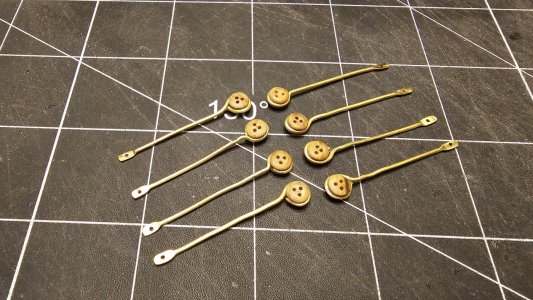
The lower deadeye strops on my current build have the form of a question mark (?) formed from brass wire. It is easy to form these so that the deadeye will just fit into the loop at the top but the next step is to tighten the loop into the groove round the deadeye. If pliers are used they tend to squeeze the strop locally but turn it into an oval such that it loosens the fit at other points. I have done a web search for suitable crimping pliers but the only likely candidate was a pair of pliers for crimping rings on bird legs: very specialised and very expensive.
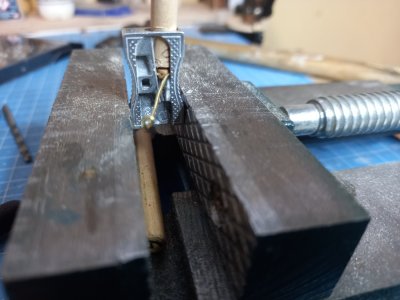
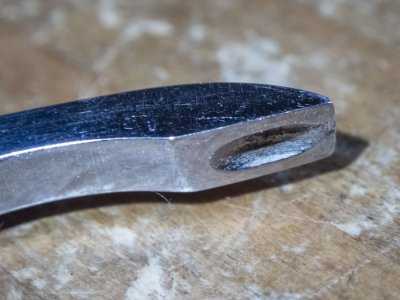
An alternative would be a conical hole with slit down the side into which the assembly could be pushed. Cue: a basic pencil sharpener with the blade removed. Placing the assembly into this and using a piece of dowel as a drift, gently tapped, closes the loop nicely. It works for 4mm and 5mm deadeyes. It even helps forming the small loop at the bottom of the strop. A < £2 solution
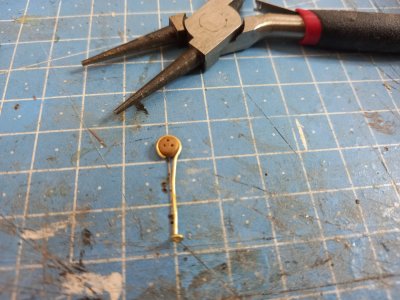
Deadeye strop1.jpg Deadeye strop2.jpg
 
Can you drill a hole in the bottom of the strop-groove ar 90 degrees to the surface - in other words aim for the center of the deadeye, right where you want the strop to start - hopefully without compromising the ropes that go through the eyes?

Then you would have a place where you could insert the start of the question mark to snug it down to the surface. My other though -looking at the picture - is that you are using soft brass wire, harder stuff might work better. You can work-harden soft wire (usually) by putting one end of a length in a sturdy vice and gripping the other in a pair of pliers and simply stretching it.
 
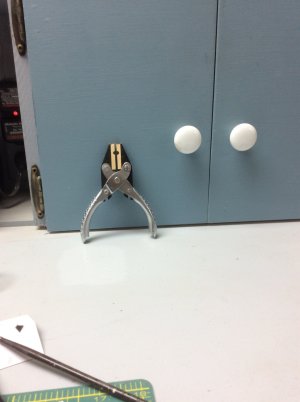
I have posted my “Deadeye Crimping Pliers before, but these things seem to get quickly lost and forgotten on these forums so I am posting again. The wooden jaws are glued on with superglue. For a model with different sized deadeyes more than one hole could be drilled. With the model finished, the wooden jaws were easily popped off and saved for a future project.

Pliers are like clamps. One can never have too many. If interested, the ones shown are called Parallel Jaw Pliers.

Roger

IMG_0951.jpeg
 
I have posted my “Deadeye Crimping Pliers before, but these things seem to get quickly lost and forgotten on these forums so I am posting again. The wooden jaws are glued on with superglue. For a model with different sized deadeyes more than one hole could be drilled. With the model finished, the wooden jaws were easily popped off and saved for a future project.

Pliers are like clamps. One can never have too many. If interested, the ones shown are called Parallel Jaw Pliers.

Roger

View attachment 481296
Ordering them as I read
 
Another thing you may want to try is using bare copper wire as it is softer. It has the added advantage of being able to blacken it after it is fixed in place with diluted liver of sulfur which will not stain the wood. Same for the lower link(s) of the dead eye chains.
Allan
 
I'm going to try to describe how I handle this process, as I don't have any real photos that show it in progress. I can attach an image that shows my completed strops on one of my builds, and they look very similar to what you're dealing with.

I use flat (not serrated or ridged) pliers to squeeze the wire around the shaft of a large diameter drill bit. That gives me most of the round. I then insert the deadeye into the rounded opening, and then again using the flat ended pliers to grip the wire against the deadeye, I then grab the longer straight part of the extended wire and pull it down and around the rest of the deadeye until I've got the deadeye completely surrounded with the wire. The last step is now that I've got the wire curved all the way around the deadeye is to grip it again with the pliers and then bend the long straight portion back up such that it now extends straight up and away from the top of the deadeye at a 90 degree angle. The last little bit is to rotate the deadeye inside the strop until the holes in it are lined up properly in relation to the strop.... and then apply a drop of CA at the top of where the wire meets the deadeye to fix it in place.

Maybe my description of who I approach this is not abundantly clear, but I'm hoping you understand the gist of how I approach this. Based on the photo, maybe mine aren't closed as tightly as you'd prefer, and if so the other suggestions about creating a pilot hole may work better for you. Additionally, I was a bit lucky as the brass??? wire from the Artesania Latina kit was pretty soft to work with. Stiff brass rod would be nearly impossible to deal with, unless a person was heating it to soften it first, and that would add a whole new level of complexity to the process.
20240518_091126.jpg
 
These look nicely done. Are these for a small vessel? Thanks

Allan
If you're referring to my photo, they're for the Artesania Latina "Swift". I have a build log for it here on the site, and yes, it's a small vessel.
 
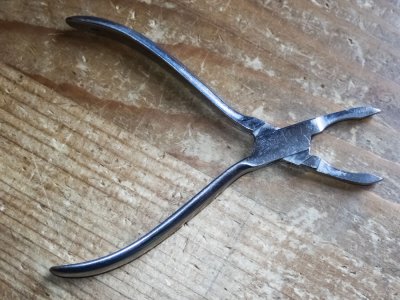
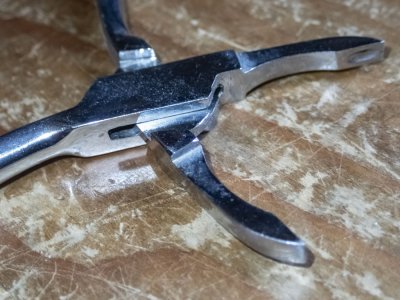
These pliers (officially called 'ring closing forceps') are designed for closing piercing rings. These are professional ones (not mine to keep), but I have seen similar ones for sale online for about 10 euros.

View attachment 481637View attachment 481638View attachment 481639
I spotted these on my web search for crimping pliers. They looked promising but couldn't bear the thought of having "body piercing pliers" 0n my Amazon list of past purchases for evermore.
 
I use annealed steel wire for my strops. It bends almost as easily as copper and is black so looks better to me. Giving the wire one or two tight twists at the bottom holds the strop in place and will fit into the notch in the channel so will not be seen.
I'll bet black soft iron bailing wire would work well like that. I'll have to try it instead of blackened brass. You'd have to cover it with varnish to prevent rust, though.
 
If you're referring to my photo, they're for the Artesania Latina "Swift". I have a build log for it here on the site, and yes, it's a small vessel.
Hi seadeep
Thought that might be the case, thanks.
Allan
 
Back
Top