
• Win a Free Custom Engraved Brass Coin!!!
    As a way to introduce our brass coins to the community, we will raffle off a free coin during the month of August. Follow link ABOVE for instructions for entering.
  • PRE-ORDER SHIPS IN SCALE TODAY!

    The beloved Ships in Scale Magazine is back and charting a new course for 2026!
    Discover new skills, new techniques, and new inspirations in every issue.

    NOTE THAT OUR FIRST ISSUE WILL BE JAN/FEB 2026

Will this work?

Joined
Jan 2, 2026
Messages
20
Points
48

I've been reading various threads on here about the best/easiest way to bend planks. It appears that to make the process simpler to use heat or steam whilst bending, or even soaking the planks to make them more pliable.

So I am considering the following set up. Firstly this bending machine...
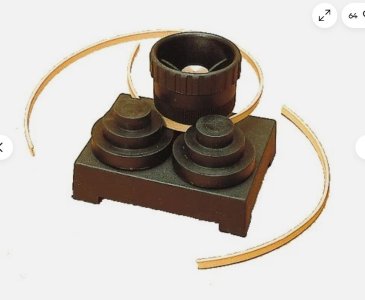
Bender.jpg

And using it in conjunction with a mini heat gun (perhaps after soaking the planks?)...
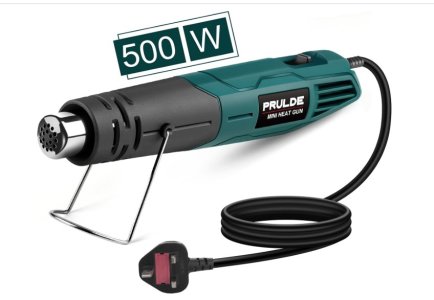
Heat.jpg


Both items would cost me about £30. But will it work or is there a simpler method?

Thanks in advance for your replies.

 
I have tried a bender like that but I found it difficult to get the right bend. For boat building you often need to make a bend that is not as smooth as you get with a bending machine.
I don't know if that translation was correct, what I mean is that the bend needs to be different strengths on different parts of the strip to follow the bend of the hull.
I prefer an electric plank bender, a type of soldering iron with a slightly larger metal lump at the end. I soak it in hot water for 5-30 minutes depending on the thickness and how much it needs to be bent. I have the electric plank bender screwed to a piece of board that I attach to the workbench, but I have seen some people use it directly against the hull.
 
So I am considering the following set up. Firstly this bending machine...

Hi Harold,

Bending planks with the breadth is easy and there are numerous of ways to perform this be it using an empty coffee can and hot air gun or hair drier, a soldering iron or something like in your photo.

Bending edgewise is a whole other story and is as important or even more important. Spiling eliminates the problem of edge bending without lifting taking place when it attached to the hull, but some years ago the idea of hot and wet edge bending came into common use if the builder wanted the planking to look like a ship where every plank lands properly in the rabbet instead of coming to a point as many kits advocate. (If it is to be painted or coppered over it will be covered so does not really matter what the planking looks like :) ) There are a number of posts here at SoS with links to videos and tutorials on how to do this so the planks will bend in both directions correctly, especially at the bow. Now if someone would come up with an edge bending "machine" that would fantastic.

Allan
 
i like your gizmo, looks like it will be vary adequate for the job.

i soak my wood strips overnight so they are very pliable, like undercooked linguine. i make jigs to hold the wet strips in place till they are dry. you gizmo can be very helpful in starting the bends without splintering the wood because its compressing it through the pinch rollers.

do you have a link to where to get your gizmo?

.
 
Model expo has it on sale for $12.49

 
Model expo has it on sale for $12.49


and only $13! in another thread i see people using machines costing hundred$ to do the same thing... although those machines are capable of working metal n heavier stock.


nice gizmo!
thanks
 
I've been reading various threads on here about the best/easiest way to bend planks. It appears that to make the process simpler to use heat or steam whilst bending, or even soaking the planks to make them more pliable.

So I am considering the following set up. Firstly this bending machine...

View attachment 573691

And using it in conjunction with a mini heat gun (perhaps after soaking the planks?)...

View attachment 573692


Both items would cost me about £30. But will it work or is there a simpler method?

Thanks in advance for your replies.

I tried the 'bender' but found it pretty useless, all plastic & fiddly, put it back on the bay where I got it! Much easier using any or all the tried & tested ways we all use on here! :D
 
It is a planking machine made in Italy, Art.8150 , by Mantua
Model.
I have had it for several years, used it many times without any
problems, maybe I have been using just the right wood for
bending after I have soaked the wood in Ammonia Water.

Winova
 
I've been reading various threads on here about the best/easiest way to bend planks. It appears that to make the process simpler to use heat or steam whilst bending, or even soaking the planks to make them more pliable.

So I am considering the following set up. Firstly this bending machine...

View attachment 573691

And using it in conjunction with a mini heat gun (perhaps after soaking the planks?)...

View attachment 573692


Both items would cost me about £30. But will it work or is there a simpler method?

Thanks in advance for your replies.
When I first strarted I got the rollers and the nipper type. Both went in the bin. To be honest most of the 'must have' model boat tools went the same way, nail pushers etc.
 
To bend the slats, get this tool, and you won't need anything else. Watch the YouTube video to learn how to use it.
It's also useful for gluing boards with wood glue.

Смотри, что есть на AliExpress! DIY Блестящий Ручной Паяльник С Алмазными Артефактами Для Глажки Одежды И Добавления Ювелирных Изделий за 540 ₽

Screenshot_20260201-064733.jpg
 
WELL SAID. I think my favorite is the loom-a-line for shrouds and ratlines which is the epitome example of how to throw money in the toilet.
Allan
At least I never bought one of those!Thumbsdown
Also. why do people appear to need plank benders? The only place I can see them helping is on the tighter curves at the stern below the gallery, but they are still not necessary? Possibly more a question of the type of timber? Closer grain, easier bending? Walnut makes a great rifle stock but I wouldn't use it on a model ship!
 
Closer grain, easier bending?
It is not so much the bending across the breadth, but edge bending without creating lift. It cannot be done without a jig and heat, homemade or otherwise. I like to soak the pieces in water in a piece of capped piece of PVC pipe then bend while holding it down and heating it with a hot air gun. That or the old fashioned spiling from flat stock rather than using strip wood which still has to be tapered to a smaller breadth forward and wider aft. The pic below is using a soldering iron but it is an old pic as I have found a hot air gun is more controllable and much easier to use.

Allan

1769962336005.jpeg
 
Years ago, I built my one and only Plank On Frame model, the New York Pilot Boat Achilles. Woods were the traditional “big three”; Pear (structure), Holly (deck planking) and Boxwood (planking). There was only one area where planks needed this sort of help: the hard twist where the boxwood planking turns up from the side to the wing transom. A short soak in some household ammonia and ,then planking bent like a wet noodle with no staining of the wood.

Roger
 
Hurrah ! Roger. I have been advocating household ammonia soaking of
timbers for planking for years and it is great to hear someone else
approves of the method.
I just turned 93 now maybe I will hear of more using household
ammonia.
Winova
 
It is not so much the bending across the breadth, but edge bending without creating lift. It cannot be done without a jig and heat, homemade or otherwise. I like to soak the pieces in water in a piece of capped piece of PVC pipe then bend while holding it down and heating it with a hot air gun. That or the old fashioned spiling from flat stock rather than using strip wood which still has to be tapered to a smaller breadth forward and wider aft. The pic below is using a soldering iron but it is an old pic as I have found a hot air gun is more controllable and much easier to use.

Allan

View attachment 574786
Every plank below the wale needs edge bending, however I've never used a heat source and the planks are not buckled. If I was using anything other than pear or castello I might have to rethink, but I'd probably spile.
 
I've never used a heat source and the planks are not buckled. If I was using anything other than pear or castello I might have to rethink, but I'd probably spile.

Hi Bob,

Castello for the hulls is my go to choice as well, but for me the planking below the wales usually buckles/lifts if it is not spiled or otherwise preshaped. How do you edge bend with no lifting? I used to use wet planks and temporarily get them in place on the hull, then remove them once dry as they would of course expand when wet then shrink when drying on the framework. Once removed they could then be put right back and glued in place. I just find that the heat works better for me but would love to learn how you do it. Thank you very much!
Allan
 
Hi Bob,

Castello for the hulls is my go to choice as well, but for me the planking below the wales usually buckles/lifts if it is not spiled or otherwise preshaped. How do you edge bend with no lifting? I used to use wet planks and temporarily get them in place on the hull, then remove them once dry as they would of course expand when wet then shrink when drying on the framework. Once removed they could then be put right back and glued in place. I just find that the heat works better for me but would love to learn how you do it. Thank you very much!
Allan
Morning Alan
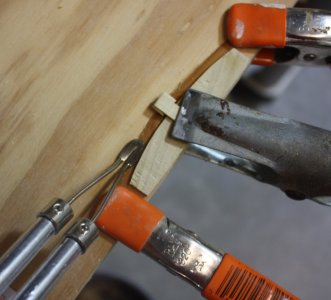
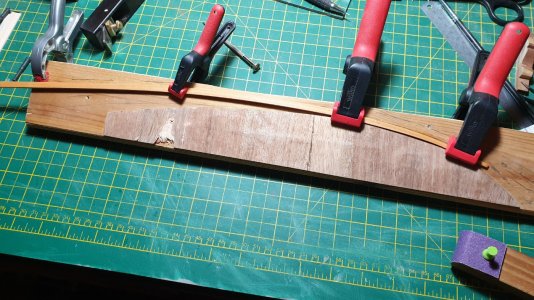
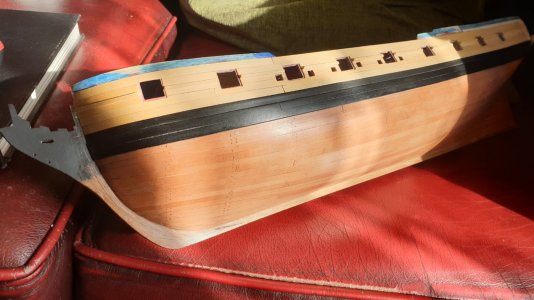
Most often I use swiss pear for the colour and castello above the wale, I don't cover my planking with copper so that's my chosen visual for frigates etc. There's no magical technique, just a jig and a soak (a bit of detergent in the water lowers the surface tension so it soaks easier) Usually I'll set on the jig or clamp into position, whichever works. For a stubborn plank I might do both. Obviously this is a slow process, 30 years ago I'd plank a hull in a day, but with a finish relying on fillers etc, and painted hulls. Now if I can do 2 strakes a side I've done well! Particularly if I have to spile a strake. Look at Kevin Kenny working, it's a long slow process working scratch.
With regard to tapering Olha advises tapering the plank on the outside of the bend. In effect slightly lengthening the outside of the bend, logical and effective enough.20221206_210721.jpg20230318_152237.jpg20210925_003245.jpg
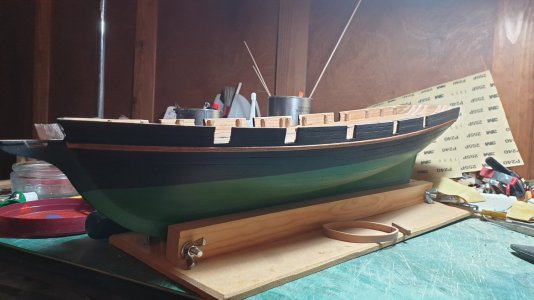
The Schooner was planked with maple using the same primitive jig. Otherwise I'm not sure what advice I can offer, except for Robert the Bruce's 'If at first you don't suceed' etc!!
My next hull will be clinker in castello, if the timber doesn't bend as well as the swiss I'll Work out the best approach.
 
Thanks Bob!
You are using the same process for edge bending that I now use whenever I can. I mark out the hull, plane, file and/or sand them to the necessary taper of their breadth then soak them. Once in the jig which is basically the same as yours, I hit it with a hot air gun. I can usually do 5 or 6 planks a day that way as the drying time with the hot gun is minutes rather than hours.
Thanks again, I appreciate your reply and the photos. (I am with you, no copper sheathing so I try to stay with British vessels launched before about 1780)

Allan
 
Last edited:
Back
Top