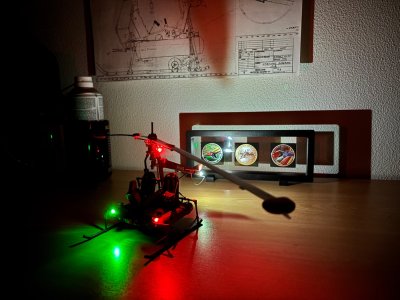
Perfection.

 |
As a way to introduce our brass coins to the community, we will raffle off a free coin during the month of August. Follow link ABOVE for instructions for entering. |
|



Totally agreeVery nice work! You would never know you are an airbrush novice.



Very nice work! You would never know you are an airbrush novice.
When there is no 'convincing evidence' then AL-FI is a good advisor, Johan. It looks GREAT! A nice overall nice color combination.
Regards, Peter
Perfection.
What you did looks great! AL can be a good thing, as long as you have good taste.
masterpiece
Totally agree
Nice work
Great looking airbrush work Johan.
As far using AL on color goes, you are correct, it can be repainted. That said, your AL on the color was good. Only way I would have painted the engine green would be if the helicopter was yellow, that would look good. Green with red...no. The only real choices with red, is black or red. If you wanted more contrast, go with black. So I feel your choice was good and matched the color scheme IMO.It's as I stated before; using the airbrush has a steep learning curve, so I still have some catching up to do.
Admittedly, the result sofar exceeds expectations. I did have some exemplary work to look at here on SOS, which convinced me to switch using the airbrush.
As far as being credited with perfection, while highly appreciated, it's a bit besides the truth; there is quite some room for improvement. Tonight, during dinner, while the model sat on the table, I noticed some of the flaws which crept into the build over time... So when I'm at the point where I have to think about a new project, well, who knows?
AL-FI is such a valuable companion, but careless use easily yields poor results. So any decision to invoke AL-FI needs to be thought through thoroughly. In this case, if my choices wouldn't have been my best, a redo was really easy; just reapply a different color.

true story.Perfection.

SCHITTEREND! / GREAT!
you totally owned this Johan!

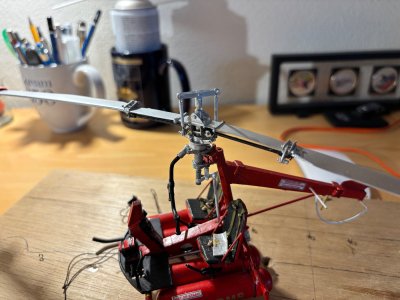
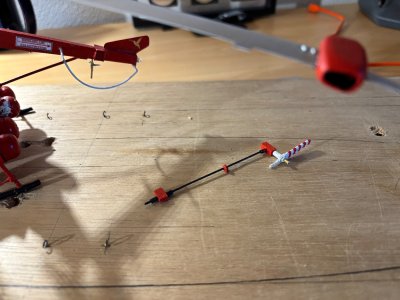
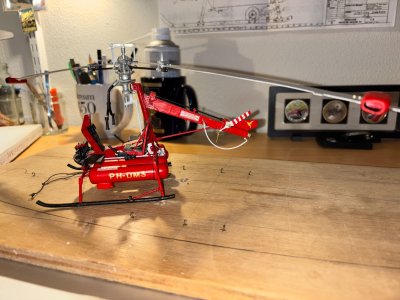
To my untrained eye your scratch build looks fully functional. The tail rotor would obviously be counterbalanced somehow but it appears it would be wildly unbalanced enough to tear itself apart. Very impressive Johan.I saw it's been more than a month ago I reported any progress. That has not been by lack of progress, but more tardiness from my side. Although I have some steps towards the finish line to report, I also experienced a few setbacks:
1. From the start of adding functional flight controls I was acutely aware of the fact I might chewed off more than I could swallow. Especially due to the potential build up of tolerances on all the moving and rotating bits and pieces it was very likely I would end up with too much play to have functional flight controls, which is exactly what happened. Furthermore, to make matter worse, the CA-bond used on the shaft/lever connection inside the torsion box, operating the collective pitch, failed. There is no way I can access these parts to reapply CA.
Still, all the linkages look great...
2. While trying to install the lamp glass and fitting of the top light, the connection between the SMD and the ground wire gave way and again, no possibility to fix that.
Luckily I was able to start and complete some other tasks, namely the addition of the control mechanisms on the main rotor and the build of the tail rotor drive shaft, gear boxes and the tail rotor itself. The fabrication and assembly of especially the mechanisms is time consuming and I find myself taking time off to give it some rest.
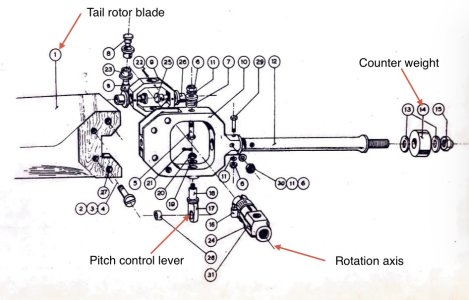
Building the tail rotor itself was done by using thin polystyrene, folded around a thin steel rod. I used steel to have a sufficiently stiff tail rotor. The connection to the drive shaft was a nightmare to build; I still might rebuild the entire thing...
Below a few pictures of the current status. Once I complete the tail rotor with it's flight control system, I'll shift my attention to one remaining main component: the canopy.
Below the completed installation of the main rotor flight controls installation, with rocker arms, linkages, torsion shafts and numerous pins:
View attachment 561283
The next picture shows the tail rotor with shaft, bearing block and gear boxes:
View attachment 561284
And finally a picture of the (temporary) installation of the tail rotor:
View attachment 561285
Despite a few broken connections, this is looking more and more impressive, Johan. The rotor head is just as piece or art!I saw it's been more than a month ago I reported any progress. That has not been by lack of progress, but more tardiness from my side. Although I have some steps towards the finish line to report, I also experienced a few setbacks:
1. From the start of adding functional flight controls I was acutely aware of the fact I might chewed off more than I could swallow. Especially due to the potential build up of tolerances on all the moving and rotating bits and pieces it was very likely I would end up with too much play to have functional flight controls, which is exactly what happened. Furthermore, to make matter worse, the CA-bond used on the shaft/lever connection inside the torsion box, operating the collective pitch, failed. There is no way I can access these parts to reapply CA.
Still, all the linkages look great...
2. While trying to install the lamp glass and fitting of the top light, the connection between the SMD and the ground wire gave way and again, no possibility to fix that.
Luckily I was able to start and complete some other tasks, namely the addition of the control mechanisms on the main rotor and the build of the tail rotor drive shaft, gear boxes and the tail rotor itself. The fabrication and assembly of especially the mechanisms is time consuming and I find myself taking time off to give it some rest.
Building the tail rotor itself was done by using thin polystyrene, folded around a thin steel rod. I used steel to have a sufficiently stiff tail rotor. The connection to the drive shaft was a nightmare to build; I still might rebuild the entire thing...
Below a few pictures of the current status. Once I complete the tail rotor with it's flight control system, I'll shift my attention to one remaining main component: the canopy.
Below the completed installation of the main rotor flight controls installation, with rocker arms, linkages, torsion shafts and numerous pins:
View attachment 561283
The next picture shows the tail rotor with shaft, bearing block and gear boxes:
View attachment 561284
And finally a picture of the (temporary) installation of the tail rotor:
View attachment 561285

I'm sure you're a bit disappointed by the functionality losses - but this is still a fine looking static model. I love your work.
To my untrained eye your scratch build looks fully functional. The tail rotor would obviously be counterbalanced somehow but it appears it would be wildly unbalanced enough to tear itself apart. Very impressive Johan.
Despite a few broken connections, this is looking more and more impressive, Johan. The rotor head is just as piece or art!
Daniel noticed it too: the unusual choice of a single wing for the tail rotor. But balanced, that won't be a problem. Did you find out why they made that choice?
Regards, Peter
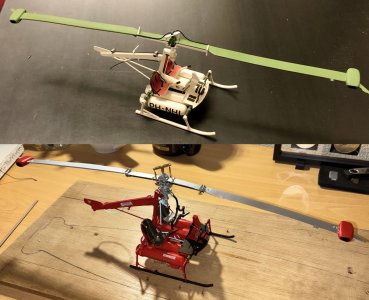
Comparisons are always nice, Johan. And it's good to see that there is another person who has taken up the challenge.Just for fun; a little over a year ago I visited the NLR in Amsterdam. There I was pleasantly surprised by another Kolibrie build. Of course I took a few pictures ( see also https://shipsofscale.com/sosforums/...-3-scale-1-48-scratch-build.15209/post-403025) and I thought it a nice idea to compare the two builds. This is not entirely fair; the scale of the other model is 1:32, whereas my model is build in 1:24, allowing me to be a bit more detailed.
Of course there are differences, despite using the same or similar information, the drawings and sketches used for the builds are far from detailed/dimensioned, so there's quite a bit of guesswork there
View attachment 561343