• Win a Free Custom Engraved Brass Coin!!!
    As a way to introduce our brass coins to the community, we will raffle off a free coin during the month of August. Follow link ABOVE for instructions for entering.
  • PRE-ORDER SHIPS IN SCALE TODAY!

    The beloved Ships in Scale Magazine is back and charting a new course for 2026!
    Discover new skills, new techniques, and new inspirations in every issue.

    NOTE THAT OUR FIRST ISSUE WILL BE JAN/FEB 2026

rigging catheads

Joined
Oct 17, 2024
Messages
1
Points
1
Hi all,
My first post here. I am new to building model ships. I am trying to rig the falls from the cathead to the anchor and cannot work out a satisfactory method. Where does the rope start and how is it rigged around the sheaves?
Any tips gratefully received.
Cheers
Jim

 
Welcome aboard Budgie
This was brought up here at SoS a few days ago so you should be able to do a quick search to find it. A bit depends on the era and maybe nation. The following is from James Lees' book The Masting and Rigging of English Ships of War some of which is based on D'arcy Lever's 1819 work.

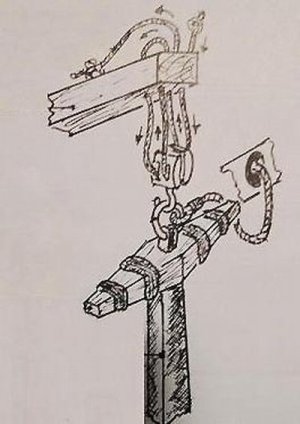
Regarding the cat falls, the fall of the tackle was rove, running from a treble block (cat block) and through the sheaves at the end of the cathead. The standing part of the fall was clenched to an eyebolt under the cathead, and the hauling part led in on to the forecastle from the cathead, generally to a cleat bolted to the inboard end of it, or sometimes to a timber head close by. Smaller ships had double cat blocks rather than triple.

There was also the back rope or cat-back, the cathead stopper, the shank painter, and the fish pendant tackle and guys to contend with and all are described on page 128 of Lee's book. I would copy it all here but I am not sure about the limit on how much can be copied in public without permission due to copyright infringement laws.

Allan
 
also from my side a warm welcome here on board of our forum
 
Hi Thanasis,
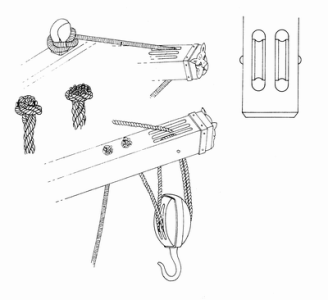
I am skeptical about a knot at the end of the standing part of the line being strong enough to support the anchor rather than being tied off to a cleat or eye. Can you give the source of the drawings that you posted? Thank you very much.

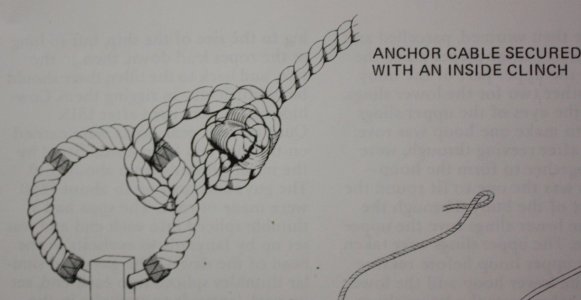
I am not saying this was never done, but it seems weak, and I cannot find any information on such a rig including contemporary models or drawings. The above left drawing shows the anchor cable secured with a seizing, but it does not show the knot used. The seizing alone would not be strong enough.
Allan
1731841553121.jpeg
alone
 
Last edited:
Hi all,
My first post here. I am new to building model ships. I am trying to rig the falls from the cathead to the anchor and cannot work out a satisfactory method. Where does the rope start and how is it rigged around the sheaves?
Any tips gratefully received.
Cheers
Jim
Hello, I'm a new member--today, 13 Dec 2024--and this is exactly the problem I have encountered with my second model! It's the reason I scoured the internet and found this site. Thanks for the question and the following help and diagrams from everyone!
 
Hello, I'm a new member--today, 13 Dec 2024--and this is exactly the problem I have encountered with my second model! It's the reason I scoured the internet and found this site. Thanks for the question and the following help and diagrams from everyone!
Welcome aboard SOS!
 
As you can see, although it's the same book, (same author!) they show different versions...
Sorry for the late reply Thanasis, but I am confused when you say the same book and author. The picture I posted is from James Lees' The Masting and Rigging English Ships of War and your post shows drawings from Monfeld's book. No matter, there seem to be very very few things that were set in stone back in those days of ship building and especially rigging. Both authors did a ton of research and I would be hesitant to argue with either one. :)
Allan
 
Hi Alan.
Maybe I wasn't clear.
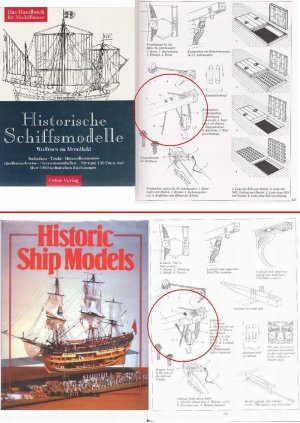
I am referring on the two books (of Monfeld's in German and English), photos' from which I posted, not on your book...
Well I can't say the same for myself, be hesitant to argue.
When an author posts different options on a "same" book, then I would think that maybe could be a missed third one (option)...:rolleyes:
At least in Gr newest bibliography, I have found many inaccuracies...:cool:
Thx
 
Last edited:
Hi Smithy. I did what you suggested...
I found than only in the book of the Eng. version writes that firstly was published in Ger. in 1977, while the present edition (Eng) is dated 1985.
Well, what if I was a German who couldn't read English and the reverse one, in any date?
Should I bought both versions to look for similarities ..? :cool: What makes sure that the newest one, is the correct one? Just saying... :)
Thx
 
Hi Allan. You gave me the chance to search my archives-books to find out the below results...
As you can see, although it's the same book, (same author!) they show different versions...:cool:
Thx
seems something got lost in translation... or shown for different ships or eras or country. but either way, they do have similarities.
 
Hi Smithy. I did what you suggested...
I found than only in the book of the Eng. version writes that firstly was published in Ger. in 1977, while the present edition (Eng) is dated 1985.
Well, what if I was a German who couldn't read English and the reverse one, in any date?
Should I bought both versions to look for similarities ..? :cool: What makes sure that the newest one, is the correct one? Just saying... :)
Thx

It’s more likely that a mistake in the early edition was noticed and corrected in the later edition, than that a good drawing was later changed to a bad one. However, it can sometimes happen that way. Cautious

As to the English/German question, I guess that both editions were originally released in both languages.
 
I seem to be resurrecting this topic a year later, but wanted to share some research on the topic.
There are two ways to attach the standing end of the catting line to the cat's head. One is with a stopper knot through a hole in the cat's head, the other is seizing the line to an eye bolt on the aft side of the cat's head slightly inboard of the sheaves.

Which do you use? Like everything else in modelling, it depends on the era.

I am building HMS Alert which was launched ~1777. For this ship, they would have used a stopper knot on the standing line, reaved through a hole inboard of the sheaves, drilled top to bottom. This was standard Admiralty practice from 1760-1790. There's a couple reasons for this.
1. Hemp line was more easily chafed attached to an iron ring of the day
2. stopper knots were preferred for shock loads relative to iron
3. iron was minimized aloft and forward in that period
4. the line was more easily replaced when necessary
5. practice favored wood-on-wood contact for loads
6. iron was hand forged in this period and less predictable under heavy loads.
7. sailors in this period was very skilled and could make the proper stopper knot. They also had a good eye for when the fibers were failing and the line needed replacement

The eyebolt approach is more common on warships, merchant vessels, and refits going forward from that period. That was for several reasons.
1. production of iron features was more standardized with new manufacturing techniques and was much more predictable
2. strong eyebolts of larger internal radii could be produce, reducing strain on the line
3. the bolts were also served with leather to reduce chafing. Leather degradation was much easier to notice
4. seaman and conscripts were, on average, less skilled and the important rope and knotting skills could not be relied on
5. anchor weight went up and hemp rope fibers got mashed much more quickly in a stopper knot.

So that's what my research turned up. I'll be using the stopper knot. Looks like I'm going to have to practice my tiny wall knots and figure out how big a hole is appropriate.
 
Back
Top