-

Win a Free Custom Engraved Brass Coin!!!
As a way to introduce our brass coins to the community, we will raffle off a free coin during the month of August. Follow link ABOVE for instructions for entering. -

SUBSCRIBE TO SHIPS IN SCALE TODAY!
The beloved Ships in Scale Magazine is back and charting a new course for 2026!
Discover new skills, new techniques, and new inspirations in every issue.
NOTE THAT OUR NEXT ISSUE WILL BE MARCH/APRIL 2026
You are using an out of date browser. It may not display this or other websites correctly.
You should upgrade or use an alternative browser.
You should upgrade or use an alternative browser.


It depends on the scale, of course. For larger scales, many use copper and blacken it with liver of sulfur. For smaller scales, the usual choice is shellacked acid-free paper strips painted black and glued to the block. While the shellac gives the paper greater strength, is is not really suitable for carrying the tension of the rig and is prone to tearing. Others use a strip of black plastic tape. The tape can be problematic because we have no idea of the archival qualities of the tape adhesive It won't do if it lets go in a few years.

Annealed steel wire works well. It is already black and as flexible as copper.

Hello RobWhat do people use to simulate the steel strap on blocks?
For internally or externally stropped blocks I use thin copper strips cut from a sheet stock. What vessel are you building?
Allan

Clinker Boat 1:6 Scale Model Kit — Clyde Model Dockyard
This model kit allows you to construct a beautiful clinker-built wooden model boat. Based on Swallow from Arthur Ransome's Swallows and Amazons , this model is perfect for radio control with a model outboard motor, or, with some modification, as an RC sailing model. It also makes for an impressiv
 www.clydemodeldockyard.com
1/6 scale clinker row boat
What’s the thickness of the copper?Hello Rob
For internally or externally stropped blocks I use thin copper strips cut from a sheet stock. What vessel are you building?
Allan
Pretty much anything you want, from 0.001" upwards. (1/16" at 1:64 scale,,,, if my math is correct) I have no idea where to get it in the UK or Europe in general but hopefully another member from the UK will post a source. If you do a search do one for copper sheets and another for copper foil. The supplier I use here in the US offers both, but the thinnest sheets are much thicker than the foil.
Allan
Allan

- Joined
- Oct 1, 2023
- Messages
- 2,102
- Points
- 488

Maybe you could post some photos of the tools used for this strappingHello Rob
For internally or externally stropped blocks I use thin copper strips cut from a sheet stock. What vessel are you building?
Allan
Maybe you could post some photos of the tools used for this strapping
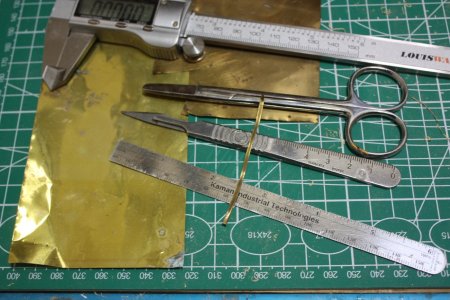
I try to stay with suture scissors or scalpel. I switched to scalpels decades ago after too many Xactos rolled off the bench and a few times sticking in my leg.
Bending metal at our scales is easy so no special tools necessary. Brass can work as well as copper but if too thick can tend have some spring and cannot be blackened instantly like copper can with diluted liver of sulfur.
Allan

Ebay UKPretty much anything you want, from 0.001" upwards. (1/16" at 1:64 scale,,,, if my math is correct) I have no idea where to get it in the UK or Europe in general but hopefully another member from the UK will post a source. If you do a search do one for copper sheets and another for copper foil. The supplier I use here in the US offers both, but the thinnest sheets are much thicker than the foil.
Allan
Cap'n Robster:1/6 scale clinker row boat
At that scale, it's pretty easy to make a lot of gear. You can use brass, copper, or styrene at scale or near-scale thickness. For example, if full size thickness is 2mm, then model thickness is 0.3mm. I like working on small craft at large scale, usually 1/12. What I have to ask is where are blocks used on a 12-foot skiff? I sail a 16-foot Sea Bright skiff with a traditional spritsail rig and there isn't a block to be seen. Fair winds!


I normally use black construction paper which is thicker than regular paper.

Maybe you could post some photos of the tools used for this strapping
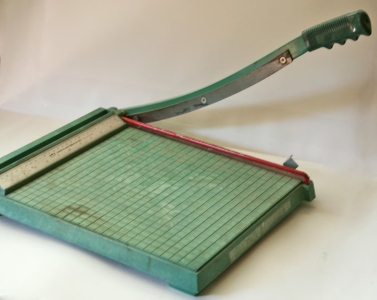
I use a standard old-fashioned guillotine paper cutter for cutting all my copper strips from copper sheet. It will cut long very narrow strips of perfectly straight copper sheet very easily. I have a stash of copper sheeting I got from a roofer friend. It's used a lot in quality roofing construction. Scraps can be scrounged pretty easily. When cut on the paper cutter, the off-cut strips will tend to curl. I then put one end of the strip in a vise and clamp a pair of vise-grips onto the other end and give the curled strip a strong, steady pull. This returns the strip to perfectly straight, uncurled shape. A paper cutter is a handy tool to have for a lot of other modeling uses, particular for card and even thin wood sheeting.
Guillotine paper cutters are a dime a dozen in the online local "marketplace" and auction sites. I even saw a somewhat tired-looking one for free on a local marketplace site the other day. Small, lightweight ones can be purchased new on Amazon for as little as twenty-five bucks. The bigger and heavier ones, the better, though. If you find a good old heavy one that has a dull blade, just take it to your local tool sharpening shop and have them professionally sharpen it for you. If not abused thereafter, it will stay sharp for the rest of your life and probably your grandkids' too!