
- Joined
- Nov 25, 2018
- Messages
- 638
- Points
- 403
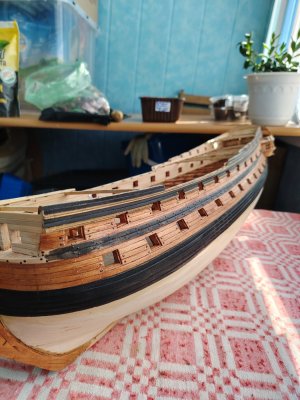
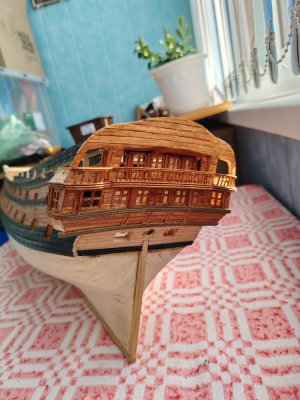
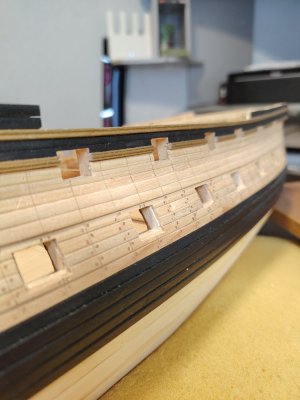
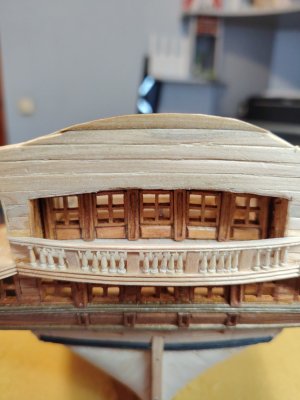
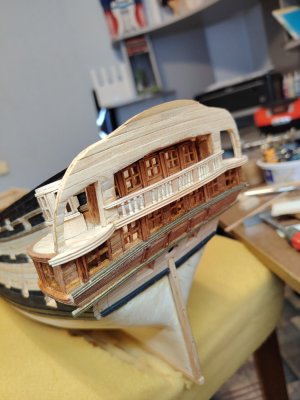
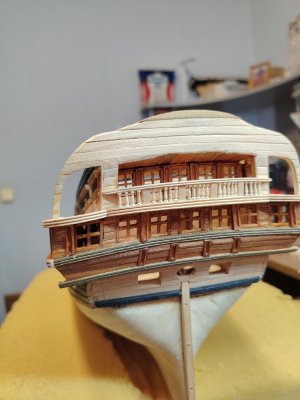
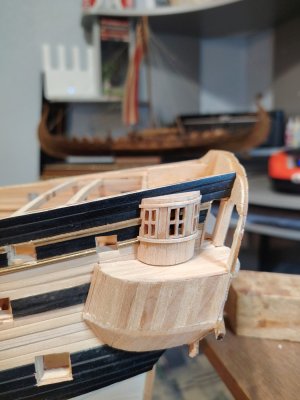
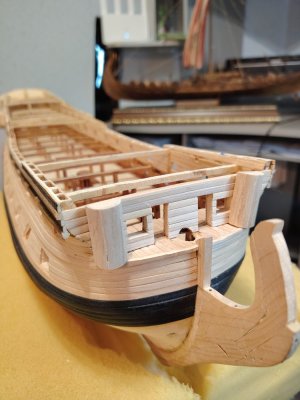
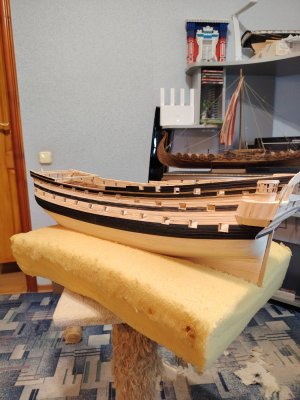
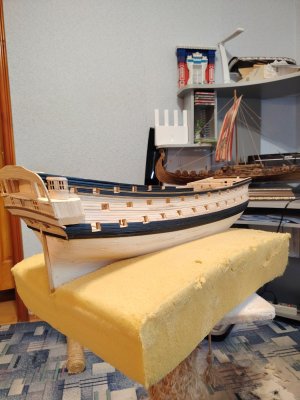
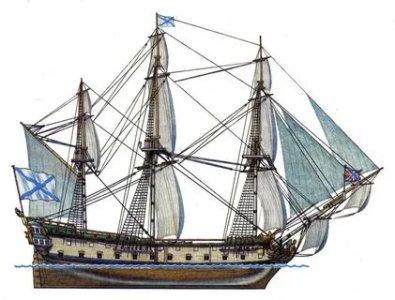
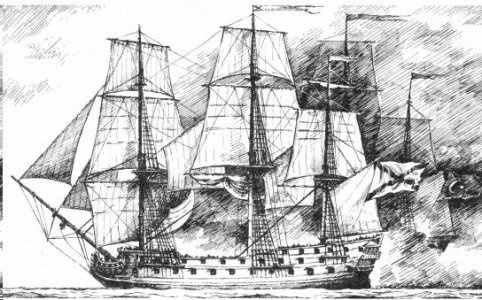
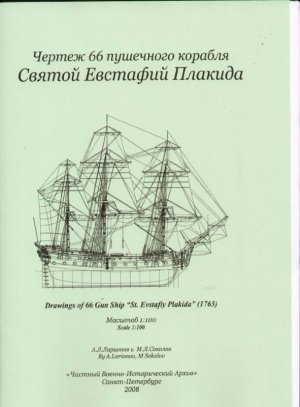
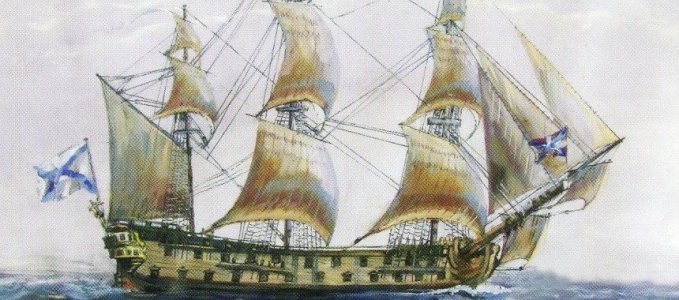
hello everyone. It's time to show off my new construction site. A model of the 66-gun battleship Evstafy Plakida.
a little history about this glorious ship. Well, it's worth reading for fans of naval battles.
The flagship of Admiral Grigory Andreevich Spiridov in the Battle of Chios. The brother and assistant of Count Alexei Grigoryevich Orlov, commander of the Russian forces in the Archipelago, Count Fyodor Grigoryevich Orlov, were on the ship in battle.
The battleship "Saint Eustathius Plakida" was laid down according to the project "Glory of Russia" on 07/30/1782 at the St. Petersburg Admiralty. The ship's builder is D. Ulfov. She was launched on 20.8.1763 and joined the Baltic Fleet.
66-gun battleships of the project or, as it was said, the "Glory of Russia" type were built at the shipyards of the St. Petersburg and Arkhangelsk Admiralties from 1733 to 1774. 58 battleships were built according to the project, the largest series of large ships of the Russian fleet. They participated in all voyages and combat operations of the Russian fleet from 1734 to 1790. The project was extremely successful. The ships had high maneuverability and good stability. They had a good wind speed of up to 8 knots.
Displacement of 1200 tons, dimensions: 45.6 x 12.3 x 5.4 meters. Armament: 60 24-, 12- and 6-pounder guns. The crew is 600 people.
ships of Admiral Elfinstein's second squadron.
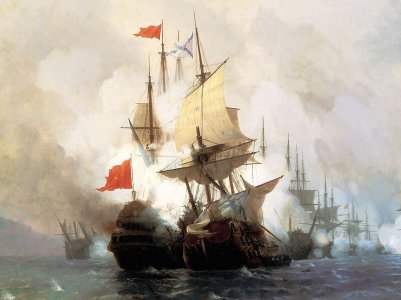
On 26.7.1770, the combined Russian squadron participated in the battle of the Chios Strait, where it attacked the more powerful Turkish fleet.
The flagship of the line "Saint Eustace Plakida" led the attack of Russian ships on the Turkish fleet.
Before the start of the battle, Count Orlov, Admiral Spiridov, Admiral Elphinstone had 9 battleships, 3 frigates, 1 bombardier ship, 1 packet boat, 3 pink and 13 smaller ships. The Russian fleet was lined up in three battle lines — the vanguard, the corps de combat (middle row) and the rearguard. Admiral Spiridov was in the vanguard, carrying his flag on the ship St. Evstafy (commander — Captain 1st rank Cruz) with the battleships Europa (captain 1st rank Klochev) and Three Saints (captain 1st rank Khmetevsky) and the frigate St. Nicholas (Lieutenant Palikuti). There are three battleships in the cordebatalia: the Three Hierarchs (Captain-Brigadier Greig) — the flag of Count Alexei Orlov, the Rostislav (Captain 1st rank Lupandin), the Saint Ianuarius (captain 1st rank Borisov) and two frigates the Nadezhda of Prosperity (Captain-Lieutenant Stepanov) andAfrica" (Lieutenant Commander Cleopin); commander of the corps de corps Greig on the "Three Hierarchs", on the same ship, the supreme commander of the entire squadron, Count Alexei Orlov. In the rear guard there are three battleships "Do not touch me" (this ship has the flag of Elphinstone, the commander is Captain 1st rank Beshentsev), Saratov (captain 2nd rank Polivanov), Svyatoslav (captain 1st rank V. V. Roksburg) and several small vessels.
Turkish ships consisting of 16 battleships (5 of them with 80 guns each, 10 with 60-70 guns), 6 frigates, 6 shebekas, 13 galleys and 32 small and auxiliary vessels lined up in two parallel lines, flanking the left flank to a small island, and the right to the shoal near the city of Chesma.
Count Orlov's order to the Russian ships in battle was simple:
"In the event that we have to attack the enemy's fleet at anchor, we must prepare ourselves for this, for which we must order all ships and other vessels on both sides to prepare one anchor, tying cables by the eye, for springing on both sides; and if it comes to anchoring, then throw from the side that is from the enemy; according to unknown orders of the enemy's fleet, the disposition is not prescribed how to attack it, but it has to be given at discretion from now on."
At 4 a.m., Greig raised the signal "Chase the enemy" on the Three Hierarchs and the Russian squadron moved towards the Turks in the Chios Strait. The advance of the ships was slow enough, and only by 9 a.m. almost the entire Russian fleet was very close to the Turks. The vanguard ships lay down to drift, waiting for the ships of the rear line. Orlov and the commanders of all the battleships arrived on Spiridov's ship "Three Hierarchs" and held the last military council before the battle (lasted less than an hour), after which they returned to their ships. At 11:00 Count Orlov gave the signal: the whole fleet to attack the enemy. The commanders of the Russian squadron used new military tactics. To deliver the decisive blow, they launched an attack in a line perpendicular to the enemy. This maneuver was very risky, as the Russian ships approached the Turkish ships in the wake column almost perpendicular to the enemy's line and were subjected to longitudinal artillery fire from part of the Turkish ships, being themselves unable to respond with a broadside. The calculation was based on a rapid approach to the enemy, which made it possible to minimize losses somewhat. It was taken into account that the firing sectors of the naval artillery at that time were very limited and the enemy would not be able to concentrate all their guns on the Russian fleet.
At 11:30 a.m., the advanced ship Europa approached 3 cables (560 meters) to the center of the Turkish line, and the Turks opened fire with all guns. Their guns hit mainly the spars and rigging to make it difficult for the attackers to maneuver. The Russian ships did not respond until they were within pistol shot, then from a distance of 80 fathoms (about 170 meters) They fired three volleys one after the other, forcing the leading Turkish ships to weaken their fire.
The advanced ship Europa made a turn and went out of service. After describing an arc, he found himself behind the ship of the Rostislav corps de Combat and joined the battle again. There are two different versions of why this happened. First: the commander of Europa, a captain of the 1st rank of the CLC, must
First, the commander of Europa, Captain 1st rank Klochev, had to give in to the insistent demands of the Greek pilot, who pointed out the need to make a turn in order not to land the ship on the underwater rocks that were on his nose. The second version, Europa, suffered very severe damage to the rigging and mast, lost control and could not keep moving for some time.
Admiral Spiridov congratulated the commander of Europa, Captain 1st Rank Klokachev, on his promotion to sailors.
The exit of Europa from the vanguard of the column led to the fact that the leading ship of the Russian squadron was the St. Evstafy, on which Admiral Spiridov held his flag, and the fire of three Turkish battleships (including the flagship of the Turkish squadron) and one shebeki was directed at this ship. Music was blaring on the quarterdeck of the ship, and the admiral ordered the musicians to "play to the last.
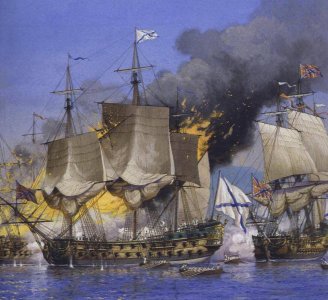
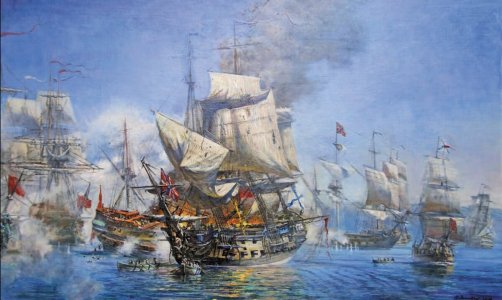
" "Saint Eustace" concentrated fire on the flagship of the Turkish navy, the 80-gun battleship Burj-u-Zafer, approached this ship and began pelting it with firebombs. A fire broke out on the Burj-u-Zafer, and the crew rushed into the sea in a panic to swim to shore. By this time, the Saint Eustace had already lost control due to damage to the rigging from the shelling of Turkish ships and was being carried away by the current directly onto the Burj-u-Zafer. In order to tow the Saint Eustace, the captain ordered rowing vessels to be lowered, but they could not overcome the current. The two ships collided, and the bowsprit of the Burj-u-Zafer was caught between the mainsail and the mizzen masts of the St. Eustace. Russian officers and sailors ran across the rigging and yards to the enemy ship and engaged in a desperate boarding battle with the Turks remaining on the Turkish ship. The boarding battle ended in favor of the Russian sailors, the Turks who remained on the ship jumped overboard and began to swim for their lives, but the fire on the Burj-u-Zafer could not be extin
The flames spread to the St. Eustace, on the deck of which the burning mainmast of the Burj-u-Zafer collapsed, sparks and firebrands hit the open hatch of the powder magazine (the hook chamber was open to replenish artillery with powder and shells during the battle), and the St. Eustace exploded, followed by Burj-u-Zafer followed.
According to the charter, Admiral Spiridov left the ship a few minutes before the explosion. Together with the brother of the commander-in-chief Fyodor Orlov, they transferred to the packet Postman, and then Spiridov transferred his flag to the battleship Three Saints. The total number of deaths on St. Eustace varies. According to one source, 34 officers and 473 soldiers and sailors were killed. According to other sources, 22 officers and 598 lower ranks were killed. It is known for sure that 58 people of the team were saved. Among those rescued was the ship's commander, Captain 1st rank Alexander Ivanovich Cruz.
Of the entire Russian fleet, the most effective actions were carried out on the "Three Hierarchs", on which Alexei Orlov and Samuel Greig were stationed. It was this ship that performed the maneuver most clearly of all the Russian ships, was able to come close to the ship on which the Kapudan Pasha flag was flying (Kapudan Pasha himself did not participate in the battle, he was on the shore on the day of the battle and inspected the fortress guns) and fired very hard at it. Due to the poor maneuvering of the Turkish sailors, the captain's ship of the Turkish fleet (Kapudan Pasha in Russian sources) took more than a quarter of an hour. It was located astern of the "Three Hierarchs", which allowed the flagship of the Russian fleet to inflict very severe damage to the Turkish ship without any harm to itself. The ships Rostislav and St. January were located near the Three Hierarchs and also operated successfully. The rearguard of the Russian fleet fired at the Turkish ships at a considerable distance and only approached the Turkish ships by the end of the battle, which prevented them from causing significant damage.
By 14:00, the Turks cut off the anchor ropes and retreated to the Chesma Bay under the cover of coastal batteries.
The Russian ships blocked the exit from it and began to prepare to continue the battle later. Only the Thunder bomber ship was left near the entrance to the bay, and the Turkish fleet was bombarded from this bomber ship in the evening and all night after the battle. To cover the Thunder, the battleship Svyatoslav fired cannons from the coastal batteries of the Chesma fortress.
In the battle in the Strait of Chios, the sides lost one battleship each, and several Turkish ships were significantly damaged. Of the Russian ships, only the Three Saints and Europa suffered minor damage. The ship "Three Saints" received 5 holes, 2 of them below the waterline. The crew losses on all Russian ships, except for the St. Eustace, were relatively small. On the Three Saints, 1 officer and 6 sailors were killed; the commander, 3 officers and 20 sailors were wounded; on the Europa, 4 were killed and several people were injured; on the Don't Touch Me, 3 were killed and several people were injured; on the Three Hierarchs, 1 sailor was wounded. The losses of the Turkish crews are unknown, but based on the damage on the Turkish ships, they should be more than the Russians.
For this battle, Captain 1st rank A.I. Cruz, who was thrown overboard during the explosion, received the Order of St. George of the 4th degree: "for bravery and courage shown during the battle and for burning the main enemy ship.
After the victory in the Battle of Chesma, Captain 1st Rank Cruz was given command of the Rhodes battleship captured from the Turks.
In memory of the heroic death of the battleship St. Eustathius Plakida, four battleships of the Russian navy were named "In Memory of St. Eustathius." And if at that time the St. George flag had been awarded for such exploits, then it is quite possible that these ships would have worn St. George flags.
a little history about this glorious ship. Well, it's worth reading for fans of naval battles.
The flagship of Admiral Grigory Andreevich Spiridov in the Battle of Chios. The brother and assistant of Count Alexei Grigoryevich Orlov, commander of the Russian forces in the Archipelago, Count Fyodor Grigoryevich Orlov, were on the ship in battle.
The battleship "Saint Eustathius Plakida" was laid down according to the project "Glory of Russia" on 07/30/1782 at the St. Petersburg Admiralty. The ship's builder is D. Ulfov. She was launched on 20.8.1763 and joined the Baltic Fleet.
66-gun battleships of the project or, as it was said, the "Glory of Russia" type were built at the shipyards of the St. Petersburg and Arkhangelsk Admiralties from 1733 to 1774. 58 battleships were built according to the project, the largest series of large ships of the Russian fleet. They participated in all voyages and combat operations of the Russian fleet from 1734 to 1790. The project was extremely successful. The ships had high maneuverability and good stability. They had a good wind speed of up to 8 knots.
Displacement of 1200 tons, dimensions: 45.6 x 12.3 x 5.4 meters. Armament: 60 24-, 12- and 6-pounder guns. The crew is 600 people.
ships of Admiral Elfinstein's second squadron.
On 26.7.1770, the combined Russian squadron participated in the battle of the Chios Strait, where it attacked the more powerful Turkish fleet.
The flagship of the line "Saint Eustace Plakida" led the attack of Russian ships on the Turkish fleet.
Before the start of the battle, Count Orlov, Admiral Spiridov, Admiral Elphinstone had 9 battleships, 3 frigates, 1 bombardier ship, 1 packet boat, 3 pink and 13 smaller ships. The Russian fleet was lined up in three battle lines — the vanguard, the corps de combat (middle row) and the rearguard. Admiral Spiridov was in the vanguard, carrying his flag on the ship St. Evstafy (commander — Captain 1st rank Cruz) with the battleships Europa (captain 1st rank Klochev) and Three Saints (captain 1st rank Khmetevsky) and the frigate St. Nicholas (Lieutenant Palikuti). There are three battleships in the cordebatalia: the Three Hierarchs (Captain-Brigadier Greig) — the flag of Count Alexei Orlov, the Rostislav (Captain 1st rank Lupandin), the Saint Ianuarius (captain 1st rank Borisov) and two frigates the Nadezhda of Prosperity (Captain-Lieutenant Stepanov) andAfrica" (Lieutenant Commander Cleopin); commander of the corps de corps Greig on the "Three Hierarchs", on the same ship, the supreme commander of the entire squadron, Count Alexei Orlov. In the rear guard there are three battleships "Do not touch me" (this ship has the flag of Elphinstone, the commander is Captain 1st rank Beshentsev), Saratov (captain 2nd rank Polivanov), Svyatoslav (captain 1st rank V. V. Roksburg) and several small vessels.
Turkish ships consisting of 16 battleships (5 of them with 80 guns each, 10 with 60-70 guns), 6 frigates, 6 shebekas, 13 galleys and 32 small and auxiliary vessels lined up in two parallel lines, flanking the left flank to a small island, and the right to the shoal near the city of Chesma.
Count Orlov's order to the Russian ships in battle was simple:
"In the event that we have to attack the enemy's fleet at anchor, we must prepare ourselves for this, for which we must order all ships and other vessels on both sides to prepare one anchor, tying cables by the eye, for springing on both sides; and if it comes to anchoring, then throw from the side that is from the enemy; according to unknown orders of the enemy's fleet, the disposition is not prescribed how to attack it, but it has to be given at discretion from now on."
At 4 a.m., Greig raised the signal "Chase the enemy" on the Three Hierarchs and the Russian squadron moved towards the Turks in the Chios Strait. The advance of the ships was slow enough, and only by 9 a.m. almost the entire Russian fleet was very close to the Turks. The vanguard ships lay down to drift, waiting for the ships of the rear line. Orlov and the commanders of all the battleships arrived on Spiridov's ship "Three Hierarchs" and held the last military council before the battle (lasted less than an hour), after which they returned to their ships. At 11:00 Count Orlov gave the signal: the whole fleet to attack the enemy. The commanders of the Russian squadron used new military tactics. To deliver the decisive blow, they launched an attack in a line perpendicular to the enemy. This maneuver was very risky, as the Russian ships approached the Turkish ships in the wake column almost perpendicular to the enemy's line and were subjected to longitudinal artillery fire from part of the Turkish ships, being themselves unable to respond with a broadside. The calculation was based on a rapid approach to the enemy, which made it possible to minimize losses somewhat. It was taken into account that the firing sectors of the naval artillery at that time were very limited and the enemy would not be able to concentrate all their guns on the Russian fleet.
At 11:30 a.m., the advanced ship Europa approached 3 cables (560 meters) to the center of the Turkish line, and the Turks opened fire with all guns. Their guns hit mainly the spars and rigging to make it difficult for the attackers to maneuver. The Russian ships did not respond until they were within pistol shot, then from a distance of 80 fathoms (about 170 meters) They fired three volleys one after the other, forcing the leading Turkish ships to weaken their fire.
The advanced ship Europa made a turn and went out of service. After describing an arc, he found himself behind the ship of the Rostislav corps de Combat and joined the battle again. There are two different versions of why this happened. First: the commander of Europa, a captain of the 1st rank of the CLC, must
First, the commander of Europa, Captain 1st rank Klochev, had to give in to the insistent demands of the Greek pilot, who pointed out the need to make a turn in order not to land the ship on the underwater rocks that were on his nose. The second version, Europa, suffered very severe damage to the rigging and mast, lost control and could not keep moving for some time.
Admiral Spiridov congratulated the commander of Europa, Captain 1st Rank Klokachev, on his promotion to sailors.
The exit of Europa from the vanguard of the column led to the fact that the leading ship of the Russian squadron was the St. Evstafy, on which Admiral Spiridov held his flag, and the fire of three Turkish battleships (including the flagship of the Turkish squadron) and one shebeki was directed at this ship. Music was blaring on the quarterdeck of the ship, and the admiral ordered the musicians to "play to the last.
" "Saint Eustace" concentrated fire on the flagship of the Turkish navy, the 80-gun battleship Burj-u-Zafer, approached this ship and began pelting it with firebombs. A fire broke out on the Burj-u-Zafer, and the crew rushed into the sea in a panic to swim to shore. By this time, the Saint Eustace had already lost control due to damage to the rigging from the shelling of Turkish ships and was being carried away by the current directly onto the Burj-u-Zafer. In order to tow the Saint Eustace, the captain ordered rowing vessels to be lowered, but they could not overcome the current. The two ships collided, and the bowsprit of the Burj-u-Zafer was caught between the mainsail and the mizzen masts of the St. Eustace. Russian officers and sailors ran across the rigging and yards to the enemy ship and engaged in a desperate boarding battle with the Turks remaining on the Turkish ship. The boarding battle ended in favor of the Russian sailors, the Turks who remained on the ship jumped overboard and began to swim for their lives, but the fire on the Burj-u-Zafer could not be extin
The flames spread to the St. Eustace, on the deck of which the burning mainmast of the Burj-u-Zafer collapsed, sparks and firebrands hit the open hatch of the powder magazine (the hook chamber was open to replenish artillery with powder and shells during the battle), and the St. Eustace exploded, followed by Burj-u-Zafer followed.
According to the charter, Admiral Spiridov left the ship a few minutes before the explosion. Together with the brother of the commander-in-chief Fyodor Orlov, they transferred to the packet Postman, and then Spiridov transferred his flag to the battleship Three Saints. The total number of deaths on St. Eustace varies. According to one source, 34 officers and 473 soldiers and sailors were killed. According to other sources, 22 officers and 598 lower ranks were killed. It is known for sure that 58 people of the team were saved. Among those rescued was the ship's commander, Captain 1st rank Alexander Ivanovich Cruz.
Of the entire Russian fleet, the most effective actions were carried out on the "Three Hierarchs", on which Alexei Orlov and Samuel Greig were stationed. It was this ship that performed the maneuver most clearly of all the Russian ships, was able to come close to the ship on which the Kapudan Pasha flag was flying (Kapudan Pasha himself did not participate in the battle, he was on the shore on the day of the battle and inspected the fortress guns) and fired very hard at it. Due to the poor maneuvering of the Turkish sailors, the captain's ship of the Turkish fleet (Kapudan Pasha in Russian sources) took more than a quarter of an hour. It was located astern of the "Three Hierarchs", which allowed the flagship of the Russian fleet to inflict very severe damage to the Turkish ship without any harm to itself. The ships Rostislav and St. January were located near the Three Hierarchs and also operated successfully. The rearguard of the Russian fleet fired at the Turkish ships at a considerable distance and only approached the Turkish ships by the end of the battle, which prevented them from causing significant damage.
By 14:00, the Turks cut off the anchor ropes and retreated to the Chesma Bay under the cover of coastal batteries.
The Russian ships blocked the exit from it and began to prepare to continue the battle later. Only the Thunder bomber ship was left near the entrance to the bay, and the Turkish fleet was bombarded from this bomber ship in the evening and all night after the battle. To cover the Thunder, the battleship Svyatoslav fired cannons from the coastal batteries of the Chesma fortress.
In the battle in the Strait of Chios, the sides lost one battleship each, and several Turkish ships were significantly damaged. Of the Russian ships, only the Three Saints and Europa suffered minor damage. The ship "Three Saints" received 5 holes, 2 of them below the waterline. The crew losses on all Russian ships, except for the St. Eustace, were relatively small. On the Three Saints, 1 officer and 6 sailors were killed; the commander, 3 officers and 20 sailors were wounded; on the Europa, 4 were killed and several people were injured; on the Don't Touch Me, 3 were killed and several people were injured; on the Three Hierarchs, 1 sailor was wounded. The losses of the Turkish crews are unknown, but based on the damage on the Turkish ships, they should be more than the Russians.
For this battle, Captain 1st rank A.I. Cruz, who was thrown overboard during the explosion, received the Order of St. George of the 4th degree: "for bravery and courage shown during the battle and for burning the main enemy ship.
After the victory in the Battle of Chesma, Captain 1st Rank Cruz was given command of the Rhodes battleship captured from the Turks.
In memory of the heroic death of the battleship St. Eustathius Plakida, four battleships of the Russian navy were named "In Memory of St. Eustathius." And if at that time the St. George flag had been awarded for such exploits, then it is quite possible that these ships would have worn St. George flags.