Below is a translated excerpt from the
Essai Sur La Vie Et Les Ouvrages de Pierre Puget
The step of the Soleil-Royal, whose decoration is also due to Puget's pencil, seems to testify to the account that this artist had taken on the need to restrict the extent of the decoration. In the drawing of this new ship, the upper gallery, that is to say, the one that culminates the coronation in the other ship, is deleted, and the figures are less gigantic. The vault does not have other ornament than simple moldings and a mask to cover the opening of the jaumière. To this seems to reduce the apparent modification made in the profusion of ornamental riches, the composition of the painting always retaining a great and noble character. It could be, however, that the absence of ornaments on the vault was less due to the modification requested by the minister, than to the quality of the ship, which being of 2nd rank did not admit as much luxury of decoration.
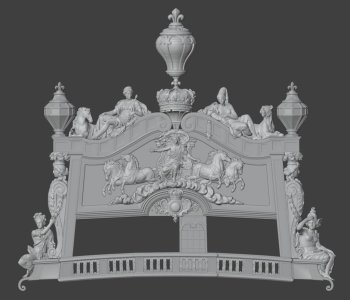
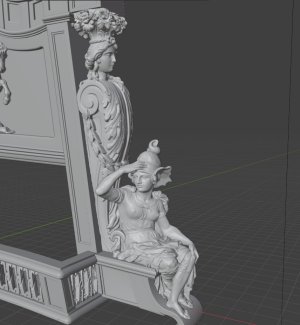
The area that bears the name of the ship, covered with beautiful arabesques is, at the Soleil-Royal, supported by four thermal baths indicating the seasons that the star of the day shares in its annual course, because it should be noted, everything is allegorical in the decoration of this building whose name itself alluded to the young monarch.
Next to the top of the painting. These sides are formed by an inverted console whose notch fit the re-entrant part of the building's blanks, at the height of the second battery. A bust of a woman carrying on her head a basket of flowers for one, fruits for the other, comes out of the small winding of these consoles. The large bas-relief, left in white in the decoration project of the first bucket, but drawn in this one that had already received his name, represents the young king under the figure of Phebus, driving his harnessed chariot of the four myphological horses launched at the ga-lop, and in the ancient style, that is to say, thrown two to the right and two to the left. The crowning of this beautiful sten, of
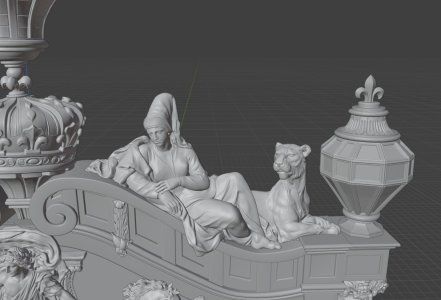
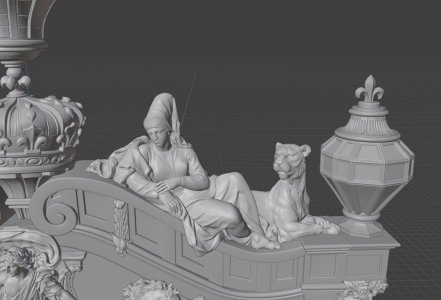
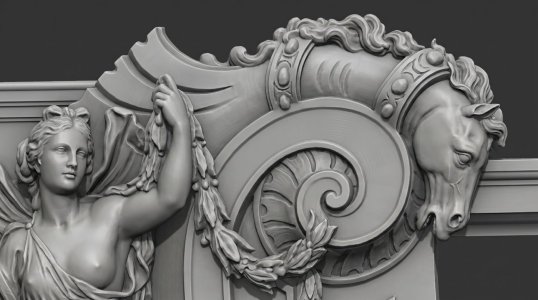
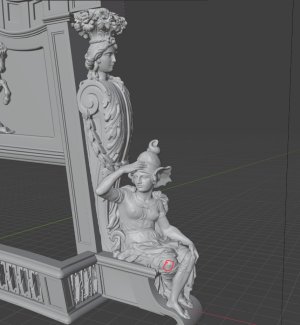
The best taste than that of the other vessel, is formed by two figures of women sitting with their legs extended along the very slightly arched bed of this crowning, and turned on their hips so as to present the entire upper body from the front. Their costume still indicates in them the symbol of the East and the West. Nobly draped one and the other, the figure of the West holds with her right hand a long scepter resting on her shoulder, landis that in front of her, at her feet, a horse with a bristly and floating mane, her head held high, her mouth open and her nostrils gaping, looks at her whining. On starboard, the symbol of the East carelessly holds in his hands, in front of her, a vase from which rises a plant apparently indicating that of perfumes.
At the feet of this figure and symmetrically with that of the opposite side, lies a tiger that a necklace passed around its neck seems to show as a tamed and submissive animal. This remarkable composition is, as we can see, only an ingenious flattery by which Puget celebrated in his own way the glory of the young monarch dominating both the East and the West, the East by the establishments created or
Encouraged, (1) the West by the power of its weapons, and
Accepting his domination with love. A huge royal crown placed between the two symbolic figures, in the middle of the area of the coronation, serves as a support for the unique. steen lantern. As in the other ship, the entire surface of the painting is still noticed by the profusion of details of the accessory ornamentation: L-limbrated, crossed cartridges, radiant sun faces, fleurde-lised medallions, strips of lambrequins between all the cutouts of which a lily flower is shown, and this.
The drawing of the Soleil-Royal still bears, as we can see, several great figures; it was there pomp, brilliance, magnificence, it flattered the vanity of the king who wanted to dazzle as much by sumptuousness as by victory, and Col-bert, whatever his conviction, was, was not a man to upset his master on this article: the great figures, a little modified in terms of greatness, were still tolerated despite the formal disapproval of sailors, despite their incessant claims. However, Puget, to make the disadvantage of too much weight disappear, had taken the side of emptying these masses of wood as much as possible, as seen by those of these figures that still remain. Ten years had thus passed in this kind of struggle since the great minister had engaged the great artist to reduce the proportions of these ornaments, when the Soleil-Royal received the decoration that I have just described. As this sculpture work was carried out in Brest and this port lacked ouVriers capable of rendering Puget's thoughts with dignity, the minister had to send some from Paris. On December 21, 1684, the Marquis de Seignelay, to whom Colbert, his father, had left the affairs of the navy, wrote to the intendant at the port of Brest, Mr. de Seuil:
"- I thought that the sculpture of the Soleil-Royal was very advanced. Since you lack skilled workers for the "big figures, I will send you from here to the plustost; but "we should avoid the defauts that are found in the or-" nements of the stern of the Royal-Louis, where we noticed "that these large and heavy figures can only em-" sweep a lot in his navigation. I admit that it is necessary that the ornaments respond to the greatness and magnificence of the king, who is in these superb bodies of buildings, but we must also be careful that they are inconvenient.