
• Win a Free Custom Engraved Brass Coin!!!
    As a way to introduce our brass coins to the community, we will raffle off a free coin during the month of August. Follow link ABOVE for instructions for entering.
  • PRE-ORDER SHIPS IN SCALE TODAY!

    The beloved Ships in Scale Magazine is back and charting a new course for 2026!
    Discover new skills, new techniques, and new inspirations in every issue.

    NOTE THAT OUR FIRST ISSUE WILL BE JAN/FEB 2026

Billings Bounty rigging query

Joined
Apr 5, 2024
Messages
2
Points
0
Hello everyone,

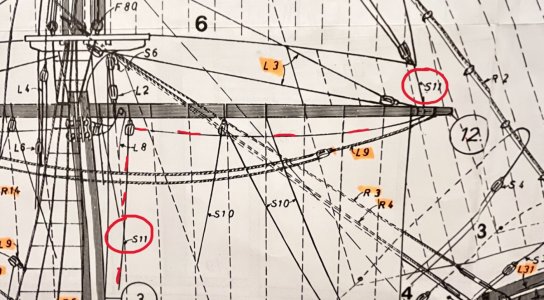
Wondered if anyone can advise how the line S11 (circled in red) might be connected to the yard immediately below it? We can see that the line then goes to a block near the mast, and then down to the deck. Would there be an aperture in the yard, that the line goes through? Struggling to find any photographs on full sized ships that might help.
Any comments / advice welcome.

Kind regards,
Andy
Bounty riggingV2.JPG
 
Wondered if anyone can advise how the line S11 (circled in red) might be connected to the yard immediately below it

Topsail sheets were never connected to the lower yards. From James Lees' The Masting and Rigging of English Ships or War, page 90-91 and page 93 ............Up until 1815 two blocks were strapped to the end of the lower yard. The topsail sheets ran through one of the blocks (then ran inboard as in your drawing.) From 1815 a sheave was faired onto the after side of the end of the yard through which the sheet passed. Were there exceptions?? As with most things in our hobby, there probably were and sheaves might have been used, even if not common practice, when Bounty sailed out of Spithead in 1787. In either case, the sheet is not attached in any way to the lower yard.
Allan
 
Last edited:
Topsail sheets were never connected to the lower yards. From James Lees' The Masting and Rigging of English Ships or War, page 90-91 and page 93 ............Up until 1815 two blocks were strapped to the end of the lower yard. The topsail sheets ran through one of the blocks (then ran inboard as in your drawing.) From 1815 a sheave was faired onto the after side of the end of the yard through which the sheet passed. Were there exceptions?? As with most things in our hobby, there probably were and sheaves might have been used, even if not common practice, when Bounty sailed out of Spithead in 1787. In either case, the sheet is not attached in any way to the lower yard.
Allan
Hi Allan,

Many thanks for the feedback

Andy
 
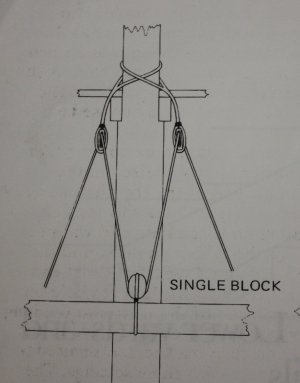
Glad to help. You may want to invest in a rigging book going forward. I just found another note that the use of sheaves for the sheets started to come into more use around 1806, then common practice about 1815 but still long after Bounty. One other thing, and it is hard to tell from the drawing, but just in case, from 1774 ships with 28 guns or smaller, like Bounty, the foreyard and main yard had jeer ties that consisted of two single upper blocks and one single block strapped to the yard, similar to the method used in the 17th century. The addition of slings started to come into use in the last quarter of the 18th century as well and were in addition to the jeer ties. I have no idea if Bounty had the slings as well as the jeer ties.
Drawing by James Lees of jeer ties.
1763407975278.jpeg
 
Back
Top