


• Win a Free Custom Engraved Brass Coin!!!
    As a way to introduce our brass coins to the community, we will raffle off a free coin during the month of August. Follow link ABOVE for instructions for entering.
  • SUBSCRIBE TO SHIPS IN SCALE TODAY!

    The beloved Ships in Scale Magazine is back and charting a new course for 2026!
    Discover new skills, new techniques, and new inspirations in every issue.

    NOTE THAT OUR NEXT ISSUE WILL BE MARCH/APRIL 2026

Billtoff, permission to come aboard,

Joined
Jan 28, 2026
Messages
2
Points
3
I am retired, and have decided to take another crack at ship modeling. Years ago I made a couple of plank on bulkhead kits,which more or less came out ok. Before the internet it was not easy to get information on how ships were built and how to model them. So I have chosen the Model Dockyards kit Hayling 1760. It’s a nice kit of a beautiful vessel. It’s pof, but how hard could it be? I’m going to name her “Hubris.”
Here’s my (first) problem: the kit come with an excellent snap-together jig to hold the ship as you build it, including slots for the frames. I have been using the diagram for each frame, but when I insert the frame into the slot it does not fill the allotted space—it does not completely fill the slot. I don’t know what I am doing wrong, and until I do there is no point in redoing them. Any thoughts?
I am excited to be modeling ships again, hoping to improve my skills and connecting with fellow modelers.
Billtoff
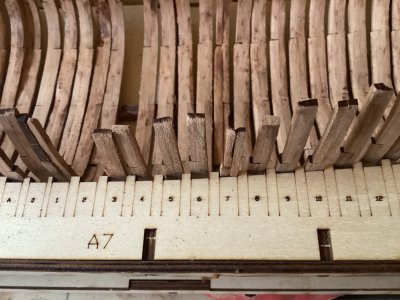

image.jpg
 
Welcome aboard from Connecticut. I have only done plank on bulkhead models, but I know there are many experienced modelers who can hopefully help with this problem.

Rob
 
Bill,

You should try glueing up your frame on a copy of the actual frame. Wait for the glue to dry before adding the next level. This glue-up must be very percise!

If you don't glue over the plans, micro errors in the joints will translate to the frame being millimeters off at the top of the jig guide.

Hope this makes sense.
 
First off, welcome to the forums !

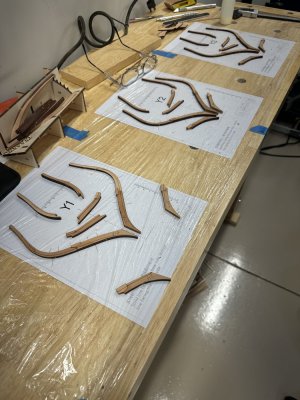
It's exactly as Brad said above. Your glue-up of the frame parts needs to be very accurate. You can put the paper frame plan (or make a copy if you prefer) and then lay some plastic wrap over it and tape it down. Then the glue will not stick to the plans.
 
Thanks to all for your kind welcome. Brad, thanks for the advice. I do get impatient and want it all done way too quickly. Cheers.
Bill
 
The frames that are too narrow may be salvagable by reshaping them, by soaking them in water, and using a jig pr pegboard you make from wood to widen them by pressing the frames carefully from the inside while retaining their proper symmetrical shape.

1) Make a tool: Create a wooden pattern piece shaped similar to inside edge profile of the frame as shown on the drawing, only a bit wider at the top ends of the frame. Or, create a peg board you can use to wedge the existing frame parts wider at the sides and top. The tool should be designed to hold the frame flat so it is not allowed to twist or warp out of the flat plane. This can be done with clamps or weights or other means.

2) Soak the mal-shaped frame in water until almost saturated. This will make the wood more pliable. Hopefully the glue joints will not come apart.

3) Insert the jig to widen the frame, or on a peg board, stretch the wet frame to widen the frame just a tiny bit wider than the width specified on the frame drawing. Try not to widen it too far such that the part breaks. The amount of over widening will have to be estimated until you do a few frame corrections, and experience will tell you how much more widening you need until the frame settles into the correct shape after drying. Over widening should not be much.

4) Now, after letting it sit overnight to dry, you may be able to get the frames to take a new, wider shape, such that they fit properly into the slots of the hull jig. Remove the frame and compare it's shape to the frame drawing. Applying heat with a hot air heat gun or applying a hot iron without scorching the wood may speed the the process or it may cause twisting and warping of the frame. The creation of stem in the wood can release internal stresses and help the frame remember it's new shape. Trial and error here. Natural drying overnight is safest.

5) Remove the frame from the jig and inspect it. If it is still not wide enough, a second attempt on the jig with it a bot more wider can be attempted. Compare it to the profile drawing. Look for twists and non-symmetry. Hopefully, the re-shaped frame will remain symmetrical, not be twisted, the shape matches the drawing, and thus you won't have to recut a new frame to replace it from scratch.

Sometimes know how to salvage a screwup is almost valuable than know how to make it correct in the first place, and sometimes more! Ask me how I know...
 
Last edited:
Back
Top