Follow along with the video below to see how to install our site as a web app on your home screen.
Note: This feature may not be available in some browsers.
Win a Free Custom Engraved Brass Coin!!!
As a way to introduce our brass coins to the community, we will raffle off a free coin during the month
of August. Follow link ABOVE for instructions for entering.
The beloved Ships in Scale Magazine is back and charting a new course for 2026!
Discover new skills, new techniques, and new inspirations in every issue.
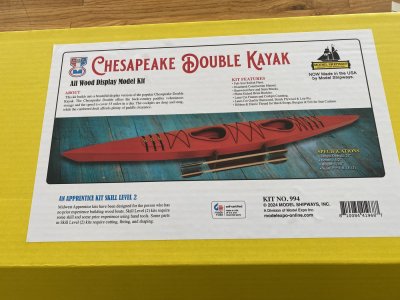
Before I delve into building the Black Swan, I thought I would do a small kit to unwind a bit. Model Expo has the Chesapeake Double Kayak on sale for $35 (one of their seemingly forever sales) so I thought I would get it. A large box arrived quickly and in another was the kit.
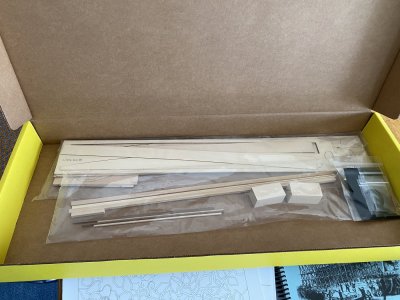
Inside it seemed to consist mostly of air . I guess this is one of their standard size boxes that they use and they decided it was easier to use this instead of investing in a smaller box.
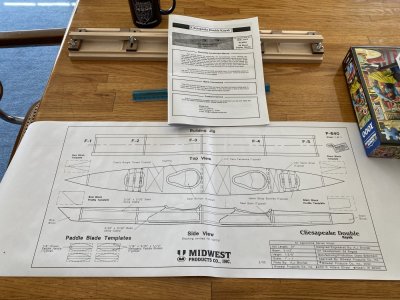
There was also a one sheet set of rolled plans with a building jig guide and a set of instructions.
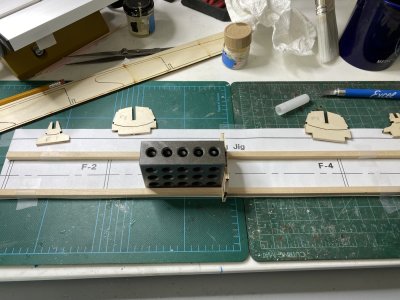
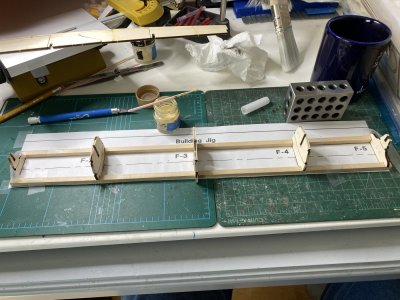
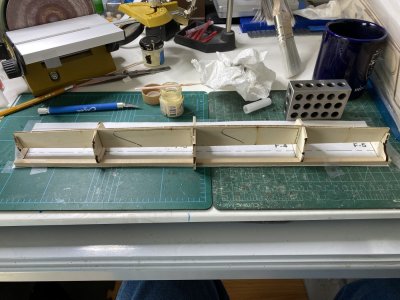
I have to say the instructions were well written (with a few typos) and very complete. This kit is obviously set out for a beginner. After flattening the rolled plans for a few days,I cut the building jig out of the plans and taped it onto my required green cutting mats. Two 1/4 x 1/4" wood strips were then taped on top of the plans. A set of 5 laser cut frames are provided. The frames are not labeled but there is a picture in the instruction showing which is which. Frames 2 and 4 are very similar so be careful when setting them up. After taking off the superficial char, I glued the frames along the wood strips. These were kept square and perpendicular using a machine block as the glue was setting.
Down the middle of the frames runs the "spine" of the kayak, also laser cut. After removing some char it fit easily into place. Due to the spacing of the frames it can only fit in one direction. Clever engineering! It was glued into place.
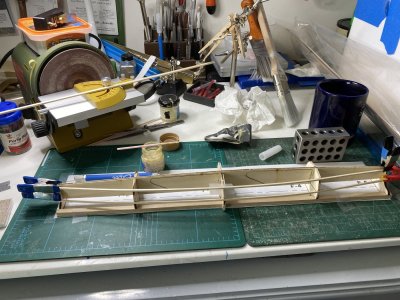
Smaller strips of wood were then fitted and glued into notches along the frame.
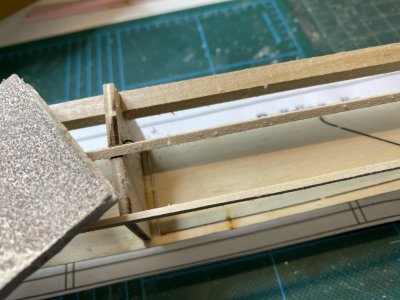
The smaller strips of wood have to be faired to curve along with the angle of the frame members. This took about 15 minutes of sanding with 100 grit sandpaper.
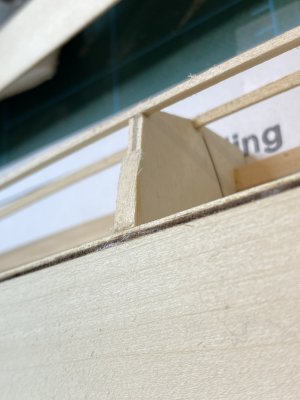
The spine at the position of the middle frame (F-3) was about a mm taller than the frame member. To help get rid of that gap I took some scrap 1/32" pieces and glued two of them on top of each other. They were about 1/2 the length of the frame to the first strip. I then faired those to blend them into the curve of the frame.
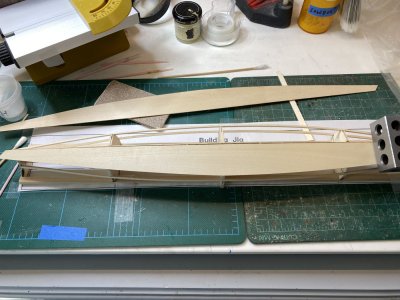
The bottom planks were then glued onto the frame. They are purposefully oversized. The frame in the front (F-1) has a rather sharp curve. It is possible to bend the wood to meet the strip, but I am not certain that this is what is needed. I will try to decide what to do when the side planks are attached.
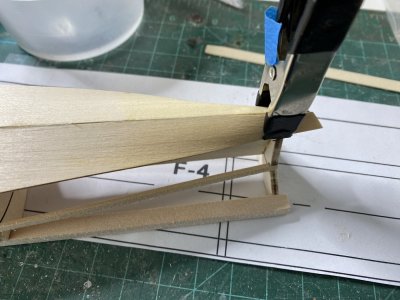
After rereading the instructions I decided to glue the ends of the bottom planks to the strips on the ends at a very acute angle. In order to make the wood more pliable (it is only 1/32" thick) I painted both ends with water and then clamped them into place. That allowed to wood to conform much easier to the sharp angle.
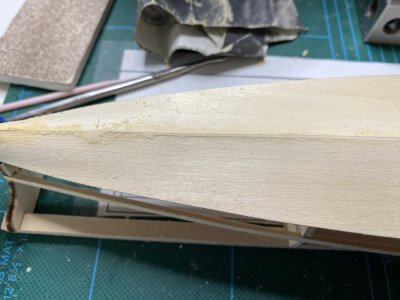
There was a small gap between the 2 bottom pieces. While I was waiting for the ends to dry I decided to fill the gap with Elmers wood filler. I like using it. It is inexpensive, fills the gap well and sands nicely. It is water soluble and reconstitutes easily if it dries out in the container.
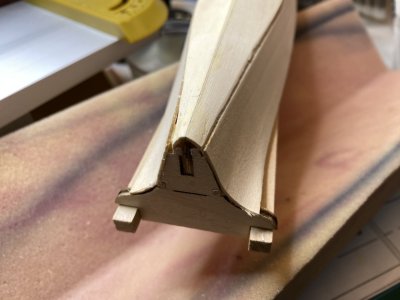
After everything dried, I flipped the kayak over and reenforced the glued surfaces with more glue to make sure it was evenly done. I then took my X-acto blade and trimmed the wood to conform to the wood strips and sanded the edges until they were flush.
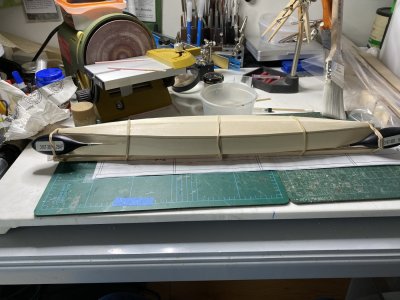
I then attached the side planks. They also had some steep curves at the ends. Once again I used water to soften them and clamped them in place using rubber bands. I used 2 small paint brush handles on the ends to help the wood conform to the curves.
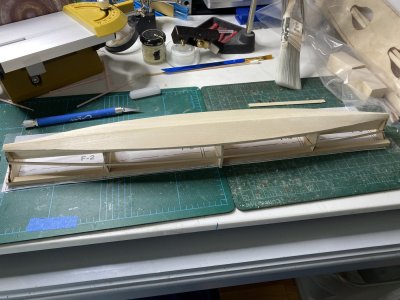
Once the two side planks of the kayak tired in place the overhanging ends of the planks were trimmed from the bow and stern frames.
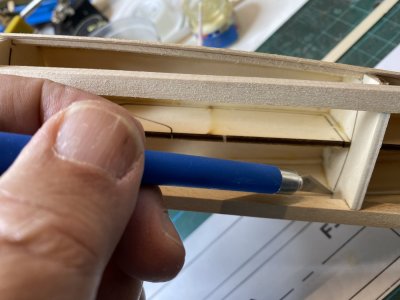
Now for the most difficult (so far) task in this model. the construction jig portion of the frame assembly is cut away from the rest of the frame. I was able to use a small razor saw for the bow and stern sections, but the interior frames hat to be slowly separated by using an X-acto blade. it was difficult due to the confined spaces.
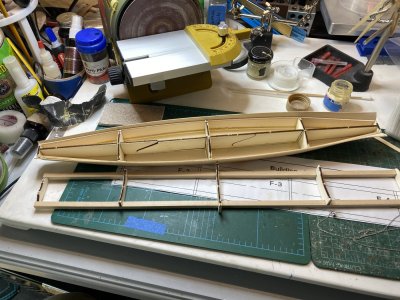
Finally though the bottom of the frame was separated from the rest of the kayak.
After it was a simple matter of running a sharp blade against the lower rail to separate the overhanging excess of the planks.





 . I guess this is one of their standard size boxes that they use and they decided it was easier to use this instead of investing in a smaller box.