
• Win a Free Custom Engraved Brass Coin!!!
    As a way to introduce our brass coins to the community, we will raffle off a free coin during the month of August. Follow link ABOVE for instructions for entering.
  • PRE-ORDER SHIPS IN SCALE TODAY!

    The beloved Ships in Scale Magazine is back and charting a new course for 2026!
    Discover new skills, new techniques, and new inspirations in every issue.

    NOTE THAT OUR FIRST ISSUE WILL BE JAN/FEB 2026

Build Log: HMS Endeavour 1768 1:60 by Artesania Latina

  • Thread starter Thread starter NoelB
  • Start date Start date
  • Watchers Watchers 2
Joined
Nov 19, 2025
Messages
6
Points
23

Location
Adelaide, South Australia
The kit had been in storage for years and this is my first timber ship modelling experience.
So it begins...

00 box.jpg

The supplied instruction booklet can be downloaded in pdf format from the Artesania Latina website homepage link to ‘Old instructions’.
The parts list details the reference number, description, quantity, size and material of each part.
The timbers are specified for each area so I sorted and grouped them by size and material to help ensure the right ones are used.

The kit included a useful full-scale schematic of the model’s longitudinal section and there are some other schematics that no doubt will be needed further down the track.
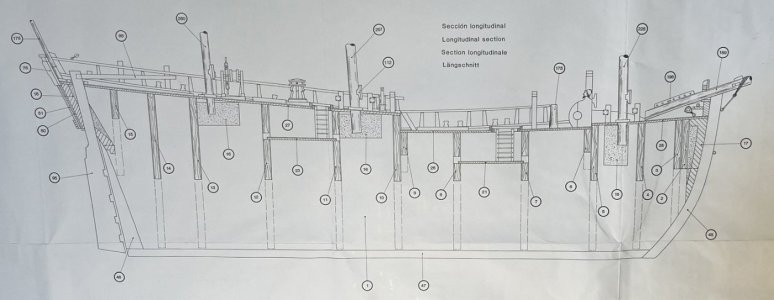
01 schematic.jpg

frames and hold decks
The laser cut frames fit well but, likely due to long time storage in less than ideal conditions, there was a noticeable curve in the false keel.
I kept this in mind when fitting the main decks to try to straighten things up a little.

Centre lines were marked on the hold deck pieces then the 0.6x5 Mukali strips were glued in pairs from the centre out.
The hold decks were glued into the slots but were easily dislodged so I added some reinforcing plywood pieces under them.
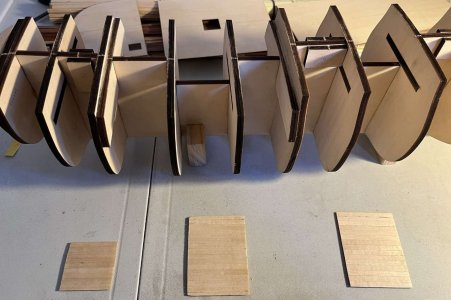
02 plank hold decks.jpg

main decks
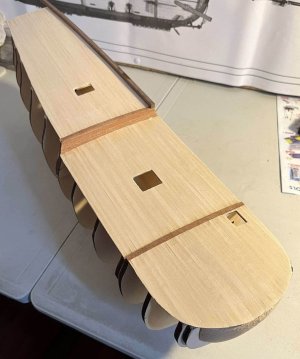
The main deck pieces were marked out with centre lines and frame locations then glued and nailed on.
03 deck marking.jpg

Started planking the main decks in pairs of 0.6x5 Mukali strips from the centre line outwards.
 
Hey, das passt ja perfekt! Ich habe mir gerade bei einer Auktion von Artesania eine Endeavour ersteigert. Gleiche Größe, sogar eine ältere Version ohne Laserschnitt.
Da ich aber gerade mit dem Rigging für eine Victory von Corel beginne und außerdem noch meine Küche renovieren muss, wird sie wohl erst einmal auf unbestimmte Zeit im Regal verschwinden.
Ich werde also deinen Aufbau verfolgen, um mich mental vorzubereiten.
Grüße nach Australien

Übersetzt mit DeepL.com (kostenlose Version)
 
Hey, congratulations on winning the Endeavour kit. Good timing!
Good luck with your Corel Victory rigging and your kitchen renovation.

I hope you will find some helpful comments in the build log.

Grüße nach Deutschland
 
Hallo Noel,
Als ich den Victory-Bausatz bekam, war auch ein teilweise zusammengebauter Endeavour-Rumpf enthalten. Dieser sieht allerdings etwas schlecht verarbeitet aus, daher werde ich ihn nur zum Biegen der Formteile verwenden.
Ich habe bereits andere Bauberichte gelesen und dabei ein Problem festgestellt, das Sie leider auch haben. Ich dachte eigentlich, dass dies in den neueren Bausätzen behoben worden wäre.
Die Aufnahmen für die Masten sind weder im falschen Kiel noch im Deck vorgesehen, was sich von den Schiffen unterscheidet, die ich bisher gebaut habe.
Artesania plant dies tatsächlich erst viel später, was zu erheblichen Problemen führen kann.
Da dies Ihr erstes Holzbauprojekt ist, würde ich Ihnen empfehlen, dies jetzt zu tun, bevor Sie sich später ärgern.

Viele Grüße, Ralf

Übersetzt mit DeepL.com (kostenlose Version)
 
deck planking
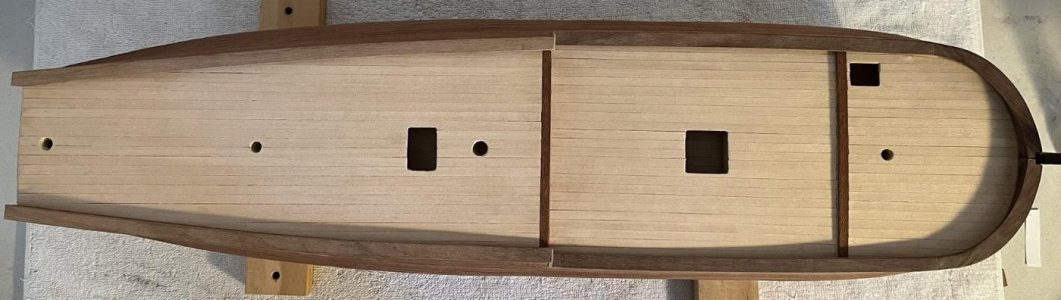
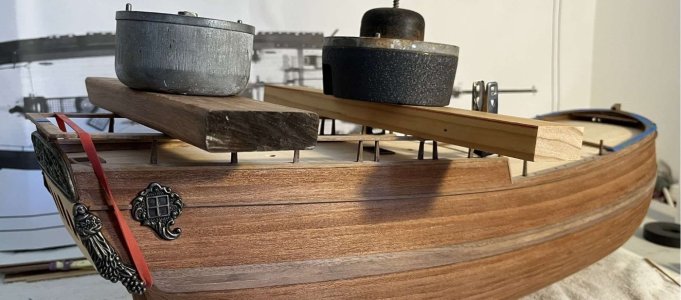
The deck planking went reasonably well though some tended to curl up on the edges. Weights and clamps were used where possible.

04 decks planked.jpg

aft counter
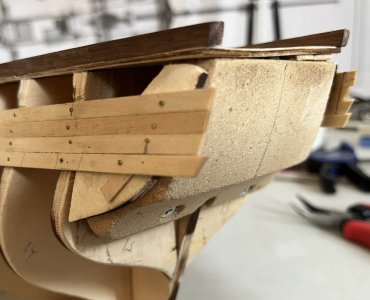
I realised the aft counter was placed too low to meet the underside of the deck, it was cut off and re-glued then screws were added to hold it in place.
The deck still wasn’t quite level so a shim was added for support.

Some information about fairing the frames suggested to mark the outer large edge of each frame with a felt-tip pen to make sure not to file that edge.
The other edge was to be filed to follow the curve to the next frame so that a plank would naturally bend from frame to frame.
This worked out ok until it got to the aft counter which was around 10mm narrower than the deck, it looked as though the planks would have to bend too much to reach it.

I pondered this for some time and ended up adding shims each side of the aft counter.
The transom support piece is wider than the modified counter so it will become covered up.

05 aft spacing.jpg

mast supports
The instructions show the mast support holes being drilled after all hull planking has been completed however, as Ralf recommended, it is easier to drill them at this earlier stage.

The masts are slightly raked back at the angles shown on the detail schematics as Mizzen mast 87.5°, Main mast 88° and Fore mast 89°. At first glance they appear to show angles relative to the decks but it was confirmed on the longitudinal schematic that they actually show relative to horizontal.

06 mast angles.jpg

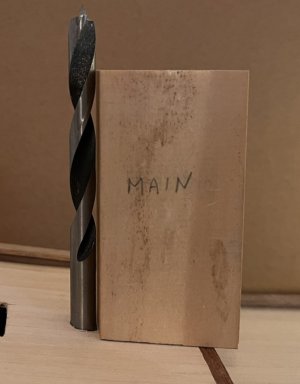
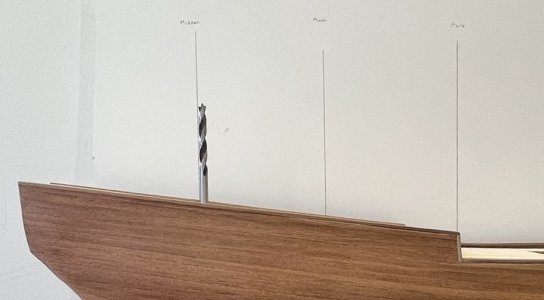
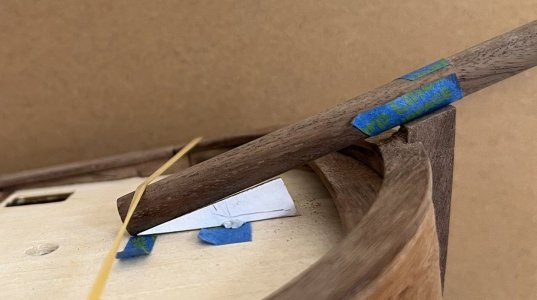
The angle relative to the deck for each mast was measured from the longitudinal schematic as Mizzen mast 82°, Main mast 84° and Fore mast 89°. Template blocks were cut at these angles and used to align the drill.

07 mast main drill.jpg

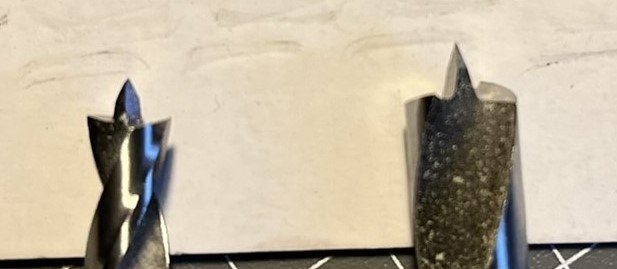
Brad point drill bits were used to make clean and precise holes. Drilling was first started anti-clockwise by hand to score the plank veneers and prevent tearing.

08 brad point drill bits.jpg

hull planking
The planking timber is 1.5x5 Samba, pale yellow colour and quite soft.
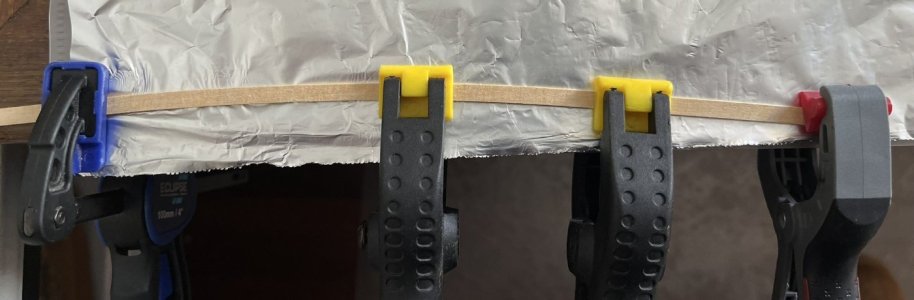
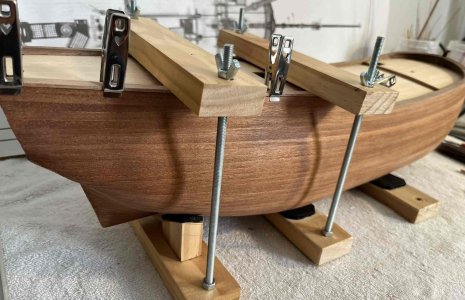
Each plank was curved to fit the frames while dampened with water and clamped, with some heat applied from a heat gun.
For lateral curves it was clamped flat and the aluminium foil was put there to protect the top of the bench from water and heat.

09 bend plank lateral.jpg

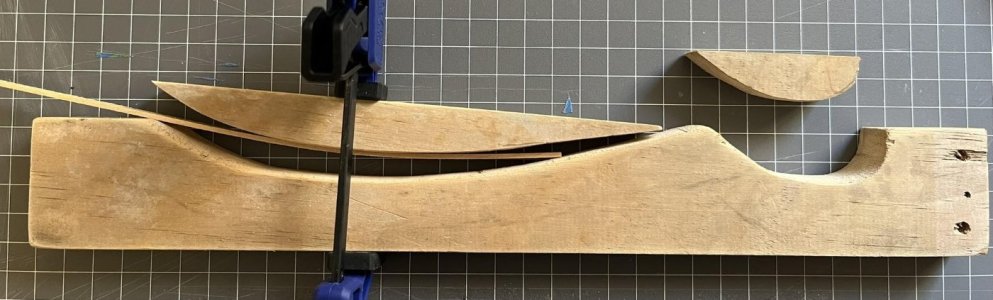
For lengthwise curves a jig made from scrap timber was used.
The Samba timber could be bent quite easily though it often took a few times to get enough curvature.

10 bend plank length.jpg

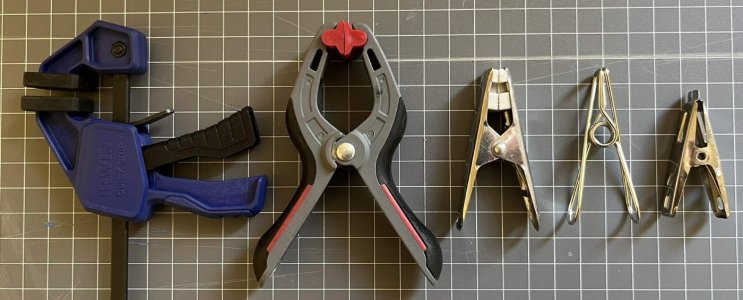
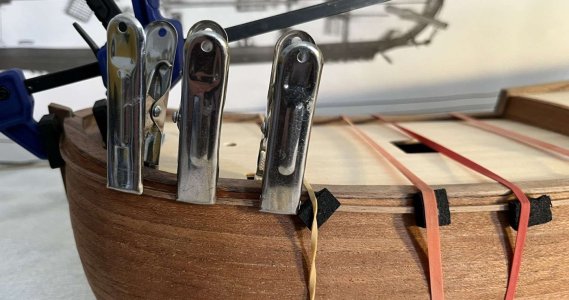
Several different kinds of clamps and pegs were used to hold the planks in position. They were held clamped against previous planks and also against the frames.

11 clamp pegs.jpg

To prevent splitting the plank timber, nail holes were pre-drilled using one of the brass pins held in a hand drill.
The first few planks were glued and fully nailed then later I came across a build log that showed them only partly nailed to hold them in place.
These nails were removed once the glue had cured.

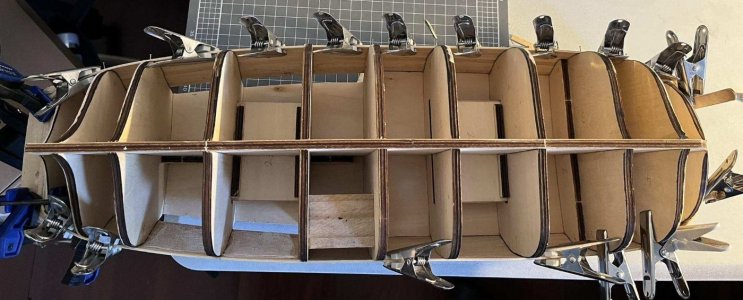
Planks were added in pairs alternating sides each time to prevent warping. Some medical gauze was glued on the inside of the planks for extra strength.
The wood block in the middle was put there to help straighten the false keel.

12 hull plank underside.jpg
 
hull planking
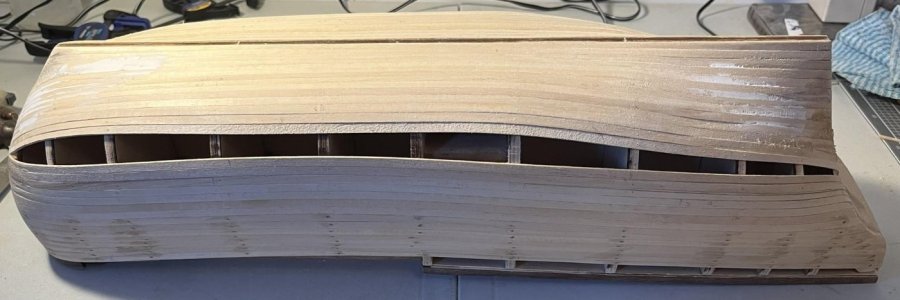
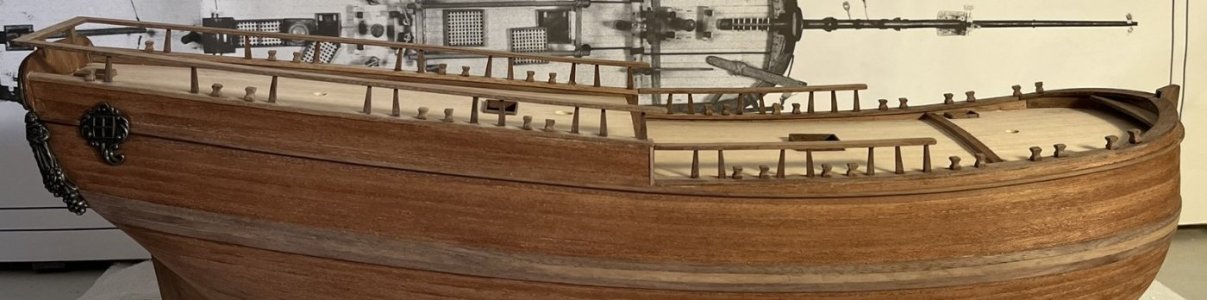
The plank bends became more difficult as the hull curves became more complex.
It would have been better to put more stealers at the aft and start tapering the planks earlier.

12 planking.jpg

plank tapering
For tapering, the gap between planks was measured around each frame using a strip of paper.
The planks are 5mm wide so the largest gap was divided by 5 to give the number of full width planks required.
The other gap measurements were divided by this number to give the ideal width of the plank at that frame.

An example from my notes:
The frames were numbered from 1 to 9 starting at the bow end.
Measured gap widths(mm) at each frame were:
Bow 1:108, 2:116, 3:117, 4:119, 5:122, 6:125, 7:122, 8:114, 9:110 Aft
Frame 6 has the largest gap (125mm) and so requires 25 full width (5mm) planks.

The gap widths were each divided by 25 to give the ideal plank width (mm) at each frame.
Bow 1:4.3, 2:4.6, 3:4.7, 4:4.8, 5:4.9, 6:5.0, 7:4.8, 8:4.6, 9:4.4 Aft

It didn’t seem necessary to try to shape each plank exactly so for this example the next few planks were tapered from 4mm at the bow end to full width at around frame 5, then from 4mm at the aft end to full width at around frame 7.

The frame gaps were measured again about every five planks.

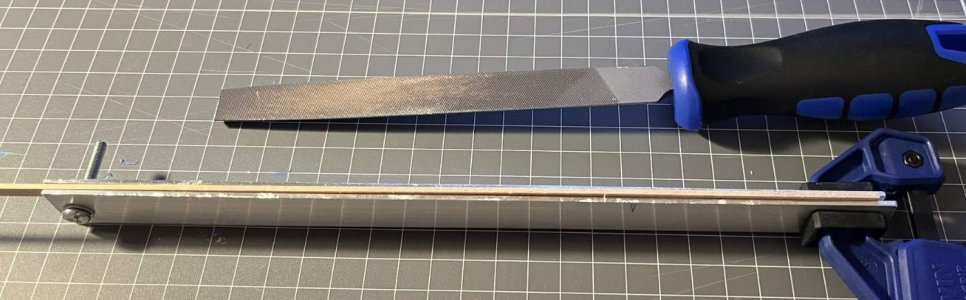
The Samba timber tended to split when cut lengthwise with a scalpel so this jig was used to make it easier to file the planks to shape.
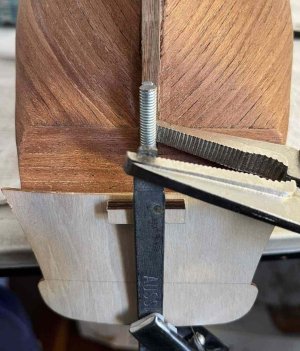
It is made up of three lengths of 20x1.6mm aluminium flat bar. The outer bars are aligned with the pivot bolt while the centre bar is set 5mm lower on the pivot.
The centre bar is swivelled up by the amount to be tapered and held clamped on the plank while the excess is filed off.

13 plank taper jig.jpg

sanding
The fine wood dust from sanding the hull was collected to be mixed with glue and used as filler for the large gaps.
Plasterboard filler mixed with glue and water was used for the small gaps and rough areas to give a smoother surface.
For those planks that were fully nailed, the nail heads were punched below the plank surface and filled.

14 filler.jpg

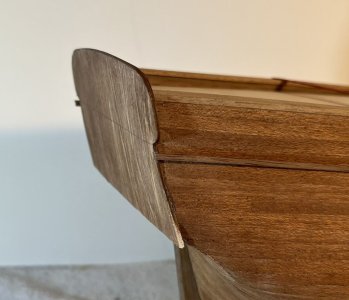
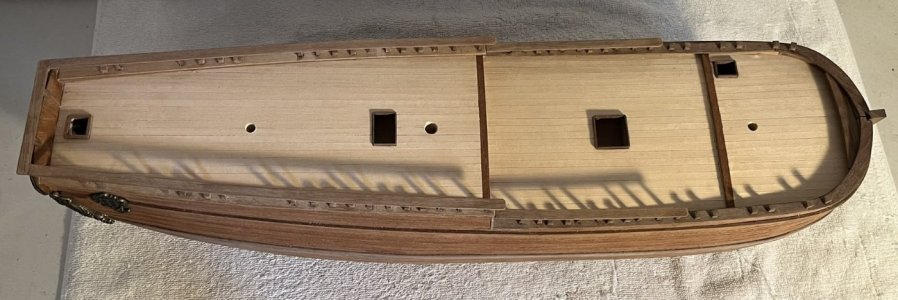
stem notch
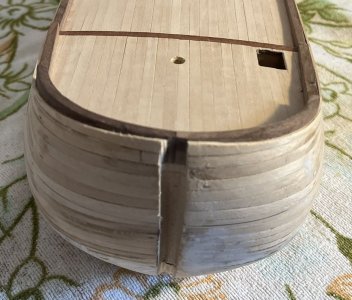
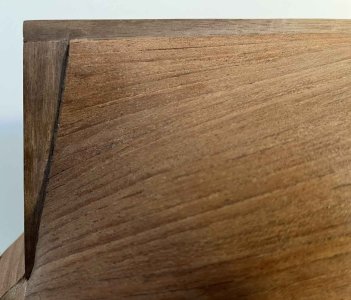
I made a bit of a mess when filing the groove for the stem, trying to get the curved stem piece to sit properly.
The stem will be glued in next, and gaps patched up, so it can be used as a guide for the ends of the second planking strips.

15 stem notch.jpg

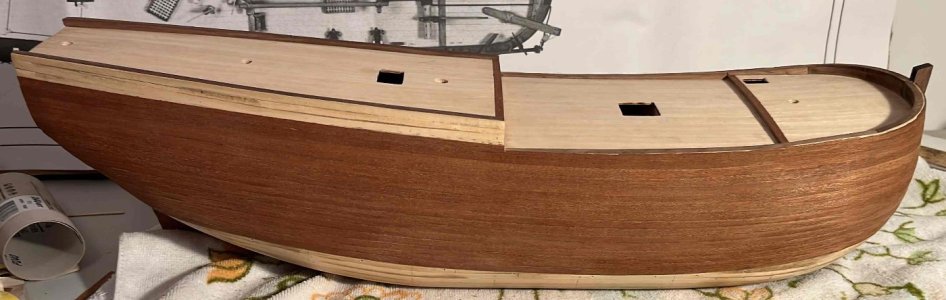
A bit more patching and sanding required, then on to second planking.
 
Hello Noel,
It almost looks to me as if you started tapering at the wrong point.
I bought the kit because I already had a partially completed hull from Victory.
After reading your post, I took a closer look at it. I would taper towards the bow starting from the third frame. So far, I haven't tapered any of my ships at the stern, but rather worked with stealers, but it's up to each individual to decide what they prefer.
To be honest, I personally don't think much of measuring everything meticulously beforehand. I lay the full planks until I notice that they are standing up and then start tapering by eye and feel, which has worked so far.

I've also noticed that the middle frames 6-8 are obviously narrower than they should be. Either the builder of my hull mixed them up or AL lasered them incorrectly.
I can't imagine that this ship has a waist, but I could be wrong.

Good luck with the second coat and greetings from the snowy Palatinate.

Translated with DeepL.com (free version)
 
After reading your post, I took a closer look at it. I would taper towards the bow starting from the third frame.
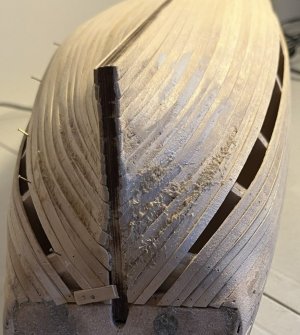
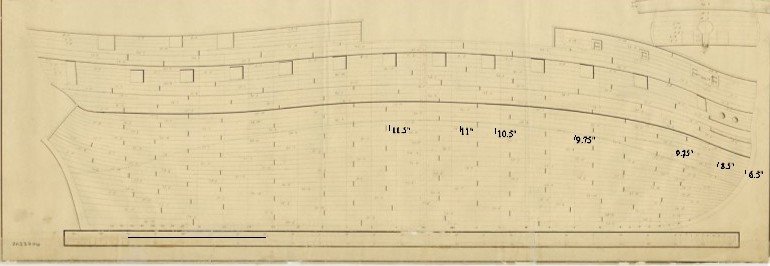
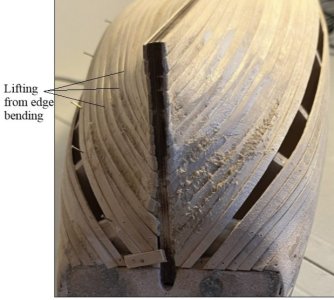
There is indeed a lot of tapering, but the taper begins at the edge of the dead flat near midships, not up near the bow. It is very easy to determine the taper if tick strips are used to mark out the hull at each bulkhead/frame. If you study some planking expansion drawings they will show the shapes of each plank. The below is of the HMS Squirrel (24) 1785. There are a lot of posts here at SoS on marking out the planking using tick strips as well as descriptions in various articles and videos on line. Some kit makers are still providing the old fashioned straight strips for planking instead of spiled planks but they can be shaped with water and heat to avoid the lifting seen on the planks as in the photo below. Properly shaped planks allow a firm seating of the plank to the bulkhead, all planks end at the rabbets fore and aft as they should and avoids a lot of sanding.
Allan

The dimensions are close but may not be exact as the drawing was in low resolution so not as precise as it could be. Still, the tapering is evident.

1767526193617.jpeg

1767526840939.jpeg
 
Back
Top