

• Win a Free Custom Engraved Brass Coin!!!
    As a way to introduce our brass coins to the community, we will raffle off a free coin during the month of August. Follow link ABOVE for instructions for entering.
  • PRE-ORDER SHIPS IN SCALE TODAY!

    The beloved Ships in Scale Magazine is back and charting a new course for 2026!
    Discover new skills, new techniques, and new inspirations in every issue.

    NOTE THAT OUR FIRST ISSUE WILL BE JAN/FEB 2026

Chainplate questions

Joined
Apr 8, 2023
Messages
295
Points
158

Location
Puerto Vallarta, Mexico
There seems to be two “major” styles of chainplates: those with the iron/metal straps attached directly to the hull (with the lower deadeye connected to the top of the strap), and those using a board or channel (at least that is what I think it is called) that has the lower deadeye attached to a rope or chain that attaches to the hull.

Questions:
  • Are there names for these different types of chainplates?
  • Is channel the correct term?
  • I believe that the iron/metal straps are installed at a slight angle so that the shroud from its connection at the hound (again I hope that is the correct term) through the set of deadeyes to the bottom of the chainplate is a fairly straight line. This means the shrouds closest to the mast are nearly straight up and down while those further away are at a bit more of an angle. Is this correct?
  • And if that is correct, should the rope/chains (from the lower deadeye at the channels) be at slight angles like the iron straps are or are they straight up and down?
 
There seems to be two “major” styles of chainplates: those with the iron/metal straps attached directly to the hull (with the lower deadeye connected to the top of the strap), and those using a board or channel (at least that is what I think it is called) that has the lower deadeye attached to a rope or chain that attaches to the hull.

Questions:
  • Are there names for these different types of chainplates?
  • Is channel the correct term?
  • I believe that the iron/metal straps are installed at a slight angle so that the shroud from its connection at the hound (again I hope that is the correct term) through the set of deadeyes to the bottom of the chainplate is a fairly straight line. This means the shrouds closest to the mast are nearly straight up and down while those further away are at a bit more of an angle. Is this correct?
  • And if that is correct, should the rope/chains (from the lower deadeye at the channels) be at slight angles like the iron straps are or are they straight up and down?

There are indeed two common approaches to securing the deadeyes for the shrouds, and you’ve got the idea exactly right.

1. Names of the two types
• Chainplates (or chain-plates):
The traditional iron or steel straps are bolted directly to the hull. The lower deadeye is attached to the upper end of the strap.
• Channels:
The horizontal timbers (sometimes called chain-wale or chain-wales) projecting from the ship’s side. Deadeyes are secured on top of the channel by short iron chain links or lanyards that then run down to bolts in the hull.
So yes — channel is the correct term.

2. Orientation of chainplates
Your understanding is correct:
The metal straps are set on the hull so that each shroud runs in a straight line from the mast’s hounds → through the deadeyes → to the chainplate. This is why each plate is raked slightly differently depending on its position — the forward shrouds are nearly vertical, while the aft ones sit at a more obvious angle.

3. And what about the deadeyes on channels
The same principle applies. Even though they’re mounted on a channel instead of directly on the hull, the deadeye strops and chain links angle inward slightly so that the line of pull from the shroud is straight.
They are not perfectly vertical. Modelers often miss this detail — but on most real ships, each deadeye on a channel is set so that the lanyard aligns naturally with the shroud above it.
 
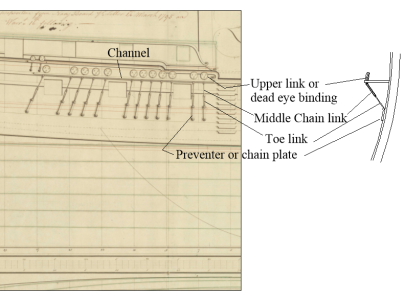
Further to Jim's explanation, at least for ships with channels.

1763120654184.png
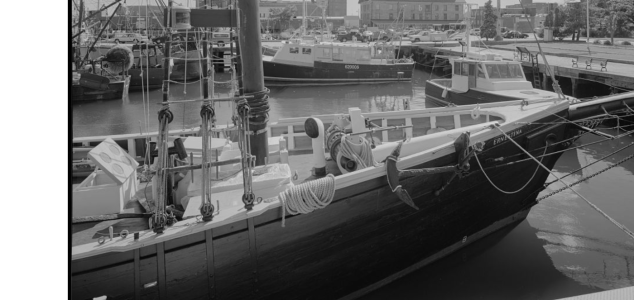
The below is a common style with the link on the deadeye and a flat strap seen on smaller vessels such as the fishing schooner in the photo.
1763120751476.png
 
Thanks Allan.

Were there any pros or cons on the 2 different styles? Or smaller ships normally used the straps while larger ships used channels?

I can see how using channels would give the shrouds (and thus the masts) a wider base, which I assume would give the masts enhanced stability.
 
You pose a great question. I have no idea if channels were related to the size of the ship. I did find the following AI response on a quick search.....

Key points regarding the use of channels:
  • Larger Ships: For substantial vessels, especially naval ships like frigates and ships of the line, channels were a standard and essential feature of the rigging design. The immense strain of tall masts and large sail plans on these ships required the additional support and spread that only channels could provide. The HMS Victory, a first-rate ship of the line launched in 1765, is a prime example of a large 18th-century vessel that utilized channels.
  • Smaller Vessels: Smaller, less complex vessels might have had simpler rigging, and while the principle of spreading the shrouds for support was still important, the specific structure might vary. Some very small working boats or certain regional designs may have run the shrouds directly to the hull or used simpler methods, but generally, any vessel with a significant mast and rigging to manage the forces of the wind would benefit from some form of channel or similar projection.
  • Technological Standardization: The 18th century was a period of significant standardization and refinement in naval architecture and rigging practices, particularly within major navies like the Royal Navy. Channels were an established part of these standard designs across different sizes of substantial sea-going ships.
In essence, the need for channels was a function of the physics of sailing and mast support. The taller the mast and the larger the sail area, the greater the forces involved, making channels essential for structural integrity across the fleet of the day's major sailing ships.


Back
Top