

• Win a Free Custom Engraved Brass Coin!!!
    As a way to introduce our brass coins to the community, we will raffle off a free coin during the month of August. Follow link ABOVE for instructions for entering.
  • PRE-ORDER SHIPS IN SCALE TODAY!

    The beloved Ships in Scale Magazine is back and charting a new course for 2026!
    Discover new skills, new techniques, and new inspirations in every issue.

    NOTE THAT OUR FIRST ISSUE WILL BE JAN/FEB 2026

Dutch frigate »Wageningen« 1723 — a couple of decades ahead of Chapman…

Joined
Apr 26, 2023
Messages
696
Points
403

Location
European Union
.​

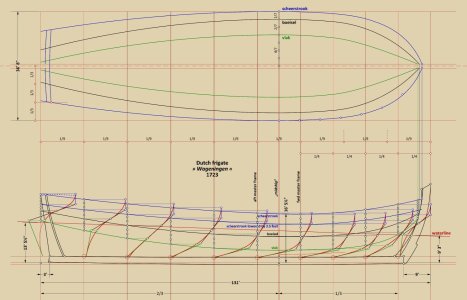
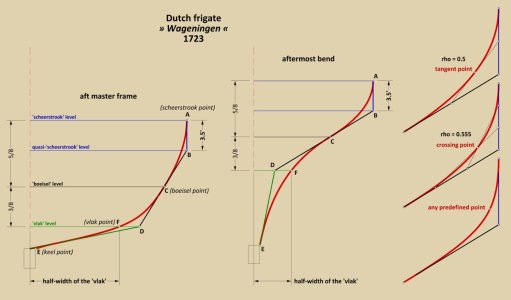
This presentation is closely related to two others, namely the postponed presentation on the design of a Dutch frigate from around 1700 by Hendrik Bindem (https://shipsofscale.com/sosforums/threads/dutch-frigate-ca-1700-by-hendrick-bindem-—-the-magic-of-the-northern-tradition.18139/) and the presentation on the method of designing American frigates by Joshua Humphreys from a century later (https://shipsofscale.com/sosforums/threads/us-frigate-“terrible”-—-design-proposal-by-joshua-humphreys-ca-1796.18163/), as it concerns the same variant of the design method in the general North Continental tradition, characterised by the use of two parabolic curves to define the contours of the frames (on each side). It may be added that in this particular respect, the design of the frigate Wageningen is a couple of decades ahead of the designs by the famous ship designer Fredrik Hendrik af Chapman.

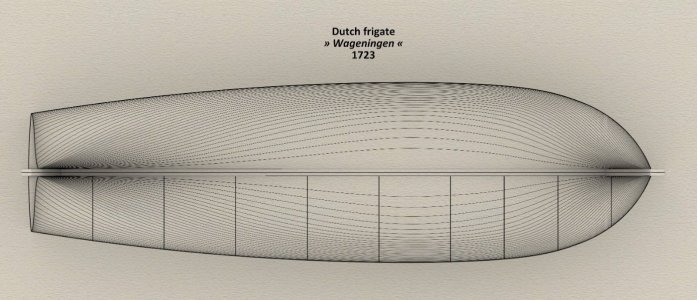
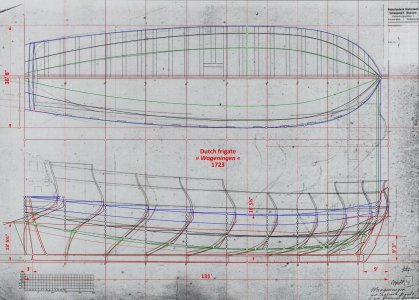
The plan of the frigate itself is kept in Dutch archives and has so far been considered, rather unjustifiably, to be the oldest surviving Dutch technical drawing of a ship, although it was assumed that in this case it was not a design in the strict sense of the word, but that the lines in the drawing had rather been copied from an existing ship or previously made three-dimensional model. However, nothing could be further from the truth — as already mentioned, the design actually demonstrates an advanced, in engineering terms, yet relatively easy to apply variant of design in the Northern European tradition.


Dimensions of the frigate Wageningen in Amsterdam feet (according to Dutch Navy Vessels 1700–1799 by Ron van Maanen, unpublished, via threedecks.org):

Length between posts: 131' 0"
Breadth: 36' 8"
Depth (distance between lower edge of unbent keel and line of max. breadth): 16' 5 ½"
Draught Forward: 9' 3"
Draught Aft: 13' 5 ½"

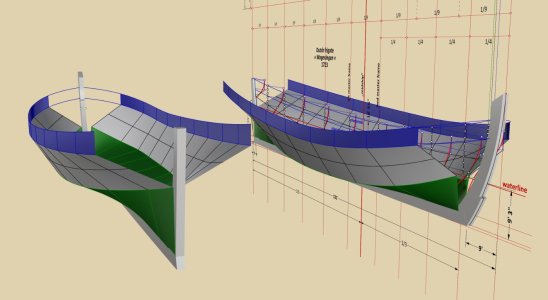
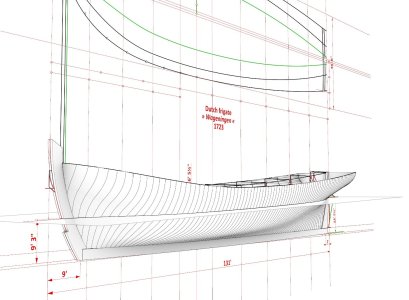
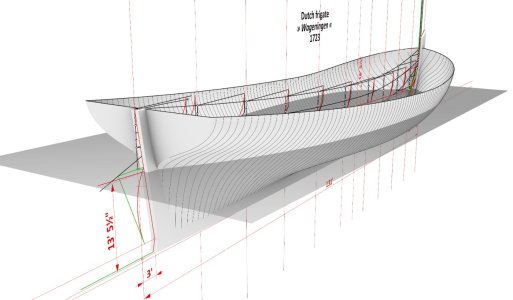
The above dimensions match the ship's plan perfectly. In addition, for greater certainty, I did a practical test on the fairness of the lines by constructing a digital 3D model of the underwater part of the hull using this method (note: as suggested by the faintly visible waterlines drawn on the plan, the ship may have actually had a round tuck stern, but for the purposes of the test, it was not essential to reproduce this particular feature).
ViewCapture20251224_170352.jpg

ViewCapture20251224_173153.jpg

ViewCapture20251224_174808.jpg

ViewCapture20251224_173821.jpg
.​
 
.​
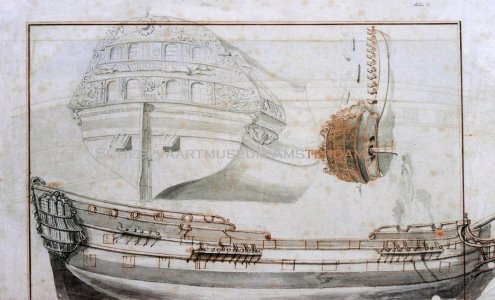
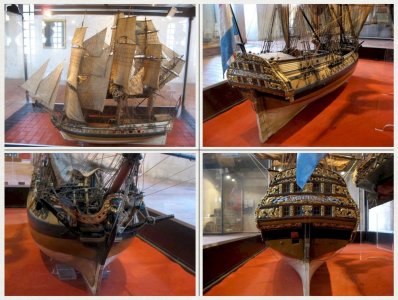
After the thread had already been started, @Jules van Beek drew my attention in private correspondence to the existence of artistic images of the frigate designed by Gerbrand Slegt (thanks, Jules). They are reproduced below (Dutch archives). These graphics confirm that Wageningen had a square tuck stern from the start, and only later could the conversion of the ship to a round tuck stern have been considered. In addition, a contemporary model of the ship has most likely also been preserved (also shown below).

The Wageningen was praised as exceptionally successful frigate in terms of sea-going properties by the experienced and influential naval officer Schrijver, who at the same time sharply condemned the lack of skill of other Dutch shipwrights at that time. However, it is worth noting that the satisfactory or unsatisfactory sea-going properties did not necessarily depend on the use of one specific design method or another, but were rather mostly a result of the skillful or unskillful shaping of the hull, i.e. specific, suitable or unsuitable design parameters (such as the height and width of the flat/deadrise and sharpness of the entry and run). The thing is, there are many indications that this particular design method, i.e. using a double parabola to form the contours of the frames, was almost certainly in use already many decades before the construction of the Wageningen, at least as early as the time of Witsen and Storck.

In the context of Schrijver's assessment, Chapman's own comment, who designed ships using this very method, is also particularly telling, in which he expressed his disappointment with the sea-going properties of the ships he designed. However, it seems that the real reason for the unsatisfactory sea-going qualities of Chapman's ships (in his own opinion) was not the design method itself, but the very unfavourable general design assumptions adopted by this designer. To put it figuratively, Chapman, for operational reasons, attempted to apply the features proper for coastal ships, particularly shallow draught, to seagoing ships, which could not yield good results even despite applying the most mathematically advanced design methods available at the time.


Contemporary drawing of Wageningen (top left):

Wageningen 1723.jpg


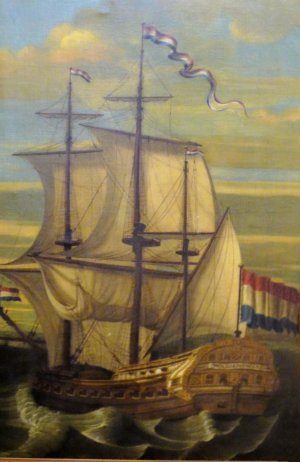
Contemporary painting of Wageningen:

Wageningen 1723 - painting.jpg


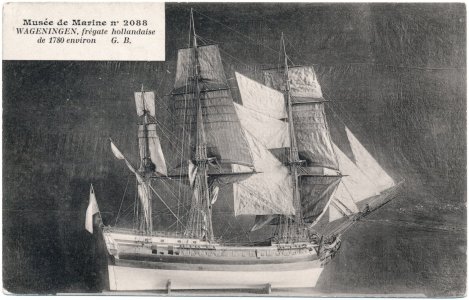
Supposed contemporary model of Wageningen:

Wageningen 1723 - model.jpg

.​
 
Last edited:
.​

The photographs of the model of the frigate Wageningen 1723, taken by Markus Leber and pointed out by @estherm, complement this thread so well that at least their lower-resolution reproductions should find their place here. For higher resolution, one should follow the links provided above.


Wageningen 1723 - model - colour.jpg

.​
 
Back
Top