
• Win a Free Custom Engraved Brass Coin!!!
    As a way to introduce our brass coins to the community, we will raffle off a free coin during the month of August. Follow link ABOVE for instructions for entering.
  • SUBSCRIBE TO SHIPS IN SCALE TODAY!

    The beloved Ships in Scale Magazine is back and charting a new course for 2026!
    Discover new skills, new techniques, and new inspirations in every issue.

    NOTE THAT OUR NEXT ISSUE WILL BE MARCH/APRIL 2026

Edge-setting deck planking

Joined
Nov 22, 2025
Messages
6
Points
8

I've been reading the discussion of edge-setting hull planking, including the excellent Bristol Shipyard videos. It's apparent that some edge-setting is acceptable, as opposed to spiled planks from wider stock and associated waste.

I'm particularly interested in deck planking for my Endeavour model, following KH Marquardt's drawing of the lower deck at the stern, shown here. It would seem that all this curvature would be edge-set rather than spiled. (With the obvious exception of the edge waterways.) Do you agree?
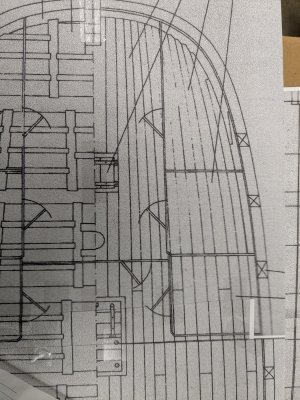

PXL_20260120_030204752_Original.jpeg
 
Agreed that the slight edge bending could work depending on the wood. If it is not going easily you can soak the plank then bend it to shape then heat it or let it dry so it shrinks back to its original size before gluing it in place. This was the first drawing I have seen showing both nibbed and hooked construction. I thought nibbed decking came about in the 19th century in place of hooked decking so I wonder if this was something unique to Endeavour where both were used on the same deck.
Allan
 
Thanks for your reply Allan. The consensus seems to be not to take Marquardt's drawing as Gospel. It was probably neither nibbed nor curved. After all, Earl of Pembroke was built as a humble collier before it was reworked into Endeavour. Cost and functionality would precede aesthetics, especially on a lower deck. I'll be doing straight tapered planks with stealers.
 
I'll be doing straight tapered planks with stealers.
Just be sure to avoid the ends of any planks ending with a sharp point same as would be avoided on the hull planking.
Looking forward to seeing your results.
Allan
 
No problem bending proper deck planking because it's laid with the grain running vertically and the deck is virtually flat so there's no twist (although decks are usually cambered a bit to promote drainage through the scuppers.) In a model, if possible, it's easiest to use vertically sawn stock laid with the grain vertically. While heat bending across the grain can be done with narrow planking stock in some species, it's really torturing the wood and the modeler doing it at the same time. What's worse are the kit manufacturers that privide strip wood gotten out of peeled veneer, which is about the worst way to get out plank of any kind, but what else is new?
 
Thanks Bob. I've recently realized the importance of grain direction in resawing planking. For one, vertical grain just looks better, and you're right that it edge sets easier. For this lower deck at least, I'm going to avoid edge setting as much as possible. I use cherry for my planking.
 
How wide would the deck planks be on the actual ship? Lots of modern yachts have bent deck planking but the planks are quite narrow 2”, maybe 3.” Bending a 6” wide x 2” thick plank is a different matter. Bending something where the axis of the bend is perpendicular to the width of the material being bent is called in the trade “bending the hard way” for good reason. The wider dimensioned material will try to twist. Also trying to bend something 6” wide without power equipment requires a massive snout of force. If the deck planking was curved it was probably spiled.

Roger
 
Back
Top