

- Joined
- Dec 16, 2024
- Messages
- 17
- Points
- 28

Hi! Manually moved this to the right area (I hope). My first build log, albeit for tools, not ships.
In my naïveté, I didn't realize my Polaris kit was shipping from Europe and wouldn't be here for a couple of weeks. The agony of waiting! Impulsively, I decided to go ahead and order the Shipwright series too and see which gets here first. I don't think either will be here before Christmas.
In the meantime, I was itching to do anything to work with wood so I set about making some gadgets based on all the cool stuff I've seen. Please remember that I'm not experienced at this at all and my only power tools are a a jig saw and a drill. This is very amateur stuff compared to what I've seen people here create, but I have to start somewhere!
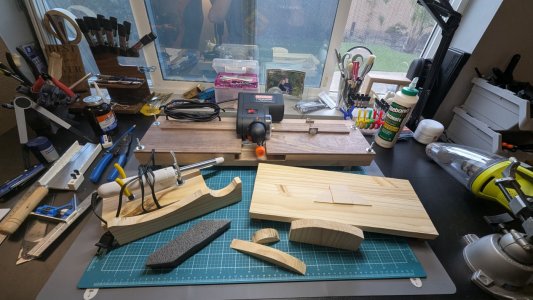
So in addition to acquiring way too many tools for someone who hasn't even started a model yet, I warmed up by making a bunch of basic stuff like a holder for my $15 curling iron bending tool, a bending block I stenciled by eyeball, and a few different shapes of sanding blocks. I'm getting ready to make some sanding sticks too. I also made an edge bending station based on Chuck Passaro's video.
But what I'm really proud of is my chop saw table:
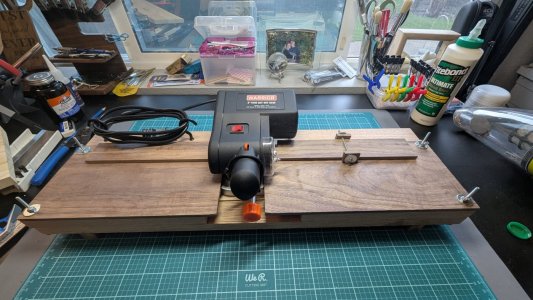
Man, do I go overboard (haha) on research when starting a hobby! I was doing a bunch of reasearch on how to make a lot of repetitive cuts, like for decking. I thought about getting a plank cutter but that seems so limited in use and the best one is $150 US. I saw a few DIY versions but they all seemed hard to make (metal, 3D printed, etc.) and still limited. I was mostly not liking the beveled edges the blades create. Anyway, I ran across a post from 2019 of someone who had taken an inexpensive 2" chop saw from Harbor Freight and made his own cutting table for it. I decided to try and make something similar without trying to copy it exactly. I had looked pretty closely at the photos to get a general idea of how it worked. I just took my time and did a lot of dry fitting and testing along the way. And Harbor Freight still sells the saw for only $38 US!
Again, while I'm a somewhat compuslive tinkerer, my experience with wood projects is really limited, so I'm sure there are better ways to do this, but this is what I did. I would appreciate any advice!
I used red oak for the base as that was the staightest small board I could find at the hardware store. I know oak is a really hard wood and I wanted to be sure it wouldn't flex. I remembered the homemade cutting table I'd seen on the forums used some sort of darker wood for the cutting deck and I liked that, so I decided to use walnut for the top. It seemed like it would be hard enough to last and felt like it would be easy to work with. I wanted mahogany but what they had at the store was very warped. Oh, I got all the wood from a Home Depot in their "craft wood" area.
I started by mounting the saw at the center of a 2' x 7.25" x .75" oak board and making sure it was very straight with the front edge of the board. This was the base table. I tried several positions for the mounting plate on the base table. The saw is a bit back-heavy and the mounting plate needed to be fully supported, so positioned it with the back edge of the mounting plate at the back edge of the base table.
After mounting it I had to tackle what I knew would be my first challenge... how do I get the table level with the plane of the saw cutting platform? In the photo I had seen, I think the person had made some boards thinner (I think that's called "ripping"?) to specific thicknesses to get them perfect. I don't have those tools (whatever they are!), so I had bought some 1/4" walnut planks and 1" square pieces, plus some 1/16 and 3/16 bass wood planks (all the hobby store had). I hoped I would be able to build find a combination of layers to get it to work. The perfect combination ended up using one layer red oak (~3/4") and one layer of walnut (~1/4") for the table extensions and the saw had to be mounted on 3/16 bass wood platform. I cut the platform to shape and glued it to the table base before mounting the saw. (Had I been able to take accurate measurements of the mounting plate at the time this would have been a lot easier. As it was, I had to use rough estimates when purchasing the wood... it went to that wrinkle on my knuckle... plus a little bit.)
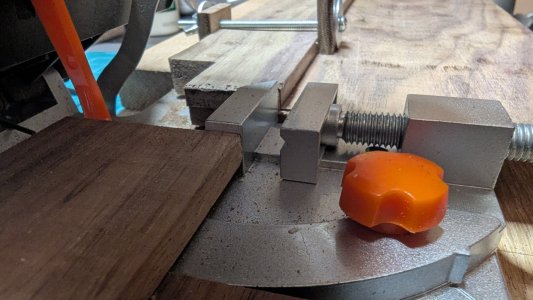
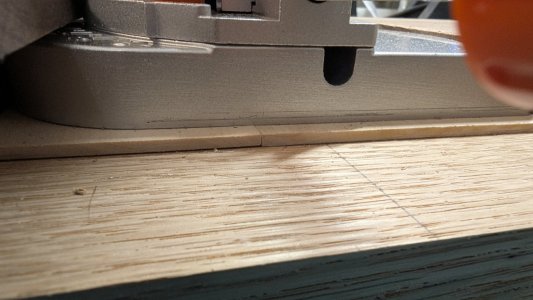
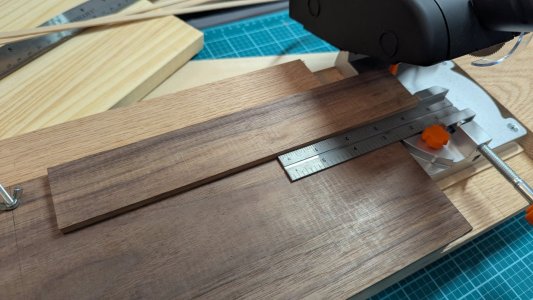
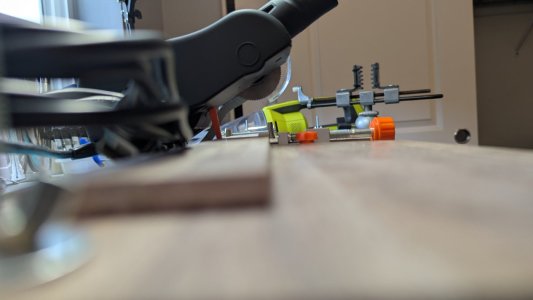
The first image shows the raised part of the vice that I was trying to get level with and the second is the bass wood platform.
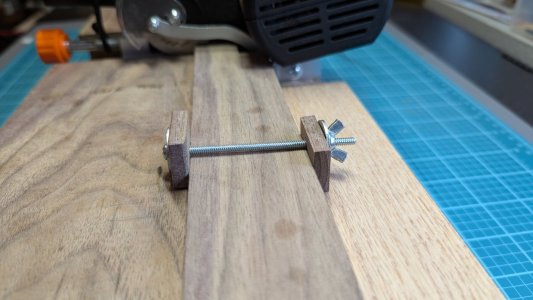
Next was getting a perfectly straight fence. I was nervous about being able to get the fence perfect so I didn't want the top deck permanently attached. I had to have a bit of play so I could "calibrate it" when I changed decks, yet obviously it has to be very stable during use. I came up with the idea to use some bolts I had from a previous project (robot) and it worked out great. I had planned to use 4 bolts but it wasn't necessary. Two were plenty, as you can see in photos above.
After cutting and gluing the first layer of oak to the top of the table base, I cut and positioned the walnut plank and firmly clamped it in place. Then I drilled the bolt holes all the way through and bolted the plank down. Next, I used a metal straight edge clamped in the vice of the chop saw to align and glue down the fence. This 6" ruler from my right angle is the only ruler I had that would fit in the vice. After gluing I let it set for a several minutes with weight on top before removing it and clamping overnight.
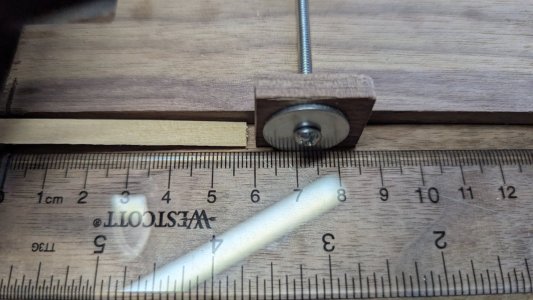
Since the whole point of this was to be able to make hundreds of repeat cuts very accurately, I also needed a stop. I cut some small pieces of walnut (using the chop saw!) and created a sort of clamp. I can lay a ruler on the table and then align the stop. A bit fiddly but works really well. I've been looking around for a thin metal rules or an adhesive ruler. I may end up printing my own ruler on a clear Avery label and using that. Simple and easy to replace as long as I can get the scale perfect. Right now I use a command strip to hold a plastic ruler in place.
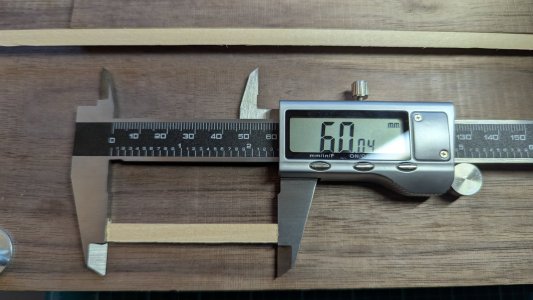
The saw has very little lateral play, but I did push it slightly left and right to create a canyon for the blade to fit in on the cutting deck:
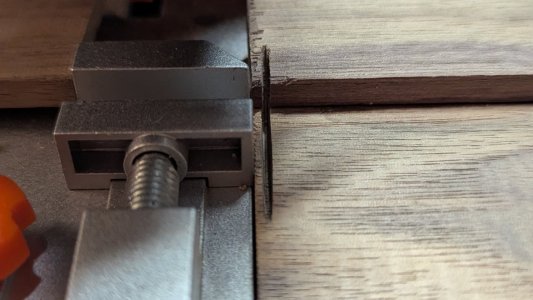
I added some hooks for cord management and a quick twist tie down to hold the blade closed for storage, as shown in the first photos above. My "shop" is in my office so I don't have a lot of space and need to be able to store things up and out of the way.
I did make one mistake that I didn't notice until it was way too late. During gluing, the left side platfrom had slid about 1/16 of an inch away from the saw mounting base. It left an overhang. I was going to fix it but because I had already drilled the hole for the bolt I couldn't do it without screwing up the symetry on top. I figure it's a work bench, not a work of art, so ta heck wid it, right?
I'm most eager to add a fixed ruler of some type. I also want to create a different right hand deck that can rotate with the miter plate. I have ideas how to do that but they feel beyond my skills at the moment, like cutting a nearly perfect half circle.
Love to hear your thoughts!
In my naïveté, I didn't realize my Polaris kit was shipping from Europe and wouldn't be here for a couple of weeks. The agony of waiting! Impulsively, I decided to go ahead and order the Shipwright series too and see which gets here first. I don't think either will be here before Christmas.
In the meantime, I was itching to do anything to work with wood so I set about making some gadgets based on all the cool stuff I've seen. Please remember that I'm not experienced at this at all and my only power tools are a a jig saw and a drill. This is very amateur stuff compared to what I've seen people here create, but I have to start somewhere!
So in addition to acquiring way too many tools for someone who hasn't even started a model yet, I warmed up by making a bunch of basic stuff like a holder for my $15 curling iron bending tool, a bending block I stenciled by eyeball, and a few different shapes of sanding blocks. I'm getting ready to make some sanding sticks too. I also made an edge bending station based on Chuck Passaro's video.
But what I'm really proud of is my chop saw table:
Man, do I go overboard (haha) on research when starting a hobby! I was doing a bunch of reasearch on how to make a lot of repetitive cuts, like for decking. I thought about getting a plank cutter but that seems so limited in use and the best one is $150 US. I saw a few DIY versions but they all seemed hard to make (metal, 3D printed, etc.) and still limited. I was mostly not liking the beveled edges the blades create. Anyway, I ran across a post from 2019 of someone who had taken an inexpensive 2" chop saw from Harbor Freight and made his own cutting table for it. I decided to try and make something similar without trying to copy it exactly. I had looked pretty closely at the photos to get a general idea of how it worked. I just took my time and did a lot of dry fitting and testing along the way. And Harbor Freight still sells the saw for only $38 US!
Again, while I'm a somewhat compuslive tinkerer, my experience with wood projects is really limited, so I'm sure there are better ways to do this, but this is what I did. I would appreciate any advice!
I used red oak for the base as that was the staightest small board I could find at the hardware store. I know oak is a really hard wood and I wanted to be sure it wouldn't flex. I remembered the homemade cutting table I'd seen on the forums used some sort of darker wood for the cutting deck and I liked that, so I decided to use walnut for the top. It seemed like it would be hard enough to last and felt like it would be easy to work with. I wanted mahogany but what they had at the store was very warped. Oh, I got all the wood from a Home Depot in their "craft wood" area.
I started by mounting the saw at the center of a 2' x 7.25" x .75" oak board and making sure it was very straight with the front edge of the board. This was the base table. I tried several positions for the mounting plate on the base table. The saw is a bit back-heavy and the mounting plate needed to be fully supported, so positioned it with the back edge of the mounting plate at the back edge of the base table.
After mounting it I had to tackle what I knew would be my first challenge... how do I get the table level with the plane of the saw cutting platform? In the photo I had seen, I think the person had made some boards thinner (I think that's called "ripping"?) to specific thicknesses to get them perfect. I don't have those tools (whatever they are!), so I had bought some 1/4" walnut planks and 1" square pieces, plus some 1/16 and 3/16 bass wood planks (all the hobby store had). I hoped I would be able to build find a combination of layers to get it to work. The perfect combination ended up using one layer red oak (~3/4") and one layer of walnut (~1/4") for the table extensions and the saw had to be mounted on 3/16 bass wood platform. I cut the platform to shape and glued it to the table base before mounting the saw. (Had I been able to take accurate measurements of the mounting plate at the time this would have been a lot easier. As it was, I had to use rough estimates when purchasing the wood... it went to that wrinkle on my knuckle... plus a little bit.)
The first image shows the raised part of the vice that I was trying to get level with and the second is the bass wood platform.
Next was getting a perfectly straight fence. I was nervous about being able to get the fence perfect so I didn't want the top deck permanently attached. I had to have a bit of play so I could "calibrate it" when I changed decks, yet obviously it has to be very stable during use. I came up with the idea to use some bolts I had from a previous project (robot) and it worked out great. I had planned to use 4 bolts but it wasn't necessary. Two were plenty, as you can see in photos above.
After cutting and gluing the first layer of oak to the top of the table base, I cut and positioned the walnut plank and firmly clamped it in place. Then I drilled the bolt holes all the way through and bolted the plank down. Next, I used a metal straight edge clamped in the vice of the chop saw to align and glue down the fence. This 6" ruler from my right angle is the only ruler I had that would fit in the vice. After gluing I let it set for a several minutes with weight on top before removing it and clamping overnight.
Since the whole point of this was to be able to make hundreds of repeat cuts very accurately, I also needed a stop. I cut some small pieces of walnut (using the chop saw!) and created a sort of clamp. I can lay a ruler on the table and then align the stop. A bit fiddly but works really well. I've been looking around for a thin metal rules or an adhesive ruler. I may end up printing my own ruler on a clear Avery label and using that. Simple and easy to replace as long as I can get the scale perfect. Right now I use a command strip to hold a plastic ruler in place.
The saw has very little lateral play, but I did push it slightly left and right to create a canyon for the blade to fit in on the cutting deck:
I added some hooks for cord management and a quick twist tie down to hold the blade closed for storage, as shown in the first photos above. My "shop" is in my office so I don't have a lot of space and need to be able to store things up and out of the way.
I did make one mistake that I didn't notice until it was way too late. During gluing, the left side platfrom had slid about 1/16 of an inch away from the saw mounting base. It left an overhang. I was going to fix it but because I had already drilled the hole for the bolt I couldn't do it without screwing up the symetry on top. I figure it's a work bench, not a work of art, so ta heck wid it, right?
I'm most eager to add a fixed ruler of some type. I also want to create a different right hand deck that can rotate with the miter plate. I have ideas how to do that but they feel beyond my skills at the moment, like cutting a nearly perfect half circle.
Love to hear your thoughts!