
• Win a Free Custom Engraved Brass Coin!!!
    As a way to introduce our brass coins to the community, we will raffle off a free coin during the month of August. Follow link ABOVE for instructions for entering.
  • PRE-ORDER SHIPS IN SCALE TODAY!

    The beloved Ships in Scale Magazine is back and charting a new course for 2026!
    Discover new skills, new techniques, and new inspirations in every issue.

    NOTE THAT OUR FIRST ISSUE WILL BE JAN/FEB 2026

HMS DIANA by Caldercraft 1:64 kit by Kimosubby [Kim Holland]

Joined
Nov 21, 2024
Messages
29
Points
58

Well, having purchased the kit over 20 years ago I now think I've practiced with enough other builds to attempt this large model. My workshop is in the attic, access is via a normal fold down ladder and hatch. I just about manage to get either Snake, Racehorse of Bounty down the hatch by carrying stern first down the ladder, but I think I may have problems with Diana, we'll see.

The usual start for this log, the box with stuff in, and being Caldercraft the timber should be sound and fit for purpose. If not, I have plenty of material to help out, I buy stock timber in and cut my own planks as required. I also make my own scale ropes on a rope walk made some thirty years ago and it's still in fine fettle.

I've also waited long enough to allow lots of other builds to go through on this site for this kit, so will be able to avoid some of the already discovered errors between plans with the kit and the AOSDiana, and have taken the opportunity to also print myself those plans from the Wikipedia site as well.

So I've started the physical build by releasing the frames from the various sheets of ply and set up the centre frame square on my build board and will mount each frame in turn, I plan to shape the frame edges as I progress knowing from experience how difficult that can be with them glued in place. I learnt early on in my boat building to complete the framing right side up and then invert the whole to start the planking.

So let the build commence. I'll try and keep this build up to date, best intentions and all that. I hope to complete ready for rigging by Easter next year...IMG_3084 copy.jpgIMG_3083 copy.jpg
 
Last edited:
In addition to using the book as a reference, which is an excellent idea, there are also contemporary plans in high resolution for free on the Wiki Commons site as well as the 14 page contract with the dimensions of all the parts of the Artois class which includes Diana 1794 on the RMG Collections website.
Allan
One page of the contract as an example:
1760983212566.jpeg
 
Thank you Allan, I must look into that information, looks very interesting and lots of data.
I'll enjoy working through that english, what with all those f's for s's etc. A bit like my early copy of STEELE.

Kim
 
If you cannot find the entire contract or the full set of 9 drawings, please feel free to PM me and we can figure how to send them to you or where to get them on the internet, whichever is easier for you. As most of the plans are high resolution, they are very large files.

You mentioned working through the English. For some "fun" try transcribing the older hand written contracts. No punctuation, capitalizing every noun, contractions all over the place, different spellings from scribe to scribe......

Maybe you can transcribe these into Manx :) - I know the Irish are doing more and more to have their kids learn Gaelic to keep the language alive and well which is terrific and I was wondering if Manx form of Gaelic is commonly spoken by the people there on the Isle of Man.

Gow-jee tastey jeh'n phrojekt

Allan

,
 
Agh red erbee son co-modeller!

The true language died out in the 70's but it got fully revived soon after. We now have a primary school that is bi lingual Manx/English and there are also examinations written in Manx. Lots of people speak Manx now, though it's still very much in the background. We are part of the Celtic league of nations.
A crown dependency and almost entirely self governing, the King is now the Lord of Mann, as was the Queen before him.
Manx gaelic, as you are probably aware, is a spoken language, so it's awkward in it's written form.

I'm what is termed a "come over", arrived in Nov 1971 and never looked back.

I've obtained the full contract document and all the images of Diana/Artois frigates class images too.
I've also joined the Greenwich Museum in way of thanking them for having such a tremendous on-line archive of material, the search engine is very intuitive.

Now back to shaping the forward frames. Although the kit is over 20 years old the ply used is excellent, tight fits on all joints with no warping with storage.

Aye, Kim
 
After a week I have assembled all the frames and the lower deck piece to check fitting. I have shaped the front four frames and the aft 5 frames to the curve of the hull using a full length plank as a guide.
Double checking it is all labelled the whole was carefully taken apart and all contact areas glued and re-assembled. Used Titebond III glue which is not a very quick setting adhesive, to permit time to check it all over. Noted that frame 12 was about 2mm high, so resorted to two large clamps to pull the whole back into full alignment, I suspect a sawdust fragment in the frame slot as the clamps pulled the deck piece down easily enough. The steel rule confirmed the run of the upper deck supports. Luckily I had used a narrow building board which gave room for these clamps.
Assemblage left to dry overnight and then the stern gallery pieces were added, having shaped them prior to positioning.
It is a big boat, and is very sturdy at this stage.
Next job is the gun deck fitting, the plans give two options; plank then fit (which involves cutting the deck in two along it's length) or bending and folding to fit as one piece, then plank in situ. I'll let you know which way I progressed next post.IMG_3087 copy.jpg
 
Thank you frankieg, yes slightly over 5mm and quite dense too.

The gundeck choice made was to fit it and then glue. A trial fitting showed how much bend was required to get the deck into position in/on and about the frames. The deck when bent onto the frame support areas touched at all points and the deck had a very nice camber as well. To split the deck would possibly effect that shape, so I opted for gluing in place and then planking. The only pre installation deck work was to scribe a central pencil line down the middle and to check the mast holes were of the correct size.

I was aware of the re-positioning of the mizzen mast on the Greenwich plans, but have decided to ignore that, it is only a few mm.
I am attempting to plank in a similar pattern as shown in the Anatomy of Diana book. The upper deck image was copied and using the computer enlarged to almost working scale. The supplied planking was also trimmed on a table saw down to appropriate widths, using a small slitting saw blade that I use for creating planks from stock material. A lot of this deck is covered, only the mid area is open to full view, but I will treat all the deck in the same fashion.

I have also re-checked the mast holes after planking, checking that the mast holes fully align with the lower deck/frame piece for upright masts when viewed from ahead. Good job really as the slot for the mizzen mast in the lower deck/frame piece was only 7mm, the mast is 8, so some slight trimming there.
I am also aware from other build logs that the bowsprit angle is wrong as it encounters the figurehead.

Firstly, the inboard end of the bowsprit was to a slot, and did not penetrate bulkheads to the upper deck. Having glued on the cheek pieces (part 21) about the stem, I used the Anatomy book to derive a bowsprit angle, cut that to a small block and transferred the mark to the cheek pieces. Very carefully drilled via the slot already present through the fore-end of the stem into the front of the hull. I had marked the position of the bowsprit bitts on the deck planking and could confirm that the angle I was using should be about right. Success, the slow drilling with a large, long 10mm wood drill was online, the drill emerging where required, and the angle just enough to clear the figurehead. To make sure, I lowered the figure head mount by 2mm.
The image shows the planking started, water way installed, the three masts stubs in place and the bowsprit through the stem into the upper deck area.

IMG_3116 copy.jpg
 
Time has passed quite quickly, so here's where I'm at now. I took two weeks off during November to attend the Blackpool Model Show, and then visit family about the UK. I've completed the gun deck planking, and also built up the internal walls of that deck to the floor of the upper deck.
I ensured that the stern arrangement aligned with the upper deck, using it for positioning parts.
I also decided that I would add the support beams for the upper deck as per the Anatomy of Diana book. This entailed strengthening the internal walls with additional strip wood. The ply upper deck piece was marked out with the deck beam patterning and this was dry fitted so that the beam locations could be transcribed to the top of the inner walls. I also used mast stubs to ensure the deck aligned with the lower deck and support holes in the main longitudinal frame piece. Additional beam pieces were cut and and the images show nearly all the beams in place, dry fitted. These will all be removed, numbered and stored for permanent fitting after the hull has been planked.
The upper deck piece now fits smoothly along its whole length, complete with the deck camber overall. Whilst at this stage I will mark out the gun port locations, again taking notice of other builders comments regarding their positions and follow the plans from the RMG website.
My kit did not have a template for the gunports, so having the upper deck beams marked in full, I have reference points the full length of the gundeck.
I still have to paint the inner walls, and add fittings for the gun tackles. I am undecided whether to make and display with gun tackles, I have done so before at this scale and they looked a bit "busy" but I'll leave that for latter.IMG_3186 copy.jpg
 
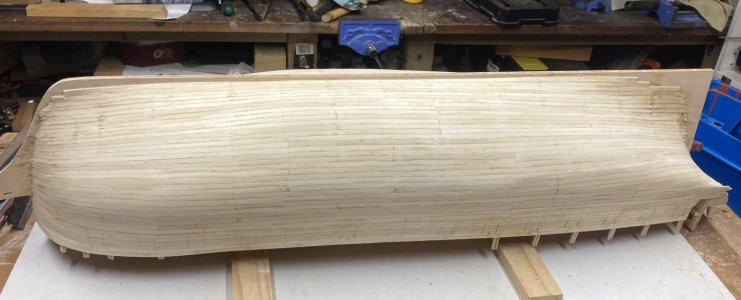
Time to invert the hull for first planking, I find it much easier that way.
All the upper deck beams were numbered and removed.
Two stubs were inserted into the fore and main mast positions with about 2 inches above deck
To invert the hull I also ensured that the hull would be raised sufficient height for the frames fore and aft to be clear of the build board.
The block chosen was slightly under the required height, so a piece of 6mm ply was laid on the deck first, then the block slid onto the mast stubs.
Cross feet had been screwed onto the block to give it stability when inverted.DSC00282 copy.JPGDSC00283 copy.JPGDSC00284 copy.JPGDSC00285 copy.JPG

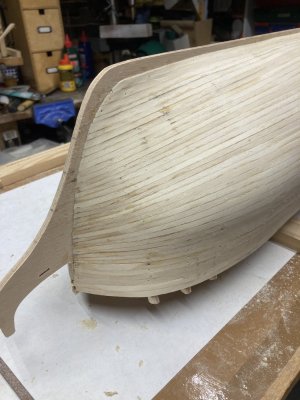
The first check for frame alignment showed that frame 13 needed building up, this was achieved using spare planking strips, glued in layers so give the correct run of planks at this frame.

DSC00286 copy.JPG

Also, the next important function was to highlight the positions marked for the display stand, as these will require reinforcement prior to planking covering their locations. The size of this ship will require three pedestals of turned wood.

DSC00287 copy.JPG
 
Back
Top