


- Joined
- Aug 15, 2026
- Messages
- 6
- Points
- 8

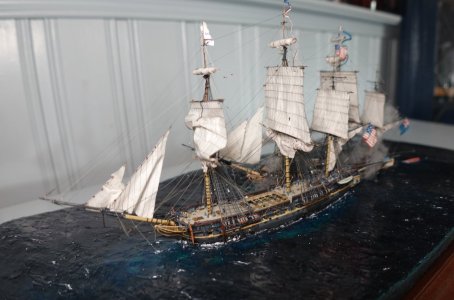
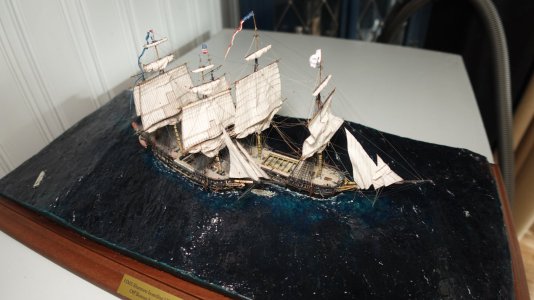
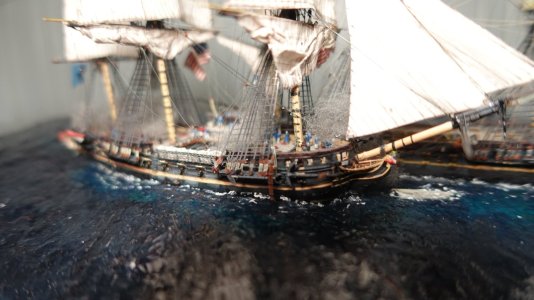
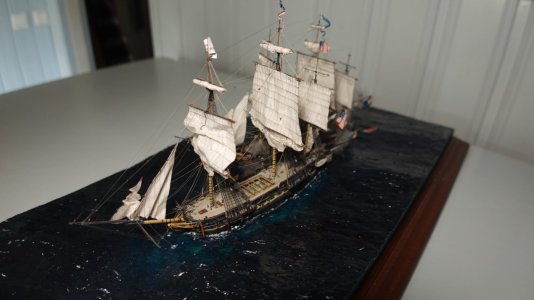
HMS Shannon vs USS Chesapeake, 1 June 1813 – 1/350 diorama
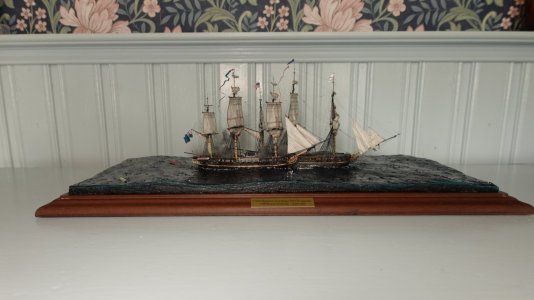
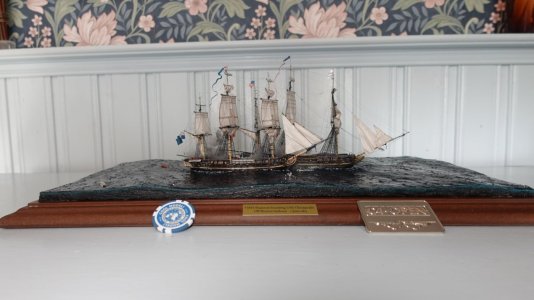
The diorama is finished, so this thread is a build summary rather than a running log. Short build clips are on my YouTube channel Linus Napoleonic Shipyard, and on Instagram and Facebook (Linus Spjutsberg). There is also a longer video on the sails.
On 1 June 1813 HMS Shannon, Captain Philip Broke, met USS Chesapeake, Captain James Lawrence, off Boston. Broke's report, dated Halifax 6 June and printed in the London Gazette that July, is the account most often quoted:
"after exchanging between two and three broadsides, the Enemy's ship fell on board of us, her mizen channels locking in with our fore-rigging. I went forward to ascertain her position, and observing that the Enemy were flinching from their guns, I gave orders to prepare for boarding."
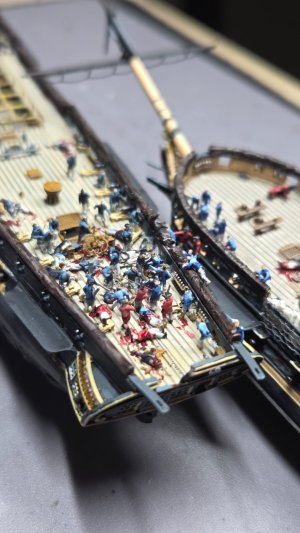
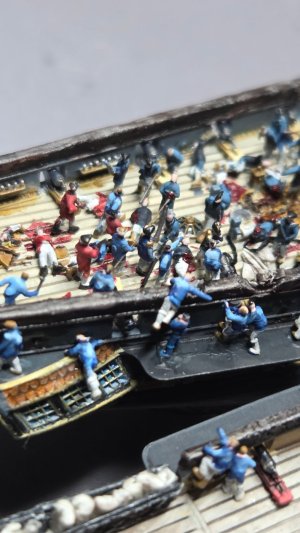
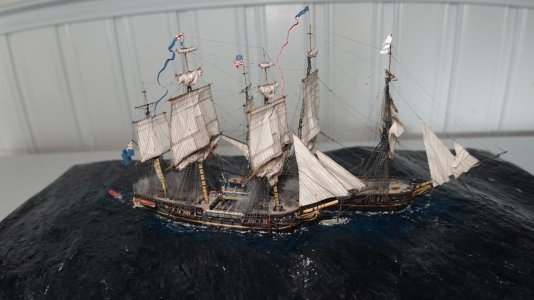
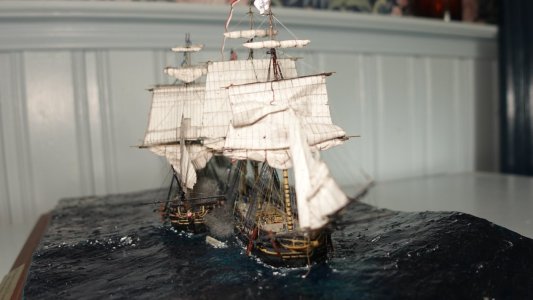
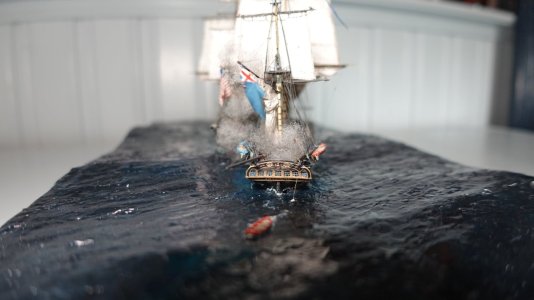
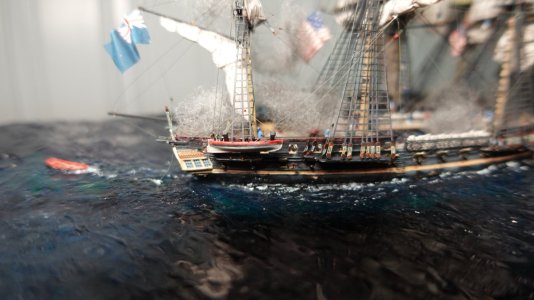
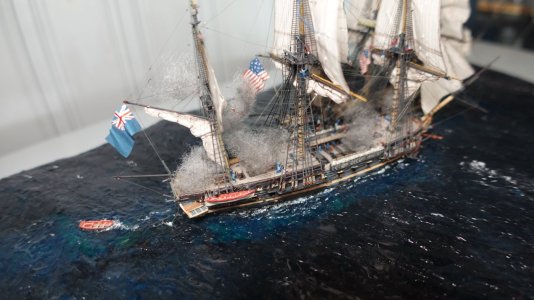
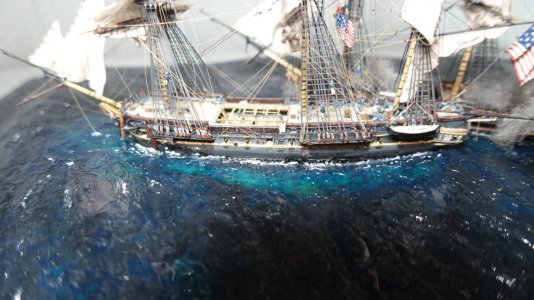
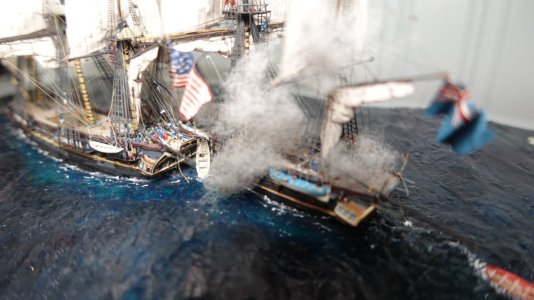
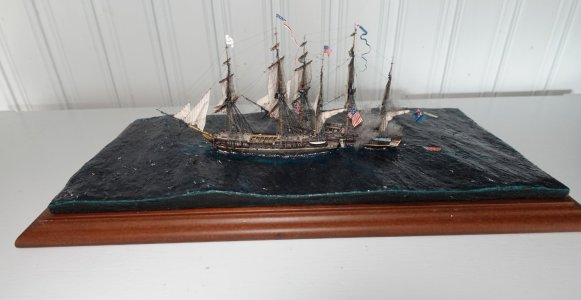
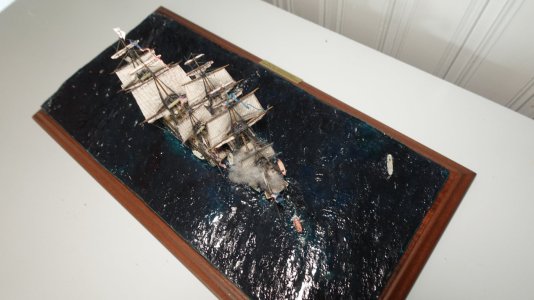
The diorama shows that moment, at about 18:02: Chesapeake has fallen aboard, and Broke's boarders are going across onto her quarterdeck.
Why this action
What draws me to this fight is the conduct on both sides. Before the action Broke wrote to Lawrence inviting him to "meet the Shannon with her, ship to ship". He gave the force of his own ship in the letter and sent his consort Tenedos away to make the odds equal. Lawrence never received the letter, as Chesapeake had already sailed, but he came out to meet Shannon ship to ship all the same.
Both captains were struck down. Broke led his boarders himself and received a sabre wound to the head. Lawrence was mortally wounded and carried below. The British buried him at Halifax with military honours.
Research approach
Where the prints and the written record disagreed, I followed the written record, since artists often left the rigging intact for clarity. Two prints of 1813 have a direct link to the action. The first is Robert Dodd's aquatint of the approach, painted from information given by Lieutenant Falkiner of the Shannon. The second is G. Webster's aquatint of the boarding, made under Falkiner's direction. Details found only in secondary sources were either left out or modelled as a judgement call, and are noted below. Full source list at the end.
Why the flags stream aft
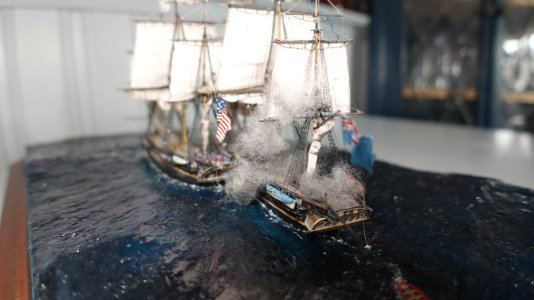
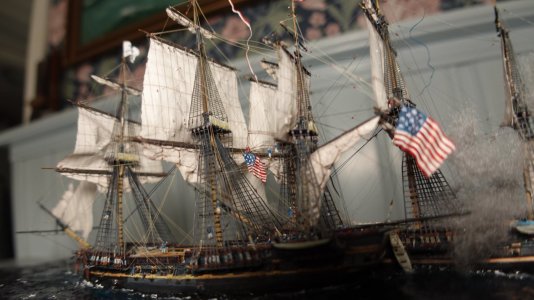
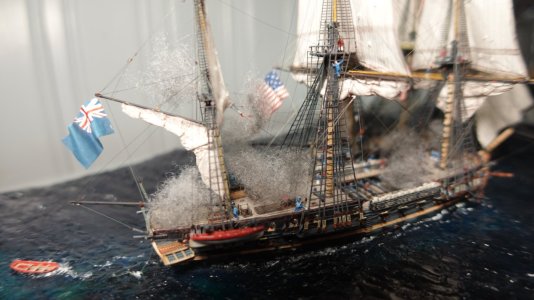
As Chesapeake ranged up, her helmsmen were killed and her wheel smashed. Shannon's fire also cut her jib sheet and foretopsail tie. With no headsail and no way to steer, she came up into the wind, lost way and made sternway, drifting stern-first onto Shannon. Shannon's anchor then caught in her quarter and held the ships together. As I read the accounts, at the moment of boarding the wind was coming from ahead of both ships, so the ensigns and pendants stream aft. The Schetky/Haghe lithograph shows the flags and the gun smoke going the same way. Chesapeake's fire also cut Shannon's jib (the sheet in one account, the stay in another), so the jib is loose and shaking rather than drawing.
A note on the layout
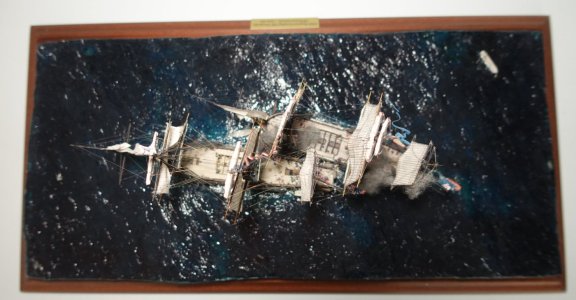
Historically Chesapeake came up on Shannon's starboard side, and Shannon grappled from her starboard bow. I wanted Shannon at the front of the diorama, and the scene reads better left to right, so here Shannon's port bow lies against Chesapeake's starboard quarter. It is a freedom I hope does not detract too much from the historical representation.
Hulls
Both hulls were designed from the original plans and printed on a 16K resin printer by Admiralty Models. A lot of the credit goes to him: scratch-building hulls to this level would have taken me years. I finished them with photo-etch details and battle damage, including broken planking and decking torn up by a round shot, and added hammock cranes with hammocks among a lot of other things.
Paint
Shannon: black hull with a thin ochre/buff strake, following the prints. She had been blockading Boston for over 56 days, and James describes her as in need of paint, so she is heavily weathered. Buff inner bulwarks, red ochre gun carriages.
Chesapeake: black hull with a light buff strake. I found no paint record for Chesapeake herself. Her spring 1813 refit was done in a hurry and at minimal cost, so I judged a full repaint to white unlikely. That is a reasoned choice, not a documented fact.
Sails
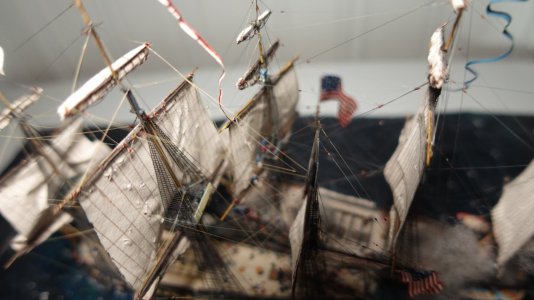
Eze tissue (similar to Silkspan), four layers laminated with PVA and ironed. I drew the seams and panels on both sides with a sepia Sakura Pigma fineliner over a light table, then toned them with thinned Vallejo umber wash. The British sails follow Steel. The American sails are my best approximation, built up differently so the two ships read as distinct. All the sails were shaped wet with CA. Shot damage is holes, not burns.
Sail state: Shannon is under topsails, topgallants, jib and spanker, with her royal yards crossed (James). Chesapeake has her courses hauled up, royals and topgallants taken in and royal yards struck, and her fore-topsail is hanging after its tie was shot away (Budd, James).
Masts and rigging
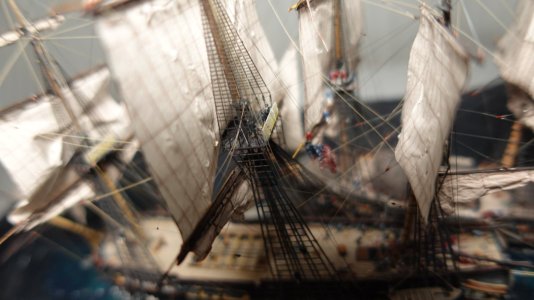
The sails went on after the standing rigging. The masts are brass rod. The rigging is a mix of brass, memory and copper wire; the finest memory wire is 0.02 mm, which is like working with hair. The shrouds and ratlines are photo-etch, a mix of parts I made myself and parts from various frets, and the upper shrouds come from a generic 1/350 fret. Both bowsprits have spritsail yards crossed under them with footropes, which was standard practice in 1812–13.
Broke wrote that both ships came out of action with their rigging "as perfect as if they had only been exchanging a salute". Shannon fired mainly into the hull at close range, so I kept the damage aloft light. Although Chesapeakes fore-topsail yard is hanging from the lifts. Hence the slack.
Damage
Chesapeake: the damage is heaviest on the starboard quarter (James), with Shannon's anchor fouled in her quarter and the wheel shot away.
Shannon: the mizzen is badly wounded, and the rigging is only lightly hit. Shotholes and tears in most of the courses and top sails.
Crew
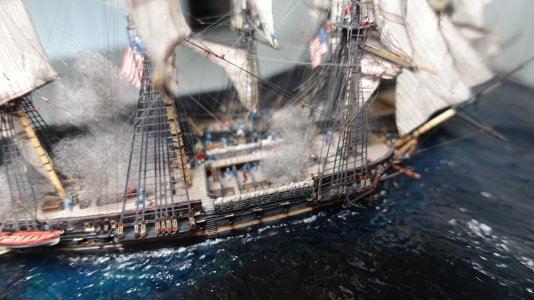
The figures are 3D-printed, with swords and pikes added; some were reposed with glue and sculpting putty. Their placement follows Broke and James: Broke and about 20 men onto the quarterdeck, marines following as a second wave, and Midshipman Smith's topmen crossing yard to yard into Chesapeake's fore-top.
Flags
Shannon flies one old blue ensign at the peak, the only colour James mentions, plus a pennant. I made this a ligher greyed out blue to show the wear.
Chesapeake flies three ensigns, at the mizzen royal masthead, the peak and the starboard main rigging, plus the white "Free Trade and Sailors' Rights" flag at the fore. The ensigns have 15 stars and 15 stripes, following her surviving ensign at the National Maritime Museum, Greenwich (AAA0921).
Smoke
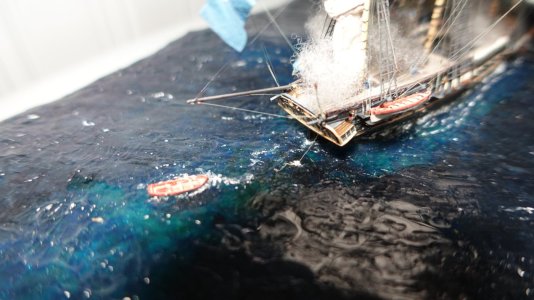
Pillow wadding, lightly spray painted.
Sea
Epoxy cast in a reverse mould over crumpled foil. I poured the wave tops first and painted the colour on the underside so it shows through the resin, with UV resin and water effect on top. The wind on the day was light and the sea calm, but I added long ocean rollers to mark it as the open Atlantic rather than a harbour. This is the part I am.least happy about, the sea base.
Base and case
Solid wood base, 50 × 25 cm, with a plexiglass case. The brass plaque reads "HMS Shannon boarding U.S. Frigate Chesapeake" with the date and place.
Time
Research from spring 2026. Build from June, roughly 8–20 hours a week. At the end much more.
What I would do differently
- The lower shrouds turned out a little too wide. I should have used or made finer PE parts. I did fashion some using memory wire, but in the end whent for the PE.
- Next time I will sculpt the sea in clay on a Styrofoam board and finish it with an airbrush, instead of casting it in resin.
Sources
- Broke's report, London Gazette, July 1813 (reprinted in the Gentleman's Magazine, September 1813)
- William James, Naval Occurrences (1817) and Naval History of Great Britain
- Budd's letter, Halifax, 15 June 1813
- Theodore Roosevelt, The Naval War of 1812 (1882)
- US Naval History and Heritage Command, The Capture of Chesapeake
- Peter Padfield, The Great Sea Battle (1968)
- J.C. Schetky and L. Haghe after Capt. R.H. King RN, lithographs, c. 1830
- Robert Dodd, aquatint, August 1813; G. Webster, aquatint, 1813
- Pocock/Havell aquatints
- David Steel, The Elements and Practice of Rigging and Seamanship (1794)
Thanks to Admiralty Models for the hulls.
Questions and corrections welcome.
The diorama is finished, so this thread is a build summary rather than a running log. Short build clips are on my YouTube channel Linus Napoleonic Shipyard, and on Instagram and Facebook (Linus Spjutsberg). There is also a longer video on the sails.
On 1 June 1813 HMS Shannon, Captain Philip Broke, met USS Chesapeake, Captain James Lawrence, off Boston. Broke's report, dated Halifax 6 June and printed in the London Gazette that July, is the account most often quoted:
"after exchanging between two and three broadsides, the Enemy's ship fell on board of us, her mizen channels locking in with our fore-rigging. I went forward to ascertain her position, and observing that the Enemy were flinching from their guns, I gave orders to prepare for boarding."
The diorama shows that moment, at about 18:02: Chesapeake has fallen aboard, and Broke's boarders are going across onto her quarterdeck.
Why this action
What draws me to this fight is the conduct on both sides. Before the action Broke wrote to Lawrence inviting him to "meet the Shannon with her, ship to ship". He gave the force of his own ship in the letter and sent his consort Tenedos away to make the odds equal. Lawrence never received the letter, as Chesapeake had already sailed, but he came out to meet Shannon ship to ship all the same.
Both captains were struck down. Broke led his boarders himself and received a sabre wound to the head. Lawrence was mortally wounded and carried below. The British buried him at Halifax with military honours.
Research approach
Where the prints and the written record disagreed, I followed the written record, since artists often left the rigging intact for clarity. Two prints of 1813 have a direct link to the action. The first is Robert Dodd's aquatint of the approach, painted from information given by Lieutenant Falkiner of the Shannon. The second is G. Webster's aquatint of the boarding, made under Falkiner's direction. Details found only in secondary sources were either left out or modelled as a judgement call, and are noted below. Full source list at the end.
Why the flags stream aft
As Chesapeake ranged up, her helmsmen were killed and her wheel smashed. Shannon's fire also cut her jib sheet and foretopsail tie. With no headsail and no way to steer, she came up into the wind, lost way and made sternway, drifting stern-first onto Shannon. Shannon's anchor then caught in her quarter and held the ships together. As I read the accounts, at the moment of boarding the wind was coming from ahead of both ships, so the ensigns and pendants stream aft. The Schetky/Haghe lithograph shows the flags and the gun smoke going the same way. Chesapeake's fire also cut Shannon's jib (the sheet in one account, the stay in another), so the jib is loose and shaking rather than drawing.
A note on the layout
Historically Chesapeake came up on Shannon's starboard side, and Shannon grappled from her starboard bow. I wanted Shannon at the front of the diorama, and the scene reads better left to right, so here Shannon's port bow lies against Chesapeake's starboard quarter. It is a freedom I hope does not detract too much from the historical representation.
Hulls
Both hulls were designed from the original plans and printed on a 16K resin printer by Admiralty Models. A lot of the credit goes to him: scratch-building hulls to this level would have taken me years. I finished them with photo-etch details and battle damage, including broken planking and decking torn up by a round shot, and added hammock cranes with hammocks among a lot of other things.
Paint
Shannon: black hull with a thin ochre/buff strake, following the prints. She had been blockading Boston for over 56 days, and James describes her as in need of paint, so she is heavily weathered. Buff inner bulwarks, red ochre gun carriages.
Chesapeake: black hull with a light buff strake. I found no paint record for Chesapeake herself. Her spring 1813 refit was done in a hurry and at minimal cost, so I judged a full repaint to white unlikely. That is a reasoned choice, not a documented fact.
Sails
Eze tissue (similar to Silkspan), four layers laminated with PVA and ironed. I drew the seams and panels on both sides with a sepia Sakura Pigma fineliner over a light table, then toned them with thinned Vallejo umber wash. The British sails follow Steel. The American sails are my best approximation, built up differently so the two ships read as distinct. All the sails were shaped wet with CA. Shot damage is holes, not burns.
Sail state: Shannon is under topsails, topgallants, jib and spanker, with her royal yards crossed (James). Chesapeake has her courses hauled up, royals and topgallants taken in and royal yards struck, and her fore-topsail is hanging after its tie was shot away (Budd, James).
Masts and rigging
The sails went on after the standing rigging. The masts are brass rod. The rigging is a mix of brass, memory and copper wire; the finest memory wire is 0.02 mm, which is like working with hair. The shrouds and ratlines are photo-etch, a mix of parts I made myself and parts from various frets, and the upper shrouds come from a generic 1/350 fret. Both bowsprits have spritsail yards crossed under them with footropes, which was standard practice in 1812–13.
Broke wrote that both ships came out of action with their rigging "as perfect as if they had only been exchanging a salute". Shannon fired mainly into the hull at close range, so I kept the damage aloft light. Although Chesapeakes fore-topsail yard is hanging from the lifts. Hence the slack.
Damage
Chesapeake: the damage is heaviest on the starboard quarter (James), with Shannon's anchor fouled in her quarter and the wheel shot away.
Shannon: the mizzen is badly wounded, and the rigging is only lightly hit. Shotholes and tears in most of the courses and top sails.
Crew
The figures are 3D-printed, with swords and pikes added; some were reposed with glue and sculpting putty. Their placement follows Broke and James: Broke and about 20 men onto the quarterdeck, marines following as a second wave, and Midshipman Smith's topmen crossing yard to yard into Chesapeake's fore-top.
Flags
Shannon flies one old blue ensign at the peak, the only colour James mentions, plus a pennant. I made this a ligher greyed out blue to show the wear.
Chesapeake flies three ensigns, at the mizzen royal masthead, the peak and the starboard main rigging, plus the white "Free Trade and Sailors' Rights" flag at the fore. The ensigns have 15 stars and 15 stripes, following her surviving ensign at the National Maritime Museum, Greenwich (AAA0921).
Smoke
Pillow wadding, lightly spray painted.
Sea
Epoxy cast in a reverse mould over crumpled foil. I poured the wave tops first and painted the colour on the underside so it shows through the resin, with UV resin and water effect on top. The wind on the day was light and the sea calm, but I added long ocean rollers to mark it as the open Atlantic rather than a harbour. This is the part I am.least happy about, the sea base.
Base and case
Solid wood base, 50 × 25 cm, with a plexiglass case. The brass plaque reads "HMS Shannon boarding U.S. Frigate Chesapeake" with the date and place.
Time
Research from spring 2026. Build from June, roughly 8–20 hours a week. At the end much more.
What I would do differently
- The lower shrouds turned out a little too wide. I should have used or made finer PE parts. I did fashion some using memory wire, but in the end whent for the PE.
- Next time I will sculpt the sea in clay on a Styrofoam board and finish it with an airbrush, instead of casting it in resin.
Sources
- Broke's report, London Gazette, July 1813 (reprinted in the Gentleman's Magazine, September 1813)
- William James, Naval Occurrences (1817) and Naval History of Great Britain
- Budd's letter, Halifax, 15 June 1813
- Theodore Roosevelt, The Naval War of 1812 (1882)
- US Naval History and Heritage Command, The Capture of Chesapeake
- Peter Padfield, The Great Sea Battle (1968)
- J.C. Schetky and L. Haghe after Capt. R.H. King RN, lithographs, c. 1830
- Robert Dodd, aquatint, August 1813; G. Webster, aquatint, 1813
- Pocock/Havell aquatints
- David Steel, The Elements and Practice of Rigging and Seamanship (1794)
Thanks to Admiralty Models for the hulls.
Questions and corrections welcome.