




- Joined
- Oct 22, 2018
- Messages
- 157
- Points
- 253

The Maryland Terrapin Smack was a shallow-draft vessel used in the Chesapeake Bay in the late 19th and early 20th centuries for capturing and transporting live sea turtles. Built with a Sharpie-style hull, it had a flat bottom, a pivoting centerboard, and a keel aft, providing a good balance between shallow draft and seaworthiness.
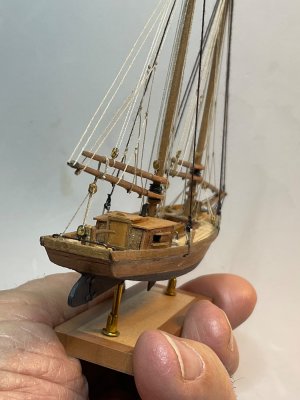
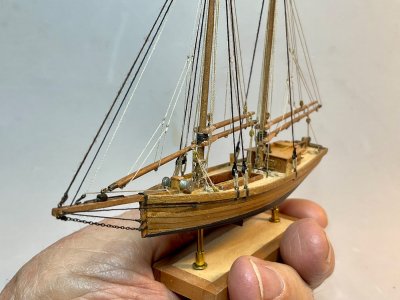
Often rigged as a schooner, it had a seawater-fed livewell open to the deck where the captured turtles were kept alive and fresh. These vessels, inspired by the Sharpie predecessor of New Haven, were notable for their ability to navigate in shallow waters, a feature that made them ideal for the Chesapeake Bay.
Unlike the New Haven Sharpie rig, which used "leg-of-muttons" sails—triangular sails that opened to the wind with a sprit boom—the schooner rig of the Terrapin Smack allowed for greater sail area adjustment and, therefore, better handling in any weather.
Sea turtle hunting is currently prohibited in Maryland, and these boats are now of historical and recreational interest rather than a working vessel, although their design influenced modern boats, and the term "Terrapin" is used in the names of modern boat designs.
The model is based on the lines plan found in Howard I. Chapelle's Paper 25: The Migrations of an American Boat Type (1961—Library of Congress).
Since Chapelle's plan did not contain sufficient information about the boat's rigging—it only showed the position of the masts and the dimensions of the booms and gaffs—I decided to follow the rigging work of modeler Paul Le Wol on his North Carolina Oyster Sharpie, given the similarity that his vessel has with the Maryland Terrapin Smack, although the North Carolina Oyster Sharpie is somewhat larger.
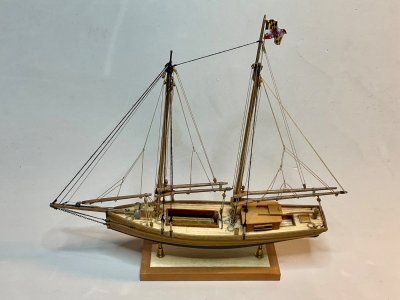
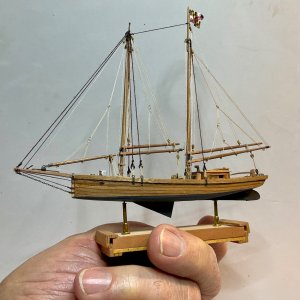
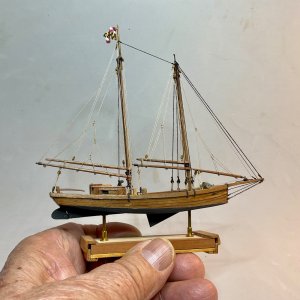
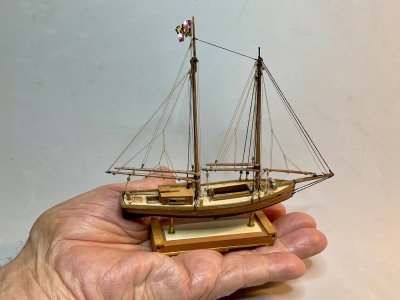
I hesitated about adding sails to the model, but in the end, I preferred to present it bare-hulled. I also took the liberty of having the ship fly the Maryland state flag, which fits well with its designation.
The dimensions of the real vessel, based on plans by Howard I. Chapelle, are 11.3 meters in length, 2.7 meters in beam, and a draft of 0.53 meters.
Model Specifications
• Length: 113 mm
• Overall Length: 154 mm
• Beam: 27 mm
• Scale: 1:100
Often rigged as a schooner, it had a seawater-fed livewell open to the deck where the captured turtles were kept alive and fresh. These vessels, inspired by the Sharpie predecessor of New Haven, were notable for their ability to navigate in shallow waters, a feature that made them ideal for the Chesapeake Bay.
Unlike the New Haven Sharpie rig, which used "leg-of-muttons" sails—triangular sails that opened to the wind with a sprit boom—the schooner rig of the Terrapin Smack allowed for greater sail area adjustment and, therefore, better handling in any weather.
Sea turtle hunting is currently prohibited in Maryland, and these boats are now of historical and recreational interest rather than a working vessel, although their design influenced modern boats, and the term "Terrapin" is used in the names of modern boat designs.
The model is based on the lines plan found in Howard I. Chapelle's Paper 25: The Migrations of an American Boat Type (1961—Library of Congress).
Since Chapelle's plan did not contain sufficient information about the boat's rigging—it only showed the position of the masts and the dimensions of the booms and gaffs—I decided to follow the rigging work of modeler Paul Le Wol on his North Carolina Oyster Sharpie, given the similarity that his vessel has with the Maryland Terrapin Smack, although the North Carolina Oyster Sharpie is somewhat larger.
I hesitated about adding sails to the model, but in the end, I preferred to present it bare-hulled. I also took the liberty of having the ship fly the Maryland state flag, which fits well with its designation.
The dimensions of the real vessel, based on plans by Howard I. Chapelle, are 11.3 meters in length, 2.7 meters in beam, and a draft of 0.53 meters.
Model Specifications
• Length: 113 mm
• Overall Length: 154 mm
• Beam: 27 mm
• Scale: 1:100