• Win a Free Custom Engraved Brass Coin!!!
    As a way to introduce our brass coins to the community, we will raffle off a free coin during the month of August. Follow link ABOVE for instructions for entering.

Pichler Hand Drill Set

Joined
Feb 20, 2025
Messages
84
Points
78

Location
Schleswig - Holstein, Germany
Hi!
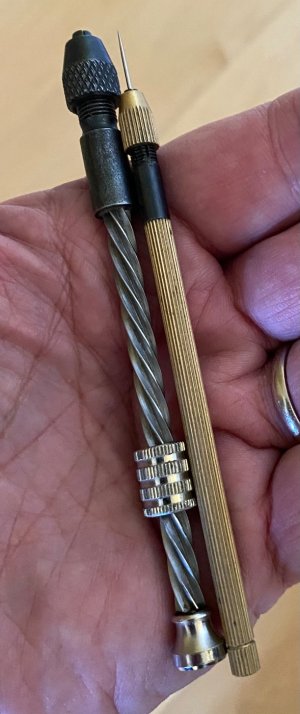
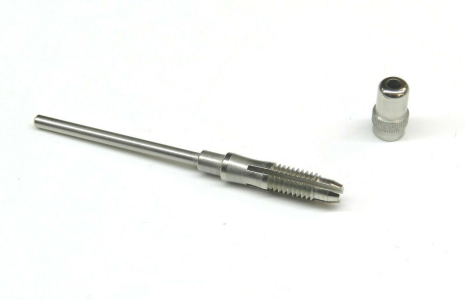
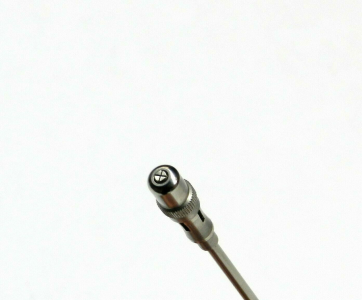
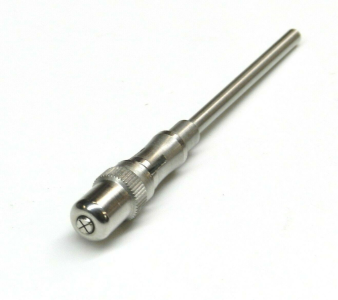
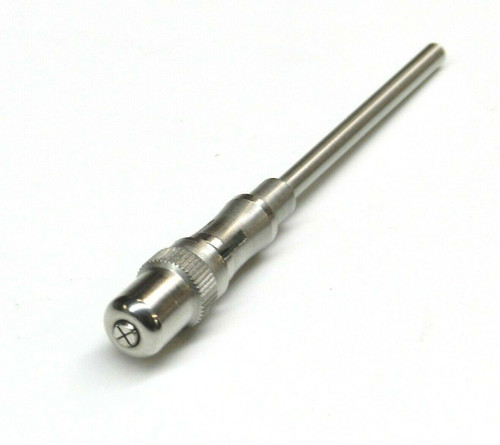
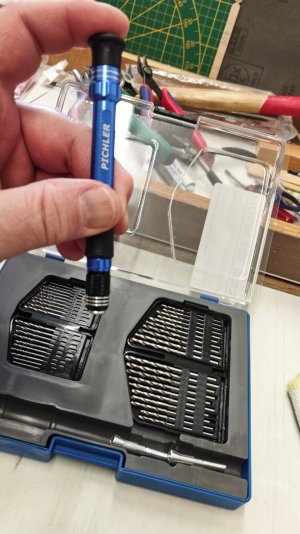
I ordered a bunch of stuff lately and also this 'Pichler - Hand Drill Set 8336' made in Germany and has a nice plastic box full of bits from 0.3 to 3 mm plus 3 collets for them. It was also a priced reasonable enough.

Alas, I thought I could use it single handed in situations where my 'Proxxon - MiniMot 40' isn't practical. But low and behold this thing is only for those with so big of hands they can pick cabbages in the field one handed! I had enough problems as Organist with my hands.

Anyway the swivel cap on the end also doesn't turn well. Of course I do have a nice box of bits with a plastic box for the hand drill I still need to buy. Baäaäh!
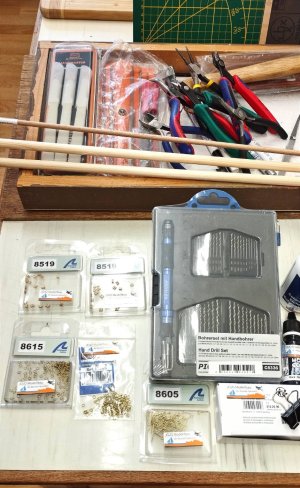
Supply 1.jpg

Supply 3.jpg
Greetings! UrkerVisser
 
Last edited:
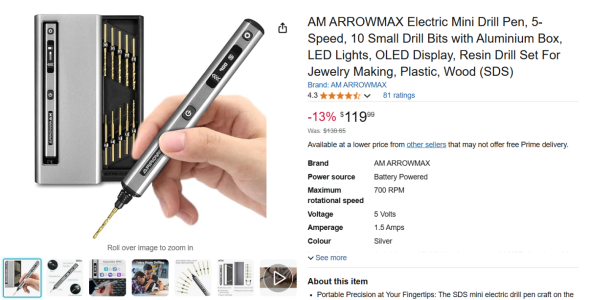
For 50 years I have used a Dremal drill for most of my drilling needs. I also have a half dozen pin drills but find all rather unwieldy to use, especially in tight places. Last month I did an internet search for a small battery powered drill and purchased an ARROWMAX drill. This drill is powered by an rechargeable battery and comes with 9 drill sizes from 0.2mm to 2.0 mm, all packaged in a very compact and nice plastic case. The drill is about 100 mm long and10 mm square (won't roll off your bench). Its shape and satin stainless steel construction make it very easy to control. It has five speeds (500, 600, 700, 800,and 900 rpm). All drills feature the same size shank making bit changing a breeze and, in addition, each drill is marked in size on the shank (in millimeters). The drill even has a reversing mode and LED lights on it tip! Addition drill bits are available, as are many other attachments such as grinding and polishing. I love this new tool and it has already solved a number of previously difficult tasks with ease. Only negative is that it is fairly expensive. Bottom line -- best new tool I have bought in years!
 
Anyway the swivel cap on the end also doesn't turn well

You may wish to try applying a mild abrasive, such pumic, valve lapping paste, or even toothpaste to the bearing surfaces of the spinning top cap and working the cap for a while. (Consider chucking the pin vise in an electric drill motor and holding the knob on the end while the drill motor is running to make short work of it.) This should loosen it up.
 
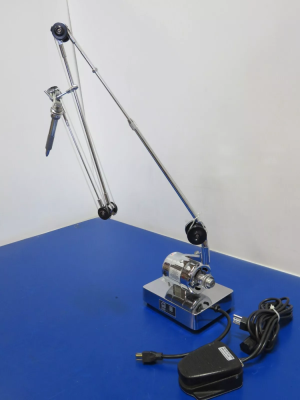
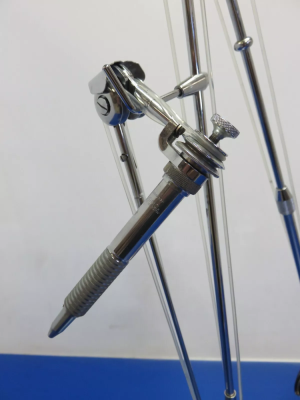
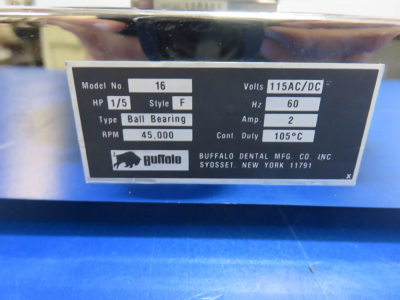
For drilling really small holes with a maximum amount of control and no bit breakage, may I suggest a dental bench engine used by dental labs to fabricate dental prosthetics. Standard dental engine handpiece chucks take standard 3/32" dental burrs which come in a wide range of very small diameters and configurations. 1/8" "Dremel size" accessories and any size numbered drill bit can be accommodated with the use of an adapter collect chuck.

These are high torque rotary tools which serve much better than low torque tools (e.g., Dremel) because they do not have to rely on speed rather than torque to do their job. The 45,000 RPM foot pedal controlled high torque dental engine permits working at much lower speeds without the loss of cutting power, overheating, or "stalling out," which makes the cutting tool far more controllable. There is also a wide range of interchangeable handpieces, including angled ones, all designed to be used in tight places like human mouths and model ship hulls. :)

Dental bench engines are very high-quality medical instruments engineered to last a lifetime. A new bench engine and handpiece (sold separately) together will set you back about a thousand dollars U.S. Now, before you ask "What's he smoking?", let me explain that these rotary cutting and drilling tools were for ages universally employed in dental clinics and labs all over the world and for some purposes still are, but the dental professionals are currently transitioning to 3D printing technology and high-speed air turbine and micro-motor handpieces for a lot of the work once done exclusively with bench engines. Consequently, there are a fair number of them turning up on eBay and other online auction sites at greatly reduced prices. (I got my Buffalo Dental Co. model #16 engine and handpiece in like-new condition on eBay for only $75.00 last year.) If you're lucky and know someone in the dental lab business or a friendly dentist, you may even be lucky enough to talk them out of a spare one gathering dust on the shelf in their supply cabinet! Now's the moment of opportunity when you can grab a very expensive tool at a greatly reduced price.

Very highly recommended!

See: https://buffalodental.com/shop/heavy-duty-bench-engines/
See: https://www.ebay.com/itm/1669244456...3405eb&gclid=99be7e549cdd1e0a08fd19829e3405eb

1742078868307.png
1742079120622.png
1742079025316.png


Anybody who's never used one of these will probably think at first glance that the jointed armature holding the hand piece would restrict the use of the tool, but, in fact, to my surprise I discovered that within the field of work encountered in ship modeling (e.g., a square foot), the handpiece can be moved without limitation anywhere one wishes in any direction and is supported such that the handpiece's weight is barely noticeable.
 
Last edited:
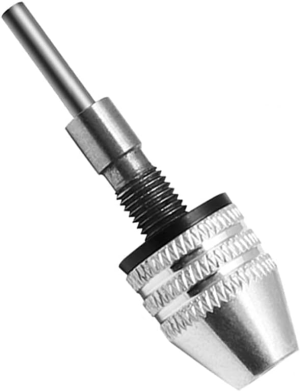
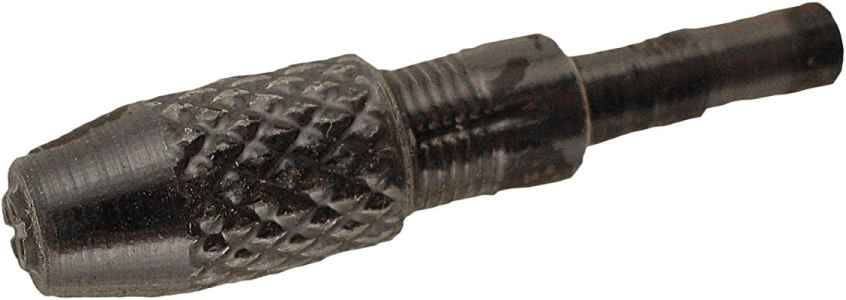
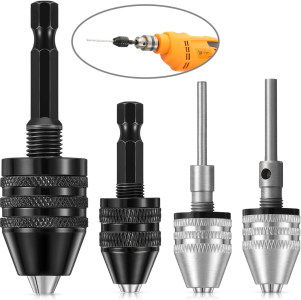
Hi Bob. What is this? And how does it work with the handpiece of the Buffalo machine?


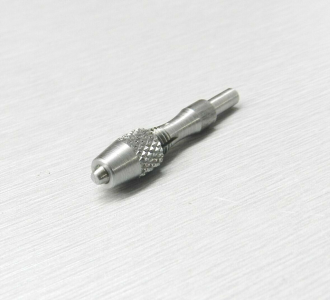
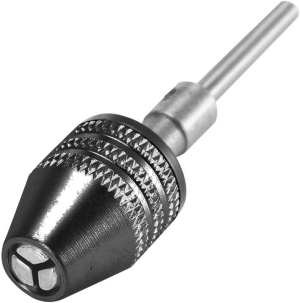
It's just a small chuck with a 1/8" or smaller shaft on the back end and a bit capacity starting at zero.

These micro-drill bit adapters can be very expensive (like $200 even!) but those are for extremely high tolerance work on highly sensitive micro-drill presses used by watchmakers and such. These examples below are all in the less than $12 range. There's lots of them out there. Search around on the internet and pick whichever one looks best in your price range. I can't remember where I got mine. The standard dental burr shaft diameter is 3/32" or just 1/32" less than 1/8", so if you have one with a shaft that's 1/8" and won't fit into the chuck on a dental engine handpiece, you can always put the adapter in a drill press or hand drill and file it down a smidgen while it's turning, or, of course, turn it down on a lathe if you have one. I have my mini-bit adapter for my drill presses and use dental burrs in my dental engine, but as I recall, I've put 1/8" Dremel size tooling into it without any problems. The dental engine collet clamps down on the tool shafts by turning the knob at the back end of the handpiece.

I should mention that numbered micro-bits are somewhat fragile and prone to breaking if not kept in alignment with the hole being drilled. I would not advise trying to use them with an aggressive "free hand" handpiece. They really require a drill press that will hold them without any runout. If I'm not using a drill press, I usually carefully use a pinvise for drilling very small holes. Note that you can get dental burrs that are very small and they're much stronger in this regard, but that's only because their cutting ends come to a point from a much thicker shaft that a numbered drill bit.


1742203310430.png


1742202587047.png


1742202107447.png


1742202316780.png
 
Last edited:
It's just a small chuck with a 1/8" or smaller shaft on the back end and a bit capacity starting at zero.

These micro-drill bit adapters can be very expensive (like $200 even!) but those are for extremely high tolerance work on highly sensitive micro-drill presses used by watchmakers and such. These examples below are all in the less than $12 range. There's lots of them out there. Search around on the internet and pick whichever one looks best in your price range. I can't remember where I got mine. The standard dental burr shaft diameter is 3/32" or just 1/32" less than 1/8", so if you have one with a shaft that's 1/8" and won't fit into the chuck on a dental engine handpiece, you can always put the adapter in a drill press or hand drill and file it down a smidgen while it's turning, or, of course, turn it down on a lathe if you have one. I have my mini-bit adapter for my drill presses and use dental burrs in my dental engine, but as I recall, I've put 1/8" Dremel size tooling into it without any problems. The dental engine collet clamps down on the tool shafts by turning the knob at the back end of the handpiece.

I should mention that numbered micro-bits are somewhat fragile and prone to breaking if not kept in alignment with the hole being drilled. I would not advise trying to use them with an aggressive "free hand" handpiece. They really require a drill press that will hold them without any runout. If I'm not using a drill press, I usually carefully use a pinvise for drilling very small holes. Note that you can get dental burrs that are very small and they're much stronger in this regard, but that's only because their cutting ends come to a point from a much thicker shaft that a numbered drill bit.


View attachment 507934


View attachment 507932


View attachment 507930


View attachment 507931
Thank you for the explanation, Bob!
 
Those adapters are a waste of money. The chuck jaws should be self-centering, but they are not. The centering mechanism is controlled by individual springs and will not guarantee a center. This will wobble the drillbit and defeat the entire purpose of micro-drilling. The hole, let's say 0.5mm, becomes 0.6mm. Any adapter will also add to the wobble (as the extension).

If you require to use micro drills (0.2 -0.4mm) then I would recommend this mandrel-adapter. It is also not ideal, but there are no jaws, it works as a collet chuck. You can find them with a standard 2.35mm shank or 3.00mm.

1742217144768.png 1742217165985.png
1742217208171.png


Here is another variation of this

1742217437609.png
 
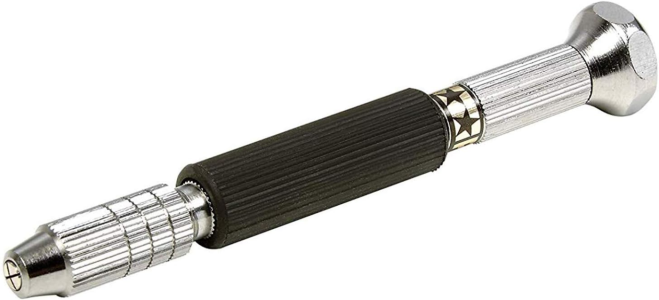
I agree with Paul, a good pinvise will do the job. I would recommend this one, it is a bit pricy compared but... you will not regret spending extra. It has a micro thread and has a secret in the handle (another collet, for larger size drill bits). Tamiya 74112 Craft Tools - Fine Pin Vise D-R (0.1-3.2mm)

1742218787904.png

 
This one? Looks nice but... what are you going to do after you brake your drill bits? The smallest diameter deems to go first and quick.

View attachment 507503
Additional drills are available in a variety of sizes. I mis-posted the smallest size in the kit as 0.2 mm. In fact it is o.6 mm. While my main drill set ranges from about 40 to 80, I normally find myself in the 60 - 80 range. The nine drills that came with my ARROWMAX will probably suffice for many of my needs and I will still use the Dremel for most drilling where tight access is not a problem. The ARROWMAX will basically replace my pin drills.
 
While we are talking about an Arromax brand, here are my thoughts: For some reason, the rotary tool I received (a long time ago) is not good quality and wobbles. It does a dirty job drilling the holes. But let's not talk about my tool, I might be one of the luckiest. :cool: Let's talk about this device in general. Again, this is only my observations, others may have a different one.

Pros:
Stylish and handsome. Small and ergonomic, comes in the plastic carrying case alone with set 'A' drillbits held by magnets. Some models come with an LCD display (extra cost) that shows the drill rotation and selected speed. USB C charging outlet. Optionally, you can purchase set 'B' to have the entire drillbits set range from 0.5mm to 2.3mm with 0.1mm increments (storing both sets A and B in the same case).

Cons:
The major disadvantage is the proprietary collet of 2.35mm. This means the only drillbits you will use are based on 2.35mm shanks. You can remove the collet, but no other collets will fit! I hear you saying that it is a standard shank and you can find many varieties of drill bits. This is true, but if you search for quality drill bits replacement, it is not easy to find.
Operation is cumbersome. There are two buttons: an ON/OFF switch, also a speed selector, and the second button operates on the rotary tool: You press it once, and it will start rotating the drillbit forward. You press it again, and ... you would guess it will stop the tool, then guess it again; it will rotate reverse, and only if you depress it the third time it will stop. This is so weird and inconvenient, IMHO, specifically if you require a sudden stop only.
Also, with a top speed (of 4) is kinda slow for most of our needs and most importantly doesn't have torque.

Bottom line: A very stylish device and will feel great in your hands, but it is hard to call it a tool. BTW, it is an expensive toy.
 
Hi Jimsky,

I didn't realize just how much more precise a collet is compared to a chuck! :-S While I'm happy with my Proxxon Micromot 60/EF, I found it a bit tricky to position a very small drill accurately. After doing a quick search online, here's a summary of what I found:

  • Collets: Known for their precision and tight grip, collets are designed to hold smaller diameters with an even, firm clamp. This makes them ideal for tasks that require minimal run-out and high concentricity. They offer consistent clamping and are great for delicate work.
  • Chucks: Chucks, on the other hand, are all about versatility and ease of use. They're generally simpler to use for quick setups, especially when working with larger or irregularly shaped workpieces. Chucks are also more robust, making them a better choice for applications that require strength or involve rough handling and larger loads.
However the Micromot 60/EF can be used with collets .... so it was not that wrong investment :cool:
 
My thoughts on drilling holes using tiny wire sized drill bits:

I have a bench top drill press that sits on a homemade stand. It is fitted with a drill chuck with a range from 3/32” to 3/8” so it won’t close on wire sized drill bits smaller than 3/32.”

I also have one of the adaptor chucks with a hex shank shown in Bob Cleek’s post above and a set of quality pin vises (Moody). I use only HSS (steel) drill bits. No Carbide! I also have a massive old drill press vise.

I move everything possible to be drilled to the drill press. I have a couple of wooden extensions that bolt thru the slots in the table to handle large subassemblies like a complete deck. Building subassemblies is part of my overall model building strategy. Tiny parts are fastened to a block of wood which is clamped in the vise. ALL holes are center punched. Larger sized drills too small for the drill press’s chuck are chucked in the adaptor. I find that the adaptor does center drills accurately. Very tiny drills are chucked in a pin vice. I originally assumed that using the drill press would not be sensitive enough but so far I have not broken any drill bits.

For the few holes that cannot be drilled on the drill press, I have an archimedes type hand drill.

Note: Brass “Work Hardens.” So, drilling with dull bits or insufficient pressure hardens the surface that you are trying to drill making things more difficult. It pays to take a good bite from the beginning.

Roger
 
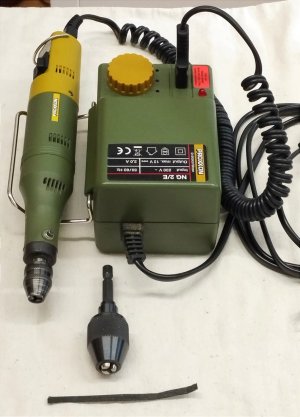
Another drill I use a lot is my 'Proxxon Mini Mot-40' which is really nice it also has various collets but I do like using it' chuck most often.

Proxxon MiniMot 40.jpg
(The big chuck is for my accu driver)

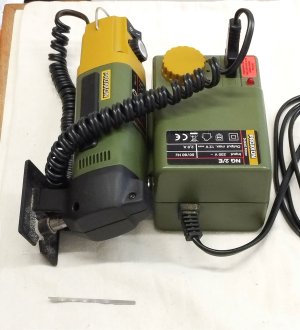
Plus I also bought myself the matching 'Proxxon - Mini JigSaw' which is really nice.

Proxxon STS 12-E Mini-Jigsaw.jpg

But anyhow, my photo also shows a chuck for my 'FREM - accu driver' which I twist in my hand as a 'make shift hand drill' when drilling 0.7 mm holes into the deck of my schooner for mounting brass eye-pins. But only if something on deck blocks me from using of my 'Mini Mot-40'.

I also secure this small accu driver chuck in my drill press's chuck to allow it to use smaller bits.

And although I have power tools galore I still love using my dads old grey and red 'Stanely 1200 Hand Drill' from the 1960's; what a wonderful drill!

Best Regards, UrkerVisser
 
Last edited:
Back
Top