

Here’s a great use for AI.
I have the Mamoli Kit of the victory. And of course the instructions are in Italian. Now that AI ChatGPT is available foreign instruction are no longer problem.
I took a photo on my iPhone copied and pasted into ChatGPT and asked it to translate it into English.
This is the results.
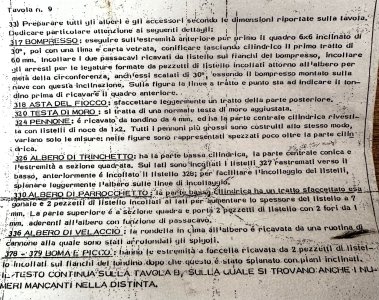
Below is a careful English translation of the text as written (keeping the meaning and technical flavor of the original Italian). I’ve kept the numbering and structure the same.
Table (Plate) No. 9
317 – BOWSPRIT (BOMPRESSO):
Make at the forward end first the inclined 6×6 square at 30°, then with a file and sandpaper shape the first 60 mm section into a cylindrical form. Glue the two fairleads (passacavi) made from strip wood onto the sides of the bowsprit. Glue the stays for the rigging formed from small pieces of strip wood glued around the shaft, also tapered at 30°, since the bowsprit is mounted at the bow with this inclination. In the figure, the dashed-and-dotted line indicates the end of the part from which to obtain the forward square.
318 – JIB BOOM (ASTA DEL FIOCCO):
Lightly chamfer a section of the rear part.
320 – MOOR’S HEAD (TESTA DI MORO):
This is a normal adjusted Moor’s head.
324 – PENNANT (PENNONE):
It is made from a 4 mm dowel and has the central part covered with 1×2 walnut strip. All larger pennants are built in the same way; only the measurements vary. In the figures they are shown cut slightly beyond the cylindrical part.
326 – MAIN YARD (ALBERO DI TRINCHETTO):
It has a cylindrical lower part, a conical central part, and the end with a square section. On the sides are glued the strips 327 tapered toward the bottom; previously strip 328 is glued on to facilitate gluing the strips. Slightly plane the yard along the gluing lines.
330 – TOPMAST (ALBERO DI PARROCCHETTO):
The lower cylindrical part has a chamfered section and 2 pieces of strip glued on the sides to increase the thickness of the strip to 7 mm. The upper part is square in section and has 2 pieces of strip with 2 holes of 1 mm attached to the yard to act as fairleads.
336 – MASTHEAD (ALBERO DI VELACCIO):
The round top of the mast is made from a cannon wheel to which the spikes have been rounded off.
378–379 – BOOM AND GAFF (BOMA E PICCO):
They have forked ends made from 2 pieces of strip glued to the sides of the spar after it has been planed with inclined planes.
THE TEXT CONTINUES ON TABLE B, WHERE THE MISSING NUMBERS IN THE DRAWING ARE ALSO FOUND.
If you’d like, I can also:
I have the Mamoli Kit of the victory. And of course the instructions are in Italian. Now that AI ChatGPT is available foreign instruction are no longer problem.
I took a photo on my iPhone copied and pasted into ChatGPT and asked it to translate it into English.
This is the results.
Below is a careful English translation of the text as written (keeping the meaning and technical flavor of the original Italian). I’ve kept the numbering and structure the same.
Table (Plate) No. 9
- Prepare all the shafts and accessories according to the dimensions shown on the table.
Pay particular attention to the following details:
317 – BOWSPRIT (BOMPRESSO):
Make at the forward end first the inclined 6×6 square at 30°, then with a file and sandpaper shape the first 60 mm section into a cylindrical form. Glue the two fairleads (passacavi) made from strip wood onto the sides of the bowsprit. Glue the stays for the rigging formed from small pieces of strip wood glued around the shaft, also tapered at 30°, since the bowsprit is mounted at the bow with this inclination. In the figure, the dashed-and-dotted line indicates the end of the part from which to obtain the forward square.
318 – JIB BOOM (ASTA DEL FIOCCO):
Lightly chamfer a section of the rear part.
320 – MOOR’S HEAD (TESTA DI MORO):
This is a normal adjusted Moor’s head.
324 – PENNANT (PENNONE):
It is made from a 4 mm dowel and has the central part covered with 1×2 walnut strip. All larger pennants are built in the same way; only the measurements vary. In the figures they are shown cut slightly beyond the cylindrical part.
326 – MAIN YARD (ALBERO DI TRINCHETTO):
It has a cylindrical lower part, a conical central part, and the end with a square section. On the sides are glued the strips 327 tapered toward the bottom; previously strip 328 is glued on to facilitate gluing the strips. Slightly plane the yard along the gluing lines.
330 – TOPMAST (ALBERO DI PARROCCHETTO):
The lower cylindrical part has a chamfered section and 2 pieces of strip glued on the sides to increase the thickness of the strip to 7 mm. The upper part is square in section and has 2 pieces of strip with 2 holes of 1 mm attached to the yard to act as fairleads.
336 – MASTHEAD (ALBERO DI VELACCIO):
The round top of the mast is made from a cannon wheel to which the spikes have been rounded off.
378–379 – BOOM AND GAFF (BOMA E PICCO):
They have forked ends made from 2 pieces of strip glued to the sides of the spar after it has been planed with inclined planes.
THE TEXT CONTINUES ON TABLE B, WHERE THE MISSING NUMBERS IN THE DRAWING ARE ALSO FOUND.
If you’d like, I can also:
- make this more “model-builder friendly,”
- simplify it into step-by-step instructions, or
- match specific parts to a particular kit or plan.