• Win a Free Custom Engraved Brass Coin!!!
    As a way to introduce our brass coins to the community, we will raffle off a free coin during the month of August. Follow link ABOVE for instructions for entering.

The GRACIE S - a Lift Model

Joined
Dec 7, 2022
Messages
114
Points
78

Within this thread I plan on demonstrating how the hull of Gracie S. can be fabricated using a lift technique.

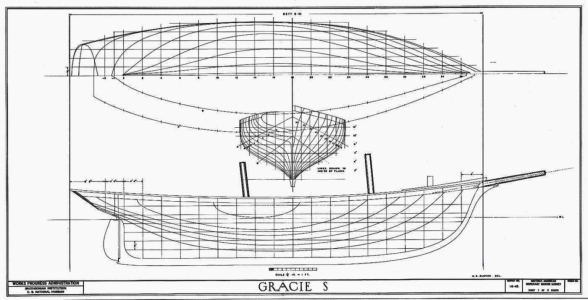
A few days ago Dave Stevens, in the PLANS thread, posted this image of the plans for Gracie S from the Historic American Merchant Marine Survey (HAMMS):
1762717373098.png

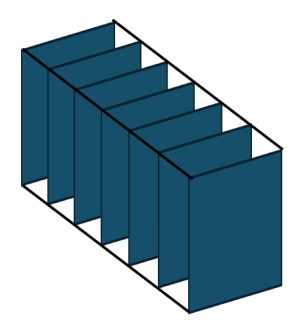
If you think of Gracie's hull sitting in a rectangular solid, then the vertical and horizontal lines in the three views above can be aligned with three sets of slices in the rectangular solid. One set of slices cuts the rectangular solid like a loaf of bread - there are 20 such cuts in Gracie's plans. The intersection of Gracie's hull with these cuts gives rise to the body plan seen in the middle of the HAMMS plan above.
1762717885338.png

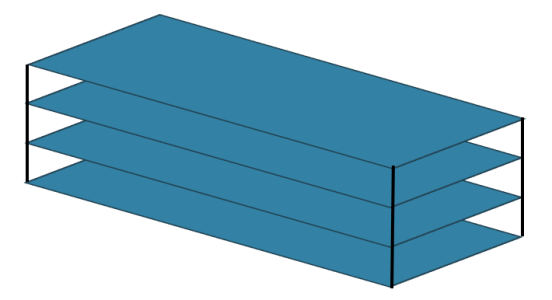
A second set of slices is like layers in a cake - there are 7 layers in Gracie's plans. The intersections of Gracie's hull with these cuts give rise to waterlines - the shape of these curves can be viewed on the top drawing in the plan above.
1762718368568.png

A third set of slices can be made as vertical slices from front to back - there are 14 layers in Gracie's plans. The intersection of Gracie's hull with these slices are called buttock lines and can be viewed on the lower drawing of the HAMMS plan.
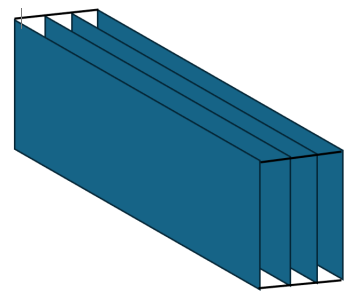
1762718647794.png

Plank on bulkhead (POB) and plank on frame models (POF) rely heavily on the body plan for shaping bulkheads (molds) and/or frames. If one fills in the region between bulkheads / frames a solid hull can be had - this is actually a type of lift model. However, it is more traditional to view lift models as coming about by making use of waterlines or by buttock lines.

In Grimwood's book American Ship Models and How to Build Them the focus is on building lift models based on horizontal waterline lifts. As an example, the second vessel in the book is the Piscataqua gondalow 'Fannie M.' that can be fabricated out of 5 lifts based on the provided plans.
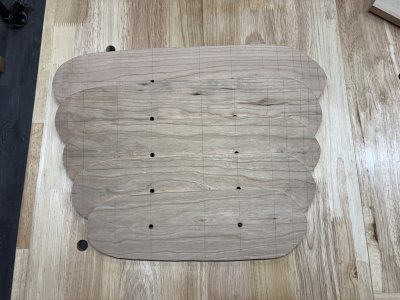
1762719801731.jpeg

The lifts are glued together and shaped using edges of the lifts as guidelines:
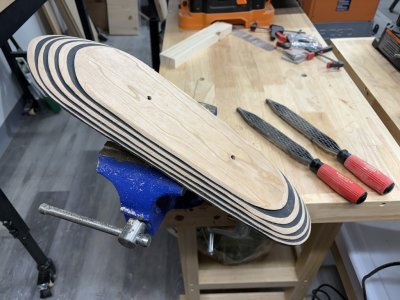
1762719971635.jpeg

After some time the smooth hull shape appears!
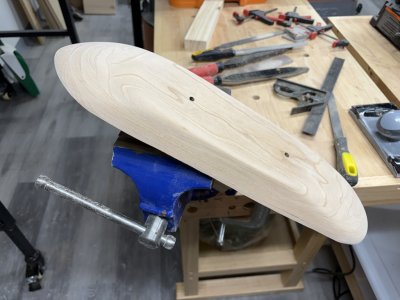
1762720025859.jpeg

Notice that the exterior of this hull is completely convex in nature. This made shaping the hull a relatively straightforward task. Gracie's hull is much more complicated having both concave and convex surfaces.

In the next post I will explain why I have chosen to use vertical / bottock lifts for my model of Gracie S.
 
Before I get going on the model I'd like to say how this thread may be a little different from a standard build log. My aim will be to present material in an organized manner that clarifies not only how I am doing the work, but why I've chosen to do the work in a particular way. However, since most everything in model ship construction can be done via multiple methods, I will try to point out alternate ways when I can. I expect that this thread will be monitored by others from the Teacher's Lounge and that they will chime in as the work proceeds. Moreover, I expect their input will not only enhance what I present, but will also challenge and critique me in a completely honest fashion.

I'm not going to write much in this thread about why / how Gracie S. was chosen as a modeling subject as I feel that those reasons have / will be discussed in other parts of the School. I will reiterate that the ship was chosen with the idea that the hull could be fabricated in a variety of ways - notably POB, POF, and via lifts - and that multiple builds would be presented. I volunteered to give lifts ago - but at that point it had not been decided if I would used waterline or buttock lifts for the model.

Dave Stevens graciously provided me with TIFF files containing the HAMMS plans for Gracie S. I brought the files to the local Digi Copy and had copies made at the scale of 1:48; i.e., 1/4" to a foot. At this scale the two central lifts in the model will be approximately 23" long - several inches longer that the pilot schooner Phantom modeled at the same scale. I studied the plans for quite awhile determining how I would make the model and where difficulties would likely present themselves.

Simultaneously with the development of the Gracie S. project, in the Teacher's Lounge there were discussions as to building materials for archivable models. A couple of wood species were discussed as good choices for a solid hull with white pine and yellow poplar coming to the top. These species are said to be easily worked and also hold good edges. I finally settled on Yellow Poplar (Tulip Poplar) Liriodendron tulipifera. Here, I will pass on advise I was given - when buying Poplar be sure it is not Aspen!

So why vertical / buttock lifts? Three major reasons had me make this choice. First the center line of the hull would naturally be recorded by the joining of the two central lifts. (Note, the centerline can also be preserved by using horizontal lifts that are split down the middle.) Second, and probably the one carrying most weight, I felt that the grain direction would be advantageous when shaping the lower portion of the hull near the sternpost. Third, I've never made a model using buttock lifts and this would give me the opportunity to have that experience.

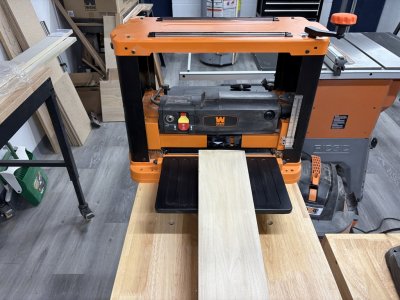
Getting the wood came next. I purchased (more than) enough of this material from a local Menards. This was done after making sure that their poplar was truly the type I needed and not Aspen which is sometimes marketed as Poplar in similar stores. The cost was higher than purchasing the building material at a local lumber yard; however, the wood I purchased was of very good quality and little waste would be made during the milling process. At the lumber yard Yellow Poplar boards contained more knots and would need to be split with a band saw prior to finishing to the desired ½” sheets needed for the lifts. The wood I did purchase could go straight to the thickness planer. I have a Wen 13-inch Spiral Blade Benchtop Thickness Planer that does a fine job thinning material. It can produce flat boards down to 1/8” thick (thinner if you ride your material on another board). I find the thickness planer to be a ‘safer’ alternative to using a jointer if the wood is already square. It turned out that I used 16' of 6" x 1" popular boards from Menards. The actual dimension of their boards is 5 1/2" x 3/4".
 
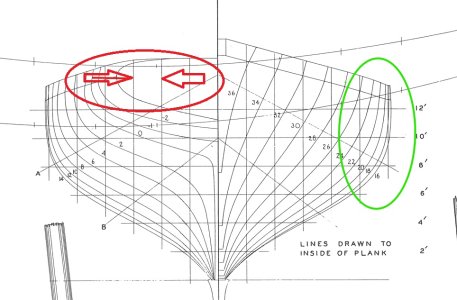
Here's a look at the body plan for Gracie S.:

1762729583372.jpeg

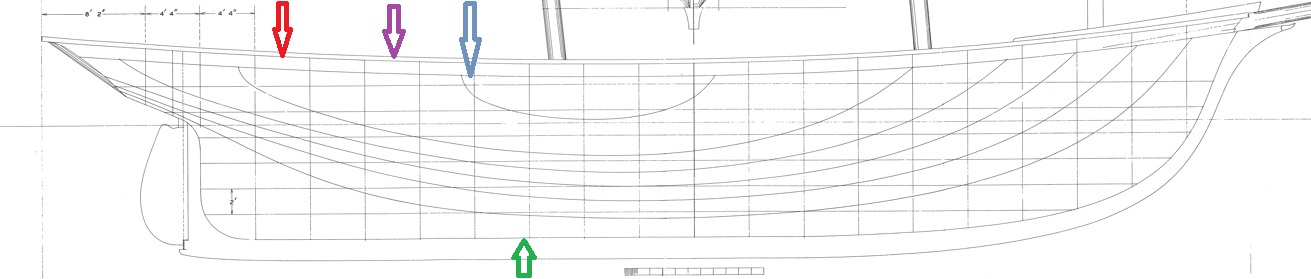
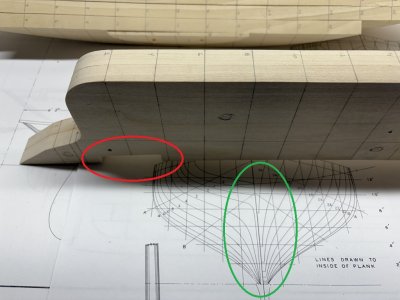
The vertical lines are define the width of the buttock / vertical lifts. The width at 1:48 scale (red arrows) is 1/2", with the exception of the most exterior lift (circled in green) which is slightly wider. Thus for my purposes I needed to prepare a good amount of 1/2" thick material and a little bit of ~ 5/8" material. Here the thickness planer is connected to the shop vac and ready to thin some wood.

It is also very important to observe the printed comment: 'LINES DRAWN TO THE INSIDE OF PLANK'. Should one use the plans as drawn for a solid hull, which I will be doing, the expectation is that the hull will later be planked. If one wished to make a solid-hull model of Gracie S. that was not to be planked, then the plans should be redrawn to account for the planking thickness.
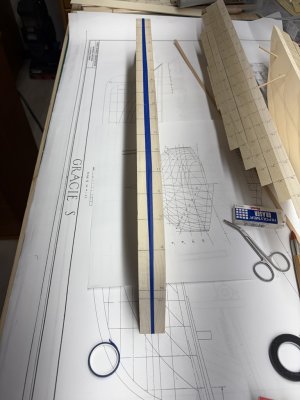
1762729885242.jpeg

I'm lucky to have the space and resources to own some larger machines (many of which I will put to good use in this project), but there are other ways to get the job done. You may have a friend or relative that has the machinery to mill the wood, there may be an 'open shop' nearby where you can get time on the needed tools, or you may find a business to mill your wood (locally or an online order). Perhaps you rely on hand tools and could get out one of those large planes (maybe not!).

Another alternative is to choose the scale of you model to match the wood you can easily obtain. For example, Gracie could be modelled at 1:96 scale where the lifts would be 1/4" - a standard thickness of basswood sheets at the local hobby store. Or if you like these 3/4" thick Poplar boards, you could increase the scale so that the lifts are 3/4" inch - no milling needed, but the hull would approach 3 feet in length!

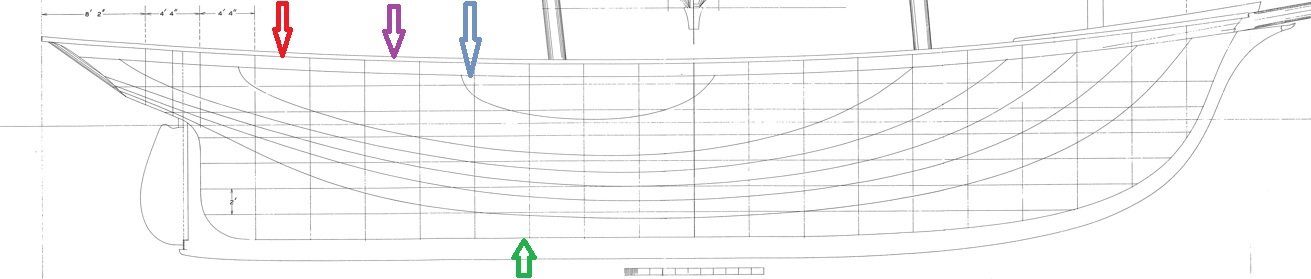
The shape of each lift is read from the sheer plan. I've placed a few arrows on the plan so that a few notes can be made. The purple arrow marks the top of the cap rail, the red arrow marks the top of the bulwark, and the blue arrow marks the sheer at the (aft) deck. The fore deck is dropped below this line. The green arrow marks the division of the middle lift and keel/stem/stern structure.

I needed to make a decision as to build the solid-hull to the top of the bulwark or to the sheer line. Ultimately I plan on having a planked deck, waterways, and bulwark stations visible on the model. To do so I will need to have the hull structure stop at the sheer line where the waterway will be placed. Hence I can originally build to this line - or I build higher and then remove material. It should also be noted that the hull has tumblehome aft. A plus to building to the top of the bulwark and then removing it is that you can better continuously shape the hull to bulwark juncture - but then some care is need to remove the excess material. Conversely, building the solid-hull to the sheer would require additional attention to the hull shape at he bulwark juncture.

I decided to cut all my lifts to the sheer line as shown in the plans. But I am considering a compromise between the two options - temporarily attaching material to represent the bulwark during the hull shaping process.

1762731053536.jpeg
 
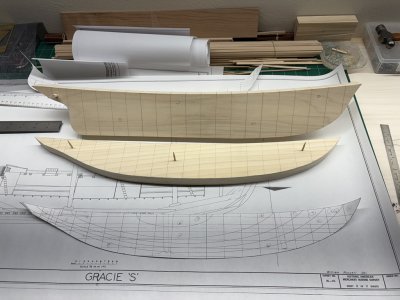
Fabricating the lifts went smoothly. I started the work this past Wednesday and had the lifts completed yesterday (Saturday). Three days of work, as Thursday I needed to have an endoscopy and for some reason its advised that you don't use machinery the rest of the day. Here's the result:

1762733502287.jpeg

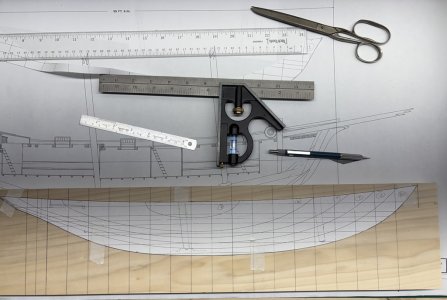
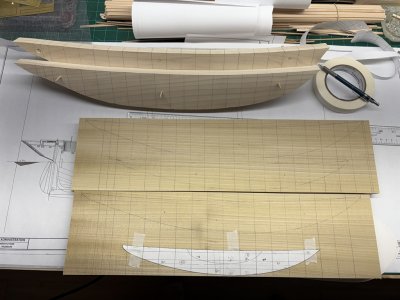
The lifts were made in order from inside to outside. I started by cutting a copy of the sheer plan along the outline of the 'middle' lift - so along the sheer (blue arrow) and around the keel structure (green arrow). the plan was taped to a milled board and the outline of the shape was transferred to the board along with the station lines. This board was doweled to a match board and then the outline of the lift was cut on a band saw. The shape was then finished using a spindle sander. The process was repeated for each lift - remembering that the last (smallest) lift was made from thicker material.

1762733584525.png

Here's the process illustrated for the second lift. The sheer plan has been cut to the profile of the second lift and taped, using drafting tape, to a piece of wood that has station lines marked. While the sheet of paper is not as stiff as a posterboard template, I still find it as or better to use. First, with a good pair of scissors I can cut the paper closer / smoother to the printed contour. Once it is taped in place, I use one hand to keep the paper tight to the wood during the tracing process. I use drafting tape because it releases easily from the plan that needs to be used a few more times!

1762734041300.jpeg

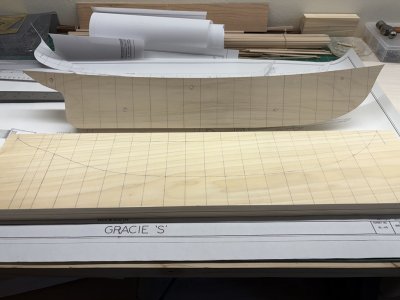
After the plan was removed the board was clearly marked. Note in this picture the middle lifts have been doweled with 1/4" poplar dowels. When I showed the middle lifts in the Teachers Lounge, bamboo skewers were recommended as an alternate doweling material. I gave it a try in the second lift and liked it - so the remaining lifts all got skewered.

1762734053650.jpeg

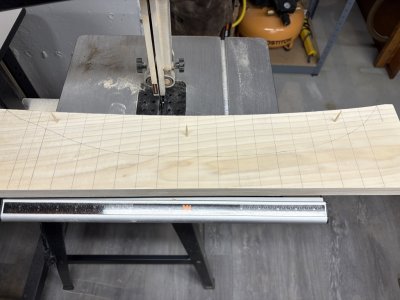
Unfortunately, I didn't take a picture of an intermediate step between these two pictures. The marked board was clamped to a matching board and holes for the skewers were drilled on a drill press. Each lift was cut at the deck sheer first and then brought to the thickness sander. I wanted to have the best chance I could have for the top curve of each lift to match when they were assembled. Sanding the top curve with excess material on the ends also minimizes the chances of sanding a dip at the ends of the lifts.

1762734072529.jpeg

In this picture the sheer has been sanded and the piece has gone back to the bandsaw for the lower edge to have been removed. Now some more sanding is to be done. I used 150 grit sanding sleeves for this work. I took this picture with the lift sitting on the 'back-side' of the table was a reminder to me as to how important it is to keep the work piece flat on the table if a right angle is desired. Also, there is a lot more room on the back of the table to steady the work piece than on the front-side.

1762734086816.jpeg

With the sanding done on lift two it was time to move on; cut another piece off the sheer plan, ....

1762734127003.jpeg

Two sets of the smaller lifts fit easily on the 5 1/2" wide Yellow Popular - here lifts 3,4,5, and 6 are laid out. Number 7 got its own smaller but thicker piece of wood.

1762734140570.jpeg

That's how I did the work. Obviously, the drill press is not absolutely needed - a hand held drill would do the same. Having the bandsaw - even the light duty 10" Wen bandsaw I have - is a luxury, the same work (albeit slower) can be achieved with a coping saw. Likewise rasps, files, and sandpaper could be used in place of the spindle sander. Here again, choosing the scale / size of a model can be influenced by the tools you have at hand. Making a solid-hull Gracie S. at the 1:96 scale would not be overwhelming with a collection of hand tools.
 
It took some time yesterday and today to complete two tasks. The first was to extend the station lines that you could see in the previous post and extend them around the cut pairs of lifts. This was accompanied with a very important task (for me) - numbering all of the stations along the top of each lift. Having the stations labeled will help with shaping later; but now, they have the very important role in making sure all the lifts are connected in the correct locations.

The second task was to extend the holes for skewers from each lift pair to the pair inside of it; i.e., the second set of lifts needed to be pinned to the first (middle) set, third to second, and so on until the outer seventh set was pinned to the sixth set. To do so, for example, I aligned and clamped the pair of second lifts with one of the third lifts making use of the marked / numbered stations. At this point the pins were still in the second pair. After the three pieces of wood were clamped, the pins in the second lift were removed and then drilled through the third lifts pin positions though the pair of second lifts. This was repeated for all pairings.

Once these tasks were completed, Skewers were cut it just under an inch and all the lifts were pinned together. At this point I noticed an error in my work - the outermost lift was not to be thicker - it was to be much thinner. After making the thicker lift, it kept running through my mind - how is such a small lift that thick going to be able to fair into the hull? Seeing it pinned on was a clear not right signal and another look at the plans told me to thin the lift down!

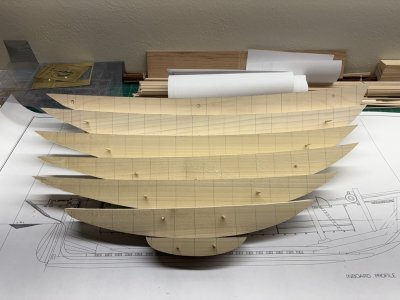
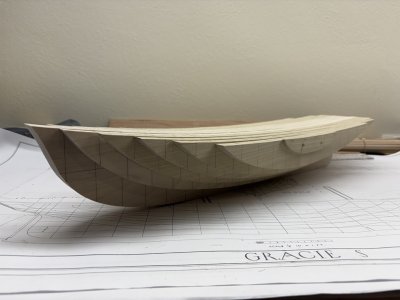
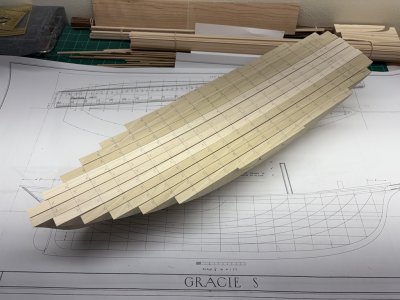
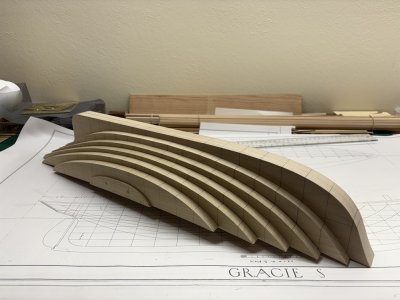
Now everything is in order and here are a few pictures that show what the hull block is going to look like before A LOT of wood is removed!

1762917548513.jpeg

1762917525062.jpeg

1762917501412.jpeg

After a few minor adjustments the lifts will be ready for gluing. But I can say now, that I will not be gluing everything together right away. Currently I plan on gluing the two middle list together and then doing some preliminary shaping where the keel joins as well as removing some material were the cockpit drops into the hull. After that is done I'll be adding more lifts.
 
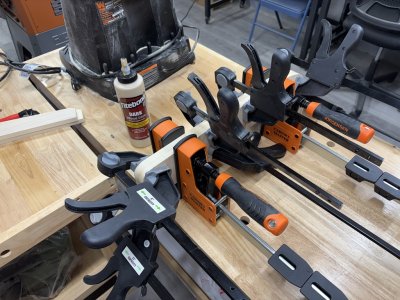
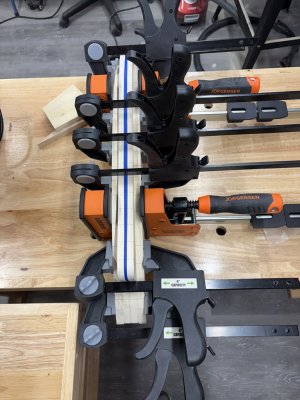
First stage of the glue-up. Just the inner two lifts. For these, I have chosen to use Titebond II Dark Wood Glue. This should leave a very thin dark glue line along the middle of the hull; i.e., it should emphasize the joint between the two inner lifts.

Clamping was 'practiced' before gluing!

The claim is that this glue fully cures in 24 hours - time to plot the next move!


1762996009587.jpeg
 
PVA glue can also be colored if you don’t want to buy specially colored stuff. A little brown poster paint powder does the job and doesn’t seem to affect the strength of the joint.

Roger
 
back when the model club and shop at the museum was in full use one of the builders who built solid hull models always used

Resorcinol glue, also known as resorcinol-formaldehyde, is an adhesive combination of resin and hardener that withstands long-term water immersion and has high resistance to ultraviolet light. The adhesive, introduced in 1943, has been popular in aircraft and boat construction.[2]

Until the invention of epoxy resin, resorcinol was one of the most common marine glues. Unlike epoxy, it does not have gap filling properties, requiring joints to be close fitting and clamped under pressure to achieve good results. The glue comes in two parts, a deep red syrup and a light brown powder, that are mixed to form a dark reddish-brown glue.
 
PVA glue can also be colored if you don’t want to buy specially colored stuff. A little brown poster paint powder does the job and doesn’t seem to affect the strength of the joint.
Powder sounds like a great way to go. You can also add a drop of acrylic paint mixed in with the glue. It works without degrading the strength of the glue enough to be a concern. I did test pieces years ago that were glued together then I tried to break them apart the next day. The wood splintered without the colored glue joint coming apart.
Allan
 
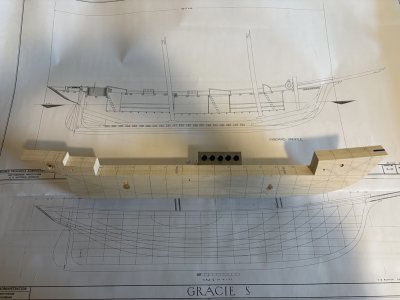
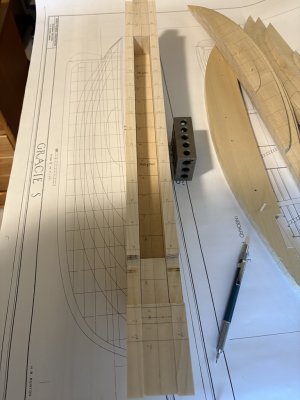
The middle lifts have been released from the clamps. I cut a recess into these lifts for the cockpit (red outline). The measurements for the recess were taken from the Inboard Profile. Moreover, the LWL, not the deck sheer, was used as the reference for the depth of the cut. The deck sheer on the Inboard Profile is higher than the upper edge of the lifts' top. This is due to the deck camber which presents the deck higher on the Inboard Profile.

The dark glue left a very thin, but visible, division that can be used to center the keel structure. As a next step, I plan on using the Body Plan to measure (and then mark) the width of the keel at each station. A smooth curve will then be drawn through the marks to delineate the region of attachment. It should be easier to secure just these middle lifts when marking the keel joint as opposed to having all the lifts connected together.

1763084076016.jpeg
 
Some additional progress. Using the body plan, I marked out the keel joint width dimensions on the middle lifts. I then used tape to cover the region that the joint with accompany. Later I will shellac and paint exterior to the tape so that I have a nice reference for shaping this portion of the hull.

Keel Joint Location Taped Off.jpg

I finalized my decision on how much (if any) additional material would be removed from the center two lifts. I have now removed material down to the LWL between the cockpit region and station 30. Station lines were remarked as were the center locations for the passage of masts at the LWL. Notice that there still is plenty of surface for gluing the next set of lifts.

Middle Lifts Interior Cut to LWL.jpg

When the second set of lifts are placed in position the inch wide slot will later allow for a plug (made from the cut out material) to seat and allow the hull to be held steady for shaping.

Open Region in Middle Lifts.jpg

The second set of lifts have been glued and are now clamped and drying. I used regular Not wanting the joint to be visible, Titebond Wood Glue was used here.

Second Lifts Glued to Middle Lifts.jpg
 
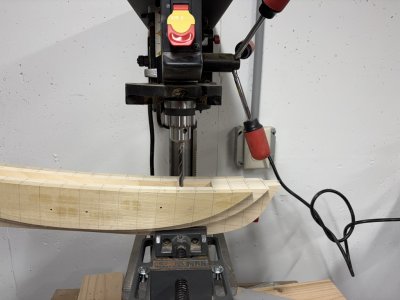
I drilled holes for the masts today. This was probably my last opportunity to easily do so. In fact, it would have been prudent to have done this when either two or four of the lifts had been glued up. Nevertheless, it went well; the hull lifts were clamped at the correct angle and set up on the drill press to have the work done.

Drilling Hole for Fore Mast.jpg

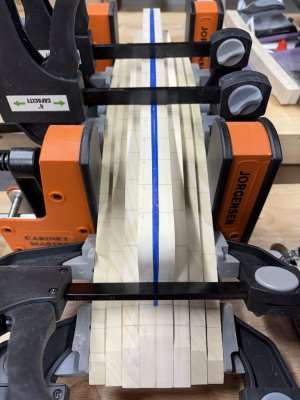
Then another pair of lifts were added - now there are two full-size pairs and the very thin exterior lifts left to glue in place. I'm thinking the 6" capacity clamps are not going to be useful much longer!

While it does take more time than gluing up most or all of the lifts a one time, the reason that I am gluing one additional pair of lifts at a time is two-fold. One, I can insure more precise alignment of each lift; and two, using a slightly different clamp-up at each stage helps insure that each lift is held tightly to its neighboring lift.

I may be overdoing it, but each gluing has been left clamped for a full day - well beyond the minimum clamping time listed on the glue manufacturers information sheet / bottle. I have read of projects that have gone astray by unclamping too soon. Apparently you can clearly unclamp too soon, but there is also a phenomena known as glue creep to avoid - just not sure how often this happens in model building. Anyway, since there is no rush, the clamps are staying on a long time.

1763419843477.jpeg
 
Thank you for sharing this build log, it's fascinating to see how the lift technique comes together. I've been considering giving it a try in the future, because I've found it quite difficult to find good modeling wood here in Mexico City. Pine is really the only readily available wood, at least in the city, and seems like it would work well enough for a hull made from lifts.

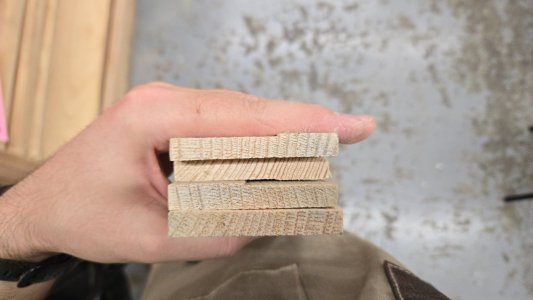
Getting it properly thicknessed without the right tools is hard, though, and is a vital step to get the hull lines right. My most recent order of pine came in with some serious ridges and inconsistent thicknesses, as can be seen below, and required a lot of time with a handplane to get into workable shape--at least workablr enough for a produce crate, but not consistent enough yet for a lift model.
20251025_165317.jpg

In any case, I'm looking forward to following your build!
 
Woods can be tricky as they often have different names depending on where you live. Real pine is a great choice for building ship models using this lift technique aka “solid hull.” It is the method used by professionals for building models to be tested for hydrodynamic resistance in towing tanks and is specified for exhibition models by the US Navy and museums.

Here in the USA pine can be found in lumberyards and home improvement stores for construction and DIY projects. Unfortunately if you read the fine print, the wood in the pile at the store is SPF (Spruce Pine Fir). Sort through the pile to find the pine. Spruce is distinctive. It is by far the lightest and has a distinct, to me unpleasant smell. Fir has a bold grain. The very wide 10” and 12” x1” select grade pin is sometimes received with cracks in the ends. Rather than downgrading the entire piece the seller will crop 2 ft containing the crack and sell a shorter board. The 2ft crop is sold in the bargain bin. Our local Menards charges $2.50. This piece can be ripped to eliminate the crack to provide a lot of inexpensive model building wood.

The 1” thickness of this lumber is a nominal dimension. The actual thickness is 3/4”, sometimes 13/16”. Either of these dimensions probably will not match the spacing of the waterlines or buttocks on your lines drawing. If you have access to a planer, you can of course, easily reduce your lumber to the required thickness. If not draw new waterlines or buttocks spaced to match the thickness of your lumber on your lines drawing body plan and plot the results on the sheer or half breadth view.

My technique differs slightly from Greg’s in that I cut the lifts a little oversized. This gives me a little “Kentucky Windage”when carving.

I find that this lift method gives me a solid durable hull upon which to build a model and I enjoy seeing the hull’s lines appear while shaping it.

Roger
 
My technique differs slightly from Greg’s in that I cut the lifts a little oversized. This gives me a little “Kentucky Windage”when carving.
My lifts are approximately two pencil 0.5mm lines oversized from the tracing process - so 'plenty' of excess to work with ;)

Pine is really the only readily available wood
Can you get 1/4" basswood (or other) from a hobby or craft shop? If plans have 1/2" lifts, you can reduce the scale by 1/2 - or you can keep the scale the same and use the body plan to draw additional intermediate lifts for either waterline or buttock lifts. Then cut, and glue, twice as many as seen in the original plans. More work in making the lifts, but then less work in shaping the resulting block as the thinner lifts provide a refinement in the volume approximation. (A better Riemann sums approximation, from calculus!)
 
Thanks, all!

Here in the USA pine can be found in lumberyards and home improvement stores for construction and DIY projects. Unfortunately if you read the fine print, the wood in the pile at the store is SPF (Spruce Pine Fir). Sort through the pile to find the pine. Spruce is distinctive.
I'm not sure what exactly is sold here, but I'll keep an eye out. The lumber I get is through big orders with a woodworking workshop I attend, so I've never had the chance to sort through a pile at the store.

Can you get 1/4" basswood (or other) from a hobby or craft shop?
Unfortunately the only basswood I've found here is 1/16-inch sheets, the only other wood I've seen is balsa which I've found too flimsy when I've tried to use it in the past. I suppose I could build up layers and/or try to make a really tiny miniature hull. Most of the modeling wood I have was brought in my luggage from trips to the US. I was recently able to get some 1/4-3/8‐inch boards of more local woods--xochicuahuitl and manzanillo--on a trip to Veracruz. The manzanillo in particular may work better, as the xochicuahuitl is so beautifully figured that it would be a shame to make lifts from it, and those boards are rather variable-thickness to begin with. But I'll have to see how the manzanillo is to work with, first, as the boards are still acclimating to Mexico City's drier climate--one warped pretty spectacularly, the others are holding straight for now.

My apologies for taking over your log with a discussion of Mexican lumber!
 
Yeah, Greg’s posts are more about demonstrating a scratch building technique than being an actual build log. As such discussions related to the building technique are encouraged. Selecting and milling the wood is part of the building technique.

Roger
 
Back
Top