

• Win a Free Custom Engraved Brass Coin!!!
    As a way to introduce our brass coins to the community, we will raffle off a free coin during the month of August. Follow link ABOVE for instructions for entering.
  • PRE-ORDER SHIPS IN SCALE TODAY!

    The beloved Ships in Scale Magazine is back and charting a new course for 2026!
    Discover new skills, new techniques, and new inspirations in every issue.

    NOTE THAT OUR FIRST ISSUE WILL BE JAN/FEB 2026

Thoughts on Making Deck Clamps

Joined
Jan 31, 2021
Messages
814
Points
403

Location
Loveland, CO
I'm faced with making the Deck Clamps to support the beams for the main deck.

The plans show (and I love the look of) angled mortise/tenon for the beams to fit into.

I feel making the angled mortise joint will be extremely difficult after the beam is glued in place. Has anyone had success doing this way and have any advice?

Making them before installation of the beam seems straightforward for the parallel midbody BUT the curved stern/bow has me stumped. Has anyone done them before installation and have any advice?

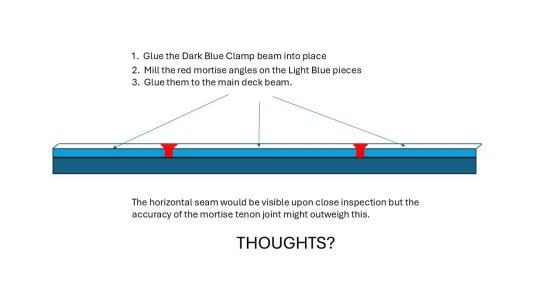
Finally, has anyone tried doing them this way:
1. Installing the bottom 3/4s of the deck beam (no notches).
2. Then cutting the mortise on a separate piece (the top 1/4 of the beam) to make the notch.
3. It would look something like the below photo:
Beam support.jpg

Any feedback appreciated!
 
The plans show (and I love the look of) angled mortise/tenon for the beams to fit into.
Hi Brad,

What ship/nation/year? At least for British warships in the age of sail the mortise in the upper strake of the deck clamp was typically 1 inch (about 0.25mm at 1:96, and 0.5mm at 1:48) This can be done even after the clamp strakes are in place with a small sharp chisel, hobby knife or file. It is so small, you can mortise the end of the beam, and it will appear the same as if the clamp was mortised as was actually done. At 1:96, maybe not worth the trouble to try to make a 0.25 mm mortise in either the clamp or the beam. As the upper strake of the clamps (there were usually two or three strakes for the clamps) were about 14" to 18" broad, the depth would be 1/14th to 1/18 deep, not 1/4 deep. Looking at various sources I cannot find any mortise being 1/4 the breadth deep. Are the plans you mention from a kit or otherwise modern drawings or are they contemporary plans?

I would not try to cut the mortises before installing the clamps. The chances for perfect alignment of every beam are possible but not likely and not easy to do.

Allan
 
Last edited:
Hi Brad,

What ship/nation/year? At least for British warships in the age of sail the mortise in the upper strake of the deck clamp was typically 1 inch (about 0.25mm at 1:96, and 0.5mm at 1:48) This can be done even after the clamp strakes are in place with a small sharp chisel, hobby knife or file. It is so small, you can mortise the end of the beam, and it will appear the same as if the clamp was mortised as was actually done. At 1:96, maybe not worth the trouble to try to make a 0.25 mm mortise in either the clamp or the beam. As the upper strake of the clamps (there were usually two or three strakes for the clamps) were about 14" to 18" broad, the depth would be 1/14th to 1/18 deep, not 1/4 deep. Looking at various sources I cannot find any mortise being 1/4 the breadth deep. Are the plans you mention from a kit or otherwise modern drawings or are they contemporary plans?

I would not try to cut the mortises before installing the clamps. The chances for perfect alignment of every beam are possible but not likely and not easy to do.

Allan
Allan,
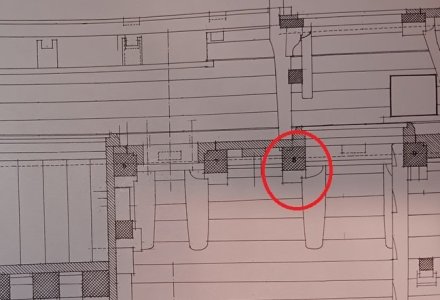
French mortar ship Salamandre. 1:48 scale, plans by Boudroit.

Looking at main beam 8 (circled). It measures 13"x13". It is cut into the deck clamp 4" and the deck clamp is 13" (about 25-30%).

I agree, cutting the mortises BEFORE would be extremely difficult to get perfectly perpendicular beams. I've got some good sharp micro chisels to cut the in place but the tumblehome of the hull and tight working space at bow stern make it seem like it will be difficult.

BUT cutting those angles (on a scale strip 4" thick or 25% of the deck clamp), OFF the model would allow for extreme accuracy of both the joint and keeping the beams perpendicular.

Appreciate any more thoughts you might have after seeing Boudroit's drawing.

Salamandre beam support size.jpg
 
I have no experience with his work but would trust that Jean Boudroit did a ton of research on something like this. Never having had to cut such deep mortises on such small clamps I am not sure what route I would take, cut in place or off the ship. Sometime in the past I remember learning a good rule of thumb was that the depth of the mortise should never be more than two thirds the thickness of the piece.
Sorry this is no help in answering your question. :confused:
Allan
 
A bomb vessel would need extreme structural support because of its job. Vessels that do not experience the extreme downward vector shock and force would be a bit less in scantlings and joinery would be my prediction.

The loop that I am on has prevented my getting there but I intend to set my deck beams on top of the clamp. No notches. I intend to lock them in place by added a timber on top of the clamp - between each beam - just as you propose.
My intended display is entirely external. If it cannot be seen with the completed vessel, I will not show it. I intend to fully plank each deck that is visible.
This saves dealing with carlings, ledges, hanging knees and lodging knees. The galley oven is a pipe. Black paper off set from windows so no parquet or furniture in officers' country.

So, I agree with your intention re: the beams. I just do not care about the looks.
 
There's an old saying, "House framers work to the closest quarter inch, finish carpenters work to the closest eighth of an inch, and shipwrights work to the closest ship." The meaning is that there are few straight lines that would permit the use of a ruled measure cut on a ship or boat which are pretty much all oddball angles, bevels, and curves. It's easier to get a tight fit working the pieces in situ on a ship or boat.

The first question I'd ask is whether anybody's going to see it after the hull is closed up. If not, I'd consider whether it wouldn't be easier to lay the covering boards first and then glue the deck beams to the corner between the underside of the covering board and the frame. Then I'd glue a clamp running the length of the hull beneath the deck beams. It should be plenty strong for a model and save you the trouble of fitting all those mortises.

Just a thought.
 
Bob, Allan, Jaager,

Thanks for the feedback. It made it obvious that the internals of the joint won't be visible, so a parallel or angled mortise/tenon joint is irrelevant!

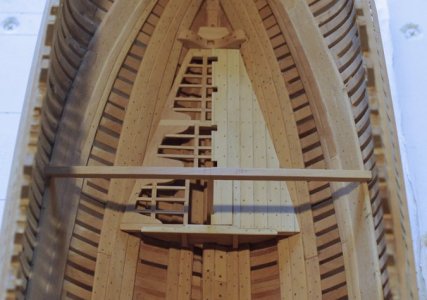
My plan then is to cut small mortises on top of the deck clamps. Similar to Toni's (Director of NRG) build of HMS Atalanta 1775, see a photo from her log below:
Deck Beam.jpg

I appreciate your feedback which helped me see the obvious!!
 
Last edited:
If you’ve seen log on my Le Rochefort, I abandoned trying to get make dovetails and simply made straight cross lap joints for the deck clamp. I’m doing the same for the waterways.
 
If you’ve seen log on my Le Rochefort, I abandoned trying to get make dovetails and simply made straight cross lap joints for the deck clamp. I’m doing the same for the waterways.
Thanks Olivier, I did see that. Since it gave you problems, that's why I'm looking for tips. Still debating if I'll give them a try?
 
Back
Top