• Win a Free Custom Engraved Brass Coin!!!
    As a way to introduce our brass coins to the community, we will raffle off a free coin during the month of August. Follow link ABOVE for instructions for entering.

Tools and Misc. for Polaris build?

Joined
Dec 16, 2024
Messages
17
Points
28

Hi!

My Occre Polaris is on the way! I'm super excited. I ordered it with the basic tool set and the paints. I've watched over half of the build videos Occre published on YouTube. I noticed lots of little odds and ends being used that I do not have. I was wondering if anyone had specific recommendations on some of these items:

Glues: It comes with 'white glue' but in the video they used contact cement and 'fast glue'. Is there specific type or brand of contact cement that is recommended? Is fast glue Super Glue? Any recommended brands/options?

Sand Paper and Sanding Blocks: The basic tool kit comes with one of the sanding blocks they show in the video but there is also a curved one, a tiny foam one, etc. It also wasn't always clear what grit was being used. What is a good source to find stuff like that? I haven't had any luck searching on Amazon.

Files: They use several different types and sizes of file. Is there any file sets or kits or other methods of acquisition recommended to get my collection started?

Clamps: I have a few clamps but they use several different types. Are there any specific sources, brands, sizes, how many, etc. I should be sure to have on hand for my first build? Any recommended starter packs?

Planking Tools: They use the water soaking method for plank bending but I watched the videos (forget the guys name) of planking using a travel iron and I think I would like that technique a lot better. Are there any recommended odds and ends I should have on had to do that? E.g., he uses some scrap pieces but I won't have any scrap pieces since this is my first build, so I'm wondering if there is a kit or something? I found a cheap travel iron on Amazon that I think will work.

Misc: What else would be essential or just nice to have for my first build? I have a remaining budget of $315US to get tools and accessories to complete this build, not including a display stand.

Thanks!

P.S. Tweezers! I forgot to ask about tweezers.
 
Last edited:
Where to even begin?

A variety of hobby knives, but exacto #11 is essential.

Quality set of Jeweler’s file. Let me say that again; QUALITY jeweler’s files

Wet and dry sandpaper in a variety of grits, but you shouldn’t need much courser than 150. Sanding blocks can be created from scrap to suit your needs as you go. Use contact cement or spray adhesive to attach sandpaper in the size and shape you need.

Razor saw with or without miter box

Digital calipers and small steel ruler

Clamps, all kinds. Can never have too many. I’ll post a photo shortly of the clamps I use for planking.

White glue or wood glue for general assembly. CA glue has its uses, but I use it sparingly.

So much more….
 
I think your query is likely to me met with a plethora of responses and an extremely long list of suggestions. One of the aspects of modelling I find satisfying is the acquisition of new tools. I now have a lot but started off with relatively few and built up. Things I find I use a lot are:
A digital caliper, cordless mini drill, razor saw various pliers, tweezers, cutting knife, small hammer, tweezers ( including reverse tweezers), small files.
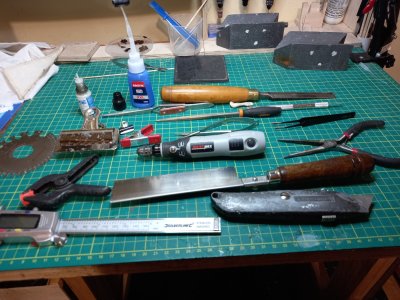
Clamps are of limited use because ship hulls have few parallel surfaces. A variety of clips are an asset. I have chucked a sample of useful things on my bench and append a photo. The small vape juice bottle is a handy pva glue dispenser!
Toolss.jpg
 
Glues: The glue they include as "white glue" is what we call PVA. It is great to use for almost everything. yes, "fast glue" would be a CA glue. there are many brands and different thickness. I almost only use the "meduim" thickness. Unlike the thin glue, it is a little easier to control where it goes and it will fill a minor gap whereas the thin glue you need to have a perfect mate between the surfaces. I have not used contact cement for a ship in a long time. I just use PVA glue in it's place. I will use the thin CA to glue knots in rigging. Just a VERY small amount.

Sandpaper and blocks: You will never have all the shapes you need. The easiest thing to do is just find something with the shape you need and wrap sandpaper around it. I don't know what comes with the kit, but you will always be able to use sandpaper. Get a good assortment from 60 or 100 grit up to 220 or 320.

Files: same rules as sandpaper and blocks. However, whatever you can do with a file, you can do with sandpaper. :)

Clamps: You will never have enough or the right shape. For planking, I use binder clips with a piece of wood stuck under it to hold the plank down. I also have bar clamps (the very small ones that are about 5" long) and rubber bands, etc.

Planking: there are a number of different methods that people use and they all work. :) Now I use a specialized tool that looks like a soldering pencil with a disc on the end. Previously, I would clamp a regular soldering iron in a vise, soak the wood for a few minutes and bend the wet plank over the hot iron into the shape I needed. You want to keep the wood wet for this method. You should be able to shape the plank into form you need without any pressure on the clamps when you attach it to the frame.

For the tweezers you forgot to ask about, yes, you will want some. Also, you may want some of what is referred to as "spring hooks" for rigging.

Misc: This is a tough one because everyone has different likes and dislikes. I would say wait until you find out which part of the process you like the least (hopefully you will LOVE them all :) ) and get something to make that easier. A few things that were not mentioned is a cutting mat (it was determined that by the group here that green helps you the most LOL ) , a good quality steel ruler (you will need both standard and metric. Get used to it. :) ) and a few small squares or something you can use to make things are square like machinist blocks. Or maybe both. A decent razor saw with the little miter box for square cuts.

Also, even this early, you want to start thinking about how you want to finish your model. Are you going to leave it in wood finish, or paint the hull?

So many other things to discuss, but this will get you started and keep you going for a bit.

Oh and of course, if you have a question, don't hesitate to ask here on the forums. You will probably get more answers than you want with 20 different ways to do something. LOL

Jeff
 
Optivisor is another essential for old dudes like me.

My Handy-Chopper from Northwest Short Line gets a fair bit of use.

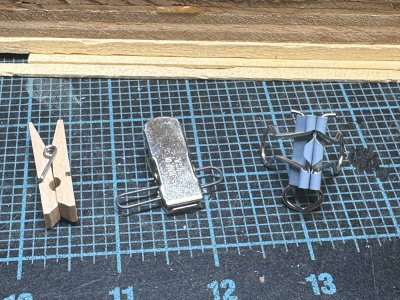
Here’s what I use a lot for planking:
IMG_5200.jpeg
The clamps on the right were made with the smallest binder clips I could find. I removed the handles from 1/3 of them and inserted those in the jaws of the remaining clips. The middle clamps are the clips from coffee bags with a paper clip inserted in the hole through the hinge. Those can get into tighter spots than the binder clips. On the left is a tiny clothes pin. I got a package of those at the Japanese equivalent of a dollar store
 
OMG! How could I forget the most crucial, most indispensable tool in the modeler’s arsenal?! A green cutting mat—green is essential, what gives the mat it’s magical powers ROTFROTF
I cannot wait to learn about the origins of that inside joke! I've seen reference too it a few times now.

Thanks for all the suggestions everyone! Some very clever DIY ideas in there. I ordered a few items from Amazon so I think I've got a good kit on the way. Looking forward to starting my build log. Already got my workspace prepped and ready to go. C'mon FedEx!

By the way, how important is a work stand? I see some very cool (home built?) ones in some of the build logs but I saw one on the Occre website as well. Seems like an essential item. Thoughts?
 
I cannot wait to learn about the origins of that inside joke! I've seen reference too it a few times now.

Thanks for all the suggestions everyone! Some very clever DIY ideas in there. I ordered a few items from Amazon so I think I've got a good kit on the way. Looking forward to starting my build log. Already got my workspace prepped and ready to go. C'mon FedEx!

By the way, how important is a work stand? I see some very cool (home built?) ones in some of the build logs but I saw one on the Occre website as well. Seems like an essential item. Thoughts?
I have a few different stands suited to different purposes. The best ones are homemade.
 
Here's a link to a home made keel clamp built by a fellow S.o.S'er. I made one similar and works very well.

 
I have been building models for longer than many forum member have been alive. Allow me to pass on things learned from experience. Ship modeling is like golf; It is difficult, easy to acquire habits that impair good performance, and full of gadgets advertised to make everything difficult, easy. Therefore:

Learn to differentiate between specialized tools actually required for the project that you are working on and those that can be adapted from things that you already have. For example, a razor saw is an essential tool. Regular saws are too coarse and will tear thin wood. Sanding blocks are a waste of money. They are easily made from scrap lumber. A set of jewelers files, about a dozen different shapes, is also essential. Sandpaper can be bought from any home improvement store. As soon as it stops cutting throw it out and use a fresh sheet.

Good tools will last a lifetime. I regularly use ones over 50 years old.

Glue: the PVA family glues is ideal for most of our needs. They are non toxic, water resistant, and stable. Epoxy, and old fashioned nitrocellulose glue (Duco) work for difficult gluing jobs. I avoid CA (super glues). Fumes can cause a nasty allergic reaction, and I am unsure of their longevity. Avoid contact cements. They have poor longevity. Learn how to fasten things without having to resort to these poor adhesives. Experienced modelers do not rely on glue alone. Where possible, glue supplements a mechanical fastener such as a wooden peg or a metal pin.

I have four vises in my shop; each serving a different purpose. Start with one small vise that can be permanently fastened to your workbench or if necessary be clamped to a table. Get in the habit of clamping work in it

A 12in metal rule (mine came from Target, $1.00) is used daily. In addition to measuring things, it is used as a straight edge. In addition, you will need a square. The little engineers squares work well. Also, get something to keep pencils sharp and get in the habit if using it!

Roger
 
An item I did not see mentioned above is quality lighting. Overhead neon bench lights are find, however at my age, 80 years and still building, I can not due without the LED light stand with adjustable arms I have on the bench. They are not very expensive and readily available.
 
I made one from a cut up pool noodle
Nice! I presume a large one cut in half or something like that?
Here's a link to a home made keel clamp built by a fellow S.o.S'er. I made one similar and works very well.

I like that! Does every model ship have a clampable keel like that?
I have been building models for longer than many forum member have been alive. Allow me to pass on things learned from experience. Ship modeling is like golf; It is difficult, easy to acquire habits that impair good performance, and full of gadgets advertised to make everything difficult, easy. Therefore:

Learn to differentiate between specialized tools actually required for the project that you are working on and those that can be adapted from things that you already have. For example, a razor saw is an essential tool. Regular saws are too coarse and will tear thin wood. Sanding blocks are a waste of money. They are easily made from scrap lumber. A set of jewelers files, about a dozen different shapes, is also essential. Sandpaper can be bought from any home improvement store. As soon as it stops cutting throw it out and use a fresh sheet.

Good tools will last a lifetime. I regularly use ones over 50 years old.

Glue: the PVA family glues is ideal for most of our needs. They are non toxic, water resistant, and stable. Epoxy, and old fashioned nitrocellulose glue (Duco) work for difficult gluing jobs. I avoid CA (super glues). Fumes can cause a nasty allergic reaction, and I am unsure of their longevity. Avoid contact cements. They have poor longevity. Learn how to fasten things without having to resort to these poor adhesives. Experienced modelers do not rely on glue alone. Where possible, glue supplements a mechanical fastener such as a wooden peg or a metal pin.

I have four vises in my shop; each serving a different purpose. Start with one small vise that can be permanently fastened to your workbench or if necessary be clamped to a table. Get in the habit of clamping work in it

A 12in metal rule (mine came from Target, $1.00) is used daily. In addition to measuring things, it is used as a straight edge. In addition, you will need a square. The little engineers squares work well. Also, get something to keep pencils sharp and get in the habit if using it!

Roger
I love the golf analogy! I work in the golf industry and enjoy golfing (though I'm probably going to be a better ship modeler than I am a golfer!) so I totally get the comparison. Thanks for the tips on tools as well. There is a great antique store near me that has an entire section dedicated to tools and when I was in there last time they had a bunch of weird miniature files. They were just "cute" to me at the time, but now I'm eager to get back and take a closer look.
 
If you have a nearby Harbor Freight they can be a goldmine of inexpensive clamps of all sizes, cutting mats, sandpaper, glues etc. Good lighting is essential. I have bright LED strip lighting and an LED close up light. I also second the need for some optical aid like the optivisor.
 
All the above and.... The most valuable for me is a high quality Optivisor with lighting and adequate work surface lighting that does not shadow.
 
Back
Top