
• Win a Free Custom Engraved Brass Coin!!!
    As a way to introduce our brass coins to the community, we will raffle off a free coin during the month of August. Follow link ABOVE for instructions for entering.

Rotary Tool - Recommendation Request

Joined
May 22, 2025
Messages
108
Points
68

Location
Coral Gables, Florida
I’m sure this question has been asked many times, but here I am again: I’m looking to add a rotary tool to my growing tool arsenal, and I’m not entirely sure which brand or model would be the best fit. There are plenty of great options out there—Dremel, Foredom, Proxxon, and more—so it can get a bit overwhelming.

From Dremel alone, I’m considering the 300, 3100, and 4300 models. On the Proxxon side, the FBS 115/E and the IBS/E both look like solid contenders. Foredom is also an excellent alternative, but its price point is a bit high for me right now since I’m still learning and trying to spend wisely.

As always, I’ll appreciate any feedback. My daughters asked me for a Christmas present, and I need to get Santa ready for delivery!

 
Hi. I have used a Dremel (available at the museum where I do occasional restoration work), and a Proxxon (which I have at home).
I prefer the chuck on my Proxxon, but maybe the Dremel was an old one. I have had my Proxxon for 14 years, constant use and it has sometimes had a hard life when I use it for carving, and no problems whatsoever. The flexishaft is also very good.
Hope this helps.
 
Graham, Thanks so much for sharing your experience! It’s really helpful to hear from someone who has used both. Since I’m just starting out, I’m not sure I’d even notice the difference in precision yet — I imagine that probably depends more on the person using the tool than the tool itself. But it’s great to know how each one performs in real, long-term use
 
I believe my Dremel is an 8250 12V rechargeable with variable speed which I'm very happy with. I have a number of Dremel rotary tools and I've never had one fail me. I still have the first one I bought 45 years ago. The drawback to any rotary tool like this is that it takes off a lot of material even at the lowest speeds. And I'm sure that will be true of any of the tools similar to the Dremel. You can get either the collet style chuck or an chuck with jaws. You can also get a flexible shaft attachment for it. :) There are TONS of bits and attachments !

Oh, you used to need a wrench for tightening the chuck, but I believe all the current ones you are able to use your hand to tighten the chuck.
 
Hi Jeff, thanks for the support. I wasn’t really considering a rechargeable model since I usually work in my garage, but I can definitely see the advantage—some days it’s nice to work out in the garden and enjoy the Florida sun.

On the other hand, I wonder whether the cord might make certain jobs a bit more difficult. I’m guessing the main advantage of a corded unit is the consistency of power, right?
 
I have both a Dremel and a Foredom Flex shaft. There is a place for both, however I prefer the Foredom by a large margin. The Dremel relies on speed for to work and have low torque. I started to get quite frustrated by that.

The Foredom, however, has high torque and can work at low/moderate/high speed. In addition, the variable speed can be controlled by a foot pedal. For modeling, I prefer working at low speed to control the amount a material when sanding. For drilling I can take it slow. For milling, which I have done rarely, you can crack up the speed. The Flex shaft can be in your way though.

If you planning to use only on few occasions.... Dremel would be my pick. If you want low speed and use from moderate or often... the Foredom, which would be more expensive. OR... if you want light sanding and drilling >>manual tools.
 
Last edited:
Hi Jeff, thanks for the support. I wasn’t really considering a rechargeable model since I usually work in my garage, but I can definitely see the advantage—some days it’s nice to work out in the garden and enjoy the Florida sun.

On the other hand, I wonder whether the cord might make certain jobs a bit more difficult. I’m guessing the main advantage of a corded unit is the consistency of power, right?
There have been a few times where I've broken something on what I'm working on because the power cord snagged it. I use the rechargable in my shop mostly.
The only time I take out the corded ones is if the rechargeable runs out of power (which is not that often).
 
I have both a Dremel and a Foredom Flex shaft. There is a place for both, however I prefer the Foredom by a large margin. The Dremel relies on speed for to work and have low torque. I started to get quite frustrated by that.

The Foredom, however, has high torque and can work at low/moderate/high speed. In addition, the variable speed can be controlled by a foot pedal. For modeling, I prefer working at low speed to control the amount a material when sanding. For drilling I can take it slow. For milling, which I have dome rarely, you can crack up the speed. The Flex shaft can be in your way though.

If you planning to use only on few occasions.... Dremel would be my pick. If you want low speed and use from moderate or often... the Foredom, which would be more expensive. OR... if you want light sanding and drilling >>manual tools.
I’ve looked into the Foredom as well, but the cost is a bit high for my current skill level and budget. Still, it’s definitely on my future shopping list for when my skills improve and I start tackling more advanced builds. For now, I’m still working with intermediate-level kits.
 
CarlosE, what type of materials is that tool going to work on as that might help you to determine what tool to get?
i'm using an old Dremel non-variable speed of 28,000+ rpm from about 1976-77 christmas present that would break in half 1/4"x1/2" balsa due to the speed so could not really use til i got an external speed control the following year or so. i now use it mostly to grind/carve glued up layers of styrene plastic into the shape i want. i have a few clones with 1 having a fried speed control board that i am going to rewire to bypass that board & use it with my external speed controller.
 
CarlosE, what type of materials is that tool going to work on as that might help you to determine what tool to get?
i'm using an old Dremel non-variable speed of 28,000+ rpm from about 1976-77 christmas present that would break in half 1/4"x1/2" balsa due to the speed so could not really use til i got an external speed control the following year or so. i now use it mostly to grind/carve glued up layers of styrene plastic into the shape i want. i have a few clones with 1 having a fried speed control board that i am going to rewire to bypass that board & use it with my external speed controller.
Hi David, basically, I’ll be using it for wood and the materials typically involved in wooden ship building, and maybe occasionally for small home-maintenance tasks as well.
 
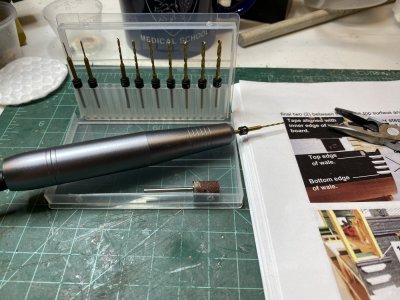
I have a dremel corded and find it very awkward to use. I have been using a nail drill that I picked up from Amazon for $13. It is much lighter weight and easier to control than a Dremel. The shafts are not the same size but arrowmax drills fit it. I use it mostly for sanding and drilling holes. It does not have as much torque as a Dremel but it is more than enough for my needs. I highly recommend it for use on model building.

These tools definitely do not have the torque of a Dremel but they do a decent job especially on the softer woods we commonly use. The great advantage of them, especially for me, is that they are quite compact, fit easily in your hand and are not as bulky as a Dremel. They are much easier to use around delicate parts. The sanding drum comes with a number of different grits and you can buy more cheaply. I use mine constantly while the Dremel is used only occasionally like for cutting metal tubing. You can't beat the price.

Nail drill

https://www.amazon.com/dp/B0DBKQVJHB?ref=ppx_yo2ov_dt_b_fed_asin_title&th=1


Drill set
https://www.amazon.com/AM-ARROWMAX-...d_bap_d_grid_rp_0_1_ec_pd_nav_hcs_rp_1_i&th=1

IMG_0275-1.jpeg
 
There are plenty of great options out there—Dremel, Foredom, Proxxon, and more
You might consider going minimal for the Dremel - the recharge light weight one and invest the the Foredom when you can afford it.

The Foredom has more jobs that it can do than is generally known.
MasterCarver has a hand piece with a 1/4" Jacobs chuck. There are a lot of cutters with 1/4" shafts.
Foredom has a drill press accessory. Clamp the base to your bench 180 degrees opposite the hand piece holder. Clamp a XY table under the hand piece and you have a mill. I bought a XY table from TEMU that is larger than the mini that I intended and I can get as far under as the small one and I have 9" of travel on the long axis.
TEMU has 3 jaw chucks with a 1/4" shaft and a 4 jaw with 1/4" also. TEMU also has tail stocks and pillow blocks so the Foredom can be a wood lathe better than using a drill.

Think a 3/4" ply table top on top of you bench top that has mini T-track 4 East-West and 4 North-South A stable base for the accessories.
MasterCarver also has a reciprocating hand piece that is heavy duty if you do a lot of chiseling. Flex-Cut has a wide variety of blades and also a handle if freehand is needed.

If you want to spend ~$1,000 US , there are hand piece that are 90 degree drill or sand 1/8" chuck and Foredom has mandrels to hold bits down to #80 And even more rare, an end that replaces the 90 degree with a 45 degree drill. But the 45 has reverse rotation so the you need the SR model because it has CW/CCW rotation options.
 
I have a dremel corded and find it very awkward to use. I have been using a nail drill that I picked up from Amazon for $13. It is much lighter weight and easier to control than a Dremel. The shafts are not the same size but arrowmax drills fit it. I use it mostly for sanding and drilling holes. It does not have as much torque as a Dremel but it is more than enough for my needs. I highly recommend it for use on model building.

I have a dremel corded and find it very awkward to use. I have been using a nail drill that I picked up from Amazon for $13. It is much lighter weight and easier to control than a Dremel. The shafts are not the same size but arrowmax drills fit it. I use it mostly for sanding and drilling holes. It does not have as much torque as a Dremel but it is more than enough for my needs. I highly recommend it for use on model building.

These tools definitely do not have the torque of a Dremel but they do a decent job especially on the softer woods we commonly use. The great advantage of them, especially for me, is that they are quite compact, fit easily in your hand and are not as bulky as a Dremel. They are much easier to use around delicate parts. The sanding drum comes with a number of different grits and you can buy more cheaply. I use mine constantly while the Dremel is used only occasionally like for cutting metal tubing. You can't beat the price.
Good advice, probably getting an smaller hand tool can be a future option !!
 
Okay, what the others said. I've got two corded Dremel mototools (one old style and the other new style) and a rechargeable small Dremel. I also have a Buffalo dental engine and an older Foredom flex shaft with a collet chuck handpiece and a "zero closing" Jacobs chuck.
Very important: Dremels run at high speed - low torque to get the work done. This makes them difficult to use for fine work because they remove so much material so quickly. If you slow them down (internal variable speed control or external rheostat speed controls,) you lose torque and at slower speeds can actually stall out the motor trying to get them to work. Dremel mototools are relatively large and not ergonomically well-suited for fine detail work. Mine get used more for grinding through drill bit shanks and metal rods and trimming the dogs' toenails. I don't use them much for modeling because my other alternatives are much more suitable. I also don't consider the Dremel mototools to be "industrial strength" machines. They are more DIY hobbyist level tools.

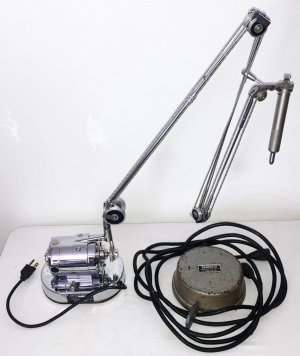
The Buffalo Dental Equipment Company dental engine is what the old-time dentists used to drill your teeth with. The "bench engines" are what are used for bench work in dental labs for making dental prosthetics and the like. There is a huge range of handpieces available for these and many types of bits and burrs that can be held in them. This is really the best tool for doing powered micro-carving and the like. Foot pedal speed controlled. Reversable rotational direction. Excellent "professional surgical quality" construction and materials. The belt-driven armature may look cumbersome to use, but it is quite the opposite. This machine is made for drilling and grinding inside your mouth, so it has no trouble tackling any job you'll encounter on a ship model. The handpieces are ergonomically designed for fine work, unlike the big, heavy and fat Dremel mototools. Dental engines rely on torque to get the job done, not speed, so you can slow them down to where you can easily control the aggressiveness of the cutting action without losing any of the power to get the job done. Dental engines can get very expensive. It's not unusual for a new dental engine and a couple of handpieces to cost more than a $1,000 USD, but the good news is that there a quite a few used ones on eBay and the like because the dental lab technology is changing and new casting and 3D printing technology is replacing a lot of the free-hand shaping that used to be done with these workhorses. I got mine in like-new condition with a handpiece for $75.00 on eBay.

Buffalo EMESCO labeled dental lab bench engine:

1765535516790.png

Overall, for general rotary tool work encountered in ship modeling, the Foredom flex-shaft machines are the way to go. Like the dental engines, they depend on torque, not high RPM's to get the job done. There is a wide selection of handpieces and attachments. Foredom flex-shafts are built like tanks and will last a lifetime. I got mine used with two handpieces from a local online "want ads" site for about $60.00 USD.

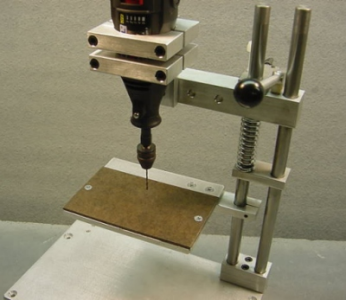
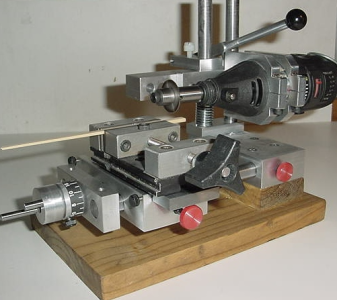
It should be noted that Vanda-Lay Industries makes a quality selection of light duty tools such as drill presses and milling machines powered by either the Dremel mototool or the Foredom flex-shaft machines mounted in them. The Vanda-Lay tools are much better than similar ones offered by Dremel and Foredom. These light duty drill presses and mills are not as good as dedicated power tools, but for a modeler on a budget, they are an excellent compromise. See: https://vanda-layindustries.com/

Below: A variety of Vanda-Lay tools for drilling, milling, sawing, and turning. Dremels shown mounted in the tools. Foredom handpieces are mounted in the same way. Specify Dremel or Foredom sized clamps when ordering.

1765536798680.png

1765536868823.png

1765536924599.png

Used professional quality tools in good condition are the best value around. "Homeowner," "DIY," or "Hobbyist" tools (e.g. Dremel, Proxxon, MicroMark, Asian clones) are lightly built and not intended to last forever. They're rarely designed to last as long as you hope to live. When buying tools, buy the best you can possibly afford. It's always better to set a few bucks aside and save up for the "good stuff," rather than buying cheap tools because you don't want to wait. Don't ask me how I know this. ;)

This video from The Scale Model Workshop (a great resource!) on rotary tools is worth watching:
 
.​

I realize that American readers may not be thrilled about this, but I will honestly say that in the DIY category, and comparing Dremel to Proxxon rotary tools, the latter is far superior in my opinion. I have both systems, but I now only use the Dremel for rough, dirty jobs that don't require precision, when I don't want to expose the more precise Proxxon to dust, dirt, and consequently faster wear and tear.

Dremel rotary tool: high vibrations, hence deafening noise, particularly at highest speeds, plastic, non-rigid construction sensitive to sideways loads, large run-out, awkward shape of the tool making it somewhat troublesome for making holder attachments, the lowest available speed much too high for typical small-scale jobs (this comment applies to older model in black color).

Proxxon rotary tool: much better precision (run-out) and generally much nicer “culture” of work, quiet without much vibration even at highest speeds, better speed ranges, i.e. lower speeds available than Dremel provides, rigid strategic components made of metal less sensitive to sideways loads, all rotary tools from the Proxxon range feature a very convenient 20 mm diameter neck in the best place, i.e. at the very tip of the tool (making it easy to self-make holders that "automatically" maintain perpendicularity and parallelism, such as the one below).


Proxxon self-made holder.jpeg
.​
 
You might consider going minimal for the Dremel - the recharge light weight one and invest the the Foredom when you can afford it.

The Foredom has more jobs that it can do than is generally known.
MasterCarver has a hand piece with a 1/4" Jacobs chuck. There are a lot of cutters with 1/4" shafts.
Foredom has a drill press accessory. Clamp the base to your bench 180 degrees opposite the hand piece holder. Clamp a XY table under the hand piece and you have a mill. I bought a XY table from TEMU that is larger than the mini that I intended and I can get as far under as the small one and I have 9" of travel on the long axis.
TEMU has 3 jaw chucks with a 1/4" shaft and a 4 jaw with 1/4" also. TEMU also has tail stocks and pillow blocks so the Foredom can be a wood lathe better than using a drill.

Think a 3/4" ply table top on top of you bench top that has mini T-track 4 East-West and 4 North-South A stable base for the accessories.
MasterCarver also has a reciprocating hand piece that is heavy duty if you do a lot of chiseling. Flex-Cut has a wide variety of blades and also a handle if freehand is needed.

If you want to spend ~$1,000 US , there are hand piece that are 90 degree drill or sand 1/8" chuck and Foredom has mandrels to hold bits down to #80 And even more rare, an end that replaces the 90 degree with a 45 degree drill. But the 45 has reverse rotation so the you need the SR model because it has CW/CCW rotation options.
At this time and after feedback received today Dremel will be the selected choice, still trying to decide between cord or cordless one
.​

I realize that American readers may not be thrilled about this, but I will honestly say that in the DIY category, and comparing Dremel to Proxxon rotary tools, the latter is far superior in my opinion. I have both systems, but I now only use the Dremel for rough, dirty jobs that don't require precision, when I don't want to expose the more precise Proxxon to dust, dirt, and consequently faster wear and tear.

Dremel rotary tool: high vibrations, hence deafening noise, particularly at highest speeds, plastic, non-rigid construction sensitive to sideways loads, large run-out, awkward shape of the tool making it somewhat troublesome for making holder attachments, the lowest available speed much too high for typical small-scale jobs (this comment applies to older model in black color).

Proxxon rotary tool: much better precision (run-out) and generally much nicer “culture” of work, quiet without much vibration even at highest speeds, better speed ranges, i.e. lower speeds available than Dremel provides, rigid strategic components made of metal less sensitive to sideways loads, all rotary tools from the Proxxon range feature a very convenient 20 mm diameter neck in the best place, i.e. at the very tip of the tool (making it easy to self-make holders that "automatically" maintain perpendicularity and parallelism, such as the one below).


.​
Thanks for the detailed information, Proxxon already on my wish list...
 
Okay, what the others said. I've got two corded Dremel mototools (one old style and the other new style) and a rechargeable small Dremel. I also have a Buffalo dental engine and an older Foredom flex shaft with a collet chuck handpiece and a "zero closing" Jacobs chuck.


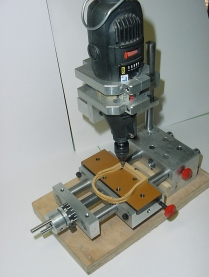
It should be noted that Vanda-Lay Industries makes a quality selection of light duty tools such as drill presses and milling machines powered by either the Dremel mototool or the Foredom flex-shaft machines mounted in them. The Vanda-Lay tools are much better than similar ones offered by Dremel and Foredom. These light duty drill presses and mills are not as good as dedicated power tools, but for a modeler on a budget, they are an excellent compromise. See: https://vanda-layindustries.com/
Bob, Thanks for your detailed feedback. Didn't realize until now about the dental engines being used as well for our hobby !! Always a new learning.
 
all rotary tools from the Proxxon range feature a very convenient 20 mm diameter neck in the best place, i.e. at the very tip of the tool (making it easy to self-make holders that "automatically" maintain perpendicularity and parallelism, such as the one below).

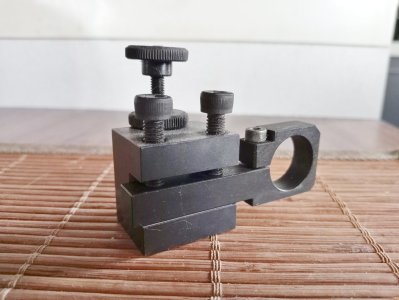
Quite true about Proxxon's quality compared to Dremel. However, Proxxon remains a "speed" rather than "torque" dependent tool and is much larger and less ergonomic than the smaller handpiece rotary tools. Holders as you've pictured are readily available in the U.S. for both the Dremel mototool and for the one-inch diameter Foredom handpieces. The one I have for my Dremel is threaded to match the threads on the neck of the Dremel mototools, while the one I have for my Foredom handpieces clamps down with cap screws. Both are styled as the one for the Proxxon, identical to 1/2" lathe tool holders so that they can be mounted on the cross-slide of my 12" lathe and used as highly accurate X-Y micro tool post grinders and mills.
 
At this time and after feedback received today Dremel will be the selected choice, still trying to decide between cord or cordless one

I don't know if the latest battery powered Dremel mototools have cured the problem, but the earlier rechargeable battery model, the smaller and easier to use one, was not "continuous duty." If the tool was run for too long, such as when doing continuous sanding, the battery contact points would heat up and melt down. I ended up buying a couple of extra batteries so I could swap the hot one out for a cooled-off one to overcome this problem.
 
Back
Top