• Win a Free Custom Engraved Brass Coin!!!
    As a way to introduce our brass coins to the community, we will raffle off a free coin during the month of August. Follow link ABOVE for instructions for entering.
  • PRE-ORDER SHIPS IN SCALE TODAY!

    The beloved Ships in Scale Magazine is back and charting a new course for 2026!
    Discover new skills, new techniques, and new inspirations in every issue.

    NOTE THAT OUR FIRST ISSUE WILL BE JAN/FEB 2026

Help with CA glue not bonding oak on oak

Joined
Sep 13, 2022
Messages
50
Points
68

I’m working on the OcCre Victory and starting the hull planking. I’ve watched the tutorials from OcCre as well as Wolfgang Zinn, John Aliprantis, and others as well as from Artesania Latina. All of them use CA glue considerably, but especially to hold planks in place to the frames while using PVA glue for the edge to edge. I’m watching several videos in what I consider to be real time and the CA glue takes only 5-10 seconds to form an initial bond. They don’t use an accelerator. The planks and frames are both oak and have been pre sanded.

My problem is that I can’t seem to get a bond. I’m using Starbond EM-150 CA glue and even when I get some test pieces to bond after clamping for 1-3 minutes I can pull them apart. Left clamped for more than 10 minutes it seems to hold but if that’s the best that can be achieved then I don’t see much advantage to using CA glue for this application. The glue is new (at least recently purchased) and less than two months old. I know for many of you, any CA glue is considered a cheat but in this application it appears to be a reasonable process. Is this the correct brand? Is there another type of CA glue that I should be using? I’ve thought of the Bob Smith brand but I hate to invest more money without some idea that it’s going to work. What do these modelers know that I don’t?
 
I know nothing of the brand of CA you are using but it does sound like there is something seriously wrong with it. It is possible you have a bad bottle. I have used Zap and Locktight brands with good result, but almost any brand should work.

If it takes 10 minutes to achieve a good bond, PVA would probably be just as good. Make sure the wood is free of contaminates such as waxes.

Rob
 
Cap'n Bargejo:
I looked at the Starbond website but could not find EM-150 glue. They do carry glues with a range of viscosities and viscosity does make a difference. I see an 800 customer service number. A call there might be helpful. As Rob444 suggests, contaminants on the wood can also be an issue.
Fair winds!
 
The planks and frames are both oak and have been pre sanded.
This is interesting, the first I have heard of OcCre using oak. (I may just be behind the times :() Can you post a photo of the planking as I am curious about how it looks. There are about 500 species (genus Quercus) worldwide so if anyone knows which species they use that would be great. The most common ones we see in North America are very open grained and look awful at our scales, but it sounds like they may have found something that works well and could be interesting for future builds, kit or scratch.
TIA
Allan
 
If one is to believe responses from AI, the following is interesting
Some oak species can be challenging for cyanboacrylate (CA) glue. Osk is a naturally acidic wood, which slows the glue's moisture-activated cure; denser oaks struggle more, but using CA accelerants or specialized gap-filling/stabilizing CA glues (like those from Starbond, Titebond, Hot Stuff), and ensuring perfect surface contact, helps significantly, though wood glue is a better choice.
 
This is interesting, the first I have heard of OcCre using oak. (I may just be behind the times :() Can you post a photo of the planking as I am curious about how it looks. There are about 500 species (genus Quercus) worldwide so if anyone knows which species they use that would be great. The most common ones we see in North America are very open grained and look awful at our scales, but it sounds like they may have found something that works well and could be interesting for future builds, kit or scratch.
TIA
Allan

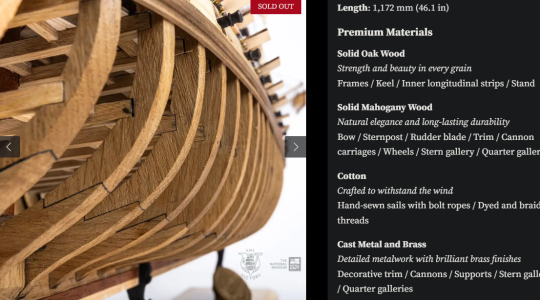
They are indeed using oak Allan. From their website:

Screenshot 2026-01-08 075843.png

I've use a lot of CA glues in the past. One technique that has worked for me is to spray a light misting of aerosol accelerator to the one part, i.e. the plank. Make sure you are not aimed toward the model where overspray can get on the frames and don't be too heavy handed, a light misting is all you need to kick off the curing process. If the part looks wet after spraying, you're using too much. Then apply drops of medium or thick viscosity (I seldom use thick) to your glue points, i.e. the frames. The advantage is that you will get very quick-setting glue joints. The disadvantage is that you will get very quick-setting glue joints. In other words, make sure the part is exactly where you want it before pressing it in place, because it will stick fast.
 
No synthetic glue sticks really well to oak wood. It's just too greasy for them. You could try to throughly brush/wipe the wood with acetone before gluing, but even this doesn't exclude later glue failure. With oak, I'd go for some other option like PVA or organic (hide/bone) glues.
 
Last edited:
If it were me, my first action would be to try a different CA. That's a quick sanity check and if the new CA works, then you're off to the races. Or use clamps and use PVA glue for everything. I've never used CA as part of my planking process, so really can't express any feelings in that regard. But yeah, step one is simply to try a different CA glue.
 
I've recently learned from a fine arts restoration specialist of a relatively new adhesive that reportedly has proven significant advantages over the previous armamentarium of adhesives used in scale ship modeling. I've yet to use it myself, but plan to do so. I've never seen it mentioned in any ship modeling forum as yet, although Rob Napier mentions it repeatedly in his new book, Caring for Ship Models (Seawatch Books: https://seawatchbooks.com/products/...tive-of-thought-and-application-by-rob-napier)

This relatively new adhesive is called "Paraloid B-72." Although readily available online in various concentrations and thicknesses, it does not appear to have hit the mainline retail adhesives market as yet and remains a specialty item popular only with museum curators and fine arts and artifacts restorationists. As far as I've been able to ascertain, its earliest widespread use was by paleontologists as a penetrating binder for stabilizing fragile fossils. It's features which are particularly attractive for ship modeling are that it binds to just about everything, dries as fast as its acetone solvent evaporates, can be mixed in varying concentrations and be thickened with fumed colloidal silica which tends to strengthen its bond. It is very easily totally reversible by the reapplication of acetone and glued joints can be later adjusted by the application of heat from a hair dryer. It has a 100+ year archival rating and is impervious to UV radiation and humidity. It can also be used as a clear sealant coating that dries with a uniform matte finish. Paraloid B-72 is sold in the form of small "chips" of plastic material which are dissolved in acetone by the user. It has an infinite shelf life and is non-toxic.

I am a card-carrying Luddite who ascribes to the maxim that "if it sounds too good to be true, it probably isn't," but this stuff sounds like the best thing since sliced bread, so my mind is open for the minute.

This article describes Paraloid B-72, what it is, what it does, and how to use it: https://resources.culturalheritage....ontent/uploads/sites/8/2021/11/osg025-001.pdf

If anybody has used Paraloid B-72 for ship modeling, I'd like to hear from them what they think of it.
 
How old is your glue? Try gluing something else together of a different material and see how fast it sets. I find after a month or so the glues can take longer to set and strength of bonding is weaker if I don’t give it time to cure. I use it mainly to make jigs for building parts or when machining brass on my lathe
 
I've recently learned from a fine arts restoration specialist of a relatively new adhesive that reportedly has proven significant advantages over the previous armamentarium of adhesives used in scale ship modeling. I've yet to use it myself, but plan to do so. I've never seen it mentioned in any ship modeling forum as yet, although Rob Napier mentions it repeatedly in his new book, Caring for Ship Models (Seawatch Books: https://seawatchbooks.com/products/...tive-of-thought-and-application-by-rob-napier)

This relatively new adhesive is called "Paraloid B-72." Although readily available online in various concentrations and thicknesses, it does not appear to have hit the mainline retail adhesives market as yet and remains a specialty item popular only with museum curators and fine arts and artifacts restorationists. As far as I've been able to ascertain, its earliest widespread use was by paleontologists as a penetrating binder for stabilizing fragile fossils. It's features which are particularly attractive for ship modeling are that it binds to just about everything, dries as fast as its acetone solvent evaporates, can be mixed in varying concentrations and be thickened with fumed colloidal silica which tends to strengthen its bond. It is very easily totally reversible by the reapplication of acetone and glued joints can be later adjusted by the application of heat from a hair dryer. It has a 100+ year archival rating and is impervious to UV radiation and humidity. It can also be used as a clear sealant coating that dries with a uniform matte finish. Paraloid B-72 is sold in the form of small "chips" of plastic material which are dissolved in acetone by the user. It has an infinite shelf life and is non-toxic.

I am a card-carrying Luddite who ascribes to the maxim that "if it sounds too good to be true, it probably isn't," but this stuff sounds like the best thing since sliced bread, so my mind is open for the minute.

This article describes Paraloid B-72, what it is, what it does, and how to use it: https://resources.culturalheritage....ontent/uploads/sites/8/2021/11/osg025-001.pdf

If anybody has used Paraloid B-72 for ship modeling, I'd like to hear from them what they think of it.
Sounds very interesting. I just ordered some and will report back when I have tried it.
 
I’m working on the OcCre Victory and starting the hull planking. I’ve watched the tutorials from OcCre as well as Wolfgang Zinn, John Aliprantis, and others as well as from Artesania Latina. All of them use CA glue considerably, but especially to hold planks in place to the frames while using PVA glue for the edge to edge. I’m watching several videos in what I consider to be real time and the CA glue takes only 5-10 seconds to form an initial bond. They don’t use an accelerator. The planks and frames are both oak and have been pre sanded.

My problem is that I can’t seem to get a bond. I’m using Starbond EM-150 CA glue and even when I get some test pieces to bond after clamping for 1-3 minutes I can pull them apart. Left clamped for more than 10 minutes it seems to hold but if that’s the best that can be achieved then I don’t see much advantage to using CA glue for this application. The glue is new (at least recently purchased) and less than two months old. I know for many of you, any CA glue is considered a cheat but in this application it appears to be a reasonable process. Is this the correct brand? Is there another type of CA glue that I should be using? I’ve thought of the Bob Smith brand but I hate to invest more money without some idea that it’s going to work. What do these modelers know that I don’t?

I had the same problem using the CA glue you mentioned, in oak and pear wood. I changed the brand of glue and the problem persisted.
I did some research and discover that ambient temperature ( below 18ºC ) and the air relative humidity ( below 60% ) significantly hinder the rapid chemical reaction of acrylates. With the arrival of spring / summer, the same bottles of CA glue started bonder perfectly in approximately 15 second.
I believe it wasn't a coincidence, I will start controlling the temperature and humidity in my gluing environement during the winter.....
 
Back
Top