• Win a Free Custom Engraved Brass Coin!!!
    As a way to introduce our brass coins to the community, we will raffle off a free coin during the month of August. Follow link ABOVE for instructions for entering.
  • PRE-ORDER SHIPS IN SCALE TODAY!

    The beloved Ships in Scale Magazine is back and charting a new course for 2026!
    Discover new skills, new techniques, and new inspirations in every issue.

    NOTE THAT OUR FIRST ISSUE WILL BE JAN/FEB 2026

Copper plate

Fool. I dont use AI, perhaps you do. What I posted is direct 'copy paste from reputable sources'.

Apologies! Sorry about that. My bad. Shame on me for graciously giving you the benefit of the doubt by blaming AI. The only other explanation I could think of was a reading comprehension deficit. Silly me! Obviously, your mileage varies. All I know is what I learned in a boatyard scrubbing crud off of copper sheathed boat bottoms. :rolleyes:
 
Last edited:
I'd be interested to know the "several places" you've read that "... copper inhibits the growth of marine life (animal and plant) on a ship's hull."

Theoretically, copper sheathing may provide a less hospitable surface for the mechanical attachment of certain marine plants and animals, causing a sloughing off of such growth as the hull moves through the water. This is, however, only a meaningful characteristic of modern powered hulls which move at far higher speeds than sailing vessels. At the speeds of period sailing ships, this mechanical scrubbing process has little or no effect on the growth of subaquatic plants and animals. Copper does not have any herbicidal qualities. Copper is a natural antimicrobial material which does have fungicidal qualities and thus, to that extent is a biocide, but copper is not an effective biocide for any subaquatic organism above the microbial level.

I'd also be interested to know where you got the impression that copper "maintained a salmon/pink color below the waterline" and "only turns green when it's not moving through the water." Copper is a shiny orange colored metal that turns colors due to a process called oxidation. When exposed to moisture and air for a time, copper undergoes a chemical reaction with the oxygen in the air forming a layer of copper oxide on its surface that is typically reddish-brown in color. As the oxidation process continues, the copper oxide layer reacts further with carbon dioxide and water in the air to form a greenish compound called copper carbonate, commonly called patina or verdigris. The rate of brownish copper oxidation patination and the development of the secondary greenish copper carbonate patina can be affected by factors such as temperature, humidity and the presence of certain chemicals in the environment including, but not limited to, salt in the water.

For these reasons, copper sheathing on a hull submerged before the secondary layer of greenish copper carbonite forms, will only form a patina of copper oxide which is brown, the color of a well-circulated penny. The areas of the sheathed hull at the waterline and above that are exposed to the air will develop a green copper carbonite patina on top of the initial brown copper oxide patina because they have access to the oxygen necessary to do so.
Here are a few sources describing the antifouling characteristics of copper.

Copper Sheathing Wikipedia page:

“The copper performed very well, both in protecting the hull from worm invasion and in preventing weed growth for, when in contact with water, the copper produced a poisonous film, composed mainly of copper oxychloride, that deterred these marine organisms. Furthermore, as this film was slightly soluble, it gradually washed away, leaving no way in which marine life could attach itself to the ship.”

Copper-Bottoming the Royal Navy by Philip K. Allan, article in US Naval History magazine June 2019.

Description of coppered hull inspection conducted on HMS Alarm in 1763.

“The frigate was sent back to the Caribbean, and when she returned after a further two years there, her hull was found to have no sign of worm attack, with the additional benefit of minimal weed growth. Copper reacts with sea water to produce an oxychloride film toxic to most marine plants. Weed growth, especially in the tropics, can quickly impair the performance of sailing ships, and it was clear that sheathed vessels would be swifter and more maneuverable than those with unprotected hulls.”

The Introduction and use of Copper Sheathing- A History, a paper by Mark Staniforth

“Copper sheathing reduced maintenance costs by reducing or eliminating teredo attack, it prevented the build-up of fouling organisms on the hull and so increased the speed and ease of handling of the vessel.”

Copper Alloys in Aquaculture Wikipedia page

“In the marine environment, the antimicrobial/algaecidal properties of copper alloys prevent biofouling, which can briefly be described as the undesirable accumulation, adhesion, and growth of microorganisms, plants, algae, tube worms, barnacles, mollusks, and other organisms on man-made marine structures.

The most important requirement for optimum biofouling resistance is that the copper alloys should be freely exposed or electrically insulated from less noble alloys and from cathodic protection. Galvanic coupling to less noble alloys and cathodic protection prevent copper ion releases from surface films and therefore reduce biofouling resistance.[

The copper reduced biofouling of the hull, which enabled ships to move faster than those that did not have copper sheathed hulls.”

Nelson’s Navy by Brian Lavery

Coppering “solved two perennial problems-it helped prevent weed growing on ships’ bottom, which slowed them down…and it prevented shipworm from getting among the timbers…”

Sail’s Last Century-Conway’s History of the Ship edited by Robert Gardiner

Definition of coppering: “This was originally intended to protect the hull from marine borers like teredo navalis but was found to have a very effective antifouling effect, the slow exfoliation of the metal preventing marine growth.”

The Construction and Fitting of the English Man of War 1650-1850 by Peter Goodwin

“It was found that the copper not only stopped sea-worm, but also reduced the build-up of marine growth on the hull, leaving the ship’s bottom far cleaner.”

China Tea Clippers by George Campbell

“The copper sheets were originally nearly pure copper which eroded away quickly even though it kept a good clean bottom, the marine growth being shed along with the eroding copper.

The appearance of the copper, varying slightly with composition from reddish to yellowish, would be like an old copper coin, when it was freshly applied. At sea in salt water it would be bright and shiny, and in port or drydock a light green when dry, like a copper dome.

An eye-witness in the mid-19th century gives a most thrilling description of a naval squadron under full sail in the Channel, majestically rising and dipping in the swell with the wet copper glinting and flashing in the setting sunshine.”

As for the appearance of copper clad ships, the only authoritative reference I’ve seen about the color is the above statement from George Campbell. But from the statements about the “eroding”, “being shed”, “gradually washed away” and “exfoliation” of the copper plates one could infer that the underwater portion of the hull was constantly being burnished by water flow and may have maintained the original copper shine. Or the hull may have settled into a dull copper penny look as you have suggested. I would assume there are no operational copper clad ships in existence, and probably haven’t been for decades, so it would probably take a good deal of research into historic accounts and historic paintings from the period to get a clearer understanding.

 
It remains up to the modeler to determine the level of detail they wish to depict consistent with the limitations of the scale in which they are building and the scale viewing distance of their model. However, it would appear that at scale viewing distance of two or three feet for a 1:48 scale model, details such as copper sheathing seams, and certainly sheathing tacks, would not be visible.
Correct. Certainly every modeler may proceed, without criticism, using whatever techniques that they enjoy and completing their models with whatever appearance they would like. But sometimes posts on these forums suggest lack of thought, or at least lack of communication, about the objectives of a project. These may include: 1) demonstrating traditional ship building techniques to the extent that scale allows, 2) presenting a 3D vision of a ship under sail, 3) recreating a traditional style of ship model (Admiralty model, votive model, folk model, half hull model, etc.), 4) showing the complex rigging that controlled the sails. There are many more possible objectives and they may be combined for a single model. It would be useful to consider your objectives and communicate them to fellow modelers on these forums.

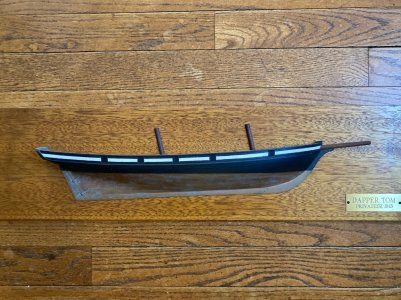
In regard to copper bottoms, here is a photo showing my approach on a half hull model of the Baltimore schooner Dapper Tom at 5/32" = 1'. This is a fairly rough, solid hull model and I wanted to show a reasonably accurate paint scheme including a coppered bottom. The bottom was painted with Testors Flat Brass Enamel followed by dry brushing of light green. To digress, I acquired the hull from the reject box at the original Model Shipways shop in Bogota NJ, cut it in two, and used the starboard half. The box contained hulls that were found to be unsuitable for inclusion in kits after rough carving. Fair winds!

dapper tom 1.jpg
 
I would assume there are no operational copper clad ships in existence, and probably haven’t been for decades, so it would probably take a good deal of research into historic accounts and historic paintings from the period to get a clearer understanding.


Ah, Grasshopper, such is not the case. I'm an old man who's never lived far from the sea, but not so old that my memory's going to pot. I've spent my life around harbors and ships and boatyards, and I've seen more than a few copper-sheathed hulls. Heck, I've even tacked copper sheathing on a few myself and scraped and power-washed them when they were hauled out to clean their fouled copper-sheathed bottoms. I've sold wooden yachts for a yacht brokerage that specialized in classic wooden vessels and been privileged to sail some of the most well-known classic yachts around. Some of those had coppered bottoms, too. For over fifty years I was never without my own wooden boat, not one of those epoxy slathered plywood monstrosities on a trailer, either, but real carvel planked ocean cruising boats. I've been there, done that, and I've got the tee shirt to prove it.

I don't make up the shite I post from whole cloth. Nor do I rely on books of questionable accuracy or mistaken understanding to tell me what my eyes see. When I describe what a copper-sheathed hull looks like from either 150 feet away or up close, from when it's first sheathed or when it comes out of the water for a bottom job, I know first-hand what a copper-sheathed bottom looks like at every stage of its existence and I know what grows on it when it sits in the water for a while. When you quote old reports of how much of a difference copper-sheathing made when it was first introduced, it must be realized that it was indeed a huge improvement over what was previously virtually "nothing at all" and that's what so impressed those you've quoted. Those reports are relative. They are also scientifically flawed. (What they perceived as an improvement due to the copper was actually the result of impure copper alloys!) For example, a vessel that spends a couple of years in the tropics and then returns to the North Sea and moors up a brackish river or tidal slough in England is bound to lose a lot of her accumulated fouling mass not because of some imagined magical property of copper, but simply because tropical flora and fauna die off when the water is far colder, the sunlight less plentiful, and the water less salty. (In fact, it was common practice where possible to run vessels upstream to brackish water for a while to kill off accumulated growth prior to careening to scrape their coppered bottoms clean.)


China Tea Clippers by George Campbell

“The copper sheets were originally nearly pure copper which eroded away quickly even though it kept a good clean bottom, the marine growth being shed along with the eroding copper.

The appearance of the copper, varying slightly with composition from reddish to yellowish, would be like an old copper coin, when it was freshly applied. At sea in salt water it would be bright and shiny, and in port or drydock a light green when dry, like a copper dome.

An eye-witness in the mid-19th century gives a most thrilling description of a naval squadron under full sail in the Channel, majestically rising and dipping in the swell with the wet copper glinting and flashing in the setting sunshine.”

As for the appearance of copper clad ships, the only authoritative reference I’ve seen about the color is the above statement from George Campbell. But from the statements about the “eroding”, “being shed”, “gradually washed away” and “exfoliation” of the copper plates one could infer that the underwater portion of the hull was constantly being burnished by water flow and may have maintained the original copper shine.

George Campbell with his China tea clippers and that "mid-19th century eye-witness" looking at that "naval squadron under full sail in the Channel... with the wet copper glinting and flashing in the setting sunshine," weren't looking at copper-sheathed bottoms at all. By the "mid-19th century," all of the larger vessels of the British Navy, and most of the seagoing merchant vessels, especially the tea clippers, were not sheathed in copper at all, but rather in Muntz metal, a patented brass alloy of copper, zinc, and traces of iron. Copper was used to sheath the wooden hulls of large ships only during a relatively short window of time. The Dutch first copper-sheathed a naval vessel in 1777 and, if memory serves, the British Admiralty starting copper-sheathing all their wooden ships around 1779. The practice of copper-sheathing only lasted until shortly after 1832 when Muntz metal came on the market and the new alloy was so much cheaper than the copper then available that the conversion to Muntz proceeded with exponential rapidity. Copper sheathing, on Royal Navy vessels, at least, only lasted around fifty years. On the other hand, at last report, the Royal Navy was still sheathing their non-magnetic minesweepers with Muntz metal to the present time.

Relevant to the present discussion, the copper available at the time when the period ships which are so fashionable to model at present were coppered was for then-unknown reasons, "good" or "bad." The "good copper" contained unidentified impurities which caused a steady rate of erosion that provided a desired anti-fouling effect when the fouling fell off with the corroded copper plate. The "bad copper" was of two types: 1) pure copper, which eroded so quickly that it only lasted for a couple of years at most before the ship had to be re-sheathed and so was deemed unsuitable, and 2) copper with so many inclusions that it did not deteriorate at all and therefore had no anti-fouling effect at all. ( https://www.awn-archeologie.nl/afde...oads/2018/08/Copper-Muntz-Metal-Sheathing.pdf) In summary, some of the copper plates they obtained were "anti-fouling" because they promptly fell apart within a couple of years but weren't worth the work and materials cost of applying them as often as necessary. Some of the copper plates they obtained were "anti-fouling" because they corroded and fell apart over a longer period of time, so they were worth the trouble and expense. And, some copper plates didn't corrode at all and so did nothing to reduce fouling. As can be seen, any "anti-fouling" effect of the sheathing was not due to some herbicidal or biocidal inherent property of the copper, but rather simply a function of the copper corroding and falling apart, which was not a particularly efficacious anti-fouling method.

Modernly, primarily copper alloys have been developed which reliably do not deteriorate at all, and have no anti-fouling effect at all, but do provide a reliable mechanical barrier against the entry of marine borers. Also modernly, effective anti-fouling paints with herbicidal properties to discourage vegetative fouling and biocidal properties to discourage marine life have been developed. It has become common practice for vessels having copper sheathed hulls to paint over the copper sheathing in order to obtain both antifouling and anti-marine borer protection.

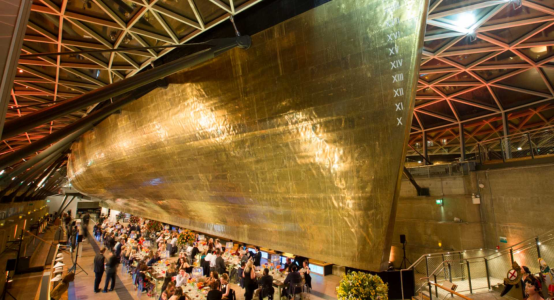
Cutty Sark with her never-been-wet Muntz metal bottom when it was fairly new:

1769234846218.png


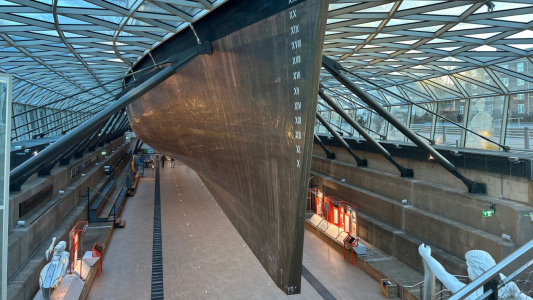
Cutty Sark's Muntz metal sheathed bottom after it had time to weather a bit:

1769235026715.png

And now I'll leave modelers everywhere to make their models' metal sheathed hulls look however they want. At this point, I don't care if somebody paints one pink!
 
Last edited:
Bob
As a young child, I remember that wooden boats’ bottoms were painted with “copper bottom paint.” There was a can in our basement workshop left over from my dad’s wooden boat building days. Fast forwarding 40 or so years to my more recent sailing days, anti fouling paints had evolved to a very thin black colored paint. My Dad’s wooden boat sailed on Lake Erie, and my more recent experience was on Lake Superior, both fresh water environments where wood boring worms and heavy vegetative fouling is not a problem. Boats are also hauled each year at the end of at most a six month boating season. The two lakes are at opposite ends of the biological spectrum. Lake Erie is shallow, relatively warm, with highly developed (agricultural) shorelines, Lake Superior is cold, deep, and mostly surrounded by wilderness. When we hauled out the boat here on Lake Superior, fouling was limited to a thin film of green slime.

So, would the copper bottom paint that my father and others used way back in 1948 have been effective?

Roger
 
i
So, would the copper bottom paint that my father and others used way back in 1948 have been effective?

Relatively speaking, yes, but not because it contained "copper" metal. The term "copper bottom paint" is technically improper in so far as people understand it to mean the paint contains copper metal as its active ingredient. At "copper bottom paint" may well have had some metal copper powder in it as a pigment that it was hoped would oxidize and present some microbial biocidal effects, primarily by reducing "slime" which might provide a foundation for larger marine life to grow upon, but the real antifouling effects in those days would have come from cuprous oxide which they added to the paint. (https://en.wikipedia.org/wiki/Copper(I)_oxide) It may have contained other biocidal additives, as well. It would have most likely been what was called a "soft" or "ablative" bottom paint, as opposed to a "hard" bottom paint. The ablative paint worked by way of an eroding surface (it would have been called "chalking" if it were house paint) that continually exposed a "fresh" surface of the paint film which presented formerly encapsulated microscopic "pockets" of the biocidal chemicals (e.g. cuprous oxide) added to the paint mix. The sort of biocides they had then had relatively short effective "shelf lives" when exposed to the marine environment. Most were "heavy metals" that began to degrade when exposed to the marine environment. The "sloughing" paint film continually exposed a surface of "fresh" biocide until it the paint film exhausted its biocidal capacity.

Antifouling coating formulations are "geographically specific." Wherever you go in the world, they will have a bottom paint that works better than the others for any given job. Bottom paints that work best in Florida, won't work best in Maine and bottom paints that work best in Maine probably won't work as well in the freshwater Great Lakes. Your dad's bottom paint was probably the "local brand" that worked best at that time.

The "hard" bottom paints were made with stronger binders that resisted sloughing. The "hard" bottom paints became popular as power boats, and particularly planing power boat hulls, became popular. The "soft" bottom paints could not stand up to the higher speed friction of the power boat hulls at speed and so wore away faster and were less effective. From about 1960 on, all bottom paints contained tributyltin oxide ("TBTO") as their primary biocide. (See: https://en.wikipedia.org/wiki/Tributyltin_oxide) TBTO was great stuff! You could even go as long as four or five years without having to haul your boat for a "bottom job" without serious negative effects. Unfortunately, in 2008, TBTO's use in bottom paint was outlawed all over the world when environmentalists "discovered" that it killed marine organisms. Since then, the "environmentally friendly" bottom paint formulas they've come up with haven't worked well at all... nearly useless, actually. The question of whether or not the economic benefits of using TBTO bottom paint (much better fossil fuel economy, less greenhouse gas emissions from fossil fuel, etc.) outweigh its detriments to the environment rages on between the environmental absolutists and the environmental practicalists while the maritime community grits its teeth and hauls out and cleans and paints their bottoms more frequently.
 
Last edited:
Back
Top