-

SUBSCRIBE TO SHIPS IN SCALE TODAY!
The beloved Ships in Scale Magazine is back and charting a new course for 2026!
Discover new skills, new techniques, and new inspirations in every issue.
NOTE THAT OUR NEXT ISSUE WILL BE MARCH/APRIL 2026 -

Win a Free Custom Engraved Brass Coin!!!
As a way to introduce our brass coins to the community, we will raffle off a free coin during the month of August. Follow link ABOVE for instructions for entering.
You are using an out of date browser. It may not display this or other websites correctly.
You should upgrade or use an alternative browser.
You should upgrade or use an alternative browser.

- Joined
- Dec 1, 2016
- Messages
- 6,656
- Points
- 728

Based on these drawings and published dimensions for the program's ships plus the many other sources he reserached, saying he made it all up does not seem reasonable.
i understand what you're saying and i agree to say it is all made up was a bit out of line. It is not made up so i edited that out of my post.
i do not have the book so i do not know how a set of plans were done or what they are based on.
however i did make the comment based on this it is listed as fiction which is
Fiction is any creative work, chiefly any narrative work, portraying individuals, events, or places that are imaginary or in ways that are imaginary.
i understand what you're saying and i agree to say it is all made up was a bit out of line. It is not made up so i edited that out of my post.
i do not have the book so i do not know how a set of plans were done or what they are based on.
however i did make the comment based on this it is listed as fiction which is
Fiction is any creative work, chiefly any narrative work, portraying individuals, events, or places that are imaginary or in ways that are imaginary.
Last edited:


What on earth do you need waterlines for if you have all the frames you need?
- Joined
- Jun 29, 2024
- Messages
- 1,776
- Points
- 488

I have the book. The plans are on a fold out drawing on the back of the dust jacket. There are two views; a Sheer view and a half breadth. Waterlines are shown on the half breadth. There is no body plan and no buttocks on the sheer view. A note says that the lines have been reconstructed by Endsor.
In theory there is sufficient information to build a model. BUT! I find that it’s much more difficult to draw body plan sections from waterlines than vice versa. Of course if the builder can get the body plan that matches the book’s drawing from Endsor, he has what he needs
Roger
In theory there is sufficient information to build a model. BUT! I find that it’s much more difficult to draw body plan sections from waterlines than vice versa. Of course if the builder can get the body plan that matches the book’s drawing from Endsor, he has what he needs
Roger
That is interesting but it does not appear to be listed by their website as fiction in spite of their name. It describes the book as non fiction even though they seem to be predominantly a fiction book website.however i did make the comment based on this it is listed as fiction which is
From their website: https://www.historicnavalfiction.com/search?q=The+restoration+Warship
- The Restoration Warship: The Design, Construction and Career of a Third Rate of Charles II's Navyhttps://www.historicnavalfiction.com/other-genres/aos-naval-non-fiction/ships-a-design/the-restoration-warship- the-design-construction-and-career-of-a-third-rate-of-charles-iis-navy
- Type: Article
- Author: Richard Endsor
- Category: AOS Naval Non-Fiction - Ships & Design

- Joined
- Sep 6, 2025
- Messages
- 10
- Points
- 28

As a yacht designer in NZ, my waterlines were drawn as the Load waterline (LWL) as the datum and for ease of identification labeled as WL1, WL2, WL3 etc above the LWL ) and WLA, WLB etc below the LWL.I have in mind drawing each individual frame for HMS Lenox. Based on great book by Richard Endsor - "The Restoration Warship". Great publication, which I bought years ago in Portsmouth Dockyards.
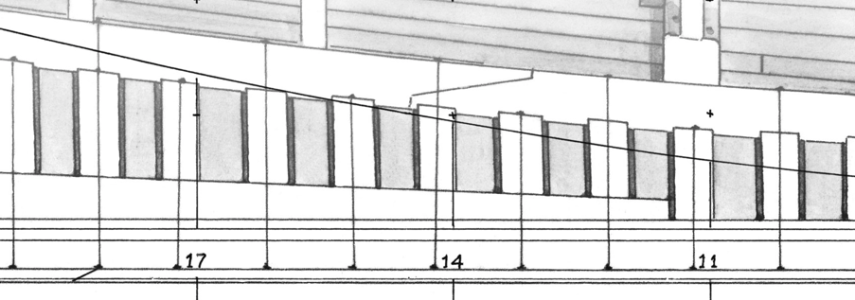
Anyway, plans included in the book are great but what I am missing are waterlines. I have station lines, side plan, but no waterlines.
Station lines show around 20 bulkheads, which is mor that enouch for POB.
I would like to draw all the frames in between, let's say 40 or 50 depending on the hull.
As I said, I do not have waterlines drawing. How can I start here? Old way with pencil and paper - no CAD.
Has anyone done that?
View attachment 575122
Above the LWL, I usually spaced the waterlines at between 250mm and 300mm, and below the LWL, usually between 200mm and 25omm. This was for yachts 6 to 15 Mtrs length
If I was going to loft off these cross sections, I would draw in 3 waterlines above the LWL and below the lower sheer line and another waterline for the raised poop deck.
Below the LWL, perhaps 4, but you will find that the diagonals are a more accurate lofting measurement, particularly in the waterlines close to the keel.
Hope this helps.
Just one thing - - The drawings are to the OUTSIDE of the hull planking/plating and when making the frames, the shipwrights would deduct the planking thickness. I have just lofted out the Cutty Sark and just went to the outside of the hull. The plankin on a model is very thin compared to the actual vessels planking, particularly on traditional wooden warships.
Hi EwokThe drawings are to the OUTSIDE of the hull planking/plating
Which drawings are you referring to? I assume this is not the body plan, which is the moulded breadth, not the extreme breadth
Thanks

Allan

Hi Jerzy, Old drafting guy here and trying to go back and help with your original question. I never had to draw naval lines but was tortured by complex curves on a drafting board for product design. To put it simply, you will need 3 points in space. You have the shear lines (first point) and most important. Now draw water lines and/or diagonals at a spacing of your choice, the number (spacing) will depend on how precise you would like the curve (second point). Then you have the location of the frames (third point).
As Roger had stated earlier I think, make a top view for each water line or diagonal line starting with the Keel and a perpendicular line at each of the known frame centers. Plot each point of intersection between the shear line and the water or diagonal line on the corresponding frame. Both are derived from the view you have originally posted. You will need some French curves (usually a set of 3) or if you can find a set of "ships" curves (a large number of curves with very subtle lines) or again as Roger had stated, a flexible piece of wood or plastic (I used plastic) to draw the curve through the points at each frame intersection.
The above will need to be done if you want to add more frames. On that same drawing, add the frame centers and note the intersection of the curve you just drew then go back to a drawing like your original view and plot the point, draw another curve through the points and that should give you the profile of the added frames.
I do not envy you on this task and glad I started 3D CAD in the late 80's. Plot the points at each frame and draw a spline through, the program interpolates the curve and I can fiddle with the tangent at each point to get a smooth curve. I apologize for not being able to show you this process as I retired my drafting board about 40 years ago.
I sincerely hope the above helps.
Thanks,
Tim
As Roger had stated earlier I think, make a top view for each water line or diagonal line starting with the Keel and a perpendicular line at each of the known frame centers. Plot each point of intersection between the shear line and the water or diagonal line on the corresponding frame. Both are derived from the view you have originally posted. You will need some French curves (usually a set of 3) or if you can find a set of "ships" curves (a large number of curves with very subtle lines) or again as Roger had stated, a flexible piece of wood or plastic (I used plastic) to draw the curve through the points at each frame intersection.
The above will need to be done if you want to add more frames. On that same drawing, add the frame centers and note the intersection of the curve you just drew then go back to a drawing like your original view and plot the point, draw another curve through the points and that should give you the profile of the added frames.
I do not envy you on this task and glad I started 3D CAD in the late 80's. Plot the points at each frame and draw a spline through, the program interpolates the curve and I can fiddle with the tangent at each point to get a smooth curve. I apologize for not being able to show you this process as I retired my drafting board about 40 years ago.
I sincerely hope the above helps.
Thanks,
Tim
Sections drawn show every third or 4th frame. I would like to design all framesWhat on earth do you need waterlines for if you have all the frames you need?
With water lines it would be easier.
- Joined
- Jun 29, 2024
- Messages
- 1,776
- Points
- 488
The following is for those of us who need to or like to draw hull form body plan sections using manual drafting methods or 2-D CAD. 3D CAD modeling is a different world that I a not familiar with.
The “correct” way do this is to draw all three views. Why? To produce frames or bulkheads that will produce fair curves in the other two views. In other words, fair waterlines and buttocks when you build your model. As you proceed with your drawing you will find (hopefully small) mismatches between the different drawing views. The drawing process, therefore. Involves reconciling the lines so that all three views match. This is not possible otherwise. As a final check it is also customary to draw a “bilge diagonal.”
Roger
The “correct” way do this is to draw all three views. Why? To produce frames or bulkheads that will produce fair curves in the other two views. In other words, fair waterlines and buttocks when you build your model. As you proceed with your drawing you will find (hopefully small) mismatches between the different drawing views. The drawing process, therefore. Involves reconciling the lines so that all three views match. This is not possible otherwise. As a final check it is also customary to draw a “bilge diagonal.”
Roger
- Joined
- Oct 2, 2025
- Messages
- 385
- Points
- 128

The lines with a bleb at each end are your addition?
They are in the middle of each floor timber. They are of no use to you where they are.
The vessel shows a bend at each station. The station line is the midline of the bend. There are four filling frames between each bend. If you alter the design a bit, it can easily become all bends, There is mutual support inherent in the pair of frames in a bend. A filling frame is all end grain to end grain bonding with its timbers. That is no bond at all. Going all bends also reduces the number of frame shapes that must be plotted. As shown,with and between each station will need 11 separate shapes. One comes in the Body plan, so that is 10 that you must plot. Going all bends will be 9 separate shapes leaving you with 8 to plot. Multiply by the number of stations - usually 30 or so.
It will take time with 2D.
If 3D CAD now has a NURBS type modelling function that allows you to skin over the known points, the in between the station frame lines can be auto extracted. Even if you have already mastered the CAD learning curve, it still may not save you all that much time. Steel is unforgiving. It requires the precision and accuracy that CAD provides. Wood is more pliable. It also does not allow for the degree of precision and accuracy that CAD provides.
They are in the middle of each floor timber. They are of no use to you where they are.
The vessel shows a bend at each station. The station line is the midline of the bend. There are four filling frames between each bend. If you alter the design a bit, it can easily become all bends, There is mutual support inherent in the pair of frames in a bend. A filling frame is all end grain to end grain bonding with its timbers. That is no bond at all. Going all bends also reduces the number of frame shapes that must be plotted. As shown,with and between each station will need 11 separate shapes. One comes in the Body plan, so that is 10 that you must plot. Going all bends will be 9 separate shapes leaving you with 8 to plot. Multiply by the number of stations - usually 30 or so.
It will take time with 2D.
If 3D CAD now has a NURBS type modelling function that allows you to skin over the known points, the in between the station frame lines can be auto extracted. Even if you have already mastered the CAD learning curve, it still may not save you all that much time. Steel is unforgiving. It requires the precision and accuracy that CAD provides. Wood is more pliable. It also does not allow for the degree of precision and accuracy that CAD provides.
Are there any examples of this process where I can see what is being described? I'm trying to visualize the steps being noted. Thanks!
Your question is a good example of the disabilities understandably faced by those who wish to build ship models but lack essential knowledge and experience regarding how to go about doing that. For that reason, and not because I think you need a lecture, I'll share a bit of an "editorial" for the benefit of those who are situated similarly to yourself and wish to know where and how to learn the foundational skills about which you are presently asking.
Naval architecture and shipbuilding at any scale are very complex, multidimensional disciplines that take years of study and experience to master. Obviously, this is why so many people never progress beyond building ship model kits which ("allegedly") provide all that knowledge and information packaged in a box for sale at a (usually inflated) price. Be that as it may, what information anybody wishing to build a ship model requires has been published in books many times over. At the risk of spinning off onto a rant, I'll only mention in passing that one of the biggest problems with the internet is that it's come to be seen by many as a "convenient one stop shop" for getting quick answers without any of the foundational learning it used to take one to reach the same point. That may seem like an advantage in terms of efficiency, but, in fact, it simply leaves the student without any foundation to build upon in order to answer for themselves the next related question that inevitably arises. Instead, the student just ends up returning to the internet again to ask the next question and likely receive twenty-seven different answers. This is problematic because if the questioner doesn't know the answer, how are they ever going to pick the right one from the diverse collection generated by their query? Worse still, in the "Age of AI" we now are beginning to see wrong answers "chiseled in stone" as they are continually repeated online, "gain weight," and ultimately come to be republished as "intelligent" algorithmically generated query responses.
All of which is a long way around saying, "If you want to get good at this ship modeling stuff, don't just ask somebody to show you how to do it. Learn how to teach yourself do it." There's nothing wrong with not knowing something. Asking for help is exactly the right thing to do, but don't let the internet turn you into a lazy learner. The mind is a terrible thing to waste.
In specific response to your question:
If you aren't in command of basic mechanical drawing skills, as appears the case, find a basic textbook in what used to be called "mechanical drawing" or "drafting." There were millions printed because they used to teach drafting in every high school in America as a prerequisite for "manual arts" or "shop" classes. A basic drafting textbook will teach you the basics of "mechanical drawing." Drafting is a "language" and if you are not conversant in this language, you will always encounter ship modeling problems like the ones you are facing now. Read and learn the basics. (See, e.g., https://www.amazon.com/Basic-Drafti...phy=88716&hvtargid=pla-4583932699603256&psc=1)
There are two books which you will find to be valuable reference works to have in your ship modeling library.
1. Yacht Designing and Planning by Howard I. Chapelle (https://www.amazon.com/Yacht-Designing-Planning-Howard-Chapelle/dp/0393332594) Although focused on wooden yachts, its content is applicable to larger wooden vessels as well. It contains an excellent step-by-step overview of how ship's plans are drawn and used.
2. Lofting by Allan H. Vaitses (https://www.amazon.com/Lofting-Allan-H-Vaitses/dp/0937822558) Lofting is the process of drawing full-sized patterns of the various parts of a vessel from the "Table of Offsets" or drawn scale "lines." I know of no other book on the subject of lofting which is as comprehensive as this one. Knowing how to loft is as essential to the scale ship modeler as it is to the full-size shipyard. Anyone who wants to build a ship model from original plans should have this reference book on their drawing board. Even if you are old enough to have been taught to read mechanical drawings in school, this book will prove a lifesaver when you run into the more complex shapes of some vessels, such as curved elliptical transoms and the like. It will also provide you with valuable information on things like orthographic projection and foreshortening which drive unsuspecting ship modelers crazy. *
I believe if you stick with ship modeling for any length of time, these books will become "old friends" on your reference library shelves. You won't need them every day, but when you do have occasion to consult them, they will provide you with invaluable in-depth information that will serve you well as you continue on your modeling journey.
All of these books are available used. One nice thing about ship modeling is that it appeals to a lot of old guys who are croaking with remarkable regularity, thereby providing a steady stream of used copies of ship modeling titles at substantial savings over new retail prices.
____________________________________________________________
* Foreshortening is the visual effect that causes an object to appear shorter than it actually is when viewed at an angle.
In the context of orthographic projection, which is a method of representing three-dimensional objects in two dimensions, foreshortening plays a crucial role.
- Orthographic projections include axonometric projections, where the object is depicted without perspective distortion, allowing for accurate measurements.
https://www.bing.com/ck/a?!&&p=b5c5...ZmlsZXMvcHJvamVjdGlvbi1jbGFzc2lmeS5wZGY&ntb=1 - In isometric projections, for example, the angles between the axes are equal, resulting in uniform foreshortening along each axis.
https://www.bing.com/ck/a?!&&p=1262...vMjAwNi8wNC9jaGFwdGVyLTQtcGFydDEuaHRtbA&ntb=1 - This method allows for clear representation of dimensions, as measurements can be taken directly from the drawing.
https://www.bing.com/ck/a?!&&p=d5fa...jb20vbGVzc29uLzEvNy9mb3Jlc2hvcnRlbmluZw&ntb=1
Understanding these concepts is essential for accurate modeling. (E.g., this is why the gunport lids in your kit box are all the same size, but on the hull elevation drawings the gunport piercings get progressively narrower than they were amidships the closer they get to the stem.)
Last edited:
- Joined
- Jun 29, 2024
- Messages
- 1,776
- Points
- 488
Yup, the process of converting the information from a naval architect’s lines drawing into usable patterns is in fact “lofting.”
Roger
Roger
Then please explain what exactly do you miss that is not in the body plan already?Sections drawn show every third or 4th frame. I would like to design all frames
With water lines it would be easier.

.
The following is for those of us who need to or like to draw hull form body plan sections using manual drafting methods or 2-D CAD. 3D CAD modeling is a different world that I a not familiar with.
To clarify: every 3D CAD program also has and actually must have 2D functionality. In fact, in order to correctly loft a three-dimensional hull surface (which is essentially optional), one must first correctly define elements such as the keel assembly and at least a certain group of frames (bends) in two dimensions. Only then can these elements be placed in three-dimensional space for the (optional) 3D lofting of the hull surface. Incidentally, 3D lofting is a very good test of the correctness of the previous steps that are performed in 2D mode.
Still in the context of historical reconstructions, in order to do this correctly at the 2D stage, knowledge of ancient design techniques is required. Instead, archaeologists and other groups use software such as Delftship, which is not a CAD program in the strict sense of the word, but works on the principle of rather unreflective kneading and stretching of a bubble in 3D space so that this bubble at least roughly resembles the desired shape of the hull of the reconstructed vessel. Programs such as Delftship, which involve “kneading and stretching a bubble,” allow archaeologists and others to conveniently bypass knowledge of ancient design methods, as well as knowledge of the correct rules of drafting in general, but this is not scientific archaeology, but rather a kind of snowman building.
.
- Joined
- Jun 29, 2024
- Messages
- 1,776
- Points
- 488
Someone who designs yachts, I don’t remember who, has commented that “no matter what I feed into one of these programs, (like Delftship) the design always looks like a J-24 (a popular American mass produced sailboat).
Roger
Roger
See the attached tutorial by Ed Tosti. It may not be pure, but it works well, especially at our common scales.
Wow! This is a very voluminous guide in terms of the number of pages, and it is no surprise that readers only get as far as page 9 and then prefer to seek advice on forums, as if in search of some magical, easy solution
.I have taken a look at it. As announced, this guide is clearly focused on the needs of model building and seems to be sufficient in this regard, but only on condition that the original or base ship's plan has been made correctly in terms of the design conception, precisely in terms of draughtsmanship, and is little distorted. Otherwise, it will only be a matter of fairing out the shapes at the cost of their increasing incompatibility with the designer's intentions. On the other hand, after all, no one verifies the correctness of the hull lines in models, even at the highest-ranking modeling competitions (at least not yet), if only because of the technical difficulties of such an attempt, so why bother unnecessarily?
By the way, why Ed Tosti and not Wayne Kempson, as stated in the guide itself?
.
Last edited:
Because I am old and that is my excuse for being an idiot at times. The admiral is not buying it, but that's my story and I am sticking to it.By the way, why Ed Tosti and not Wayne Kempson, as stated in the guide itself?
 TOTALLY my fault!!
I have been friends with both of them for many years and they are both tops in my mind. The pic below show both gentlemen when we had a great private tour at Preble Hall led by curator Grant Walker. (Ed on the left, then Grant then Wayne. I do not recall the fellow on the right.
Allan