
I have moved on to the rigging portion of the program for my Corel Beagle. I found out after starting the build it was very inaccurate. I purchased Jotika updates to accurize it. I have the Karl Heinz Marquardt book to help me. What was not included in the Corel kit were the lower main studding sail booms, top mast studding sail booms and bumpkins. I'm not rigging this ship with sails. I'm going to rig out most of the kit with the Corel instructions but could use some advice as to any rigging requirements for these items if any. Thanks in advance.

-

Win a Free Custom Engraved Brass Coin!!!
As a way to introduce our brass coins to the community, we will raffle off a free coin during the month of August. Follow link ABOVE for instructions for entering. -

SUBSCRIBE TO SHIPS IN SCALE TODAY!
The beloved Ships in Scale Magazine is back and charting a new course for 2026!
Discover new skills, new techniques, and new inspirations in every issue.
NOTE THAT OUR NEXT ISSUE WILL BE MARCH/APRIL 2026
You are using an out of date browser. It may not display this or other websites correctly.
You should upgrade or use an alternative browser.
You should upgrade or use an alternative browser.

Great decisionI'm not rigging this ship with sails.
Pages 8, 115 through 118, and dimensional information on page 184 in The Masting and Rigging of English Ships of War by James Lees goes into a lot of detail with drawings and written explanations of stunsails (studding sails, booms, etc) While your ship was not a warship per se, the rigging should be similar if not exactly the same for the stunsails. One example..... https://www.amazon.com/Masting-Rigging-English-Ships-1625-1860/dp/0870219480 He makes reference to Nares and Lever's works as parr of his sources. I am guessing Marquardt's work should be accurate as well.some advice as to any rigging requirements for these items if any
Allan
Thanx for that info. It just so happens I received today a book, Rigging Period Ship Models by Lennarth Petersson. It has very good details about these items and also has a good layout plan of where lines are belayed. I feel much more confident about getting into the rats nest of rigging now.
Your search for more details is impressive. I have the Petersson book and it really is well done, albeit limited. When you get deeper into it down the road, I strongly recommend getting a copy of Lees' book as it covers more than one ship and era. I doubt many folks would notice, but this might be important to you. There were changes regarding stunsails on British ships in 1811 so there may be differences on the Melampus 1785 drawings in the Petersson book and Beagle 1820.I feel much more confident about getting into the rats nest of rigging now.
Allan
Last edited:

1. Sail booms were sized to accommodate the sails/dimensions they were spreading, the type of wood the booms were made from, the quality of the boom wood, etc.I have moved on to the rigging portion of the program for my Corel Beagle. I found out after starting the build it was very inaccurate. I purchased Jotika updates to accurize it. I have the Karl Heinz Marquardt book to help me. What was not included in the Corel kit were the lower main studding sail booms, top mast studding sail booms and bumpkins. I'm not rigging this ship with sails. I'm going to rig out most of the kit with the Corel instructions but couldle enough". use some advice as to any rigging requirements for these items if any. Thanks in advance.
2. There is no standard for a boom. The boom had to be "big enough", "strong enough", "durable enough", and "available enough".
3. The ships bos'n was the expert and final word in this field and made these decisions.
4. You can't determine dimensions without having all the technical info of each particular situation.
5. For a model, you may have to use your "eye" to determine all the dimensions. The boom should look proportionate and within scale. Of course it helps if the boom dimensions are given on the plans. It also helps if you can acquire some photos of the booms on similar ships to help in your guessing. You will probably have to make several sets of these booms (these are very simple items), install them and live with them for awhile to see how they grate on your aesthetics.
6. For construction use the smallest grain wood you have: box works adequately for most booms.


I don't think there are stunsails on the upper yards. Only the lower two yards.Your search for more details is impressive. I have the Petersson book and it really is well done, albeit limited. When you get deeper into it down the road, I strongly recommend getting a copy of Lees' book as it covers more than one ship and era. I doubt many folks would notice, but this might be important to you. There were changes regarding stunsails on British ships in 1811 so there may be differences on the Melampus 1785 drawings in the Petersson book and Beagle 1820.
Allan
You could be right for the Beagle, Norgale. I did more digging and could not find any information based on contemporary sources for much for the Cherokee class sail plans. The closest I can find are the 1838 Admiralty orders that do show main, topsail and topgallant stunsail yard boom and yard dimensions from three deckers down to 10 gun brigs. By the same token the 1815 Burney edition of Falconer shows no information on stunsails on any yard for ships below 38 guns. Lees gives dimensional ratios for stunsail booms and yards for main and topsail yards but no mention of there being certain ships without them. Contemporary paintings and drawings of Beagle seem to show no booms at all or on the lower yards only, but hard to tell for sure. Again, while the Petersson book has some great drawings, it is not much help for other rates and eras and definitely not appropriate for a ten gun brig-sloop.I don't think there are stunsails on the upper yards. Only the lower two yards
Allan
Hi Bill,Sail booms were sized to accommodate the sails/dimensions 2. There is no standard for a boom. The boom had to be "big enough", "strong enough", "durable enough", and "available enough".
Who knows on a given ship but I believe both the stunsail booms and yards were sized according to ratios of the yard dimensions on which they were carried, not the size of the sail. The sails were then sized to fit these booms and yards, not the other way around. There is a wealth of information on how to size both the yards and booms as well as the sails in The Elements and Practice of Rigging and Seamanship 1794 by David Steel which is a free download for anyone interested in contemporary data. James Lees gives similar data in The Masting and Rigging of English Ships of War.
Allan
Last edited:


Hi Bill
IF you want detail try and find this book. Google it and try and find one reasonably priced. Dont think you'd be disapointed. Below is a pic from the book of one image of standing rigging. It is about as historicaly acurate as you will find.

 www.elizabethsbookshop.com.au
Cheers
Rick

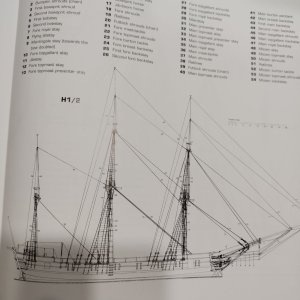
IF you want detail try and find this book. Google it and try and find one reasonably priced. Dont think you'd be disapointed. Below is a pic from the book of one image of standing rigging. It is about as historicaly acurate as you will find.
Anatomy of the Ship: HMS Beagle, Survey ship extraordinary
Karl Heinz Marquardt
Anatomy of the Ship: HMS Beagle, Survey ship extraordinary - Elizabeth's Bookshop
This is a history of the 10-gun brig and survey ship, HMS Beagle. It became famous for her survey voyages...
www.elizabethsbookshop.com.au
Cheers
Rick

I'm going to make "accurize" part of my vocabulary! I love it!I have moved on to the rigging portion of the program for my Corel Beagle. I found out after starting the build it was very inaccurate. I purchased Jotika updates to accurize it. I have the Karl Heinz Marquardt book to help me. What was not included in the Corel kit were the lower main studding sail booms, top mast studding sail booms and bumpkins. I'm not rigging this ship with sails. I'm going to rig out most of the kit with the Corel instructions but could use some advice as to any rigging requirements for these items if any. Thanks in advance.
Thanks everyone for your help. I have found over the years that when I purchase a kit I need some reference material. Did so for my Bluenose, Endeavour and Beagle. Then Oh! there's another book on rigging, planking etc. Better get those too. Can't have enough information, right? Pretty soon my research library rivals some universities. It's all good. The information I have gained about these ships has given me a much deeper appreciation of what is was like to hop on a boat and go for a quick sail around the world see what's what. In some cases this would have been an equivalent to the first moon landing. There's no safety net and you can't call AAA for a tow job back to port. I think what it would be like coming back to family and friends after being at sea for two to four years. Might be some culture shock.
1. Stunsails were/could be found on every yard high and low: courses to skysails.I don't think there are stunsails on the upper yards. Only the lower two yards.
2. The location, size and number of stunsails was determined by the knowledge and skill of the bos'n, the size and skill of the crew, the quantity and quality of the ship's supplies/spares, the aggressiveness and ego of the ship's captain, how hard the ship could realistically be driven and other factors that I do not have a clue about.
3. How many skysails you put on your model is actually determined by how close you can
relate to/pretend you are the captain of your ship in a storm and relate to #2 above (or something like that).
4. Actually, it is your ship and your call and no-one dares question your decision under pain of walking the plank. This is why it pays to read as many sea stories as you can and mentally place yourself into the narrative. The story details will eventually answer your questions of this type.
5. Questions of this type can only be answered by experience. Experience, today, can only be acquired second hand in/through fantastically contrived daydreams of your creation. There is no chart you can trust for a real- life answer to this question.
Last edited:
1. There could be stunsl's on every yard. Details of this type were handled at the captain's option.I don't think there are stunsails on the upper yards. Only the lower two yards.
2. The ship captains were assigned goals. The realization of those goals was realistically at the captain's option.
3. The minutiae of sailing the ship was not a major consideration of the owner's. Profit was the only major consideration.
4. Pretend you were a greedy non-compationate ship's captain and go from there.


I have the complete Standing riggen, as well as the running rigging. with or without sails. must have been there _el capi.I have moved on to the rigging portion of the program for my Corel Beagle. I found out after starting the build it was very inaccurate. I purchased Jotika updates to accurize it. I have the Karl Heinz Marquardt book to help me. What was not included in the Corel kit were the lower main studding sail booms, top mast studding sail booms and bumpkins. I'm not rigging this ship with sails. I'm going to rig out most of the kit with the Corel instructions but could use some advice as to any rigging requirements for these items if any. Thanks in advance.
Now, at 82 years old, I am cleaning up my more than 500 GB of storage, and some big parts of the info will be deleted.
I have nobody in my surroundings who is interested.
part os this Indo were prepared to make a book. BUILDING A MODEL SHIP from A-Z. But health problems and little interest even from here - has made mi giving up- Poul Erik -el CAPI
There was a bit more to this.The location, size and number of stunsails was determined by the knowledge and skill of the bos'n,
 The captain and sailing master decided when to change sails, the bosun managed the "how" Exceptions would be sixth rates as they did not always carry a sailing master.
 Regarding skysails I searched but found very little, and read that skysails generally did not carry stunsails . While stunsails were commonly used on lower, topsail, and sometimes topgallant yards into the 19th century they were not rigged for skysails. Skysails were small, lightweight sails used in fair weather. The mast and yard supporting them were not robust enough to support the booms and extra weight required for studding sails. Were there exceptions?? I would not be surprised. I cannot find anything specific, based on contemporary sources, stating that there were stunsails rigged on the skysail yards. Could you post where I can read more about the use of stunsails on skysail yards?
Many thanks for your help on this Bill.
Allan
Me too. It's a good word that I haven't seen before but describes the process to a tee.I'm going to make "accurize" part of my vocabulary! I love it!