
• Win a Free Custom Engraved Brass Coin!!!
    As a way to introduce our brass coins to the community, we will raffle off a free coin during the month of August. Follow link ABOVE for instructions for entering.
  • SUBSCRIBE TO SHIPS IN SCALE TODAY!

    The beloved Ships in Scale Magazine is back and charting a new course for 2026!
    Discover new skills, new techniques, and new inspirations in every issue.

    NOTE THAT OUR NEXT ISSUE WILL BE MARCH/APRIL 2026

a tiny saw to cut out parts drawn on sheets?

Joined
Mar 16, 2026
Messages
9
Points
0

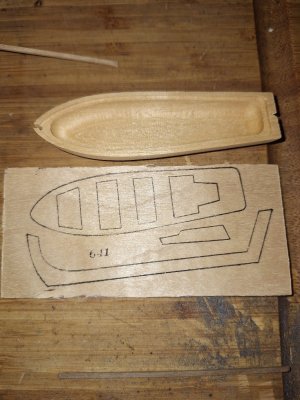
Apologies, I figure there's a precise term. I've been running an xacto blade over and over the lines but it just seems to take forever. Is there a recommendation for some sort of iddy biddy tiny saw to cutout these sorts of parts?

Thanks!
20260228_193949.jpg
 
A quick and dirty solution that I often use is a cutting disk in my Dremel, watch your fingers if you try that.
 
LOL we all have our preferences. I like to keep my fingers attached ! ROTF
I like using the band saw because the blade is always pulling your material down onto the cutting table.
I find sometimes with a scroll saw, if you are not pressing down your work, it will jump around a little bit and cause issues making a clean cut. But that could be me.
 
For the small parts I use a Fret saw. Generally finer blades than a scroll saw. Lee Valley has a great one albeit a bit pricey
 
Coping saw as described above is extremely useful. For your Xacto handle....key hole blades. These are great for cutting out gun ports and other things and might be an answer for your current situation as well.
Allan
1774431685206.png
 
If your question refers to cutting out the parts that you show above, I would not use a saw. These are very fragile and the teeth of a saw can easily destroy them unless you are using very fine blades. The tool that uses these is called a jewelers saw. Multiple passes with an Exacto knife is the best bet. A cheap steel ruler is good for a guide for cutting straight lines. A cheap plastic French curve (office supply store) can be used as a cutting guide for curves.

Roger
 
I would scan the wood to save the pattern. Or trace it. It looks like what you have there is just looking for an excuse to split. There are better species to use.

A bench vise and 5 1/2" needle files - HSS is better that diamond (no gullet) 0 is course 6 is ultra fine - a half round file should be enough - a flat side for the straight and a curve for the inside curves.

To free those parts: If you want to go Lamborghini - using this instead of ever buying an AC powered scroll saw - a 3" Knew MkIV-with-Lever-Tension-and-swivel-blade-clamps - a Knew bench pin - a Knew jewelers bench clamp - all sizes of 5" no-pin blades from fine to course. About $300 should do it.
 
I have a bandsaw and scroll saws, but for fine work that's liable to split, I prefer cutting the pieces apart individually from the sheet and then cutting them almost to the line with an adjustable frame jeweler's saw (AKA: "piercing saw") on a bench pin and then trimming to the line with a sharp Xacto knife or sanding block. The blades on the jeweler's saw are very thin and you will break some, especially until you get the hang of using it correctly. The advantage of the adjustable frame is that, if you are lucky, you can shorten the frame use shorter broken blades! ;) Jeweler's saws can be used with appropriate blades to cut both wood and metal.
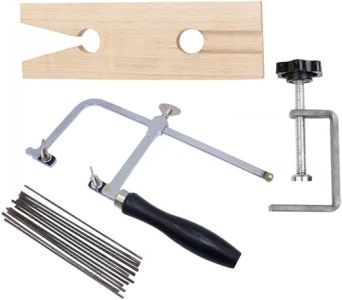
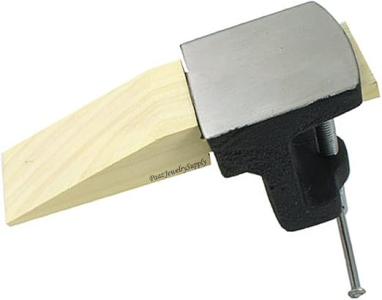
As mentioned above, you can spend $300.00 USD on a "Rolls Royce" edition coping saw these days. I've never had any problems with the old style jeweler's saws as below. I would seriously consider springing for the bench pin holder that has an integral anvil surface. I use that a lot for hammering small stuff and the bench pin that comes in the "kit" below is kind of cheesy.

Jeweler's saw, adjustable frame, blades, bench pin and clamp fixtures and 144 blades. Amazon $18.27 USD

This model is the one used by a lot of professionals. \\\


1774494711442.png


Jeweler's bench pin and anvil - $24.97 USD on Amazon.


1774497166313.png

Lots of Instructions on YouTube at https://www.youtube.com/results?search_query=how+to+use+a+jeweler's+saw?

Watch all the videos. Using a jeweler's saw correctly takes good technique. Lots of good tips there, but not all in one video. Note that the user's posture and relation to the height of the work is important. Note also that a jeweler's workbench is a specialized one. The top should be at the user's mid-chest. A lower chair or a raised box on a standard height workbench top will be most helpful. Why more ship modelers don't use jeweler's benches is a mystery to me. the front edge of the bench is cut in a concave arc so the jeweler can sit up close to the elevated benchtop. This brings fine work up close to the eyes and prevents neck and back strain when working for long periods. (See: https://www.ottofrei.com/collections/jeweler-workbenches?page=5)

An overview from Otto Frei Jewelry Supply, one of my favorite modeling tool sources:

 
Last edited:
awesome, all good options, I had been using a japanese flush cut saw to some parts loose and then a teeny block plane on the edges. These all seem better options
 
I have used all of the options listed above and all are reasonable.
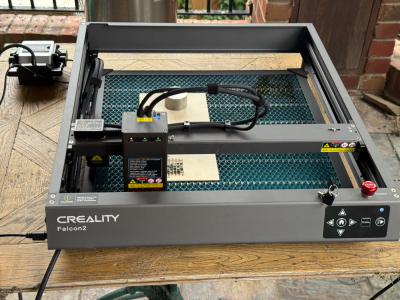
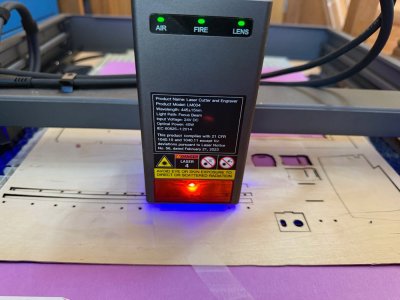
But recently, having a need to cut out several hundred parts, from materials varying from 0.5mm to 6mm thickness, to make a 1:72 HMS Bellerophon, I purchased a laser cutter. I chose a Creality Falcon2 40watt machine. Admittedly a more expensive option than those listed above, but a quantum leap in quality and speed of cutting. And it does have a learning curve. The ability to make fast clean accurate cuts, either full thickness or partial thickness, for me is a game changer.
BTW, I still use the simpler, older, conventional methods as required.
The Creality machine which I chose will cut up to 16mm thick MDF. And up to 0.25mm brass and stainless steel. The parts in the 3rd photo were cut in about 15 minutes.
Just saying.....

IMG_6947 (002).png

IMG_6937.jpeg

IMG_6986[1].JPG
 
One other idea that I have used countless times.
A full sized utility razor knife and a steel ruler.
I cut off everything as close as possible.
Then go at it with a sanding block.

It’s simple, inexpensive, and can be very quickly adapted to most ship model building task.
 
Gawd above... the simplest method I can think of and use, is to drill a series of holes, ease out the waste and tidy up with a file.

Call me cheap, I don't mind clucking.
 
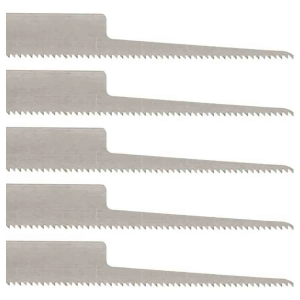
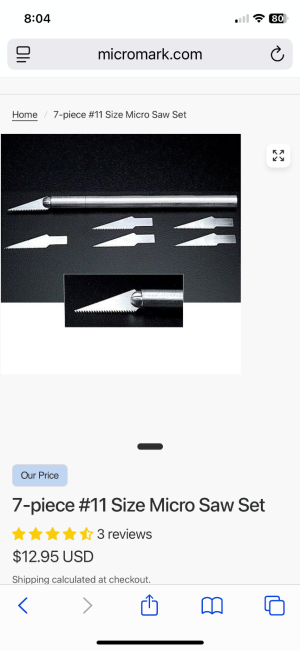
I have a scroll saw and coping saw but for very fine work I use the Micro-Mark micro saw blades: small triangular blades (#11) with narrow tips for very fine cuts. Only problem is the handle for them doesn’t hold the blades well so I use a sturdy hemostat and clamp it down on the base of the blade. Works like a charm especially in really tight spots.
 
Back
Top