
-

SUBSCRIBE TO SHIPS IN SCALE TODAY!
The beloved Ships in Scale Magazine is back and charting a new course for 2026!
Discover new skills, new techniques, and new inspirations in every issue.
NOTE THAT OUR NEXT ISSUE WILL BE MARCH/APRIL 2026 -

Win a Free Custom Engraved Brass Coin!!!
As a way to introduce our brass coins to the community, we will raffle off a free coin during the month of August. Follow link ABOVE for instructions for entering.
You are using an out of date browser. It may not display this or other websites correctly.
You should upgrade or use an alternative browser.
You should upgrade or use an alternative browser.

I suspect everyone that uses it has their favorite. Try a few to see what you like best.
Bondo, ,Minwax, Durham's Rock Hard Water Putty, Elmer’s ProBond, and MH Ready Patch are a few common ones. IF you get the planking tight, which is really good practice before starting the second layer, fillers are not needed.
Allan
Bondo, ,Minwax, Durham's Rock Hard Water Putty, Elmer’s ProBond, and MH Ready Patch are a few common ones. IF you get the planking tight, which is really good practice before starting the second layer, fillers are not needed.
Allan
I suspect everyone that uses it has their favorite. Try a few to see what you like best.
Bondo, ,Minwax, Durham's Rock Hard Water Putty, Elmer’s ProBond, and MH Ready Patch are a few common ones. IF you get the planking tight, which is really good practice before starting the second layer, fillers are not needed.
A
Thank you for the information.I use Rustin's - a two part filler. Works well and smooths down very well.


I guess I am still confused about why and when two layers of planking are needed. As AllanKP69 stated above, if the first layer of planking is tight, you may not need filler. But if the first layer of planking is tight with no gaps, why is there even a need for another layer?
Seamus
Seamus
You're not confused. Trust your own judgment!I guess I am still confused about why and when two layers of planking are needed. As AllanKP69 stated above, if the first layer of planking is tight, you may not need filler. But if the first layer of planking is tight with no gaps, why is there even a need for another layer?
Seamus

The only reason "double planking" exists as a ship modeling method is because some kit manufacturers figured they could cover up their poor supporting armature engineering ("bulkheads") and substandard materials (strip wood) with two layers of strip wood planking on an inadequate "bulkhead" structure instead of one layer of properly spiled planking on suitable framing. Two layers of planking are completely unnecessary if one understands how wooden ships and boats are really built in real life.
All sorts of "fillers," including drywall plaster ("Spackle") are used to fill gaps in strip wood "planking or otherwise poorly fitted construction. If it will stick and can be easily sanded fair, you'll see somebody using it.

elmers putty was great but i cant seem to find it anymore. i see it advertised but the stores dont have it. i see lots of plastic wood products.
when asking for it, the answer is... "whats on the shelf is all we have." the only place that was helpful was ace hardware on long island. the old timer knew exactly what i was asking for and was just as puzzeled they didnt have it either. when looking it up, he noticed it wasnt in their inventory list anymore, only plastic wood putties. i checked the other elmers putties and they dont have that distinct smell of pva.
Model # 155876
when asking for it, the answer is... "whats on the shelf is all we have." the only place that was helpful was ace hardware on long island. the old timer knew exactly what i was asking for and was just as puzzeled they didnt have it either. when looking it up, he noticed it wasnt in their inventory list anymore, only plastic wood putties. i checked the other elmers putties and they dont have that distinct smell of pva.
Last edited:
- Joined
- Jun 29, 2024
- Messages
- 1,811
- Points
- 488

I keep a can of Durham’s Rock Hard Water Putty in stock. I don’t build double planked models but it is a versatile product. It is a tan colored powder that you mix with ordinary tap water. It can be mixed to a variety of thicknesses from syrup to peanut butter so there is no tricky measuring involved. It sands easily to a feather edge.
Roger
Roger
Durhams was good in its day but the pva elmers is far superior. Sands, stains and has a nice even finish, no shrinkage, water resistant as well.
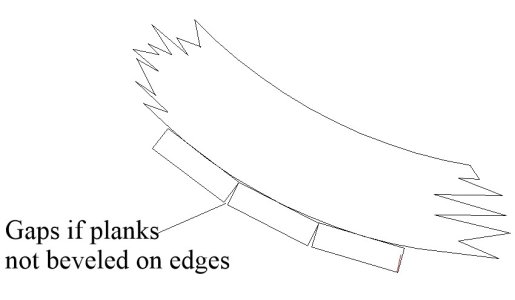
Even if the planking is done well, there are sometimes tiny gaps between the planks for various reasons such as forgetting to bevel the edges where the turn is pronounced. Rub a little PVA in the seam and sand. The saw dust will fill the seam and is from the same wood so is not as noticeable.\Allan
- Joined
- Jun 29, 2024
- Messages
- 1,811
- Points
- 488
In my post, I said that I keep Durham’s “in stock.” My modeling interests are different from 99 percent of other forum members. I am currently engaged in a very long term project to build a 1:96 scale model of a steel hulled Great Lakes freighter. Although the hull is wooden, much metal work is involved so a can of wood filler sits on the shelf for long periods of time until needed. I, therefore, like the dry powder rather than a premixed product as it is inert until it is mixed with water.
Roger
Roger

- Joined
- Dec 1, 2016
- Messages
- 6,668
- Points
- 728

I guess I am still confused about why and when two layers of planking are needed. As AllanKP69 stated above, if the first layer of planking is tight, you may not need filler. But if the first layer of planking is tight with no gaps, why is there even a need for another layer?
Seamus
Model ship kits use wide space bulkheads the gap between bulkheads is empty air space lacking the shape of the hull. As a result, planking tends to lay flat between bulkheads or budge outward. This is a short coming in kit design and also lack of hull construction on the builder's part. Planking does not form the shape of a hull the underlying structure does, the planking is just a thin skin over the structure.
lets take a look
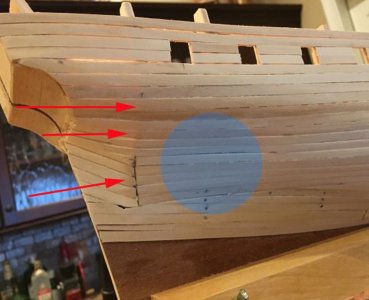
here the red arrows point to the last bulkhead which resulted in a hard bend. In a real hull there would be lower transom pieces between the last frame and the stern post. Lacking the transom pieces the planking will lay flat. The blue circle is concave due to lack of support under the planking
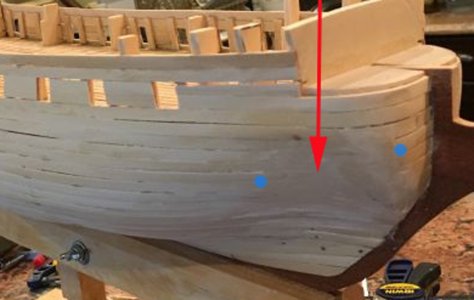
once again without the proper support the planking caves inward, the only points of reference are the blue dots.
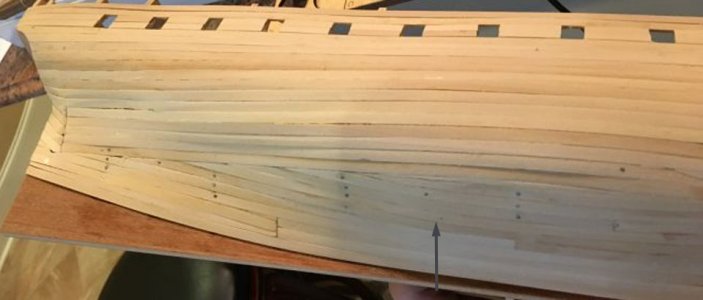
looking at the hull what we have here is a facets from bulkhead to bulkhead rather than a continues flow of the hull lines
this is a hard bend where the bulkhead causes the planking to bow outward and lay flat to the stem. Also each run of planking should end at the stem. A basic lack of understanding how a hull is planked
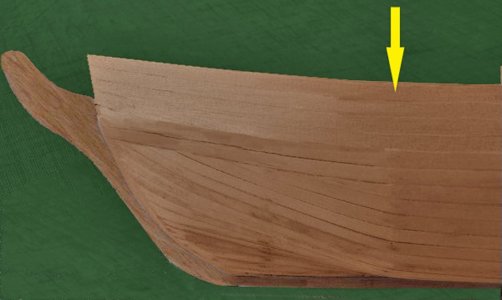
hard bends are sometimes the result of not beveling the bulkhead
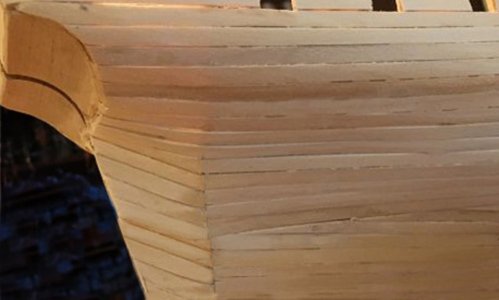
Double planking a hull is the kits way of trying to achieve a smooth flowing hull shape. As long as the builder slathers the hull with some sort of filler material to fill in the low spots, but a builder has to be careful not to sand through the hard edges or high spots.
Seamus
Model ship kits use wide space bulkheads the gap between bulkheads is empty air space lacking the shape of the hull. As a result, planking tends to lay flat between bulkheads or budge outward. This is a short coming in kit design and also lack of hull construction on the builder's part. Planking does not form the shape of a hull the underlying structure does, the planking is just a thin skin over the structure.
lets take a look
here the red arrows point to the last bulkhead which resulted in a hard bend. In a real hull there would be lower transom pieces between the last frame and the stern post. Lacking the transom pieces the planking will lay flat. The blue circle is concave due to lack of support under the planking
once again without the proper support the planking caves inward, the only points of reference are the blue dots.
looking at the hull what we have here is a facets from bulkhead to bulkhead rather than a continues flow of the hull lines
this is a hard bend where the bulkhead causes the planking to bow outward and lay flat to the stem. Also each run of planking should end at the stem. A basic lack of understanding how a hull is planked
hard bends are sometimes the result of not beveling the bulkhead
Double planking a hull is the kits way of trying to achieve a smooth flowing hull shape. As long as the builder slathers the hull with some sort of filler material to fill in the low spots, but a builder has to be careful not to sand through the hard edges or high spots.
Last edited:
- Joined
- Jun 29, 2024
- Messages
- 1,811
- Points
- 488
A wooden ship relies on CLOSELY SPACED frames to define hull shape. The planking provides longitudinal strength and of course keeps the water out.
A POB ship model is not an accurate representation of the way real ships are built for the reasons that Dave outlines above. Building the skeleton, planking (two layers) and filling dips with some sort of goop are just necessary steps to try to get a more or less accurate hull.
If a true Plank on Frame model is not your goal, why subject yourself to the often frustrating process of trying to turn a stack of plywood and wood strips into an accurate model of a real ship? Carve a hull from a laminated stack of wood, each lamination sawn to a lines drawing waterline. Now that’s fun!
Roger
A POB ship model is not an accurate representation of the way real ships are built for the reasons that Dave outlines above. Building the skeleton, planking (two layers) and filling dips with some sort of goop are just necessary steps to try to get a more or less accurate hull.
If a true Plank on Frame model is not your goal, why subject yourself to the often frustrating process of trying to turn a stack of plywood and wood strips into an accurate model of a real ship? Carve a hull from a laminated stack of wood, each lamination sawn to a lines drawing waterline. Now that’s fun!
Roger
- Joined
- Dec 1, 2016
- Messages
- 6,668
- Points
- 728
another way to get a proper shape to the hull is to fill in the spaces between the bulkheads then you do not need to use a filler. you should be able to plank the hull in a single layer. Doing this is what Roger suggests you are ending up with a solid hull. One problem with filler blocks they are usually softer than the plywood bulkheads and sand down quicker resulting in a plywood ridge sticking up.