


Hello everyone.
Today I would like to explain the basics of my aging technique for plastic ship models. I'll show you this using my current project, the IJN Mikasa.
It all starts shortly after the hull has been primed. Use a fairly light shade so that the subsequent preshading will have a good effect.
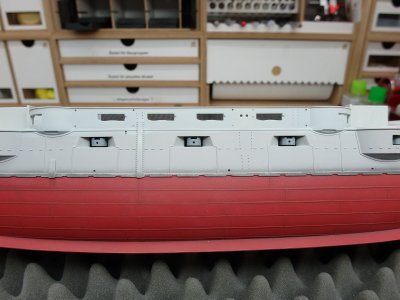
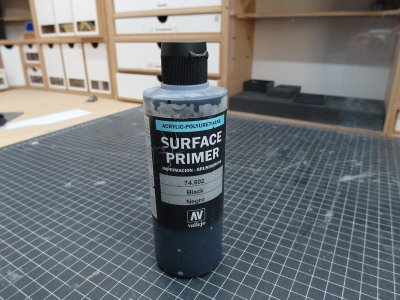
I use Vallejo primers. They provide excellent coverage and create a very good surface for the subsequent painting process.
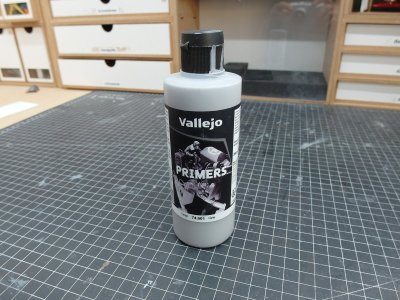
Next comes the preshading.
Since no picture of my hull exists in this state, I created the it with Photoshop. You can see that I blackened out recesses and protruding surface structures that would cast a shadow.
I create the black areas using a 0.2mm nozzle in my airbrush. Don't worry about making a mistake, even if the black area isn't perfectly in the right place. The black paint will only show through the base coat very faintly, so it's hardly noticeable.
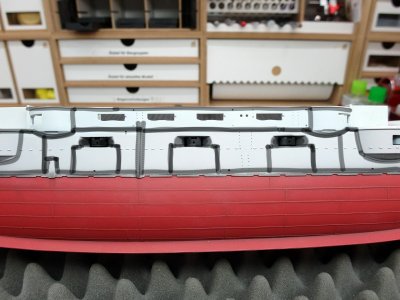
I do this with a black primer. However, you can also simply use black paint instead of the primer.
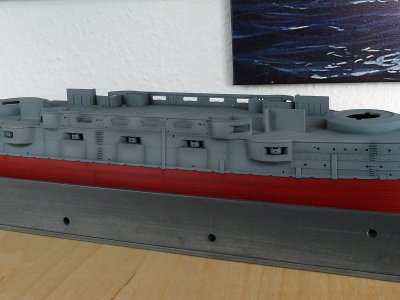
Now, apply the base color that the hull will have. Be careful not to apply too many coats, otherwise the preshading will be barely visible.
If you've done everything correctly, the black will shimmer slightly through the paint, creating an initial sense of depth.
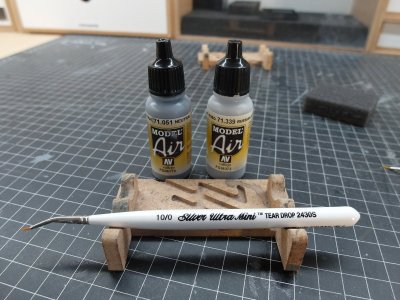
Next, I'll work on the fine details that protrude from the hull. Using a fine brush and a lighter gray than the base color, I'll highlight and accentuate these details. An angled brush is advantageous here, as it makes applying the paint easier. If you're using water-based acrylic paints like I am, you don't have to worry about making a mistake. Simply remove any excess paint with a little water on the brush immediately, and it will be completely gone. However, it's essential that the previous step has completely dried.
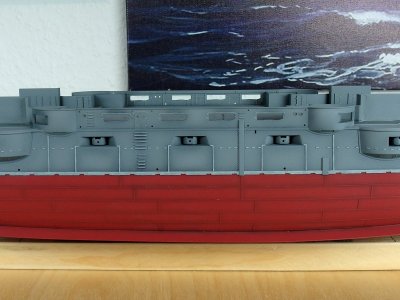
This will further increase the contrast.
Next, filters are applied. This is, like washing, simply using highly diluted paint. On my grey hulls, I usually use a blue, a light grey and a white filter. The green one is for the waterline area.
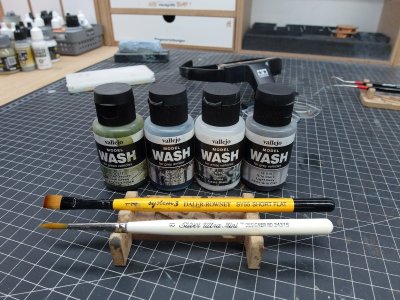
What does a filter do?
It breaks up homogeneously painted surfaces, making them more vibrant and thus varying the base coat. It's also used to mix in different shades in specific areas. For example, I use a green filter in the waterline area to represent algae growth. And finally, filter also great for lightening or darkening areas.
You apply the filter by first brushing a small amount onto the area to be treated. Then, using a flat brush dipped in water and wiped on a paper towel, spread the filter evenly over the surface. It's similar to how you would apply a wood stain. Use up-and-down brushstrokes to distribute the paint and partially pick it up again.
Once the filter is completely dry, you can move on to the wash. These are the same colors used for the filters. It's important that the wash color is always darker than the base color. You want to enhance the depth effect.
For gray areas, I use these dark grey wash color.
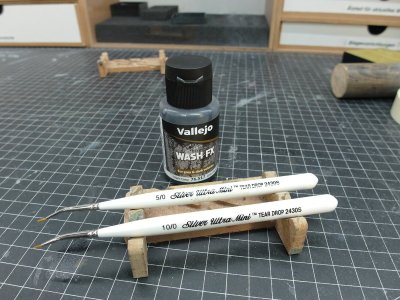
Apply the paint to an edge or a groove on the hull. Capillary action will cause the paint to run along the edge. Remove any excess paint with a clean, damp brush.
The paint will then remain in the corners and grooves, and the darkening in these areas creates an additional depth effect.
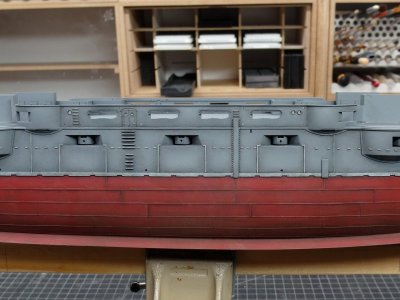
On to dry brushing.
I used to use oil paints for this. However, the market now offers products that are simpler to use. I currently use MIG dry brush paints, which I'm very happy with. These are also the only products I use that aren't from Vallejo.
I don't want to advertise for this company here. Yes, I'm very happy with Vallejo, but the point is that the individual paint products are compatible with each other. This is naturally the case if you stick to one brand. Of course, you don't have to. But if you do, you should test beforehand to make sure there are no unwanted reactions between products from different brands.
Then you'll need the paint, a piece of cardboard, and a flat brush.
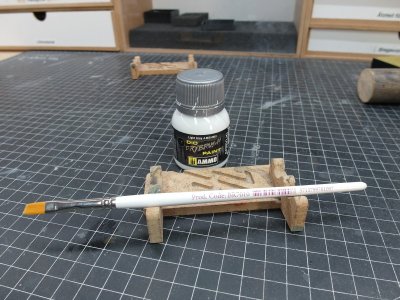
Then, pick up a little paint with the brush. Next, wipe it off on the piece of cardboard until the brush no longer releases any color Then it's ready for dry brushing.
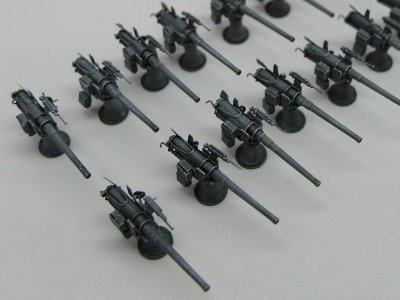
Now, take the brush and gently brush it over the component. The brush does not release any paint on the smooth surfaces. However, it will release up paint on edges and raised details like rivet heads and the like, as you can see very well from my weapons here.
Once everything is dry, the chipping can begin.
First, you'll need the following supplies:
- A small piece of sponge or foam. It should be very fine-pored, since we're not chipping a tank scale model here.
- A very fine brush
- And paint.
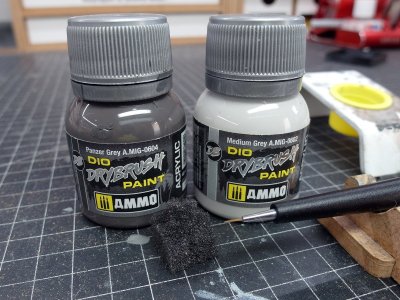
I'm using the very thick dry brush paint from MIG, but regular oil paint will also work.
For my gray ship, I'm using a very dark gray to represent the primer under the chipped paint. And then a fairly light gray to create a highlighting edge.
There are a thousand different ways to chip. You also have to consider the scale you're working on. For my 1:200 scale boats, I proceed as follows:
First, I pick up a little paint with a sponge. I then dab it on cardboard until almost no paint is visible. Next, I dab it onto the hull of my boat. Be careful; less is often more. Don't worry about mistakes. You can remove them with a water-soaked brush if the paint isn't dry yet.
Keep in mind that there's less to do on smooth surfaces than on edges and protrusions. In my experience, paint chips off more easily on the real boat in these areas. Then, continue with a fine brush, irregularly distributing small dots of varying sizes across the surface. I also add longer strokes along the hull where it might have scraped against the fenders in the harbor.
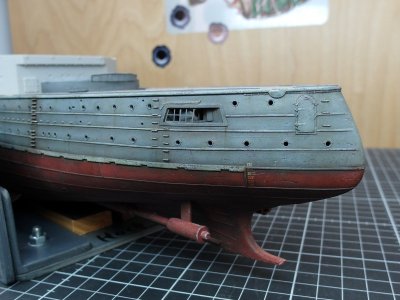
Finally, I paint highlights with a very light gray. These are applied along the gray strokes or dots. Like here at the stern of the Mikasa.
This really takes a bit of practice. You should definitely try it out on an old model. Or paint a piece from your spares box.
After that, your fuselage could look like this one.
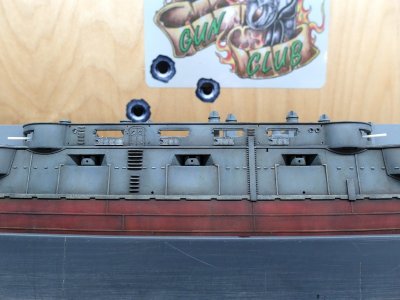
As a second example, let's take the armored command post of the Mikasa.
In the center, you can see a cluster of tiny gray spots. These are also created using the sponge technique. It's always important to dab the sponge on a piece of cardboard until it almost stops transferring paint.
Then you press it onto the areas where you want the paint to chip. This creates these small islands of spots. I then modify these with a brush. By dipping the brush in water, I remove any spots that seem excessive. Or I enlarge individual spots with a fine brush. I also extend some of the spots with a fine stroke, so they look like long scratches.
On the command post, I also add more chipping to the edges and corners, since the paint flakes off more quickly in these areas on the original.
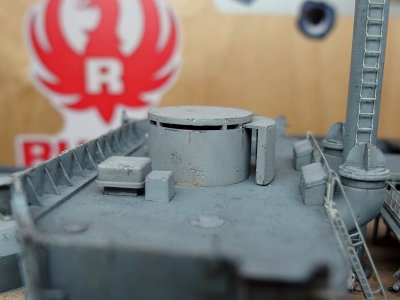
In the second step, I use the light gray to create a highlight edge on some of the spots, especially on the longer and more intense areas, like the long scratch at the entrance to the control room. This gives the scratches a 3D effect. I pick up a tiny drop of paint with the brush and draw along the edge of the gray spot with the tip. If the line is too thick, I clean the brush and go over the line again to make it thinner.
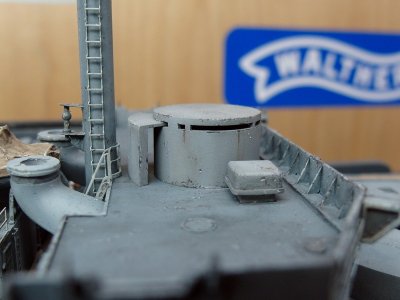
It's all just a matter of practice.
And the best part is, you can't really ruin anything. If you don't like the result, you can remove everything before it dries.
Let's move on to the last step: fading.
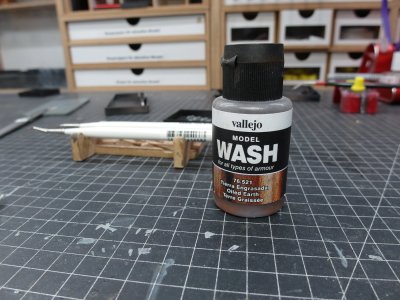
For this, I use Vallejo's special background colors. They're available for all sorts of applications. I'm using the three shown below.
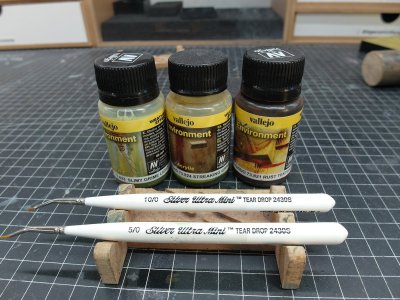
It actually works with any slightly thicker paint. I now also use MIG dry brush paints for fading. For example, the two orange and red tones on the left represent rust effects. And the olive green one represents running dirt and water.
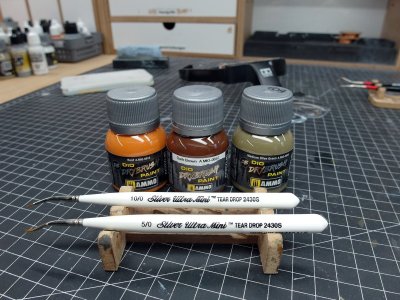
Now I put a little more paint on the smaller brush and draw a thin downward line. Then I dampen the slightly larger brush with water and drag it along the previously applied paint. This makes the downward line thinner and thinner, allowing me to adjust the direction and the length. See the green arrow.
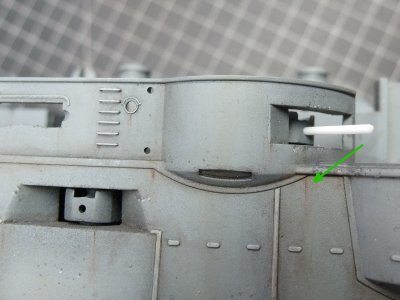
So I gradually pull streaks of dirt and rust onto the hull. In the end, it looks like this at the hawseholes.
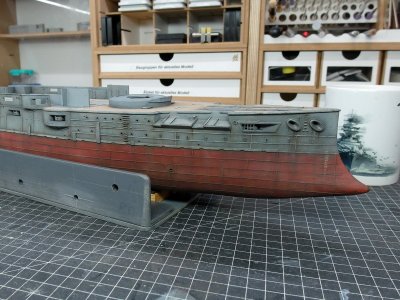
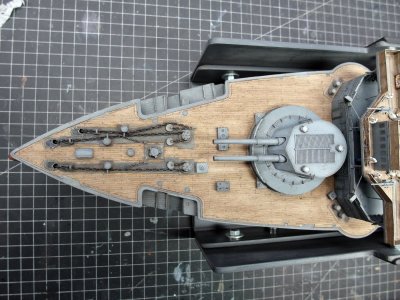
I also use washes when weathering wooden decks. A dark brown works wonderfully.
The color of the deck can be influenced depending on how many applications you make to it. I did two wash cycles on my Mikasa.
I hope I've been able to give you a better understanding of weathering ship hulls. If you have any further questions, feel free to ask.
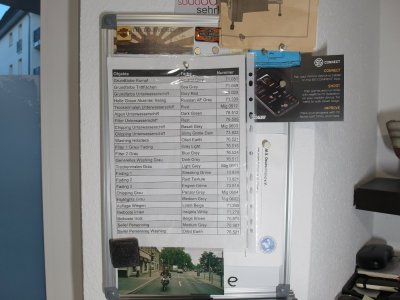
Oh, and one more thing: I always create a color key for each model. This way, you won't get confused later if you're wondering what filter you used at the beginning.
Today I would like to explain the basics of my aging technique for plastic ship models. I'll show you this using my current project, the IJN Mikasa.
It all starts shortly after the hull has been primed. Use a fairly light shade so that the subsequent preshading will have a good effect.
I use Vallejo primers. They provide excellent coverage and create a very good surface for the subsequent painting process.
Next comes the preshading.
Since no picture of my hull exists in this state, I created the it with Photoshop. You can see that I blackened out recesses and protruding surface structures that would cast a shadow.
I create the black areas using a 0.2mm nozzle in my airbrush. Don't worry about making a mistake, even if the black area isn't perfectly in the right place. The black paint will only show through the base coat very faintly, so it's hardly noticeable.
I do this with a black primer. However, you can also simply use black paint instead of the primer.
Now, apply the base color that the hull will have. Be careful not to apply too many coats, otherwise the preshading will be barely visible.
If you've done everything correctly, the black will shimmer slightly through the paint, creating an initial sense of depth.
Next, I'll work on the fine details that protrude from the hull. Using a fine brush and a lighter gray than the base color, I'll highlight and accentuate these details. An angled brush is advantageous here, as it makes applying the paint easier. If you're using water-based acrylic paints like I am, you don't have to worry about making a mistake. Simply remove any excess paint with a little water on the brush immediately, and it will be completely gone. However, it's essential that the previous step has completely dried.
This will further increase the contrast.
Next, filters are applied. This is, like washing, simply using highly diluted paint. On my grey hulls, I usually use a blue, a light grey and a white filter. The green one is for the waterline area.
What does a filter do?
It breaks up homogeneously painted surfaces, making them more vibrant and thus varying the base coat. It's also used to mix in different shades in specific areas. For example, I use a green filter in the waterline area to represent algae growth. And finally, filter also great for lightening or darkening areas.
You apply the filter by first brushing a small amount onto the area to be treated. Then, using a flat brush dipped in water and wiped on a paper towel, spread the filter evenly over the surface. It's similar to how you would apply a wood stain. Use up-and-down brushstrokes to distribute the paint and partially pick it up again.
Once the filter is completely dry, you can move on to the wash. These are the same colors used for the filters. It's important that the wash color is always darker than the base color. You want to enhance the depth effect.
For gray areas, I use these dark grey wash color.
Apply the paint to an edge or a groove on the hull. Capillary action will cause the paint to run along the edge. Remove any excess paint with a clean, damp brush.
The paint will then remain in the corners and grooves, and the darkening in these areas creates an additional depth effect.
On to dry brushing.
I used to use oil paints for this. However, the market now offers products that are simpler to use. I currently use MIG dry brush paints, which I'm very happy with. These are also the only products I use that aren't from Vallejo.
I don't want to advertise for this company here. Yes, I'm very happy with Vallejo, but the point is that the individual paint products are compatible with each other. This is naturally the case if you stick to one brand. Of course, you don't have to. But if you do, you should test beforehand to make sure there are no unwanted reactions between products from different brands.
Then you'll need the paint, a piece of cardboard, and a flat brush.
Then, pick up a little paint with the brush. Next, wipe it off on the piece of cardboard until the brush no longer releases any color Then it's ready for dry brushing.
Now, take the brush and gently brush it over the component. The brush does not release any paint on the smooth surfaces. However, it will release up paint on edges and raised details like rivet heads and the like, as you can see very well from my weapons here.
Once everything is dry, the chipping can begin.
First, you'll need the following supplies:
- A small piece of sponge or foam. It should be very fine-pored, since we're not chipping a tank scale model here.
- A very fine brush
- And paint.
I'm using the very thick dry brush paint from MIG, but regular oil paint will also work.
For my gray ship, I'm using a very dark gray to represent the primer under the chipped paint. And then a fairly light gray to create a highlighting edge.
There are a thousand different ways to chip. You also have to consider the scale you're working on. For my 1:200 scale boats, I proceed as follows:
First, I pick up a little paint with a sponge. I then dab it on cardboard until almost no paint is visible. Next, I dab it onto the hull of my boat. Be careful; less is often more. Don't worry about mistakes. You can remove them with a water-soaked brush if the paint isn't dry yet.
Keep in mind that there's less to do on smooth surfaces than on edges and protrusions. In my experience, paint chips off more easily on the real boat in these areas. Then, continue with a fine brush, irregularly distributing small dots of varying sizes across the surface. I also add longer strokes along the hull where it might have scraped against the fenders in the harbor.
Finally, I paint highlights with a very light gray. These are applied along the gray strokes or dots. Like here at the stern of the Mikasa.
This really takes a bit of practice. You should definitely try it out on an old model. Or paint a piece from your spares box.
After that, your fuselage could look like this one.
As a second example, let's take the armored command post of the Mikasa.
In the center, you can see a cluster of tiny gray spots. These are also created using the sponge technique. It's always important to dab the sponge on a piece of cardboard until it almost stops transferring paint.
Then you press it onto the areas where you want the paint to chip. This creates these small islands of spots. I then modify these with a brush. By dipping the brush in water, I remove any spots that seem excessive. Or I enlarge individual spots with a fine brush. I also extend some of the spots with a fine stroke, so they look like long scratches.
On the command post, I also add more chipping to the edges and corners, since the paint flakes off more quickly in these areas on the original.
In the second step, I use the light gray to create a highlight edge on some of the spots, especially on the longer and more intense areas, like the long scratch at the entrance to the control room. This gives the scratches a 3D effect. I pick up a tiny drop of paint with the brush and draw along the edge of the gray spot with the tip. If the line is too thick, I clean the brush and go over the line again to make it thinner.
It's all just a matter of practice.
And the best part is, you can't really ruin anything. If you don't like the result, you can remove everything before it dries.
Let's move on to the last step: fading.
For this, I use Vallejo's special background colors. They're available for all sorts of applications. I'm using the three shown below.
It actually works with any slightly thicker paint. I now also use MIG dry brush paints for fading. For example, the two orange and red tones on the left represent rust effects. And the olive green one represents running dirt and water.
Now I put a little more paint on the smaller brush and draw a thin downward line. Then I dampen the slightly larger brush with water and drag it along the previously applied paint. This makes the downward line thinner and thinner, allowing me to adjust the direction and the length. See the green arrow.
So I gradually pull streaks of dirt and rust onto the hull. In the end, it looks like this at the hawseholes.
I also use washes when weathering wooden decks. A dark brown works wonderfully.
The color of the deck can be influenced depending on how many applications you make to it. I did two wash cycles on my Mikasa.
I hope I've been able to give you a better understanding of weathering ship hulls. If you have any further questions, feel free to ask.
Oh, and one more thing: I always create a color key for each model. This way, you won't get confused later if you're wondering what filter you used at the beginning.
Last edited:

 , so you'll need the paint, a piece of cardboard, and a flat brush.