



The gangway ladder would only be used in port. If you are making the model at sea, it's best if you leave it off.

 |
The beloved Ships in Scale Magazine is back and charting a new course for 2026! Discover new skills, new techniques, and new inspirations in every issue. NOTE THAT OUR NEXT ISSUE WILL BE July/August 2026 |
|
 |
As a way to introduce our brass coins to the community, we will raffle off a free coin during the month of August. Follow link ABOVE for instructions for entering. |
|

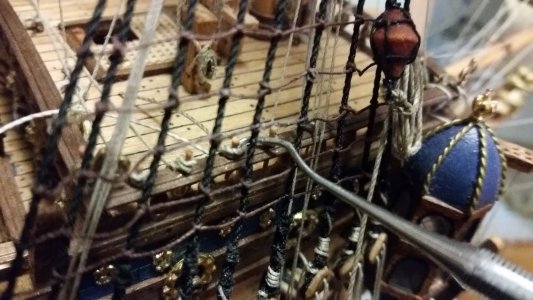
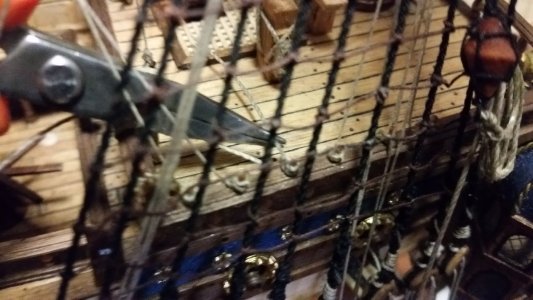
Always start rigging a line by tying the first end at the belaying pins (ankles, caviglie) and then run the line up through the blocks, and tie the other end at the yardarm or sail (vele). Start at the bottom and run the line upward. You can set the line tension easily then.HELLO EVERYONE, I'M ALMOST AT THE END OF MY "SOVEREIGN OF THE SEAS"!!!!!!
I WOULD LIKE TO ASK FOR HELP WITH A BIG PROBLEM I'M HAVING.
ALL THE ROPES COME FROM THE SPADES (EXCUSE MY INTRACTION IN NAUTICAL TERMS) AND NEED TO BE TURNED AT THE ANKLES.
MY PROBLEM IS HOW TO MAKE THEM TIGHT, SINCE IT'S RATHER DIFFICULT TO KNOT THEM AT THE ANKLES SO THAT THEY ARE TIGHT.
AT LEAST I CAN'T GET A GOOD RESULT.
COULD YOU KINDLY GIVE ME A SUGGESTION?
THANKS…
When you build Corel model kit, you learn some Italian! Caviglie (ankles in English) translates to belaying pins.Hi Fabriv;
Your translation software has made this impossible to understand. Can you try another, which might make more sense?
Ratty

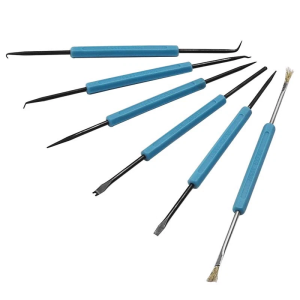
Use rigging tools.HELLO EVERYONE, I'M ALMOST AT THE END OF MY "SOVEREIGN OF THE SEAS"!!!!!!
I WOULD LIKE TO ASK FOR HELP WITH A BIG PROBLEM I'M HAVING.
ALL THE ROPES START FROM THE TOP (BLACK OUT MY NAUTICAL INTRODUCTION) AND MUST BE DIRECTED AT THE ANKLE HEIGHT.
MY PROBLEM IS HOW TO MAKE THEM TIGHT, SINCE IT'S QUITE DIFFICULT TO KNOT THEM AT THE ANKLE HEIGHT IN A TIGHT WAY.
AT LEAST I CAN'T GET A GOOD RESULT.
CAN YOU GIVE ME A SUGGESTION?
THANKS…
I'm also leaving the Italian version, maybe it's easier for you to find the translation
CIAO A TUTTI, SONO QUASI ALLA FINE DEL MIO "SOVEREIGN OF THE SEAS"!!!!!!
VORREI CHIEDERE AIUTO PER UN GROSSO PROBLEMA CHE STO AVENDO.
TUTTE LE CIME PARTONO DALLE PIGHE (SCURATE LA MIA INTRODUZIONE IN TERMINI NAUTICI) E DEVONO ESSERE RIVOLTE ALL'ALTEZZA DELLE CAVIGLIE.
IL MIO PROBLEMA È COME FARLE STRETTE, VISTO CHE È PIUTTOSTO DIFFICILE ANNOdarle ALL'ALTEZZA DELLE CAVIGLIE IN MODO CHE SIANO STRETTE.
ALMENO NON RIESCO AD OTTENERE UN BUON RISULTATO.
POTETE DARMI UN SUGGERIMENTO?
GRAZIE…


 s' as follows: 1 @ 60 cwt; 1 @ 55 cwt; 1 @ 54 cwt; 2 @ 45 cwt; 1 @ 44 cwt; & 1 @ 43 cwt.
There are a few things in Payne's engraving which are not correct. His depiction of one achor being weight with two other anchors already stored on the port channel is one of them. There should be typically five anchors, four on the fore channels and probably one smaller kedging anchor stored elsewhere, perhaps on the main channel. As @Bilge Ratt points out, a later source showed that the Sovereign had seven anchors. The various sizes, measured in hundred-weight, were used for different purposes.Hello, I'd like to ask a new question: How many more ships does the Sovereign of the Seas have left?
From John Payne's drawings it would appear that there are 3 anchors per side, and there are also 2 mouths. From Van de Velde's drawing however there are 2 anchors per side.
can you help me?
Thank you!
Hello, I'd like to ask a new question. How many anchors does the Sovereign of the Seas have? From John Payne's drawings, it would appear that there are three anchors per side, and there are also two anchor mouths. From Van de Velde's drawing, however, there are two anchors per side. Can you help me? Thanks.
Thanks Ratt! That's very interesting!A list in the Coventry Papers, dated approximately 1642-45, lists the Sovereign as having 'Great
Ratty
Thank you very much! I found that there were 7 anchors: 2 in the spare hold, 4 on the bow, and 1 emergency anchor just aft.Nell'incisione di Payne sono presenti alcune inesattezze. Una di queste è la raffigurazione di un'ancora appesantita insieme ad altre due ancore già stivate sul canale di babordo. In genere, le ancore dovrebbero essere cinque: quattro sui canali di prua e probabilmente un'ancora di prua più piccola, di tipo "knift", stivata altrove, forse sul canale principale. Come sottolinea @@Bilge Ratt , una fonte successiva indicava che la Sovereign possedeva sette ancore. Le diverse dimensioni, misurate in quintali, erano utilizzate per scopi differenti.
Alcuni elementi, come la cima di ormeggio sul bompresso, mancano nell'incisione di Payne. L'attrezzatura velica della nave non era ancora completa quando fu realizzata l'incisione, quindi si presume che la disposizione delle cime sia quella standard inglese dell'epoca. I disegni di Van de Velde dovrebbero raffigurare la nave dopo il riallestimento del 1658-1660, ma mostrano elementi probabilmente ripresi dall'incisione di Payne, come la posizione della botola del cannone sotto il balcone inferiore della galleria laterale. Quel portello non è allineato correttamente con gli altri cannoni su quel ponte. Le fonti a cui ci siamo ispirati per realizzare i nostri modelli sono raramente complete o corrette. Ci vuole molta ricerca e indagine per capire quali parti di una fonte siano attendibili e quali siano invece da considerarsi supposizioni o errori. Questo è particolarmente vero quando si utilizzano dipinti come fonte di informazione, ed è la vera sfida nella costruzione di un modello di nave del XVII secolo. Costruire il modello in sé è facile in confronto.
Thank you very much! I found that there were 7 anchors: 2 in the spare hold, 4 on the bow, and 1 emergency anchor just aft.
Ciao,
Fabio.
