• SUBSCRIBE TO SHIPS IN SCALE TODAY!

    The beloved Ships in Scale Magazine is back and charting a new course for 2026!
    Discover new skills, new techniques, and new inspirations in every issue.

    NOTE THAT OUR NEXT ISSUE WILL BE MARCH/APRIL 2026
  • Win a Free Custom Engraved Brass Coin!!!
    As a way to introduce our brass coins to the community, we will raffle off a free coin during the month of August. Follow link ABOVE for instructions for entering.

La Renommee 1744 1:48. (CAF) by Salty

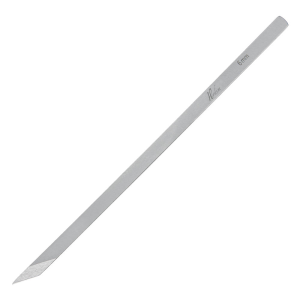
Salty that looks good - just check the underside of those parts when you get to the fairing stage and you should be good to go. Its a complicated juncture of multiple parts and angles. That knife sounds interesting - please share a pic when you get a chance.
Chris
 
Chris, thanks, I feel a bit more reassured. The knife is used for making musical instruments, but I guess it could also be used for marking out joints in full size woodworking pieces. It’s 6 mm wide and 2 mm thick, made of HSS and I use a 1000/4000 grit stone to sharpen it.

IMG_4542.jpeg

Paul, thanks for your constant encouragement and support. Your Saint Philippe continues to amaze. Your obvious meticulous attention to refining each piece to the nth degree pushes me to do the same, but never it seems with the same results.

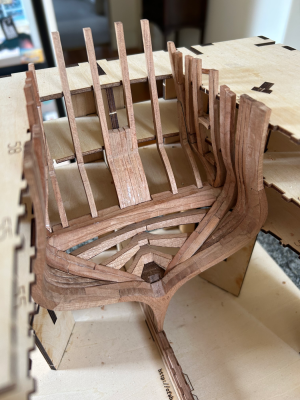
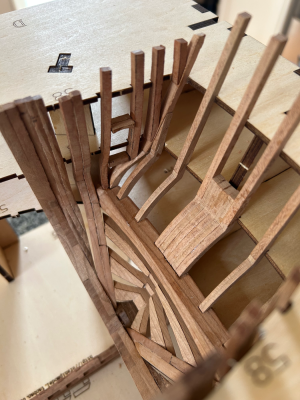
This is the completed stern section with the corner posts, fashion pieces and counter timbers.

IMG_4094.jpeg

IMG_4095.jpeg

The little chocks between the fashion pieces are the frames for windows. The kit came with a small template to get the spacing right.

Now all I have to do is wait until I inevitably break one, some or all of the counter timbers working on the rest of the ship.

Kind regards

Salty
 
Now all I have to do is wait until I inevitably break one, some or all of the counter timbers working on the rest of the ship.
ROTF I was thinking this very thing as I was reading your post and looking at the images. I added a temporary horizontal brace to the counter timbers (and on the frame tips as well when they were installed).
 
Chris, thanks, I feel a bit more reassured. The knife is used for making musical instruments, but I guess it could also be used for marking out joints in full size woodworking pieces. It’s 6 mm wide and 2 mm thick, made of HSS and I use a 1000/4000 grit stone to sharpen it.

View attachment 594530

Paul, thanks for your constant encouragement and support. Your Saint Philippe continues to amaze. Your obvious meticulous attention to refining each piece to the nth degree pushes me to do the same, but never it seems with the same results.

This is the completed stern section with the corner posts, fashion pieces and counter timbers.

View attachment 594531

View attachment 594532

The little chocks between the fashion pieces are the frames for windows. The kit came with a small template to get the spacing right.

Now all I have to do is wait until I inevitably break one, some or all of the counter timbers working on the rest of the ship.

Kind regards

Salty
Broke them 3 time, leaving them off till I plank
 
Chris, thanks, I feel a bit more reassured. The knife is used for making musical instruments, but I guess it could also be used for marking out joints in full size woodworking pieces. It’s 6 mm wide and 2 mm thick, made of HSS and I use a 1000/4000 grit stone to sharpen it.

View attachment 594530

Paul, thanks for your constant encouragement and support. Your Saint Philippe continues to amaze. Your obvious meticulous attention to refining each piece to the nth degree pushes me to do the same, but never it seems with the same results.

This is the completed stern section with the corner posts, fashion pieces and counter timbers.

View attachment 594531

View attachment 594532

The little chocks between the fashion pieces are the frames for windows. The kit came with a small template to get the spacing right.

Now all I have to do is wait until I inevitably break one, some or all of the counter timbers working on the rest of the ship.

Kind regards

Salty
Beautiful work!!
 
Yup - I would not have added those at this stage - way too fragile before the rest of the frames installed added and the hull is faired both interior and exterior. You may want to go ahead and added the top rail to the tops of the timbers to give it some stability as well as some temporary side battens. That said be very careful as you proceed.
 
Paul1 and Paul2 (I’ll leave you to sort out who is who), I’ll definitely put some temporary protection on the counter timbers, as I have lots of painful memories when I built Le Coureur.

Chris, the top rail sounds like a good idea. Although it seems logical to build it now, for some reason it’s not in this box of the kit. I’ll look at the instructions/plans to see whether it’s in box 5 or 6 when I get a chance.

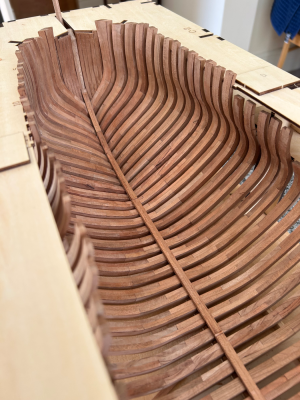
Here is La Renommee with all of the framing and keelson permanently in place:

IMG_4099.jpeg

1777256635811.png

1777256753001.png

Although it turned out OK, I had a bit of work to do to get the keelson fitting nicely - widening some of the notches in it and, in a few instances, having to widen some of the flat sections in the base of frames to accept the notches. I thought I had done a reasonable job lining up the frames when installing the on the keel, but apparently not…

Some of the frames in the midship are a little narrow at the top, but I think I can rectify this when I install some stringers in the next part of the kit. Not much pressure is needed as it’s only a few millimetres, but still I don’t want any breakages.

That’s the end of parts 1 to 4 and now I’m onto the part 4.5 internal fitout. To date, I have really enjoyed building this kit and hope you have enjoyed following my progress. With a fair slice a luck, I might be able to make a decent job of rest of it!

Kind regards

Salty
 
Good morning Tom. (Although “Salty” is a fine name considering our hobby ;) ).

Firstly, very cool framing. It almost looks like you have very little fairing to do- way to go. As for the counter timber - the Doc has it spot on :
ROTF I was thinking this very thing as I was reading your post and looking at the images. I added a temporary horizontal brace to the counter timbers (and on the frame tips as well when they were installed).
It didn’t help me though as I am a modeller with no finesse and these flimsy little $&@#• still got flung into oblivion ROTF.
Cheers Grant
 
Paul1 and Paul2 (I’ll leave you to sort out who is who), I’ll definitely put some temporary protection on the counter timbers, as I have lots of painful memories when I built Le Coureur.

Chris, the top rail sounds like a good idea. Although it seems logical to build it now, for some reason it’s not in this box of the kit. I’ll look at the instructions/plans to see whether it’s in box 5 or 6 when I get a chance.

Here is La Renommee with all of the framing and keelson permanently in place:

View attachment 594969

View attachment 594970

View attachment 594971

Although it turned out OK, I had a bit of work to do to get the keelson fitting nicely - widening some of the notches in it and, in a few instances, having to widen some of the flat sections in the base of frames to accept the notches. I thought I had done a reasonable job lining up the frames when installing the on the keel, but apparently not…

Some of the frames in the midship are a little narrow at the top, but I think I can rectify this when I install some stringers in the next part of the kit. Not much pressure is needed as it’s only a few millimetres, but still I don’t want any breakages.

That’s the end of parts 1 to 4 and now I’m onto the part 4.5 internal fitout. To date, I have really enjoyed building this kit and hope you have enjoyed following my progress. With a fair slice a luck, I might be able to make a decent job of rest of it!

Kind regards

Salty
Awesome work, cant wait to see 4.5!
 
Grant, thanks for your encouragement. I’m hoping there’s not much fairing to do. I’m also planning on cutting away sections of the starboard side, so I don’t think I’ll need to do anything midships on that side. I am going to do something about the counter timbers though. On Le Coureur, I think I broke one almost every time I turned her over to plank! Oh and by the way, I answer to both Salty and Tom away from SoS.

Paul, thank you, I am looking forward to the internal structure as it will be very different. I have been through your log and thought you did a wonderful job. I’m going to follow your example and partially plank the deck in an effort to show off some of the lovely details.

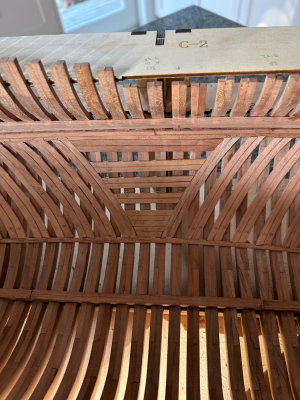
The first job in building the internal structure (part 4.5 of the kit) is install fours sets of stringers which run the length of the hull. The top one is the deck clamp for the main deck and the lowest is the top row of the ceiling planking.

IMG_4128.jpeg

IMG_4127.jpeg

The deck clamp was quite thick - 3 mm - so it took a bit of bending. I use a steam iron and that seems to work well enough. It helps that the planks are spiled, so if you bend them enough, they should (!?) fit.

The lowest row is a little different. Ordinarily, planks are a little longer than required and you simply trim them to fit. This wasn’t the case here, as the lower edges of the planks have notches to accept diagonal planking, so there’s no fudge factor. Thankfully, the plans, the pieces and I all agree about the final result.

Kind regards

Salty

 
Grant, thanks for your encouragement. I’m hoping there’s not much fairing to do. I’m also planning on cutting away sections of the starboard side, so I don’t think I’ll need to do anything midships on that side. I am going to do something about the counter timbers though. On Le Coureur, I think I broke one almost every time I turned her over to plank! Oh and by the way, I answer to both Salty and Tom away from SoS.

Paul, thank you, I am looking forward to the internal structure as it will be very different. I have been through your log and thought you did a wonderful job. I’m going to follow your example and partially plank the deck in an effort to show off some of the lovely details.

The first job in building the internal structure (part 4.5 of the kit) is install fours sets of stringers which run the length of the hull. The top one is the deck clamp for the main deck and the lowest is the top row of the ceiling planking.

View attachment 595565

View attachment 595566

The deck clamp was quite thick - 3 mm - so it took a bit of bending. I use a steam iron and that seems to work well enough. It helps that the planks are spiled, so if you bend them enough, they should (!?) fit.

The lowest row is a little different. Ordinarily, planks are a little longer than required and you simply trim them to fit. This wasn’t the case here, as the lower edges of the planks have notches to accept diagonal planking, so there’s no fudge factor. Thankfully, the plans, the pieces and I all agree about the final result.

Kind regards

Salty

Looking good!!
 
Paul and Shota, thanks for your kind words. Thank you also to everyone who has visited and left likes.

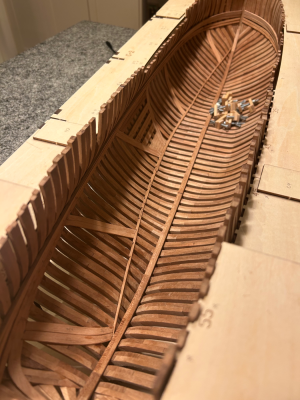
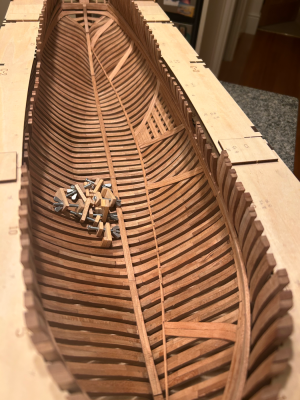
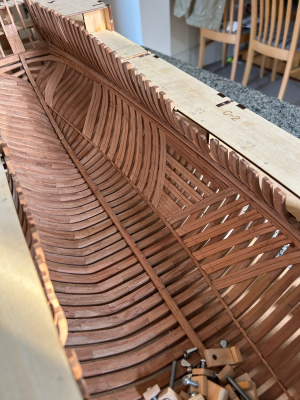
As I noted in my previous post, La Renommee is a a little different from some other ships in that she has a large section of diagonal ceiling planking. I think this as used to stop hogging which could occur with longitudinal ceiling planking.

Here is the start:

IMG_4144.jpeg

IMG_4145.jpeg

The timbers in the central “triangle” were installed first. For the horizontal timbers, I departed slightly from the kit - the instructions show 13, but only 12 are actually provided and there are 11 in the ANCRE monograph. In the end, I went for 13, making the two top timbers from scratch. I am at a bit of a loss to explain the departure from the monograph, but it’s only a minor detail.

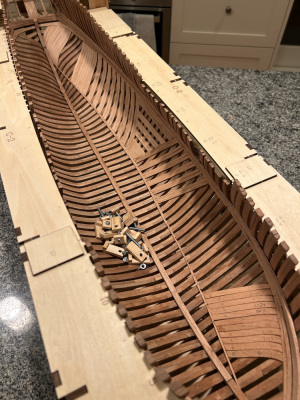
Then I temporarily clamped the four pairs of diagonal timbers and glued in place the five planks making up the lower edge. The stern timbers in particular needed a bit of steaming to get the right shape, and the clamps that fit through the frames mean I don’t have to use superglue for the moment.

Kind regards

Salty
 
Paul and Shota, thanks for your kind words. Thank you also to everyone who has visited and left likes.

As I noted in my previous post, La Renommee is a a little different from some other ships in that she has a large section of diagonal ceiling planking. I think this as used to stop hogging which could occur with longitudinal ceiling planking.

Here is the start:

View attachment 595944

View attachment 595945

The timbers in the central “triangle” were installed first. For the horizontal timbers, I departed slightly from the kit - the instructions show 13, but only 12 are actually provided and there are 11 in the ANCRE monograph. In the end, I went for 13, making the two top timbers from scratch. I am at a bit of a loss to explain the departure from the monograph, but it’s only a minor detail.

Then I temporarily clamped the four pairs of diagonal timbers and glued in place the five planks making up the lower edge. The stern timbers in particular needed a bit of steaming to get the right shape, and the clamps that fit through the frames mean I don’t have to use superglue for the moment.

Kind regards

Salty
Well done!! Looking great!!
 
Paul, if you had a dollar for every time I had visited your log… I can’t wait until you resume construction.

Jeff, you are a man after my own heart with your plank on frame HMS Enterprise. What’s more, we are at very similar stages! These types of kits can be pretty demanding but rewarding and you look to be doing a great job

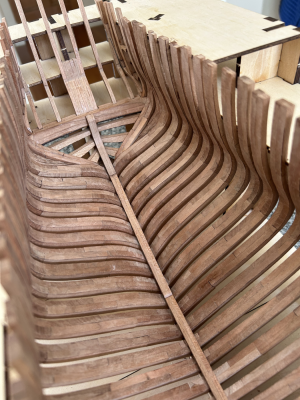
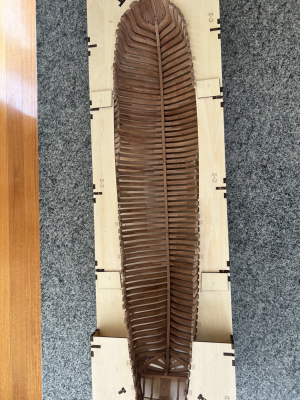
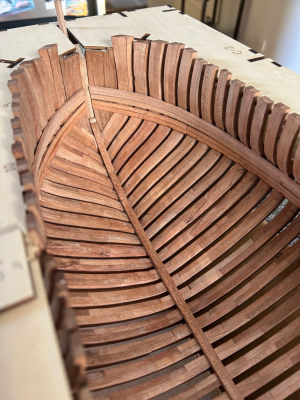
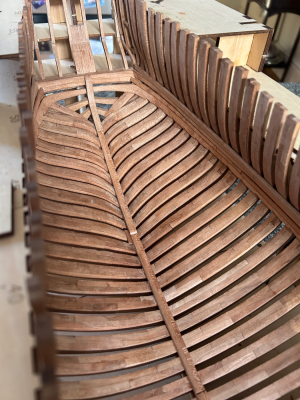
I have decided to lay diagonal ceiling planking only on the port side as I will cut away some of the frames on the starboard to expose the internal fit out. It’s not in the instructions, but it’s the way the model is depicted on the CAF website.

176.png

130.png

A little more progress on my version:

IMG_4153.jpeg


IMG_4150.jpeg

I don’t know if you can see in the photos, but steaming raises the grain and bleaches the wood (the water I dip the wood in when steaming definitely has a brown tinge). However, it’s surprisingly superficial and a little scraping smoothes the surface and restores the colour.

All these timbers seem to be cut very accurately as I have only had to make minor adjustments to them to get them to fit. This is despite the fact that most of them have a reasonable degree of bend and twist.

Kind regards

Salty
 
Paul, if you had a dollar for every time I had visited your log… I can’t wait until you resume construction.

Jeff, you are a man after my own heart with your plank on frame HMS Enterprise. What’s more, we are at very similar stages! These types of kits can be pretty demanding but rewarding and you look to be doing a great job

I have decided to lay diagonal ceiling planking only on the port side as I will cut away some of the frames on the starboard to expose the internal fit out. It’s not in the instructions, but it’s the way the model is depicted on the CAF website.

View attachment 596248

View attachment 596249

A little more progress on my version:

View attachment 596251


View attachment 596250

I don’t know if you can see in the photos, but steaming raises the grain and bleaches the wood (the water I dip the wood in when steaming definitely has a brown tinge). However, it’s surprisingly superficial and a little scraping smoothes the surface and restores the colour.

All these timbers seem to be cut very accurately as I have only had to make minor adjustments to them to get them to fit. This is despite the fact that most of them have a reasonable degree of bend and twist.

Kind regards

Salty
Looking really good!! Hoping to resume mine shortly....need to scrape up another 300.00 for the next section
 
Paul, yes, the next section is quite expensive, but it has the main deck and guns and should keep you busy for many months. If the rest of the kit is anything to go by, it will be worth the wait.

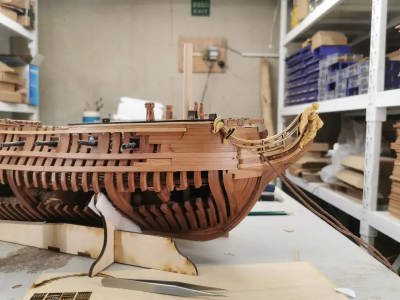
From my kit:

IMG_4607.jpeg

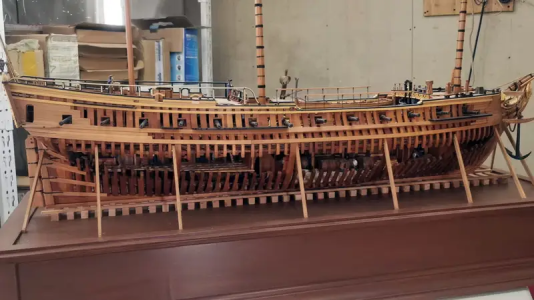
On the CAF website:

92-1.png

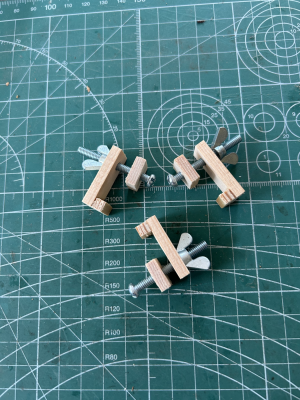
Christian, thanks for your kind words. I made the clamps of 12 x 4 mm spruce with a 40 mm long M3 screw. They are quite basic but very handy. Judging by your beautiful work on HM Sloop Fly and HM Cutter Alert, I am sure you’ll be able to put something more elegant together.

1777948864847.png

More planking:

1777948921994.png

1777948971019.png

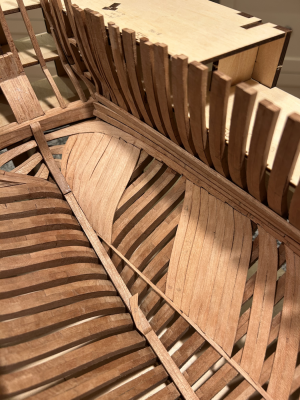
I am pretty happy with the stern section. The planks need to be very soft to take the bend and twist and I find short sections harder to work with than long ones. Because of the way the planks are cut, there is also a risk that the flared section that meets the stern post could break as the bend is somewhat across the grain.

Excuse the pencil scribble. There’s a lot of planks, each is different and each goes in a particular place.

Kind regards

Salty
 
Last edited:
Back
Top