



• At some point from current UTC of 19:40:30 Thursday up to UTC 19:40:30 Friday, it is possible the forum might be disabled for a short period of time for updates and upgrades. Another notice will be posted for status. Note: Central Standard US time would be 14:40:30 Wednesday up to 14:40:30 Thursday
  • SUBSCRIBE TO SHIPS IN SCALE TODAY!

    The beloved Ships in Scale Magazine is back and charting a new course for 2026!
    Discover new skills, new techniques, and new inspirations in every issue.

    NOTE THAT OUR NEXT ISSUE WILL BE MARCH/APRIL 2026
  • Win a Free Custom Engraved Brass Coin!!!
    As a way to introduce our brass coins to the community, we will raffle off a free coin during the month of August. Follow link ABOVE for instructions for entering.

Airfix Golden Hind 1/72 with added rigging and details

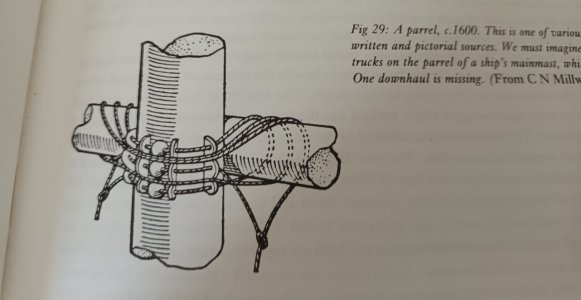
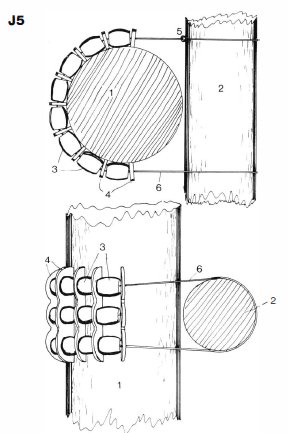
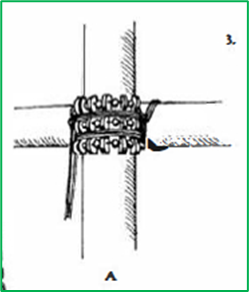
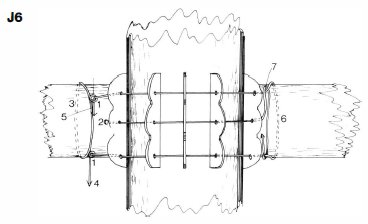
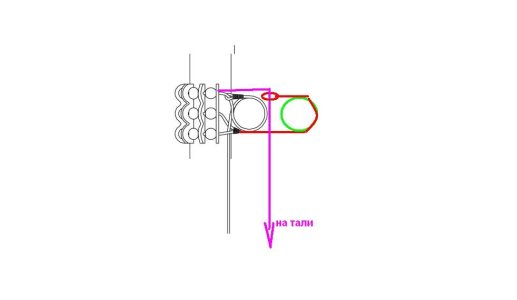
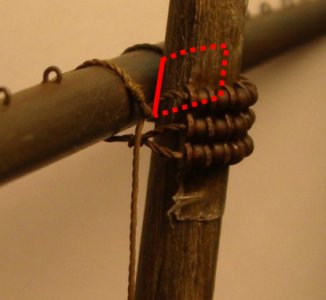
I am a little confused about the use of parrels. Here is an image I found on a FSM forum I think. It is how I understand parrels to be arranged.
Pic-1316.jpg

Clearly if raising or lowering the yard the trucks enable it to "roll" down the mast. Mostly. But there is still wood-on-wood in the red area. So there is still direct friction and wear. No?

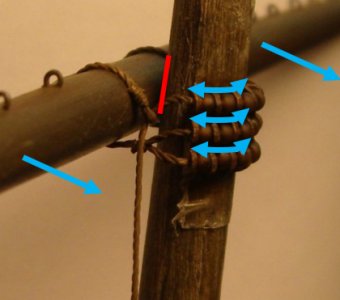
And if we are rotating the yard in the horizontal plane (using braces, see blue arrows below) then there is still friction in the red area but also the trucks are being pulled sideways, whereas they roll up and down, not sideways. Surely that is not good...
Pic-1317.jpg

Have I misunderstood something?

Thanks!
 
In order for the yard to be raised/lowered or braced the parrel will be need to be loosened thus reducing the friction, hope this helps.

Michael D.
 
Parrels are indeed complicated..
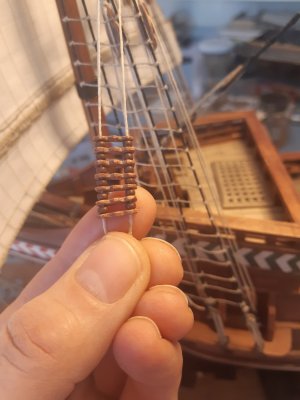
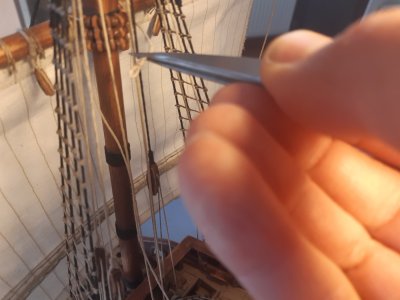
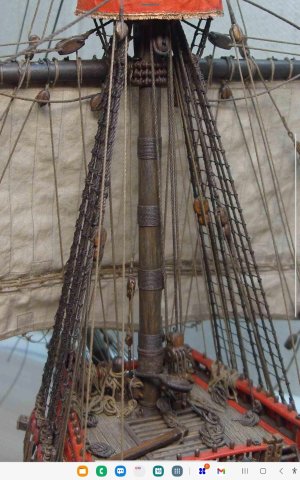
20260507_150552.jpg
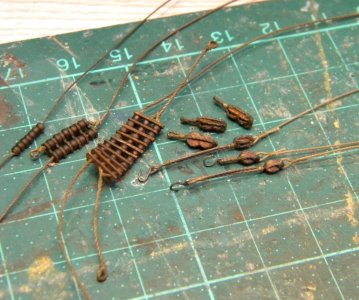
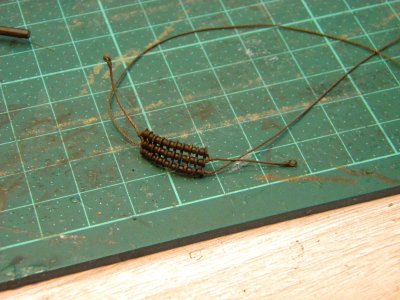
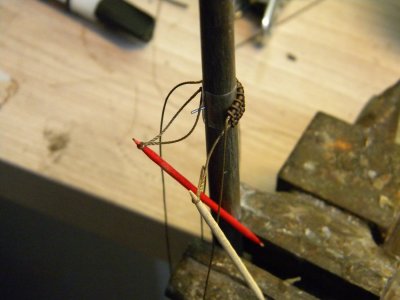
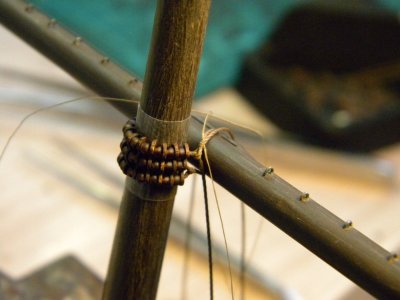
I had a build log of a scratch build GH with a good explanation, but lost it on MSW ...

edit:
Did some digging on my pc....
20220414_181941.jpg20220417_105358.jpg20220417_110440.jpg20220417_111439.jpg20220417_111509.jpg20220417_111748.jpg
 
Last edited:
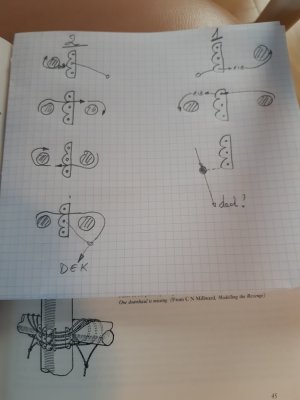
The pearls have to stick out of the ribs on the inside, thus no friction on up and down. Also the parrels are loose enough to swing sideways.

What most modelers do not realise ist the need to have those two lines running down for the adjustment for the tightness. As for bracing the yards one needs to loosen the parrels quite a lot as to be able to keep clear the shrouds :-)
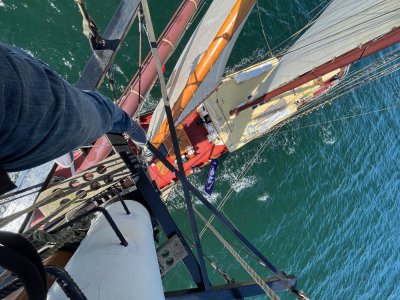
Guess how I know? I just found out when trying to brace the yards of my Vic trying to fit her into the transport case ...

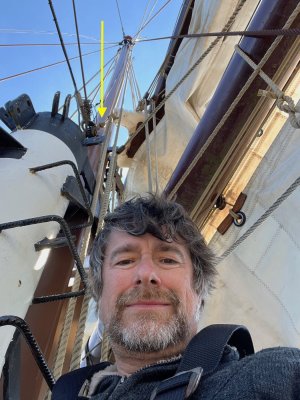
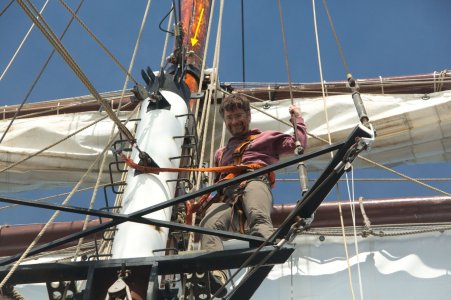
In modern ships there are not nescessairily ribs used - see the yellow arrows -, here on the Hendrika Bartels.
Also they are not set tight, as they are in my understanding only to restrict the yard from banging forth and back. These balls are too week for power transmission as they might break. Hendrika lost some in a storm some days before the picture. New ones had to be fitted.

IMG_7782.jpgOstersegeln 190425 Hendrika Bartelds_3927.jpg

Stupid smile?!? Try to be on that simply wonderful place to see how thing work in real life and try not to do so – no way, it comes automatically :-)

IMG_7779.jpg
XXXDAn
 
Last edited:
In order for the yard to be raised/lowered or braced the parrel will be need to be loosened thus reducing the friction, hope this helps.

Michael D.
I thought that might be the case. Interestingly, Gemini (AI) said you need to tighten the parrels, to secure the beads onto the mast and lift the yard a fraction of an inch off the mast so it slides easily. Now, if this is true (and AI makes mistakes!) then
a) the parrels have to go all the way around the mast, not just half way, as I see in most pictures...(no?)
b) I have no idea how to rig this so it works and still holds the yard secure when loosened!

Of course, I am not mkaing a working model so it is OK to approximate things. But now I am curious about how it actually worked (Even though my model will not be so detailed!)
 
Parrels are indeed complicated..

I had a build log of a scratch build GH with a good explanation, but lost it on MSW ...
Beautiful work and beautiful pictures! Thanks so much!

Do your parrels go all the way around the mast or just behind it?

I am still struggling to get my head "around" how they work :-)

I notice that your model has the foremast on the beakhead rather than the forecastle. There is some debate about this, but I am doing it the way you did. (That is how Airfix designed their model - I could shift the mast if I wanted but I will leave it.) It is certainly possible that it went through the beakhead and no-one can be certain. I will do it this way becasue it will also make a note of difference from more modern ships.
 
The pearls have to stick out of the ribs on the inside, thus no friction on up and down. Also the parrels are loose enough to swing sideways.
Ribs on the inside? So they go all the way around the mast? I can (in principle) see that then pulling tight could force the trucks tightly to the mast and lift the yard away from the mast, allowing it to move up and down on the trucks. I dunno how to rig that, but I can see that it might be possible...

But mostly I see the yard touching the mast on the front of the mast and the parrels on the rear, so I can't see how to avoid wood scraping on wood when raising or lowering yards. eg here is the arrangement from The Anatomy of the Susan Constant book.
Pic-1336.jpg

What most modelers do not realise ist the need to have those two lines running down for the adjustment for the tightness.
Some authors show one line for adjusting the parrels. I assume that works also?
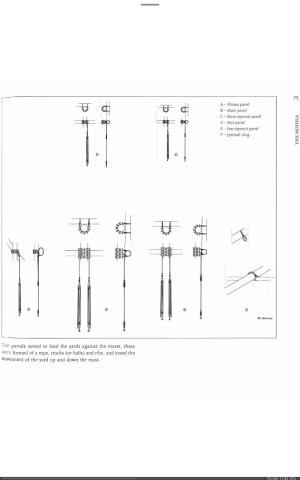
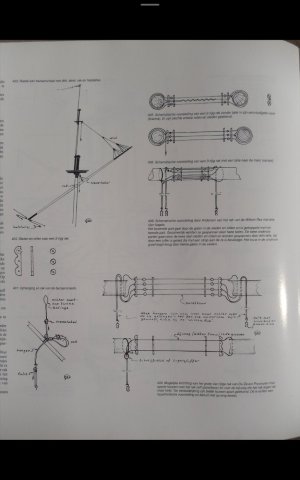
e.g. Mondfeld p312 (and they do not seem to go all around the mast...so I don't see any way to "lift" the yard off the mast and avoid friction)
1778201706164.png
Harland p28
1778201723780.png
And the Susan Constant again:

1778202397913.jpeg

As for bracing the yards one needs to loosen the parrels quite a lot as to be able to keep clear the shrouds :-)
Guess how I know? I just found out when trying to brace the yards of my Vic trying to fit her into the transport case ...
:-)
Stupid smile?!? Try to be on that simply wonderful place to see how thing work in real life and try not to do so – no way, it comes automatically :-)
I have no problem with the stupid smile...I am indeed very jealous of it!

Thanks!
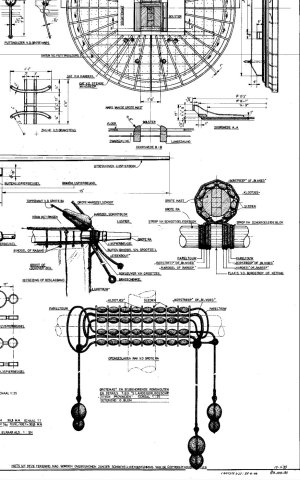
JL
 
Last edited:
Maybe this is the part I have been missing. This is form Gemini and discusses the lubrication of yard, mast and parrels. Slush and grease...!
------

The Rotation Problem (Horizontal)​

This is where the system is most "primitive." As you noted, the trucks roll beautifully up and down, but they cannot roll sideways. When the yard is braced (rotated around the mast):

  • Sliding Friction: The trucks and ribs must slide laterally across the grain of the mast.
  • The Solution—Slush and Grease: To handle this, sailors used "slush"—a mixture of animal fat and grease. The masts were kept heavily greased in the path of the yards. This turned the "wood on wood" contact into a lubricated sliding surface.
  • The "Loose" Fit: Parrels were rarely pulled bone-tight. There was always a bit of "play" in the rope. This allowed the yard to pivot slightly before the parrel started to bind, reducing the immediate friction when making small adjustments to the braces.

3. Protection: The "Leathering"​

To prevent the yard itself from gouging the mast when the parrel shifted, the center of the yard (the slings) was often "served" (wrapped in small rope) or covered in heavy leather.

  • The leather was soaked in oil or grease.
  • This sacrificial layer took the brunt of the "wood on wood" wear, protecting the structural integrity of the mast and the spar.
 
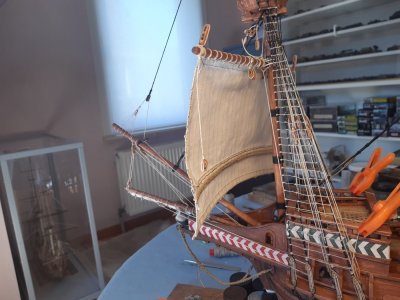
I notice that your model has the foremast on the beakhead rather than the forecastle.
The fore mast placed in the beakhead was most common in that period.

Parrels/ ribs
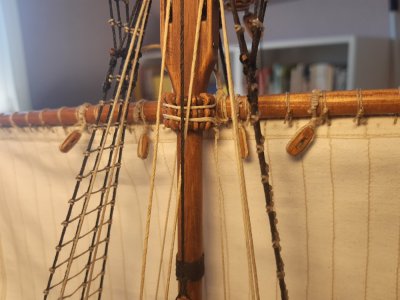
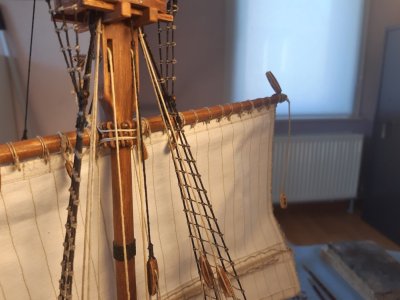
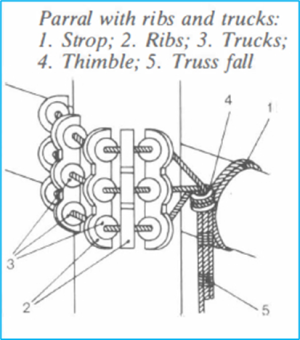
Parrels are something like a ball bearing. The parrels are the balls that absorb the friction. And the ribs hold the balls in place.
They do not go all the way around the mast.
The rigging serves to hold the entire structure together and to regulate the tension.
Complicated (to me) but effective.
 
The fore mast placed in the beakhead was most common in that period.

Parrels/ ribs
Parrels are something like a ball bearing. The parrels are the balls that absorb the friction. And the ribs hold the balls in place.
They do not go all the way around the mast.
The rigging serves to hold the entire structure together and to regulate the tension.
Complicated (to me) but effective.
Cheers.

Yes, the working of the parrels is a mystery to me too! But can see that, although imperfect, they are a significant aid to moving the yard.

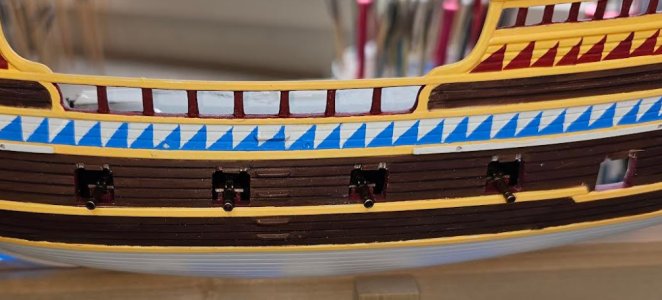
Your Mary Rose is beautiful!

JL
 
Back
Top