
• SUBSCRIBE TO SHIPS IN SCALE TODAY!

    The beloved Ships in Scale Magazine is back and charting a new course for 2026!
    Discover new skills, new techniques, and new inspirations in every issue.

    NOTE THAT OUR NEXT ISSUE WILL BE MARCH/APRIL 2026
  • Win a Free Custom Engraved Brass Coin!!!
    As a way to introduce our brass coins to the community, we will raffle off a free coin during the month of August. Follow link ABOVE for instructions for entering.

NRG 18th Century Merchantman Half-Hull - by JacquesCousteau

Joined
Nov 13, 2025
Messages
123
Points
88

Here's another reposted old build log of mine from ModelShipWorld that was lost in that site's crash. As far as I can tell, there are no build logs of this model here, so I thought it may be useful to post it. This will be a simplified re-post, missing a number of helpful discussions I had with other forum users, which would be difficult to re-create here.

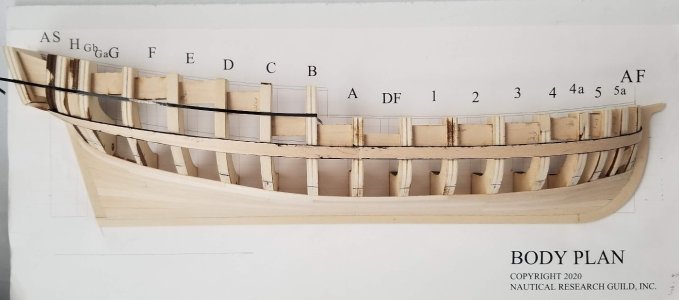
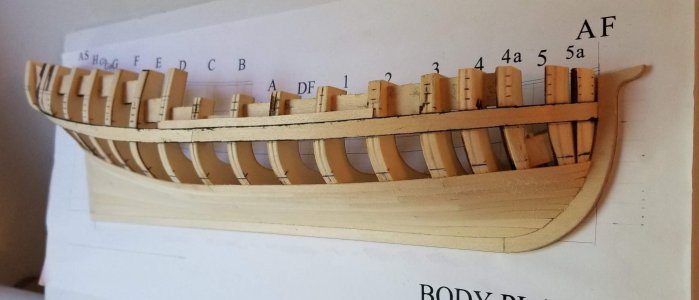
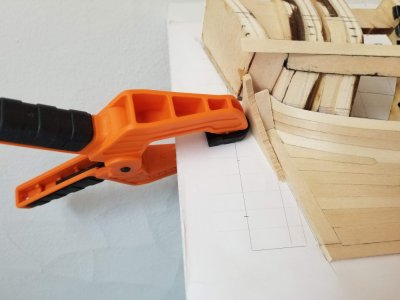
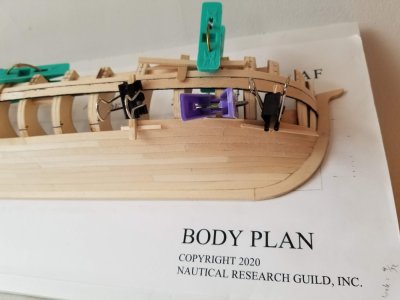
By January 2024, I had completed two models (the Model Shipways Dory and a Xochimilco Trajinera scratch-build) and had two builds in progress (a Lake Chapala Canoa de Rancho and a cross-section model of the Spanish fishing boat Juana y José). All but the Juana y José were flat-bottomed, flat-sided boats, and I was interested in learning more about how to plank a curved hull--the Juana y José had given me a taste of this, but as a cross-section, it was missing a lot. I saw that the Nautical Research Guild (NRG) sold a half-hull planking kit with a detailed instruction set on how to spile planks. I thought that a half-hull would be easy to transport (I was moving frequently those days) and display, and would simplify planking because I wouldn't have to worry about getting everything even on both sides, so I decided to give the kit a try. It helped, too, that there were a number of build logs on MSW with a lot of great advice and helpful photos, including one by the kit's designer, Toni Levine.

Overall, I found the build to be a very useful learning experience. There were a few issues I had with the kit, as will be seen, but I was pleased with the result, and more importantly, I learned a lot about hull planking, making me feel better-prepared for further builds.

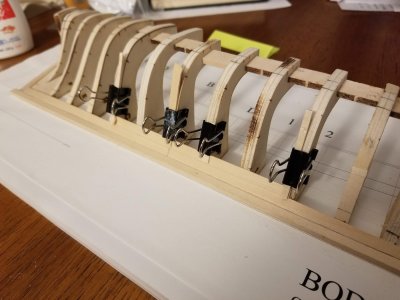
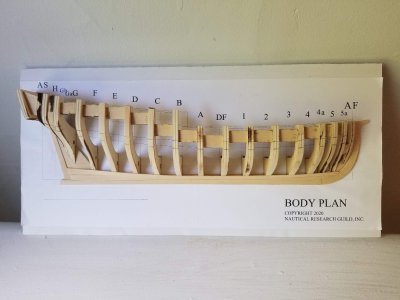
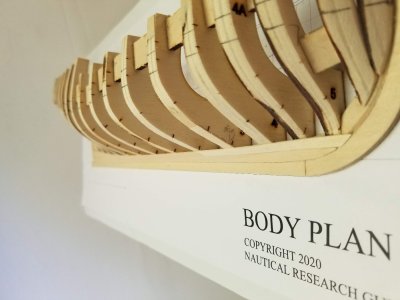
The kit itself is pretty basic: a plan drawing to be placed on the building board and used to properly set up the bulkheads, some basswood parts (keel, keelson, stem, sternpost, and some others), thick plywood bulkheads that are hollowed out and effectively thick frames (theoretically to make clamping easier, although practically all of my clamps were too small to do this), and some sheets of 1/32-inch thick basswood for planking stock.

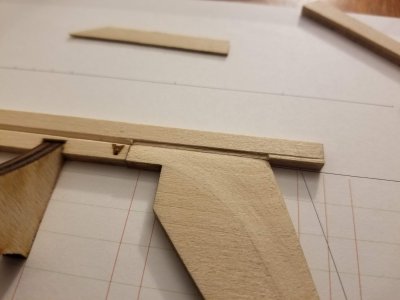
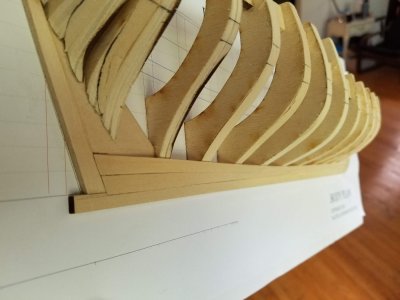
You begin the model by making a buildboard--I used foam board with the plans glued on--and assembling the keel structure. Right from the start, I ran into a bit of trouble figuring out how to fit the foreward keelson into place. The pre-cut notches (which the kit purposely leaves too shallow so as to not weaken the piece, you're supposed to deepen them later) did not line up with the plan lines, unless the part was placed to overlap the main keelson. There were also a few notches in the keelson that were slightly off.
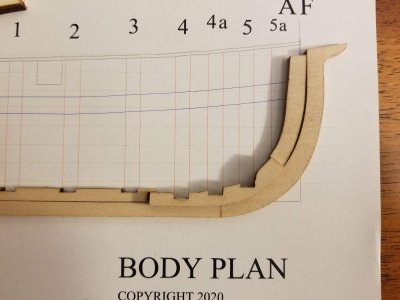
20240108_003932.jpg

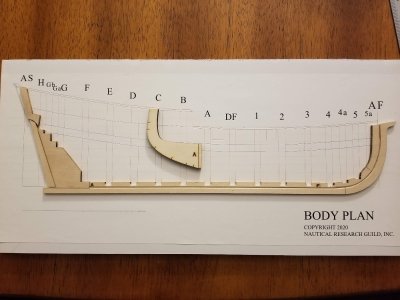
Ultimately, I decided that it would be best to trim the aft end of the fore keelson and position it so it best matched the curve of the stem, ignoring the notches as they could be re-cut later. The issue with the notches is a potential stumbling block for builders, but as you have to reshape the notches anyway later, it's really not a big deal if they don't line up perfectly. With that, I had the keel basically ready for assembly, although the parts were not glued yet so as to allow for shaping the rabbet and bearding line.
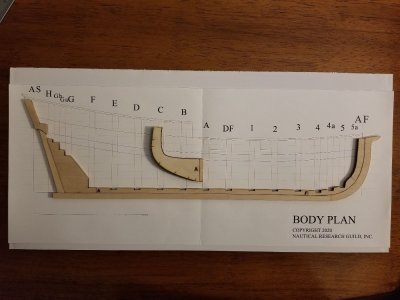
20240115_214858.jpg

I had been a bit worried about carving the rabbet--it seemed so complicated from everything I had seen, trying to get the right shape as the angle of the planking changed across the hull! But it actually was pretty straightforward. The kit instructions were detailed, and while some photos in them were a little blurry, I was able to find photos in other build logs that helped clarify any parts I didn't understand (of course, that can't be done now thanks to the MSW crash...). I used a compass to mark 1/32-inch on the keel, keelson, stem, creating a groove I later drew over with a pencil. I then drew out the approximate curve as the rabbet narrows over the fore keelson and eventually disappears on the stemson, which is necessary because the planking low down intersects the stem at a sharp angle, but by the top of the stem, it has transitioned to intersect it nearly perpendicular to the keel direction and hence needs a smaller rabbet to slot into.
20240115_233118.jpg

I started carving the rabbet on the keelson with an exacto knife, as it is hidden in the final model and any mistakes would not be visible. It worked all right, but was a bit uneven. What worked better, on the keel, was to carve the rabbet nearly to the line, and then finalize it with sandpaper. One challenge is to remember to stop the keel rabbet at a notch where the deadwood starts, as it takes a different shape after that.
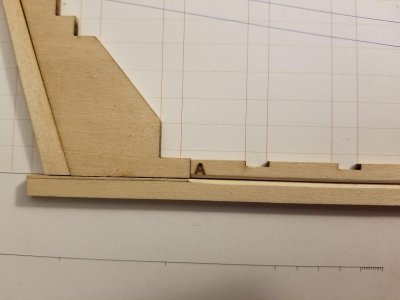
20240115_235309.jpg

And the rabbet at the stem:
20240116_000551.jpg

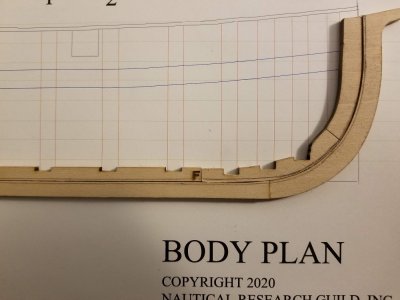
At that point, I glued down most of the keel assembly, although the deadwood is still unglued as it needs to be shaped. I then began deepening the notches so as to bring the bulkheads down to the deadwood. I started on the keelson, as being flat, it was easier to start with. Deepening the notches was mostly simple, although in some spots it was hard to cut due to glue spots between the keelson and build board. I took the opportunity to better align the notches with the drawing, although I also noticed that the D-frame was marked a bit wider than the others for some reason.
20240129_000454.jpg

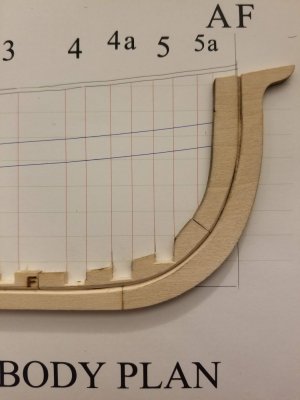
Next, the fore keelson, which was a little tricky to get sorted out as I wasn't sure how deep the notches should be--all the way to the keelson, beveled...? I went with the shape as seen below, which worked out all right.
20240215_205635.jpg
 
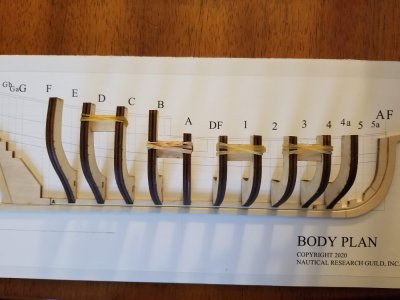
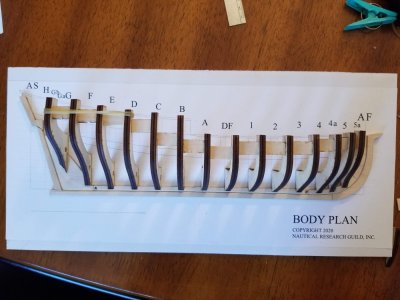
The next step is to begin fitting the bulkheads amidships. It was a little tricky to get them in place, because some of them want to fall over due to the large hollow space. The kit includes a number of spacers to hold them accurately apart. I used rubber bands to clamp every other frame pair first, and then added in the missing spacers, clamping across longer spaces with rubber bands. One important word of warning: make sure that the spacers are placed such that you can later mark at least one side of the wale from the drawing.
20240216_164706.jpg

20240216_225431.jpg

I then prepared to add the frames fore and aft. The aft frames are placed temporarily and used to mark the bearding line. You then draw the bearding line and thin the deadwood aft of it, in order to create a proper landing for the planks in this space.
20240217_122726.jpg
And then you go ahead and cut the rabbet under the deadwood, which should here be a 90-degree notch rather than a v-cut. (As can be seen, I messed up a bit by marking the rabbet line all the way to the end of the keel, which was not necessary. Ah well.)
20240217_183151.jpg

With the bearding line and rabbet set, you can start adding frames aft.
20240218_114524.jpg

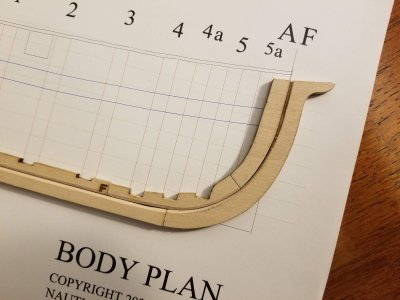
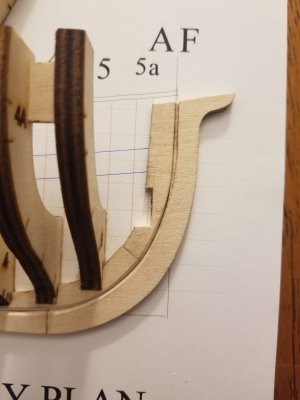
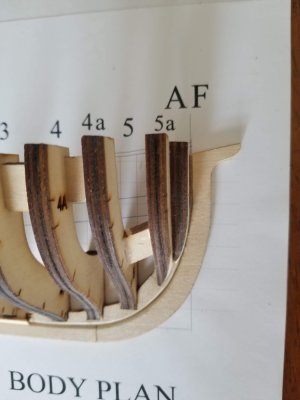
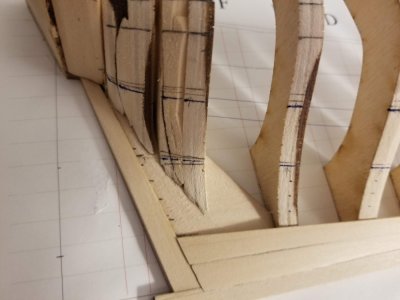
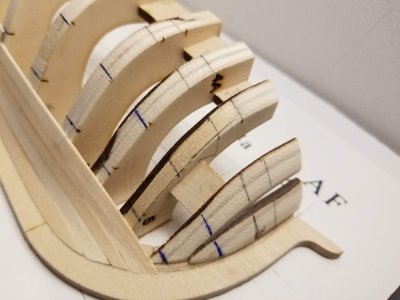
The bow was tricky, as you have to cut a new notch and shape the bulkheads to follow the rabbet. I found that the plywood used sanded pretty well, but often crumbled when cut, which took some getting used to. Below, the notch for the 5a frame:
20240218_231220.jpg

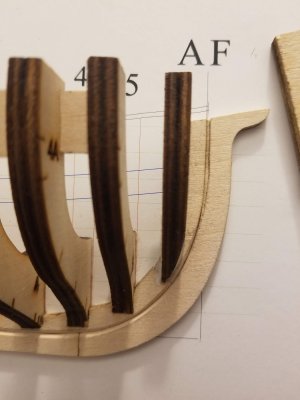
And the 5a frame in place:
20240218_231546.jpg

The last fore frame just sits on top of the stemson. The instructions in the kit say to add another bit of basswood ahead of it to run directly into the rabbet, but I didn't have space on my build. Adding the spacer was also difficult due to the serious curves at the bow, so I angled it kinda weirdly (but it worked!).
20240219_112735.jpg

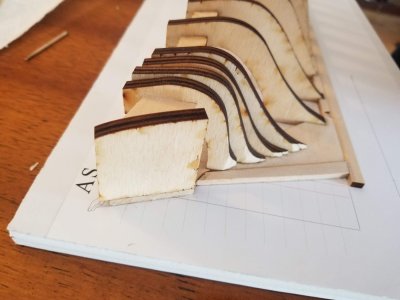
Aft, there's a huge stack of frames in order to provide a good gluing surface for the complex curves there. A spacer gets added somewhere in between them. I think I placed mine in a slightly different place than given in the instructions, but it didn't really matter in the end.
20240219_140717.jpg

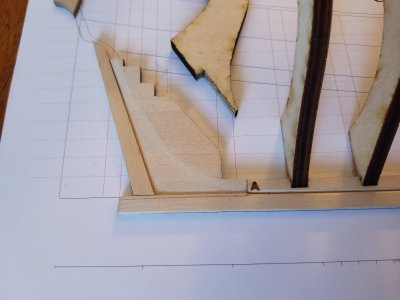
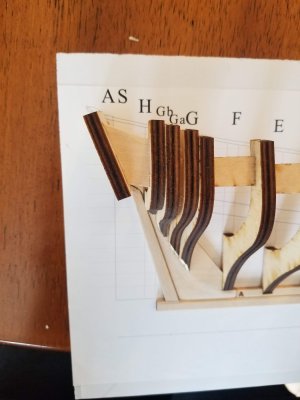
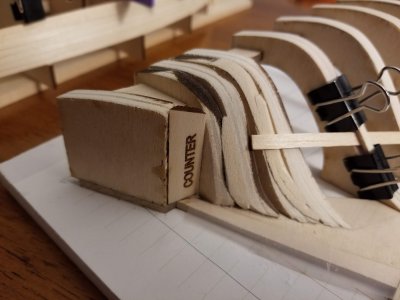
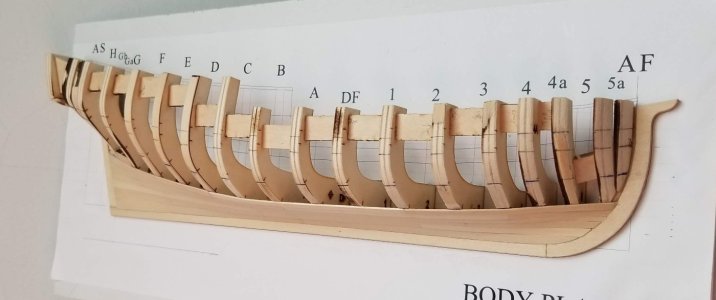
One area where I felt the kit could be improved was that it could be a little confusing how to handle the stern, especially as some photos were not very clear. The instructions, for instance, say that frame H (the final frame) should not be sanded, as it's supposed to form the bottom of the counter, which I missed until I had already begun sanding it. I then realized, thanks to other build logs, that it's fine, in fact it's necessary, to sand the bottom of the frame to properly run into the rabbet, it's the rest that should be left unsanded for now. Below, a picture showing how I handled the aft frames at this point, and how the transom should be oriented.
20240219_140723.jpg

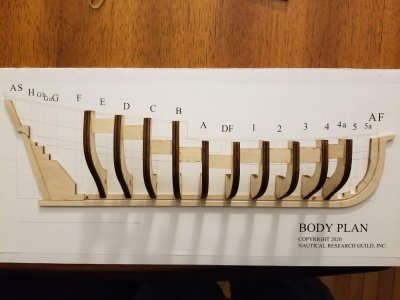
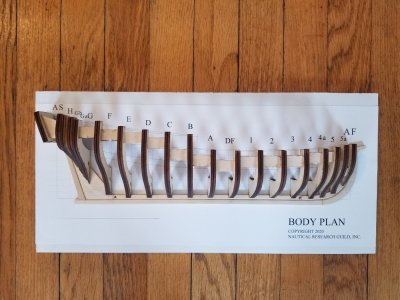
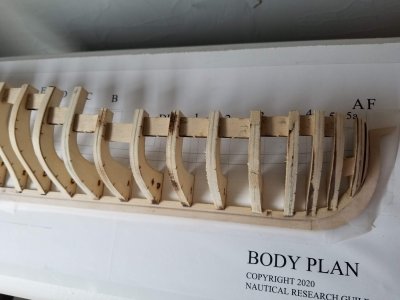
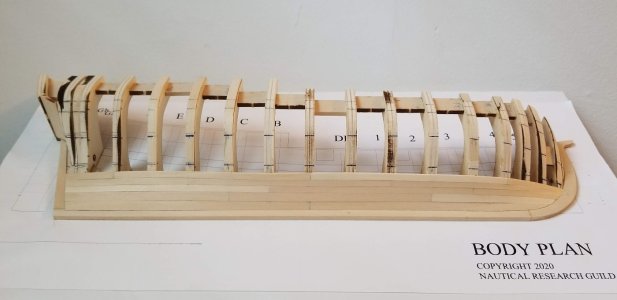
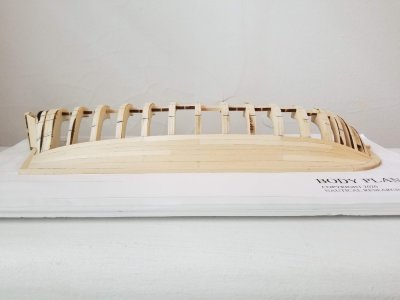
At that point, the model looked like this:
20240219_140750.jpg

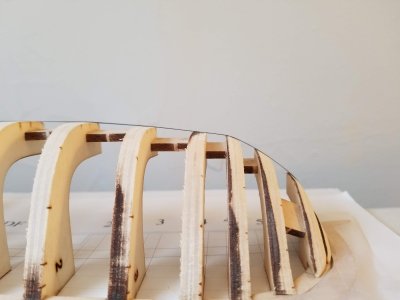
I then used a razor saw to trim the frame tops to match the drawing.
20240221_095758.jpg

With that, I was ready to begin fairing!
 
Fairing. This took way, way longer than I expected. Here I had thought I was getting a kit to learn how to plank, and instead I got stuck spending two months sanding the thing before I even got to plank anything. It was a dreary, frequently frustrating experience. But, I learned a lot!

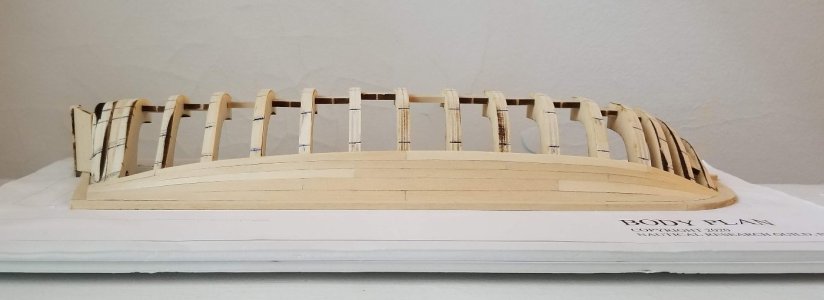
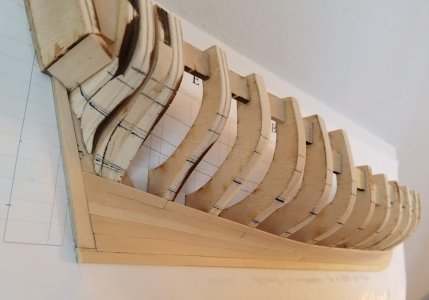
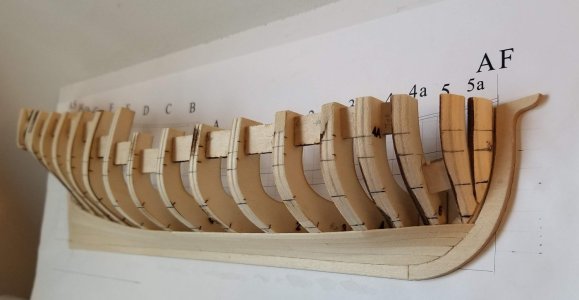
I began with a 150-grit sanding stick, and a bit of 100-grit sandpaper for areas that needed to have a lot taken off. After a week or so of this, I had the following:
20240228_125156.jpg

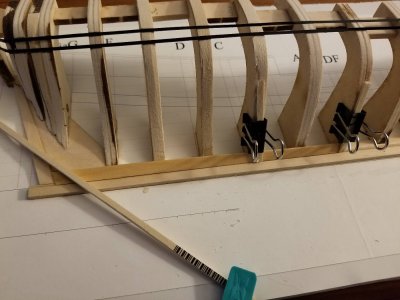
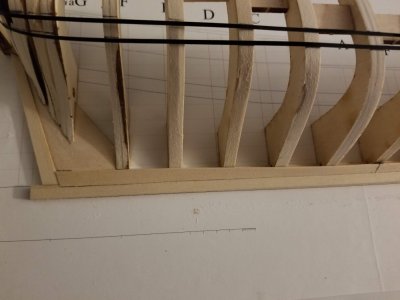
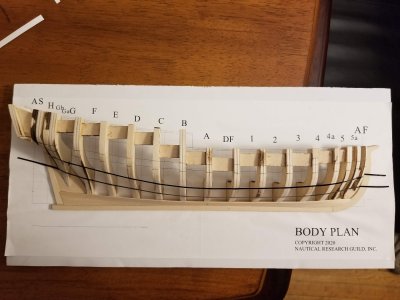
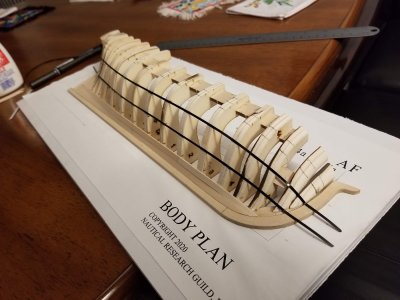
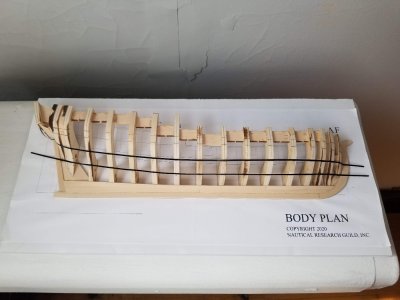
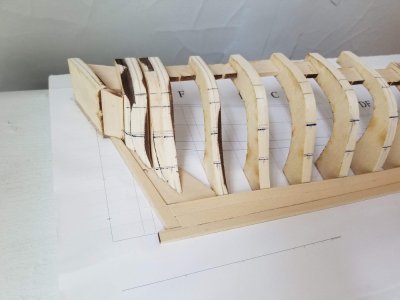
Some frames, like B, had been reduced quite a bit, while others, like C, had barely been touched. I kept at it, using a batten to check for fairness. After a while, I concluded that I needed to build up frames C and E, at least, so I added some thin basswood to the outer side of these and kept sanding.
20240321_003430.jpg

20240321_003456.jpg

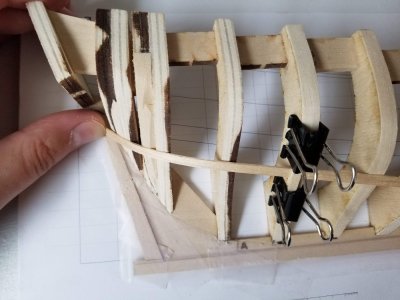
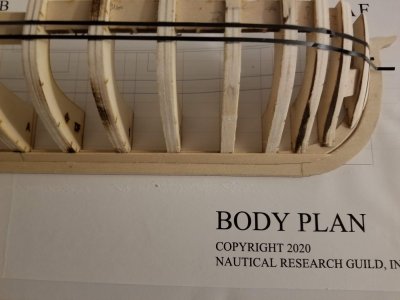
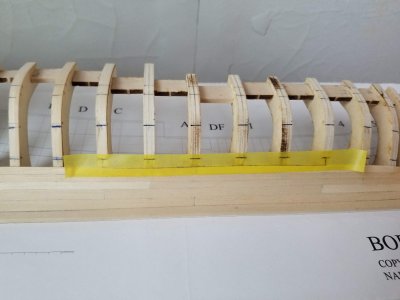
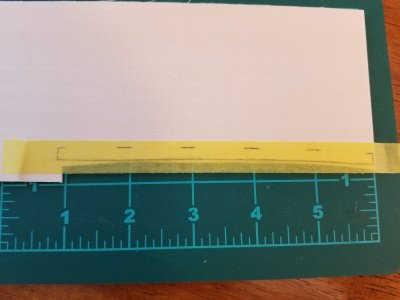
The bow needed to have a lot of material removed. It was also extremely hard to check for fairness, as battens kept breaking whenever I tried to use them to check. I mean, it's a clear sign that it's not fair yet, but it would be nice to know that before you break a batten. In the photo below, you can also see how I placed tape over the keel to try to save it. In hindsight, I should have gone with a sturdier tape, as some parts of the keel still got banged up during fairing and the little slivers of clear tape were a pain in the neck to remove.
20240321_003548.jpg

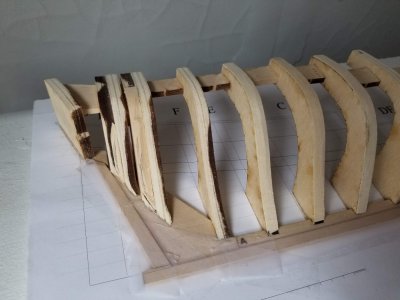
If the bow was hard, the stern posed its own difficulties. There were such major height differences between the frames that many parts were still left untouched. Meanwhile, the instructions say to not touch the bottom of frame H (the aftmost frame) so as not to mess up the counter placement, which I found almost impossible to avoid.
20240321_003524.jpg

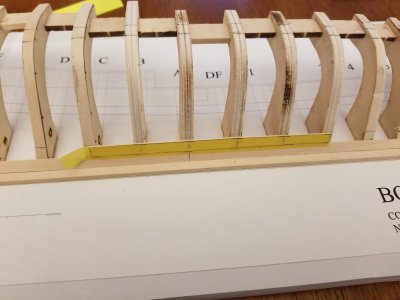
At one point, I decided to use a bit of chart tape to get another look at fairness, especially in the areas that were hard to check with a batten.
20240408_185639.jpg

I realized that I would probably need to shim frame D, which sat between the already-shimmed frames C and E.
20240408_185721.jpg

At the bow, I had initially thought that I needed to shim frame 4, as it seemed too low, but the chart tape helped me see that the real problem was that the upper part of frame 4a needed more sanding:
20240408_185739.jpg

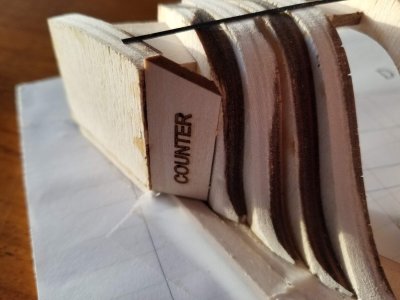
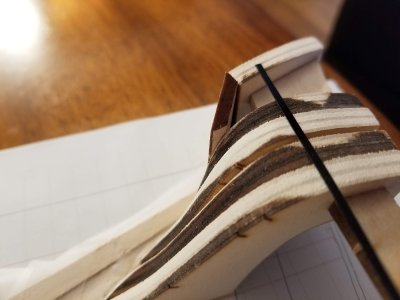
Around this point, I began to test-fit the counter to try to get a better sense of how to properly fair the stern. I found that the counter didn't really match well with the frame, and would not have even if I hadn't occasionally accidentally sanded the frame.
20240408_185824.jpg

20240408_185838.jpg

And I kept working at fairing, shimming here, sanding there. By this point, the hull was looking pretty ragged.
20240411_130511.jpg

At the stern, I started shaping filler pieces to fill some of the gaps between the frames and provide more area for gluing planking.
20240411_130506.jpg

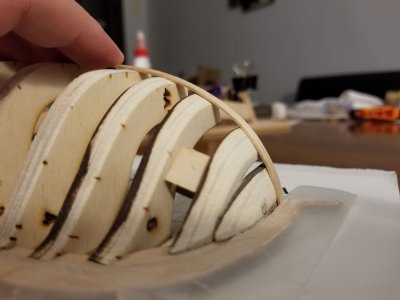
I still had a hard time visualizing how the planking, or battens, should run at the stern.
20240418_093637.jpg

While I was getting close at the bow: the battens finally stopped snapping!
20240418_221821.jpg

I also significantly reshaped the counter to better fit (still not glued on though), although the whole counter area still needed a lot of work:
20240418_224030.jpg

It was finally getting close....
 
Next up, I got started with planking. The first step was to mark out the wale location from the plans and to use thread or chart tape (I went with the later) to check that it had a good run and make adjustments as needed. If I were to redo this, I would use thread with a bit of glue, as I eventually found that it was easier to use for this purpose.
20240418_233831.jpg

20240418_233848.jpg

You then work out the run of the garboard. This is mostly a consistent width over its length and, slotting into the rabbet, it flat/straight on the keel side. The two challenges are 1) to handle the rabbet transition at the deadwood, and 2) to not place the fore end of the rabbet too high on the stem, as doing so will severely throw off the planking runs and create what the instructions refer to as the "smiley face effect" (which is not a good thing!). I again used chart tape to mark out the run of the garboard.
20240419_095021.jpg

And then used tape to create templates, starting aft. The notch in the plank was intended to fit into the rabbet adjustment at the deadwood and needed further shaping.
20240420_185428.jpg

I then cut out the piece, soaked it and water, shaped it a bit, and clamped it to dry into shape.
20240420_191212.jpg

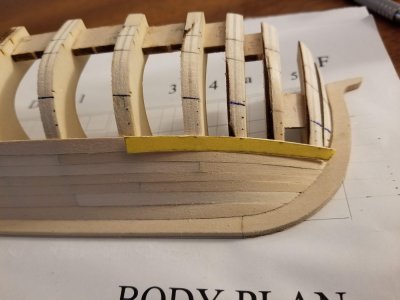
I then glued the plank in place, and repeated the procedure at the bow. With that, my garboard was on and I had finished my first strake of planking! I was pretty excited at this point, it was a really welcome change of pace from the tedium of fairing.
20240421_202739.jpg

Here can be seen the run aft. In hindsight, I could have slightly trimmed it down ever so slightly around frames E and F to get a nicer run, but that's my view with the benefit of what I've learned over the course of this hull and others. The rabbet here was also maybe a little too shallow, although that wasn't a problem once I sanded the hull later.
20240421_202759.jpg

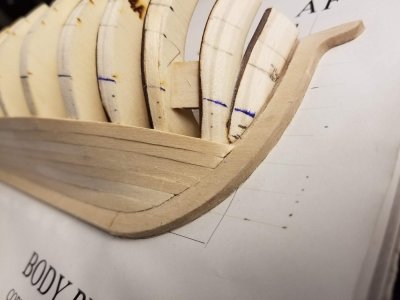
And here's the run forward. As can be seen, the garboard ends pretty low on the stem. Looking back on it, I'm pretty happy with the run of the planking here.
20240421_202807.jpg

The next strake is the broad strake. Like the garboard, this is wider than subsequent strakes, and is fitted before fully marking out the hull. After working out the width and marking it on the frames, I again used tape to make templates. While the garboard strake was made of two planks--here I should note that the kit instructions stress the importance of figuring out what typical plank widths and lengths would have been used on the vessel type you're modeling--the broad strake is made of three. I began in the middle, cutting to the template and then adjusting the fit with sandpaper until I was happy with it:
20240510_200036.jpg

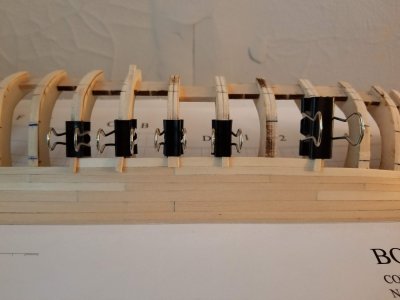
And then glued into place. I found it really useful to use bits of scrap in binder clips to hold planks in place, as can be seen:
20240510_201716.jpg

The fore and aft planks had a lot more twist and curve to them. They were shaped in the same way:
20240510_215024.jpg

20240511_101906.jpg

And with that, I had the broad strake on!
20240511_110855.jpg

Checking the run from the bow and stern. You want everything to look smoother, not lumpy.
20240511_110957.jpg

20240511_111022.jpg

At that point in the build, I was pretty happy how things were turning out, and very curious to advance to the next step: marking out the hull.
 
Marking out the hull was a little tricky, but a really valuable learning experience.

The hull is divided into three planking bands below the wale. The first step was to define the bands by dividing the frames into three parts, marking with chart tape, and adjusting to get a smooth run with proper spacing. My first attempt is below:
20240601_203110.jpg

It's important to consider the run from different angles.
20240601_203219.jpg

Once I thought I had it, I let the kit sit overnight so as to approach it with fresh eyes in the morning. I realized the next day that the runs were off toward the stern, as they would have led to some weirdly narrow planks in some spots. So, I adjusted everything and ended up with a much better result.
20240602_163529.jpg

At this point, I was able to mark the bands. I used a pen, as there were already a lot of pencil markings on the frames. Comparing the pen with the pencil, you can see how I moved the upper band division downward to fix the run at the stern.
20240602_165057.jpg

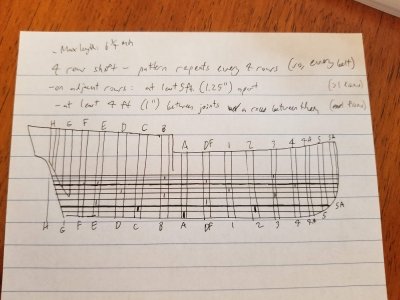
Figuring out the plank butt locations was hard for me to understand when reading about it, but much easier once I sat down to try to work it out in a drawing, as the instructions advise. At the time, I wrote the following:
"The drawing is pretty crude, but it worked. Well, mostly. Try as I might, I couldn't work out a pattern that satisfied the proper distances between joints. It was easy enough to not place a joint on the same frame for two consecutive strakes, but the rules about distance between joints (at least 1.25 inches apart on consecutive strakes, and at least 1 inch apart on strakes separated by another strake) were extremely hard to follow, especially as the frames are an inch apart. Then I noticed that the example in the instructions seems to have fudged it slightly (or I'm misunderstanding something, which is entirely possible) such that a number of joints on adjacent strakes fall one frame apart, under the 1.25-inch rule. I ended up simply following the example given in the instructions."
20240602_175108.jpg

The instructions call for including a single stealer aft and a drop plank forward, in part to help deal with the curves of the hull without needing to narrow or widen the strakes too much, and in part as a learning experience. I found it tricky to figure out the stealer, drawing in its approximate location but leaving handling it for once I finished the first belt.
20240602_203621.jpg

Next: really getting into the planking.
 
At the time, I wrote the following:
"I've completed up to the third strake on the first belt. I have to admit that I was a bit worried about how much I would enjoy the kit earlier when I was stuck in a seemingly endless fairing process, but I am having a lot of fun planking! So much so that I haven't actually taken any photos of the process itself, which maybe I should remedy. I've just been using tamiya masking tape to mark the planks, cutting them oversize, and carefully shaping them to fit. It's a very calm, thoughtful process, and I can easily do a plank in 15-20 minutes or so. I've only had to redo a few. So far one of the main challenges has been remembering to draw the caulk on the sides of the plank before gluing it down."
20240608_105037.jpg

Always good to check the runs from different angles:
20240608_104908.jpg

The stern, with a little unevenness:
20240608_104931.jpg

And the bow. I had a bit of trouble getting the planks to evenly run into the stem, but I got better as I went--no way to learn but by doing.
20240608_105004.jpg

From the original log:
"So, here's how I've been shaping the planks. This is one of the two methods shown in the kit instructions. I haven't used the other, compass-based method that's included in the instructions because I don't have a compass [note: yes I said I used a compass earlier, it was actually a set of dividers] and it sounds like it adds more steps where things can go wrong, but perhaps other people have found it simpler. The below is just what's worked for me."

First, I placed Tamiya masking tape, which is pretty translucent, on the hull. I had already divided up the planking band, so I copied the marks at each frame to the tape and traced the line of the strake below.
20240608_122029.jpg

Then, onto the basswood sheet:
20240608_122130.jpg

I used a french curve and a straightedge to connect the dots:
20240608_122239.jpg

And then cut the plank a little oversized.
20240608_122538.jpg

As can be seen, it needs some fine shaping to really join well with the strake below. That's why I made it oversized, so it had some room to be shaped to fit. I start shaping to fit against the strake.
20240608_122631.jpg

And then following trimming and sanding. I found it easiest to cut first, and then sand to smooth things out. As can be seen, it's better but still needs a bit more fitting. I was glad I cut the plank oversized because I accidentally cut a little too much away, but with the oversized plank, I had enough material to correct the error and still fit properly.
20240608_122913.jpg

Once the plank fits well against the previous strake, I turned my attention to the top edge, marking where I needed to remove the most material and where I needed to not remove material. I didn't clamp in the photo below, so in some places the plank isn't right up against the frames, but you get the idea.
20240608_123814.jpg

Once I got the plank nearly there, I removed the tape for final shaping. I aimed to shape the plank so the line is just barely visible on the frames. Once gain, I didn't clamp for the photos, so the plank isn't quite up against the frame at left, but you get the idea.
20240608_124155.jpg

Then I soaked the plank and clamped it to dry. This isn't totally necessary for the amidships planks, but I found that every bit of shaping before gluing helped.
20240608_124353.jpg

Then, I used a pencil to draw on the "caulking" on the edge. I found it helpful to approach the plank from the inner side, because I regularly accidentally went off the edge and drew on the plank face, so it was a good idea to make sure that would be on the interior and out of sight.
20240608_132119.jpg

Finally, I glued the plank in place.
20240608_181836.jpg

This is still basically the method I use for planking. One difference is that I now usually do a final shaping once the plank has been bent into shape. Especially where there are pronounced curves or twists, it's a lot easier to tell how it's fitting once you're not fighting the plank to hold it against the frames/bulkheads.
 
So, that's how my planking process looked when things went smoothly. What about when they didn't?

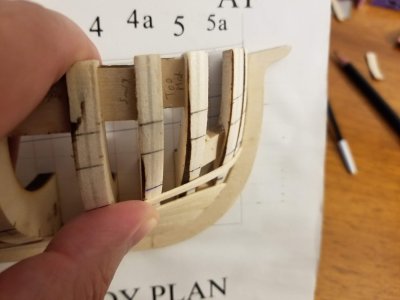
As it turns out, the very next plank, at the bow, had some problems with fit. As can be seen below, despite my best efforts during fairing, there was a gap between the plank and frame 5.
20240608_182040.jpg

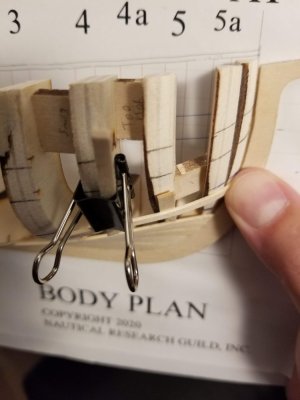
Sticking a bit of scrap in there and test-fitting showed that it needed shimming.
20240608_182240.jpg

So, I added a proper shim, faired it (carefully, to avoid damaging the planks already in place), and re-marked the band lines.
20240608_212132.jpg

With that, the plank fit properly:
20240608_212236.jpg

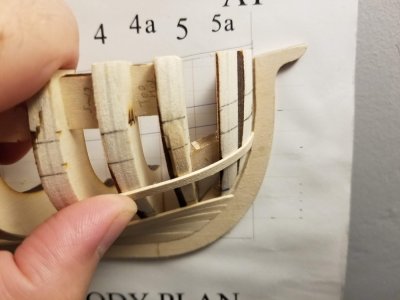
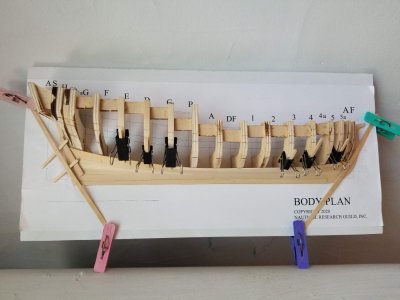
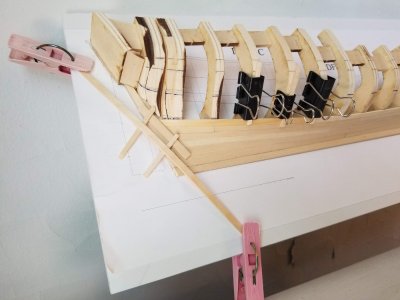
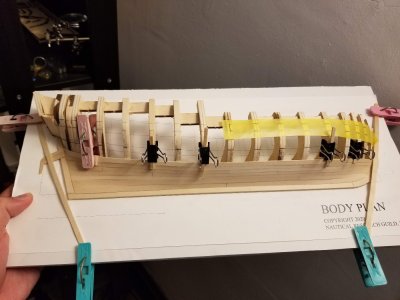
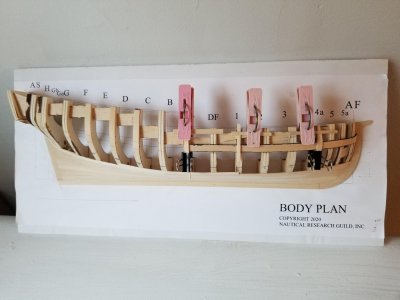
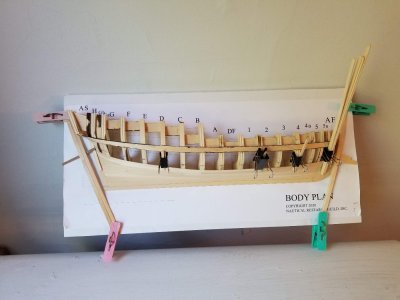
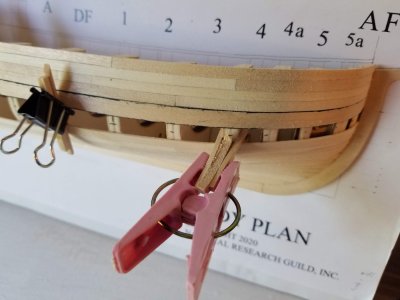
As can be seen, it was a bit tricky to clamp at the ends of the model, due to the build board. In hindsight, I should have trimmed the build board closer to the hull, but instead I jerry-rigged a bunch of awkward clamps with clothespins, coffee stir sticks, and scrap basswood.
20240609_125418.jpg

The stern, especially, was tricky to clamp.
20240609_125430.jpg

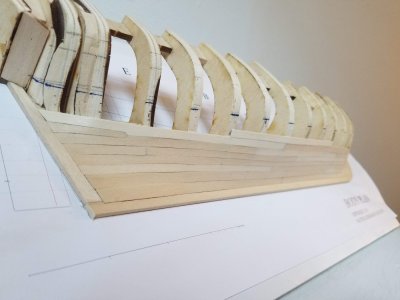
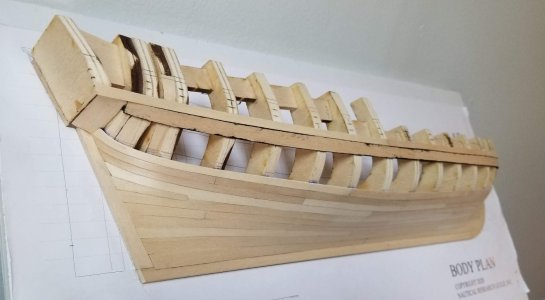
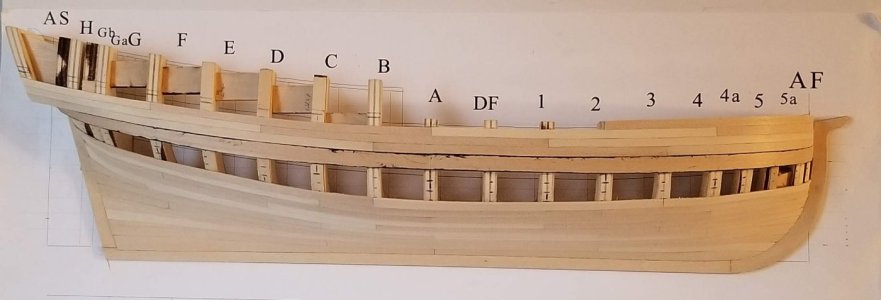
Despite the challenges, before too long I had the first band of planking finished. I was pretty excited to see the model really starting to look like a hull!
20240610_092716.jpg

In hindsight, I can see a number of uneven points here. But then again, by now I have a lot more experience with planking. I had to start somewhere, and the kit was certainly helpful for figuring it out.
20240610_220218.jpg
 
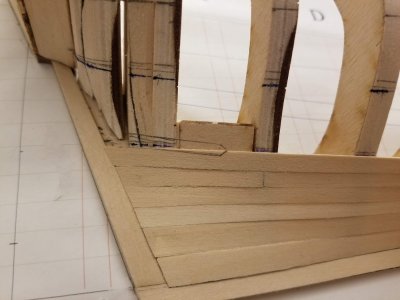
The stealer ended up being easier than I had thought it would be. I started by adding a bit of scrap as a backing--otherwise the tip would have been hanging off in space--and drawing the shape on the hull.
20240711_213512.jpg

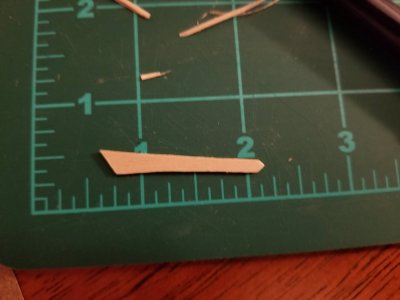
I then carefully trimmed the existing plank, and made the stealer.
20240711_215258.jpg

Wow, that photo was blurry! It then fit into place pretty easily.
20240712_103235.jpg

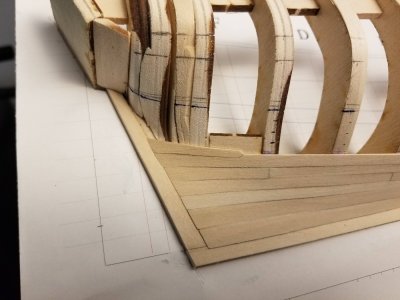
Planking above the stealer was straightforward. As can be seen, there was some variation in color between the different basswood sheets. I felt that this highlighted the planking nicely, although another option would be to be more careful about color matching.
20240714_180539.jpg

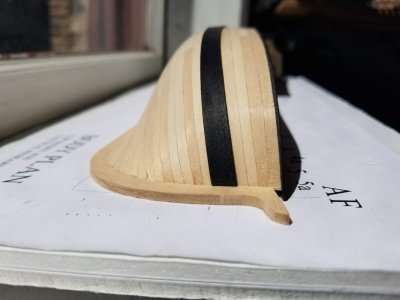
As can be seen, the planks toward the bow are bent downward pretty notably.
20240712_195449.jpg

After I finished gluing this particular plank, I realized it had been a little short and hadn't quite sat in the rabbet. I hadn't noticed because the clamps were in the way. So, I had to use IPA to unglue it, and remake it.
20240713_100632.jpg

Around this time, I began adding the wale, as well, so that I would be able to properly mark off the strakes in the last band when I got to it.
20240712_204337.jpg

20240713_103955.jpg

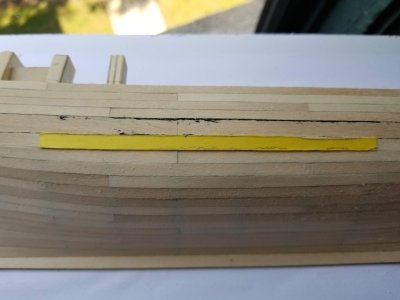
The kit's wale is made from doubled 1/32-inch thick basswood. You add the second layer later, after the hull has been fully planked and sanded. I painted the edges of the wale to better match with the outer layer, which would also be painted.
20240714_181849.jpg
 
The stealer ended up being easier than I had thought it would be. I started by adding a bit of scrap as a backing--otherwise the tip would have been hanging off in space--and drawing the shape on the hull.
View attachment 601212

I then carefully trimmed the existing plank, and made the stealer.
View attachment 601213

Wow, that photo was blurry! It then fit into place pretty easily.
View attachment 601214

Planking above the stealer was straightforward. As can be seen, there was some variation in color between the different basswood sheets. I felt that this highlighted the planking nicely, although another option would be to be more careful about color matching.
View attachment 601219

As can be seen, the planks toward the bow are bent downward pretty notably.
View attachment 601215

After I finished gluing this particular plank, I realized it had been a little short and hadn't quite sat in the rabbet. I hadn't noticed because the clamps were in the way. So, I had to use IPA to unglue it, and remake it.
View attachment 601217

Around this time, I began adding the wale, as well, so that I would be able to properly mark off the strakes in the last band when I got to it.
View attachment 601216

View attachment 601218

The kit's wale is made from doubled 1/32-inch thick basswood. You add the second layer later, after the hull has been fully planked and sanded. I painted the edges of the wale to better match with the outer layer, which would also be painted.
View attachment 601220
Thanks for posting this. I plan to tackle this project soon. I read through Toni's build log, but that's presumably gone as well.
 
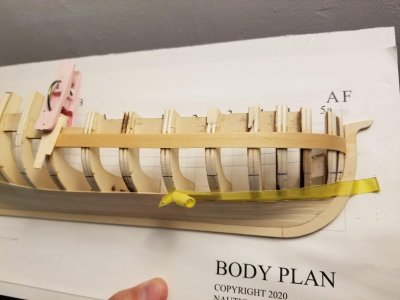
I finished adding the lower level of the wale and continued planking along. The further I went, the more creative my clamping needed to be.
20240715_110321.jpg

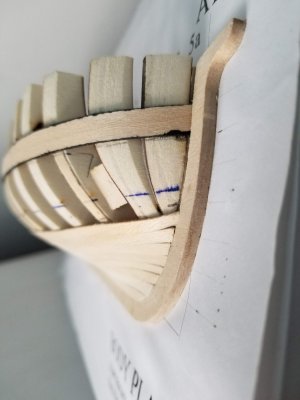
This plank turned out pretty weird at the bow, I guess I cut it poorly? It definitely didn't look weird before I glued it in place, though.
20240715_134158.jpg

I was going to redo it, but It wasn't as bad as it looked. I was able to trim the top down for a smoother run. The gap below turned out to be less of a gap, and more that the plank below it was standing slightly proud of the rabbet, so sanding it a bit made everything look better. Although the issue was still visible in some subsequent photos, the final hull sanding pretty much got rid of it.
20240715_134440.jpg

I still had some trouble with planks snapping when I tried to bend them at the bow, though. I may not have faired it as properly as I had thought.
20240715_170702.jpg

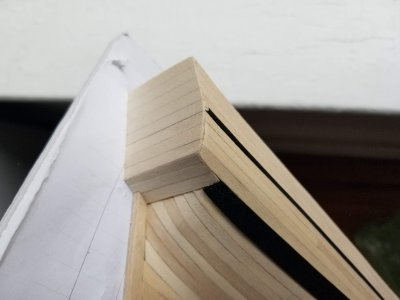
I was also creeping up on the counter at the stern. Below, a couple photos, which I include in part because I didn't think the instruction manual had enough photos of this area.
20240715_134424.jpg

20240716_102502.jpg

I also marked out the quarterdeck molding, and (as can be seen above), divided the planking band above the wale.
20240715_175008.jpg

As I was closing in on the planking below the wale, I began planking above, as well.
20240717_100017.jpg
 
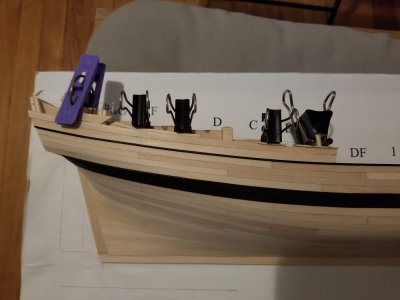
As I began working on the upper band of planking, it became more and more difficult to clamp, and I had to try out all sorts of jury-rigged solutions. Like propping scrap blocks in between a clamp and the hull.
20240718_162538.jpg

Or these assemblages:
20240718_155254.jpg

Another shot of the stern:
20240719_125304.jpg

I was finally able to mark out the final planking band (below the wale) and get started there, while I closed in above the wale, as well. Planking above the wale was much easier than below it, the shapes were a lot less curved. Later, planking the quarterdeck was the easiest of all.
20240724_225415.jpg

More jury-rigged clamping as I had less and less space to clamp.
20240725_100838.jpg

Soon I had just one strake left (not counting the quarterdeck).
20240728_172555.jpg

When it came time to place the final plank, my first attempt had some gaps.
20240730_094740.jpg

So, I redid it. Below, you can see how I marked on the tape some areas that needed further reduction.
20240730_113842.jpg

Finally, it was in place!
20240730_115053.jpg

The hull wasn't finished, but I had completed the hardest part. At this point, I had been building the model for about 7 months, although a lot of that time was spent waiting for good weather to be able to fair the frames outside. I found that the dust from the plywood really aggravated my allergies, so I only wanted to fair on my balcony, but Chicago in the spring does not always cooperate.
20240730_133633.jpg
 
One oddity that I struggled with a bit was that one of the basswood sheets was weirdly stringy. As I was sanding the hull, a few planks had little strings that tore out, leaving divots. In hindsight, maybe applying a thin coat of shellac would have helped serve as a sort of sanding sealer, but I didn't have any at the time, nor had I ever used it.
20240801_173731.jpg

20240801_173750.jpg

The worst was on the wale, where the tamiya masking tape alone somehow tore a few strings from the wood. Very weird! I've never had this issue before or since with basswood, but that one piece was very stringy. I was eventually able to carefully sand everything smooth, but it was a bit frustrating.
20240803_180953.jpg

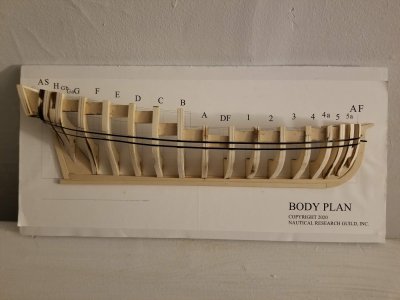
Anyway, after sanding the hull smooth, I was able to add the quarterdeck molding and begin on the wale. As can be seen, there's a sort of lap joint between the wale planks, which I found tricky to get right.
20240803_132508.jpg

Clamping required all of my creativity. It ain't pretty, but it worked more or less.
20240803_182947.jpg

And finally I had the wale on. The pieces were painted before gluing. I just used basic acrylic for the few painted parts.
20240804_104210.jpg

20240804_112904.jpg

For the gunwale, I marked a template with card.
20240803_132550.jpg

And again painted before gluing.
20240804_115654.jpg

And the hull at that point:
20240804_144809.jpg

Planking the quarterdeck was very straightforward compared to the previous planking.
20240806_003823.jpg

And the transom as well.
20240808_171038.jpg

Finally, I just had to add the molding/rail/trim pieces, and the build portion of the model was complete!
20240809_132250.jpg

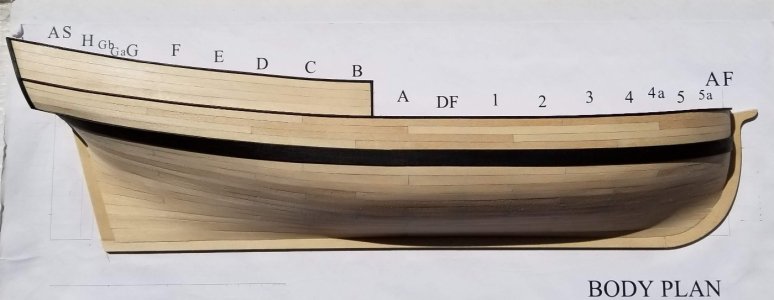
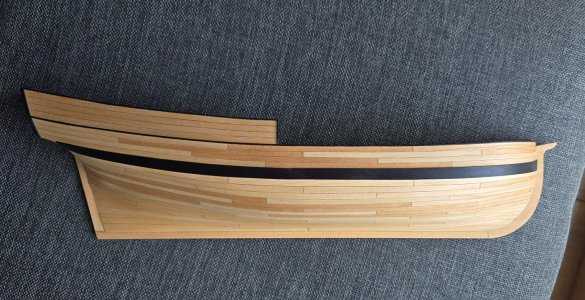
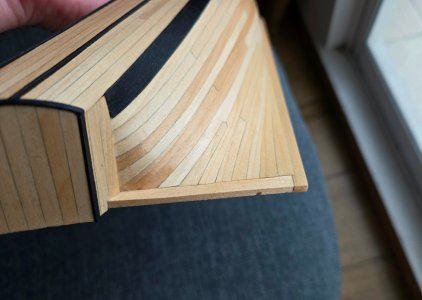
I could see plenty of areas for improvement--uneven spots in the strake runs, divots in the planking, etc. But overall I was pretty pleased with my first planked hull! Although the hull represents a merchant vessel (I think a small schooner, vaguely like the Sultana or something), it has pretty nice lines.
20240809_112000.jpg

The final steps were applying the finish and mounting it to the display.
 
At this point, I moved to Mexico, so I needed to pack everything up and fit it into suitcases. Fortunately this model is pretty easily packable.
20240824_114822.jpg

20240824_121437.jpg

Once I settled in, I turned to the question of finish. I wanted to give an oil finish a try, as I'd never done one and they looked nice in the photos I'd seen. But, I quickly found that things like Danish Oil or Boiled Linseed Oil are often a lot more expensive here than in the US. The smaller Watco bottles were like 40-60 bucks, the only reasonable price/unit I could find was for several liters, which I didn't want to have to find the space to store, and none of the small local hardware stores I visited carried it. What was extremely cheaply available was plain linseed oil. The disadvantage is that it takes a really long time to cure, around 10 weeks or so. I was in no rush, so I thought I would give it a try. As can be seen below, I did a test first on some scrap basswood, mahogany, and acrylic paint to check the effect. It nicely deepens the color compared to the pale untreated basswood on the hull.
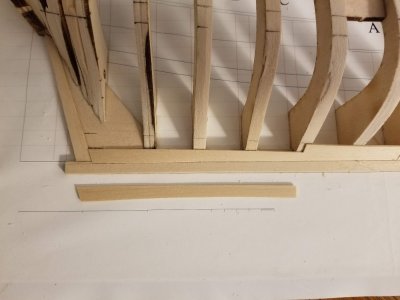
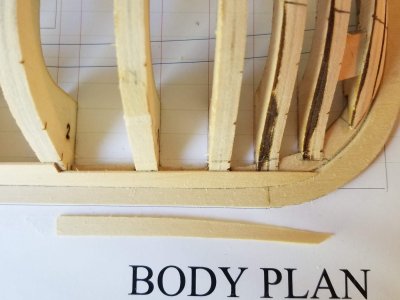
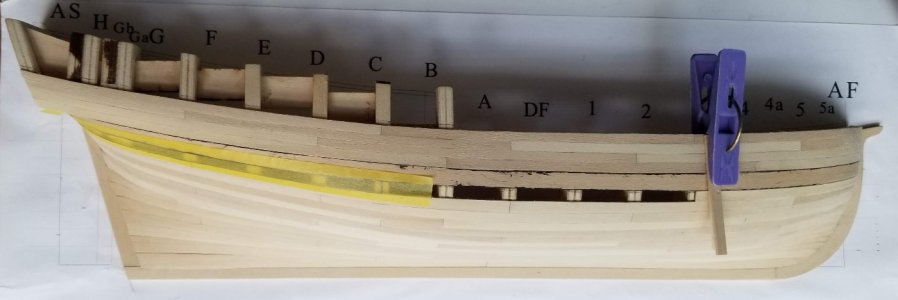
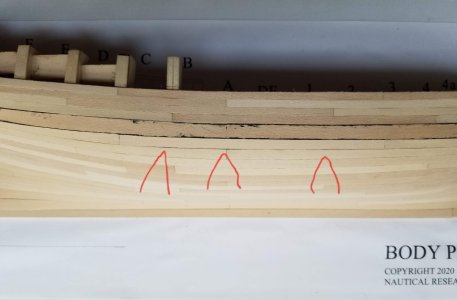
20240911_095128.jpg

I applied it by rubbing it on with a rag. After one coat:
20240912_205652.jpg

And after three or four, each applied one day apart. I quite liked the color.
20240925_083848.jpg

Of course, almost as soon as I removed the hull from the build board, I dropped it and dented the sternpost....
20240925_084045.jpg

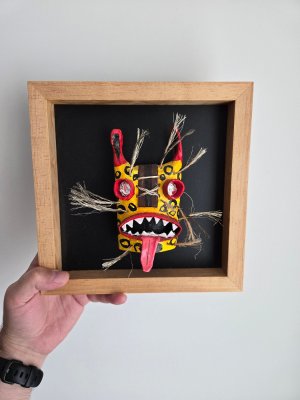
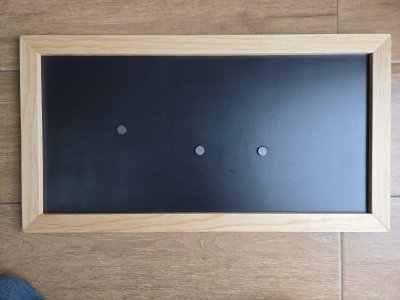
Around this time, I began attending a local carpentry workshop, which I still attend today. This has been a fantastic experience. I've learned a lot there and been able to make use of so many tools I wouldn't otherwise have access to. As the teacher herself focuses on decorative projects, the first thing she teaches new attendees to use is the fretsaw, which turned out to be exactly what I needed for cutting out all the frames for my later Bateau de Lanvéoc project. The workshop isn't quite set up to mill lumber down to modeling sizes (although it's getting there), but otherwise it's been a real benefit for my modeling, not to mention letting me make some furniture for the apartment and to discover that I really enjoy box-making, as well. Anyway, for my first real project in the workshop, I decided to make a frame. I was inspired by the frame on this miniature Tecuani mask we have, which is magnetically attached to the black backing.
20240901_155048.jpg

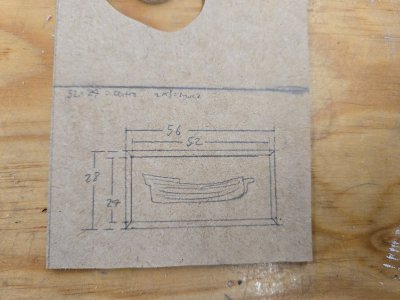
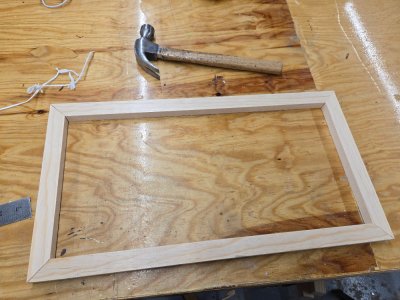
So I figured out the dimentions and set about making a frame out of pine.
20240919_135031.jpg

20240919_151015.jpg

Those miters could be tighter....

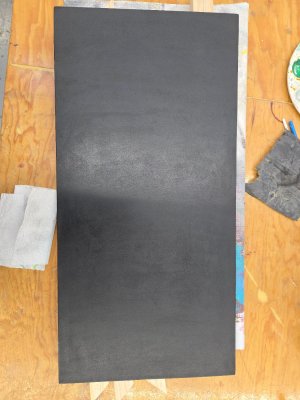
For the backing, I used mdf. I hand-painted the whole thing because those were the paints I had, although in hindsight it would be have been much, much faster and easier to just buy a spray. Mdf is really absorbent, which can make painting a challenge, so I first gave it a coat of sealer-varnish, then sanded that with fine-grit sandpaper, then another coat, then sanded that again, and I think one more round of sealer-varnish and sanding before painting it. Painting again took multiple coats with fine-grit sanding in between.
20240926_170436.jpg

Finally, the whole thing was finished with a transparent acrylic spray.
20241003_143701.jpg

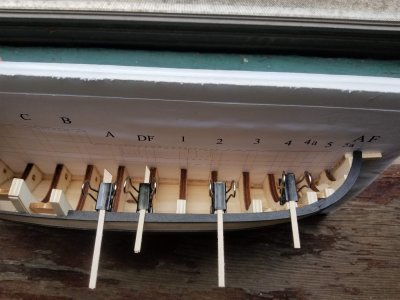
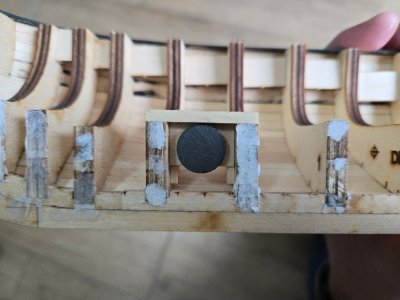
For the magnets, I added housings in between the frames of the model. As can be seen, I wasn't able to get all the paper residue off, but it's not visible when displayed, so I left it.
20241005_143030.jpg

20241005_142244.jpg

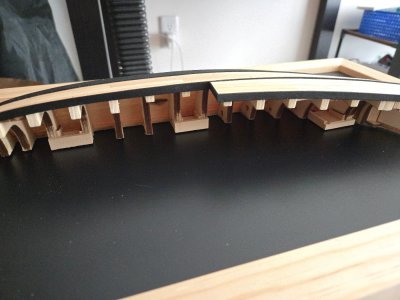
From that, I was then able to locate the magnets on the display board.
20241005_143014.jpg
 
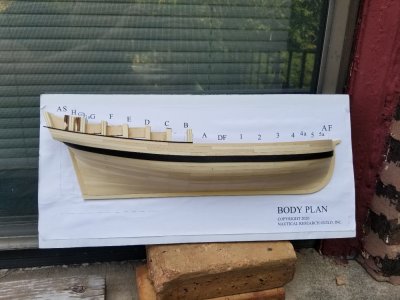
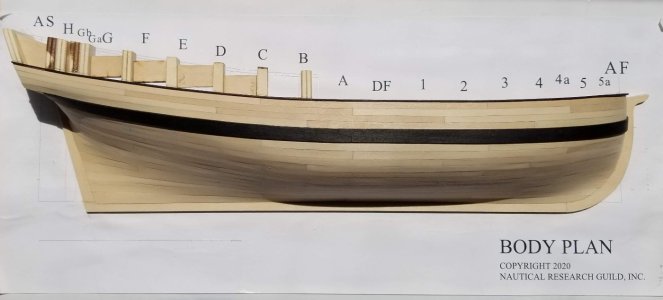
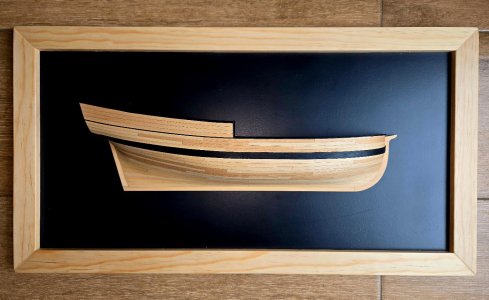
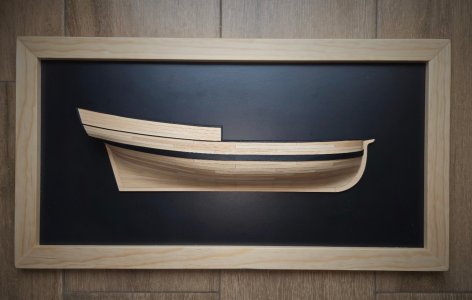
With that, the model was finally complete! The oil did take forever to cure, but really looked great with the basswood. Of course, the exact color depends a lot on the lighting conditions.
20241005_142819.jpg

20241005_142623.jpg

So, what are my thoughts on the kit? At the time, I wrote the following:

"A few brief thoughts on the kit are in order. Overall, I found this to be an excellent and very informative build. I feel confident tackling curved hull forms now, and learned a lot about spiling, measuring and marking bands, etc. Having a half-hull kit to teach this really allows you to focus on getting the planking right, without worrying about any other aspect of the build (or about getting the planking even on each side). Toni Levine did a fantastic job with developing this kit, and her instructions and build log (not to mention a lot of other build logs elsewhere on the site) were extremely helpful in explaining how to handle planking.

That said, there are a few things that I think could be improved. Most importantly, fairing the hull was more complicated than I think necessary, in part because I think the frame design leaves a lot of room for builder error to creep in. This is especially the case at the bow and stern, but even around the middle of the hull, I had to do a lot of shimming to end up with a fair hull. I feel that it would be simpler to just provide full bulkheads that reach up to deck level or so, and/or possibly to have included some sort of false deck to better lock the frames into position. From what I understand, the frame design was chosen to make it easier to clamp the planks while gluing, but few of my clamps were the right size for that. The fairing challenges were compounded by what I felt was a lack of clear photos in the manual of the stern, which made it very difficult for a relative beginner to figure out the right shape.

All of which is to say, I still highly recommend this kit to anyone looking to learn the proper way to plank. They should just be very careful with setting up the frames, should look at a lot of other build logs to figure out the stern, and should be prepared to do a ton of sanding while fairing. Otherwise, though, this can be a very informative and meditative build that produces a great model. Thanks for following along!"

I still agree with my earlier assessment. Very useful kit, it teaches a lot about a complex part of modeling, but I think the frame design could be adjusted a bit as it was tricky to line things up just right, maybe harder than it would be on a typical decked POB model, and some of the photos could be improved. But, every build has some challenges, I learned a lot and got a result I'm still happy to display in my office, even if I can see some areas for improvement still.
 
With that, the model was finally complete! The oil did take forever to cure, but really looked great with the basswood. Of course, the exact color depends a lot on the lighting conditions.
View attachment 602399

View attachment 602400

So, what are my thoughts on the kit? At the time, I wrote the following:

"A few brief thoughts on the kit are in order. Overall, I found this to be an excellent and very informative build. I feel confident tackling curved hull forms now, and learned a lot about spiling, measuring and marking bands, etc. Having a half-hull kit to teach this really allows you to focus on getting the planking right, without worrying about any other aspect of the build (or about getting the planking even on each side). Toni Levine did a fantastic job with developing this kit, and her instructions and build log (not to mention a lot of other build logs elsewhere on the site) were extremely helpful in explaining how to handle planking.

That said, there are a few things that I think could be improved. Most importantly, fairing the hull was more complicated than I think necessary, in part because I think the frame design leaves a lot of room for builder error to creep in. This is especially the case at the bow and stern, but even around the middle of the hull, I had to do a lot of shimming to end up with a fair hull. I feel that it would be simpler to just provide full bulkheads that reach up to deck level or so, and/or possibly to have included some sort of false deck to better lock the frames into position. From what I understand, the frame design was chosen to make it easier to clamp the planks while gluing, but few of my clamps were the right size for that. The fairing challenges were compounded by what I felt was a lack of clear photos in the manual of the stern, which made it very difficult for a relative beginner to figure out the right shape.

All of which is to say, I still highly recommend this kit to anyone looking to learn the proper way to plank. They should just be very careful with setting up the frames, should look at a lot of other build logs to figure out the stern, and should be prepared to do a ton of sanding while fairing. Otherwise, though, this can be a very informative and meditative build that produces a great model. Thanks for following along!"

I still agree with my earlier assessment. Very useful kit, it teaches a lot about a complex part of modeling, but I think the frame design could be adjusted a bit as it was tricky to line things up just right, maybe harder than it would be on a typical decked POB model, and some of the photos could be improved. But, every build has some challenges, I learned a lot and got a result I'm still happy to display in my office, even if I can see some areas for improvement still.
Did you repost on MSM 3.0?
 
With that, the model was finally complete! The oil did take forever to cure, but really looked great with the basswood. Of course, the exact color depends a lot on the lighting conditions.
View attachment 602399

View attachment 602400

So, what are my thoughts on the kit? At the time, I wrote the following:

"A few brief thoughts on the kit are in order. Overall, I found this to be an excellent and very informative build. I feel confident tackling curved hull forms now, and learned a lot about spiling, measuring and marking bands, etc. Having a half-hull kit to teach this really allows you to focus on getting the planking right, without worrying about any other aspect of the build (or about getting the planking even on each side). Toni Levine did a fantastic job with developing this kit, and her instructions and build log (not to mention a lot of other build logs elsewhere on the site) were extremely helpful in explaining how to handle planking.

That said, there are a few things that I think could be improved. Most importantly, fairing the hull was more complicated than I think necessary, in part because I think the frame design leaves a lot of room for builder error to creep in. This is especially the case at the bow and stern, but even around the middle of the hull, I had to do a lot of shimming to end up with a fair hull. I feel that it would be simpler to just provide full bulkheads that reach up to deck level or so, and/or possibly to have included some sort of false deck to better lock the frames into position. From what I understand, the frame design was chosen to make it easier to clamp the planks while gluing, but few of my clamps were the right size for that. The fairing challenges were compounded by what I felt was a lack of clear photos in the manual of the stern, which made it very difficult for a relative beginner to figure out the right shape.

All of which is to say, I still highly recommend this kit to anyone looking to learn the proper way to plank. They should just be very careful with setting up the frames, should look at a lot of other build logs to figure out the stern, and should be prepared to do a ton of sanding while fairing. Otherwise, though, this can be a very informative and meditative build that produces a great model. Thanks for following along!"

I still agree with my earlier assessment. Very useful kit, it teaches a lot about a complex part of modeling, but I think the frame design could be adjusted a bit as it was tricky to line things up just right, maybe harder than it would be on a typical decked POB model, and some of the photos could be improved. But, every build has some challenges, I learned a lot and got a result I'm still happy to display in my office, even if I can see some areas for improvement still.
The half hull looks really elegant. I would bever have thought of mounting it with magnets, but it makes perfect sense. I hope to start mine after the summer. This will be invaluable.
 
Back
Top