

- Joined
- Nov 13, 2025
- Messages
- 81
- Points
- 88

Here's another reposted old build log of mine from ModelShipWorld that was lost in that site's crash. As far as I can tell, there are no build logs of this model here, so I thought it may be useful to post it. This will be a simplified re-post, missing a number of helpful discussions I had with other forum users, which would be difficult to re-create here.
By January 2024, I had completed two models (the Model Shipways Dory and a Xochimilco Trajinera scratch-build) and had two builds in progress (a Lake Chapala Canoa de Rancho and a cross-section model of the Spanish fishing boat Juana y José). All but the Juana y José were flat-bottomed, flat-sided boats, and I was interested in learning more about how to plank a curved hull--the Juana y José had given me a taste of this, but as a cross-section, it was missing a lot. I saw that the Nautical Research Guild (NRG) sold a half-hull planking kit with a detailed instruction set on how to spile planks. I thought that a half-hull would be easy to transport (I was moving frequently those days) and display, and would simplify planking because I wouldn't have to worry about getting everything even on both sides, so I decided to give the kit a try. It helped, too, that there were a number of build logs on MSW with a lot of great advice and helpful photos, including one by the kit's designer, Toni Levine.
Overall, I found the build to be a very useful learning experience. There were a few issues I had with the kit, as will be seen, but I was pleased with the result, and more importantly, I learned a lot about hull planking, making me feel better-prepared for further builds.
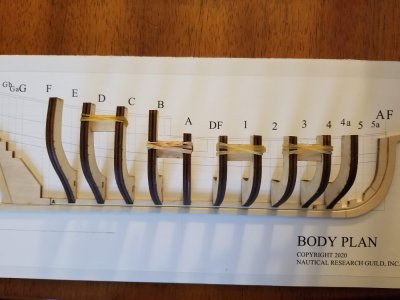
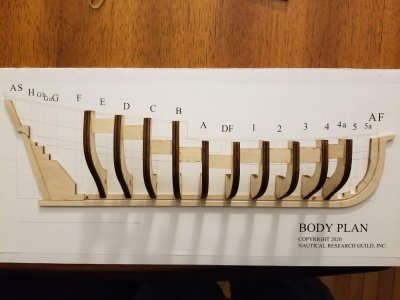
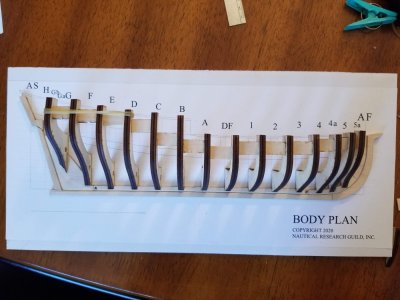
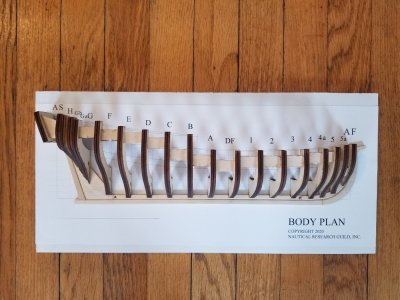
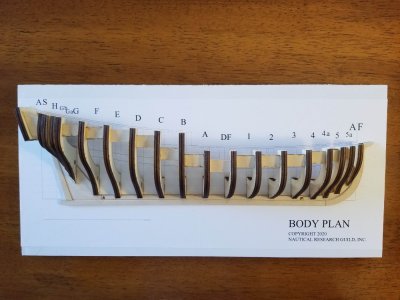
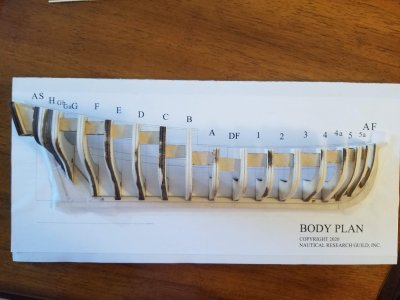
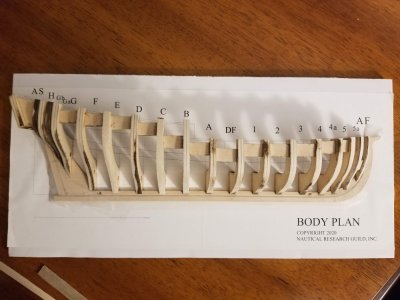
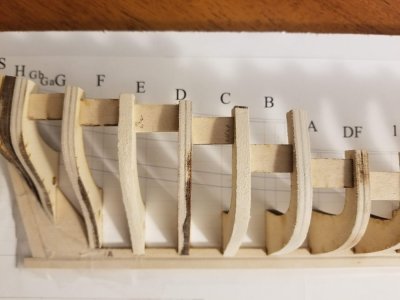
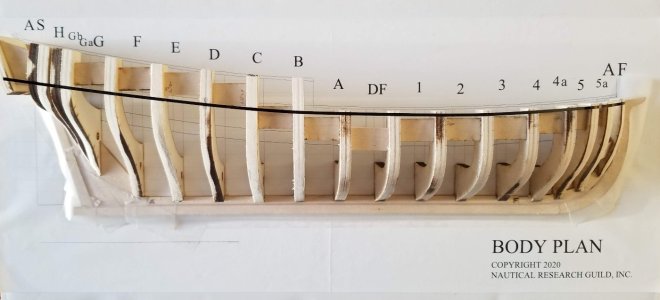
The kit itself is pretty basic: a plan drawing to be placed on the building board and used to properly set up the bulkheads, some basswood parts (keel, keelson, stem, sternpost, and some others), thick plywood bulkheads that are hollowed out and effectively thick frames (theoretically to make clamping easier, although practically all of my clamps were too small to do this), and some sheets of 1/32-inch thick basswood for planking stock.
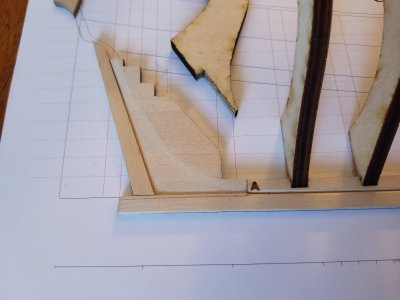
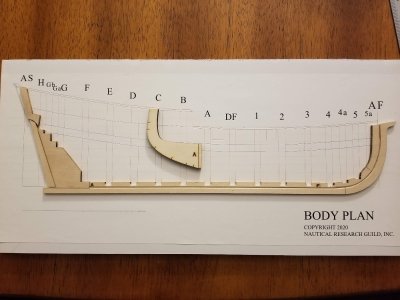
You begin the model by making a buildboard--I used foam board with the plans glued on--and assembling the keel structure. Right from the start, I ran into a bit of trouble figuring out how to fit the foreward keelson into place. The pre-cut notches (which the kit purposely leaves too shallow so as to not weaken the piece, you're supposed to deepen them later) did not line up with the plan lines, unless the part was placed to overlap the main keelson. There were also a few notches in the keelson that were slightly off.
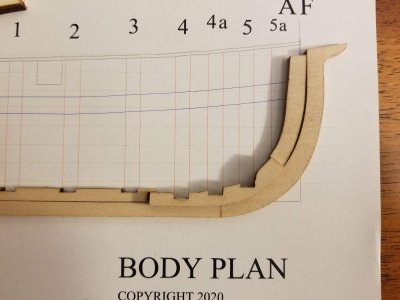
Ultimately, I decided that it would be best to trim the aft end of the fore keelson and position it so it best matched the curve of the stem, ignoring the notches as they could be re-cut later. The issue with the notches is a potential stumbling block for builders, but as you have to reshape the notches anyway later, it's really not a big deal if they don't line up perfectly. With that, I had the keel basically ready for assembly, although the parts were not glued yet so as to allow for shaping the rabbet and bearding line.
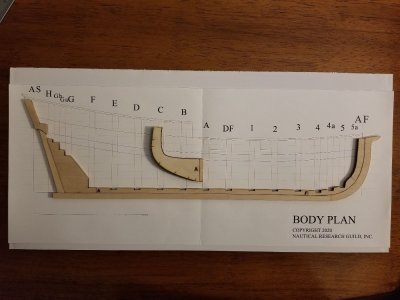
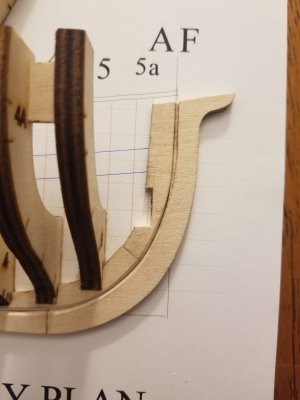
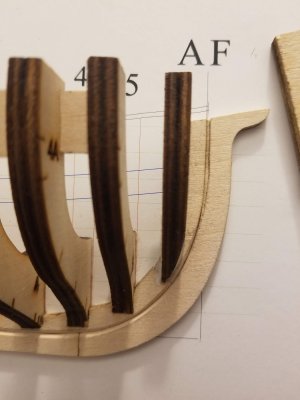
I had been a bit worried about carving the rabbet--it seemed so complicated from everything I had seen, trying to get the right shape as the angle of the planking changed across the hull! But it actually was pretty straightforward. The kit instructions were detailed, and while some photos in them were a little blurry, I was able to find photos in other build logs that helped clarify any parts I didn't understand (of course, that can't be done now thanks to the MSW crash...). I used a compass to mark 1/32-inch on the keel, keelson, stem, creating a groove I later drew over with a pencil. I then drew out the approximate curve as the rabbet narrows over the fore keelson and eventually disappears on the stemson, which is necessary because the planking low down intersects the stem at a sharp angle, but by the top of the stem, it has transitioned to intersect it nearly perpendicular to the keel direction and hence needs a smaller rabbet to slot into.
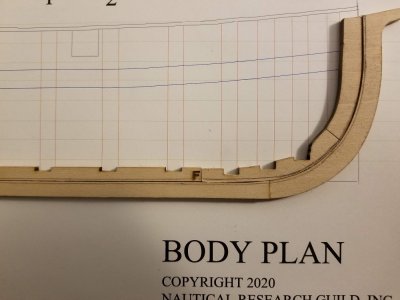
I started carving the rabbet on the keelson with an exacto knife, as it is hidden in the final model and any mistakes would not be visible. It worked all right, but was a bit uneven. What worked better, on the keel, was to carve the rabbet nearly to the line, and then finalize it with sandpaper. One challenge is to remember to stop the keel rabbet at a notch where the deadwood starts, as it takes a different shape after that.
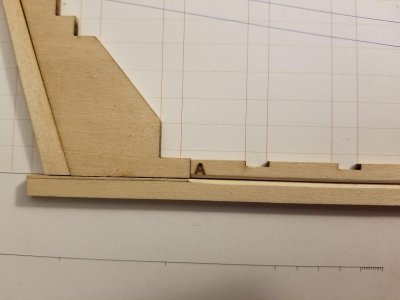
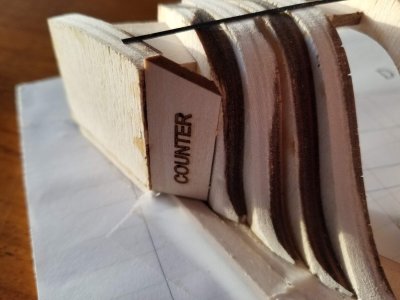
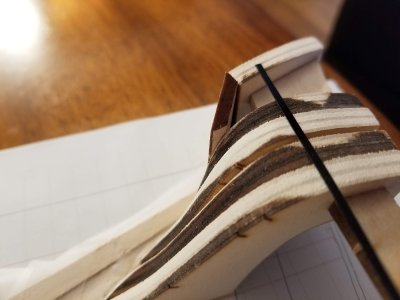
And the rabbet at the stem:
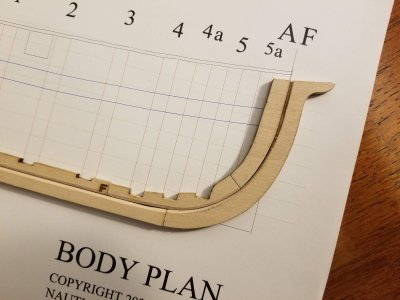
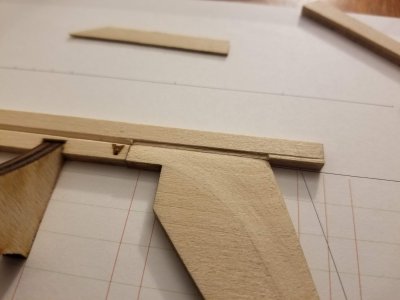
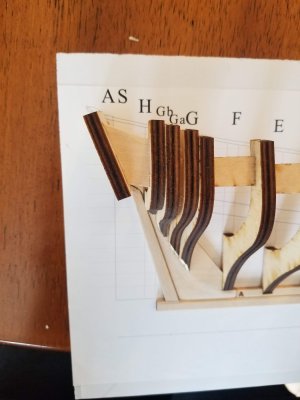
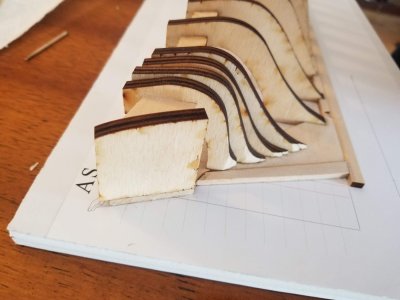
At that point, I glued down most of the keel assembly, although the deadwood is still unglued as it needs to be shaped. I then began deepening the notches so as to bring the bulkheads down to the deadwood. I started on the keelson, as being flat, it was easier to start with. Deepening the notches was mostly simple, although in some spots it was hard to cut due to glue spots between the keelson and build board. I took the opportunity to better align the notches with the drawing, although I also noticed that the D-frame was marked a bit wider than the others for some reason.
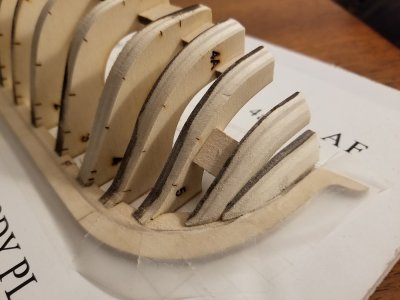
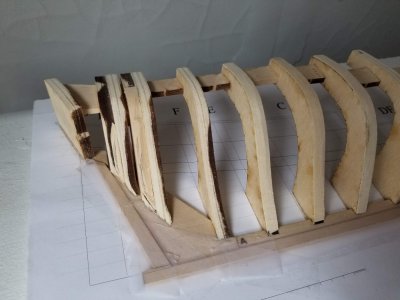
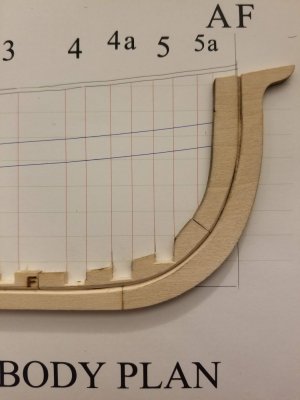
Next, the fore keelson, which was a little tricky to get sorted out as I wasn't sure how deep the notches should be--all the way to the keelson, beveled...? I went with the shape as seen below, which worked out all right.
By January 2024, I had completed two models (the Model Shipways Dory and a Xochimilco Trajinera scratch-build) and had two builds in progress (a Lake Chapala Canoa de Rancho and a cross-section model of the Spanish fishing boat Juana y José). All but the Juana y José were flat-bottomed, flat-sided boats, and I was interested in learning more about how to plank a curved hull--the Juana y José had given me a taste of this, but as a cross-section, it was missing a lot. I saw that the Nautical Research Guild (NRG) sold a half-hull planking kit with a detailed instruction set on how to spile planks. I thought that a half-hull would be easy to transport (I was moving frequently those days) and display, and would simplify planking because I wouldn't have to worry about getting everything even on both sides, so I decided to give the kit a try. It helped, too, that there were a number of build logs on MSW with a lot of great advice and helpful photos, including one by the kit's designer, Toni Levine.
Overall, I found the build to be a very useful learning experience. There were a few issues I had with the kit, as will be seen, but I was pleased with the result, and more importantly, I learned a lot about hull planking, making me feel better-prepared for further builds.
The kit itself is pretty basic: a plan drawing to be placed on the building board and used to properly set up the bulkheads, some basswood parts (keel, keelson, stem, sternpost, and some others), thick plywood bulkheads that are hollowed out and effectively thick frames (theoretically to make clamping easier, although practically all of my clamps were too small to do this), and some sheets of 1/32-inch thick basswood for planking stock.
You begin the model by making a buildboard--I used foam board with the plans glued on--and assembling the keel structure. Right from the start, I ran into a bit of trouble figuring out how to fit the foreward keelson into place. The pre-cut notches (which the kit purposely leaves too shallow so as to not weaken the piece, you're supposed to deepen them later) did not line up with the plan lines, unless the part was placed to overlap the main keelson. There were also a few notches in the keelson that were slightly off.
Ultimately, I decided that it would be best to trim the aft end of the fore keelson and position it so it best matched the curve of the stem, ignoring the notches as they could be re-cut later. The issue with the notches is a potential stumbling block for builders, but as you have to reshape the notches anyway later, it's really not a big deal if they don't line up perfectly. With that, I had the keel basically ready for assembly, although the parts were not glued yet so as to allow for shaping the rabbet and bearding line.
I had been a bit worried about carving the rabbet--it seemed so complicated from everything I had seen, trying to get the right shape as the angle of the planking changed across the hull! But it actually was pretty straightforward. The kit instructions were detailed, and while some photos in them were a little blurry, I was able to find photos in other build logs that helped clarify any parts I didn't understand (of course, that can't be done now thanks to the MSW crash...). I used a compass to mark 1/32-inch on the keel, keelson, stem, creating a groove I later drew over with a pencil. I then drew out the approximate curve as the rabbet narrows over the fore keelson and eventually disappears on the stemson, which is necessary because the planking low down intersects the stem at a sharp angle, but by the top of the stem, it has transitioned to intersect it nearly perpendicular to the keel direction and hence needs a smaller rabbet to slot into.
I started carving the rabbet on the keelson with an exacto knife, as it is hidden in the final model and any mistakes would not be visible. It worked all right, but was a bit uneven. What worked better, on the keel, was to carve the rabbet nearly to the line, and then finalize it with sandpaper. One challenge is to remember to stop the keel rabbet at a notch where the deadwood starts, as it takes a different shape after that.
And the rabbet at the stem:
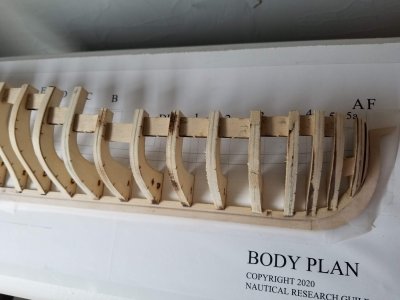
At that point, I glued down most of the keel assembly, although the deadwood is still unglued as it needs to be shaped. I then began deepening the notches so as to bring the bulkheads down to the deadwood. I started on the keelson, as being flat, it was easier to start with. Deepening the notches was mostly simple, although in some spots it was hard to cut due to glue spots between the keelson and build board. I took the opportunity to better align the notches with the drawing, although I also noticed that the D-frame was marked a bit wider than the others for some reason.
Next, the fore keelson, which was a little tricky to get sorted out as I wasn't sure how deep the notches should be--all the way to the keelson, beveled...? I went with the shape as seen below, which worked out all right.