



• SUBSCRIBE TO SHIPS IN SCALE TODAY!

    The beloved Ships in Scale Magazine is back and charting a new course for 2026!
    Discover new skills, new techniques, and new inspirations in every issue.

    NOTE THAT OUR NEXT ISSUE WILL BE July/August 2026
  • Win a Free Custom Engraved Brass Coin!!!
    As a way to introduce our brass coins to the community, we will raffle off a free coin during the month of August. Follow link ABOVE for instructions for entering.

Golden Hind 1/72 by Aifix with added rigging and details

I have had my AI agent working hard today. I now have an anchor calculation tool, and a multi-lingual translator. Enter a word in any language and it will give it to you in English, French, Spanish, German and Italian. (If it is in the dictionary, which currently contains about 200 items in these five languages.) I am happy to share these with anyone who is interested.

Curiously it kept making index errors in python. Each time it said "The error is because python starts its indices at 0. I have fixed this now." and then it made the same error! I am a fluent fortran speaker and my python is rather basic, but I was able to fix it easily. All codes seem to work now. I asked how it can tell me that the indices in the program run from 0 to 3 when one of the first lines in the code refers to index[5]...I accused it of taking drugs! It replied ""I have no physical form to consume substances, but my performance certainly suggests I have been hitting the "grog" a bit too hard."

From then on it referred to any errors as "AI grog-induced hallucinations".
 
Last edited:
Is Fortran still alive? ROTF Sorry for off-top - I used it heavily, but it was about 25 years ago!
Oh yes, fortran is still alive and well. And still the preferred language for high cpu jobs. Fortran is regularly updated and steals the nice new features from other languages so it is possible to look at sonme pieces of fortran and not recognise it as such. But it is usually backwards compatible, so old fortran code stillworks. Even the old GOTO statement - although most compilers warn you that best practice is to avoid GOTO :-)

Parallel versions of fortran are used mostly for huge multi-processor work - 100,000 cpu working on the same job for example. It is impressive stuff!
 
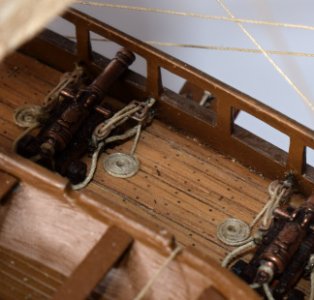
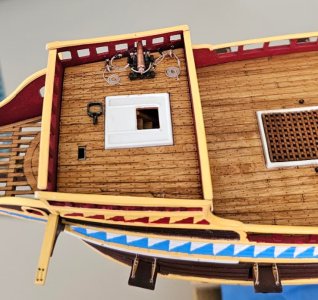
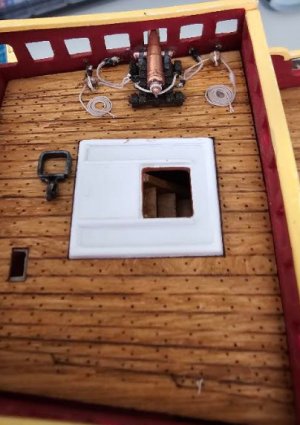
The next step for the GH seems to be the installation of the deck guns. I think they should go in before I add the ship's boat. It is going to get crowded inthere and the ship is relatively easy to add.
Good day John,
I think , as one of the option - to ommit gans rigs at all , may be as exeption, to leave that one big rope only but without all this small in/out tackles ... consider that it looks like a tradition in classic museum models , do not demonstrate guns rigs at all - You can check it by yourself, how many classic models whith perfect and detailed rigging have no guns rigging ?! :))) Even that buitifull Elizabeth Jonas galleon model( modern model) from english museum has no guns rigs?!
I know that many of modern models often have guns rigged but it is not mandatory in classic tradition !...
If You desided to rigg your guns, note that as usual for in/ out tackles used the same stuff just attached in different positions depends on needs... do not overload guns with rigging...
Without guns rigs, maybe You still be need to reproduce all that metal fittings as ring bolts etc. used for guns tackles rigging when used...?
All the Best!
 
Philosophical Thoughts
Boatman made the very fair comment, often heard in the model world: "the model is yours and you can do anything". I agree 100%. And yet... even the most casual modeller wants to do something "realistic". I don't know anyone who puts machine guns or radars on these ships. So how far do we go in accepting the constraints of historical fact? And given that older ships are less known, we have much more freedom. I also often hear "No-one can prove that is wrong." So I come to the question: What am I trying to achieve?

I think we all need to answer this question for ourselves, even if we have not formally asked ourselves. It is in the back of our mind, even if not articulated.

My approach is: I love these ships. They are a magnificent combination of sheer beauty and practical function. And I am in constant awe of the ingenuity of people to overcome enormous challenges with nothing but human muscle power to control the ships. So what I want is
  1. Something that looks good
  2. Something that conveys the beauty and the mechanics of the vessel
  3. Something that respects the people who created and operated these great machines
  4. And in doing this, I want to learn more about how they were built and operated

So I allow my self some flexibility with the rivet counting :-) But not too much!

MMmm. Doesn’t this get to the heart of scale modelling? Do I try to show an actual moment in time, or do I want to illustrate an artefact of a given era? How can I provide an accurate model that even a numpty member of ‘the public’ can understand and learn something about the object that is my passion?

All of that, and my skill at painting the figures to give context and life is not good enough (I have that problem too, John)

I shout at the TV when archaeologists make claims on the basis of a shard of pottery that ‘proves there was an active trade route between x and y in 430AD or something. It only shows that a ship brought back a few souvenirs, and broke one on the way. They threw the broken bits in the ditch when they unpacked.

One of the attributes of ships that is intriguing is the way they altered over time. Even now, they get refits and upgrades, and in the days of timber ships like GH evolutionary changes were happening as new ways to mast and rig were found.

Re-enactors have the same questions. Either they only create clothing and artefacts for which there is a factual record, or do they allow ‘improvements’ that we know existed at that date, so they ‘could have’ been in use at the particular scene being re-enacted. Suppose two ships captains were talking together as they walked a quayside, couldn’t one have bragged about his improved way to rig his anchor, and the other decides he’ll try that? Then decides it’s more trouble than value and reverts to something else.

For the benefit of others who may view our work, it might be good to write down some of the rationale for the detail we show. Especially for pre photography models, where a good proportion of what we make is a synthesised guess at the details as at a given date.
We all here know that not even builders plans can be entirely trusted, as what was built may have been varied by the availability of timber, or the skills of the labourers.
My own approach, should I get to the level of the stunning work we see here, would be to provide a paragraph, folded into the stand somewhere, to record facts and ‘likely’ and ‘possible’ features. Maybe a reference to sources used.

I’m rambling now, so I’ll stop, got timber to cut.


J


.
 
Good day John,
I think , as one of the option - to ommit gans rigs at all , may be as exeption, to leave that one big rope only but without all this small in/out tackles ... consider that it looks like a tradition in classic museum models , do not demonstrate guns rigs at all -
As always, Kirill makes good points.

In one sense, now that I understand the rigging of the guns, I no longer need to do it :-) The time spent has taught me how they work.

I have started and I have the blocks and hooks needed. So I will try do one and see how difficult it is!

I agree - the breech line is almost essential. The gun tackles, with the hooks and blocks, are rather busy, very small, and quite complicated. I will try one and then decide.

From reading the Susan Constant book, on that ship they did not permit any recoil! The reason was the narrow width of the ship. ANd the GH is very similar. So maybe they also used the breech line to hold the gun steady. Interesting.
 
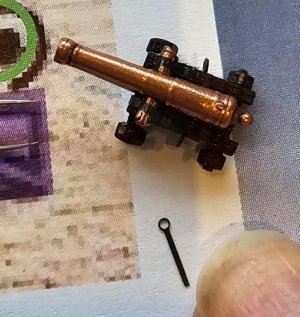
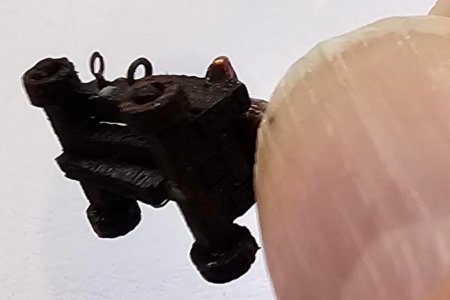
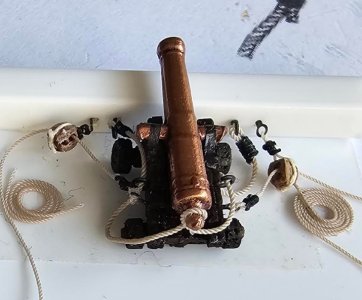
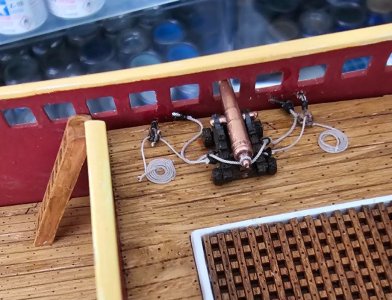
I decided to try to rig one cannon on a mock deck, as a trial, to see what was involved. Better than trying it on the ship in the first instance.

I got the little eyebolts attached to the carriage.

Pic-2169.jpgPic-2170.jpg

I got the breech line done OK. Not difficult. But I have just spent a frustrating few hours trying to rig a 3mm hook onto a 2mm block, for my first gun tackle. I got it looking OK but it was not quite straight. It is not easy to get these tiny blocks to bend to my will!

Further, by the time a 3mm hook is added to a 2mm block attached to the gun, and another hook and block attached to the side of the ship....well it all looks a bit cumbersome and, to my eyes, out of scale. Maybe the hooks are too big... 3mm on model = 216mm in real world, or 8.5" for people in the US. Doesn't sound like its out of proportion for a hook. Anyway, it was proving almost impossible for me to do neatly, and then I thought it did not look right anyway!

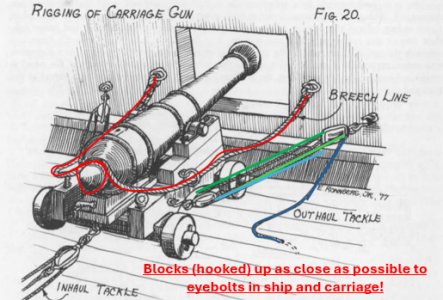
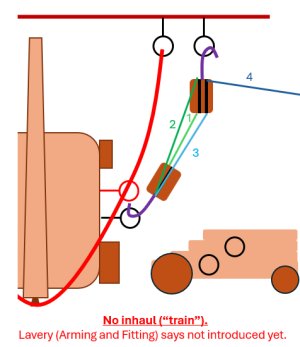
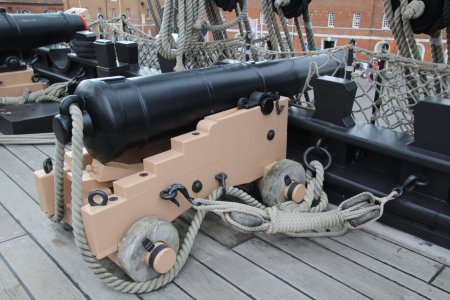
I like this image below (thanks Boatman!) ...
Pic-2167.jpg
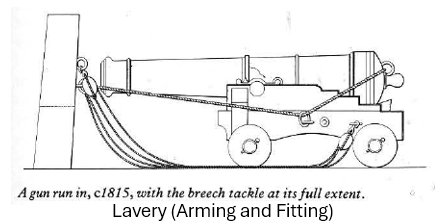
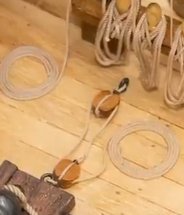
...and another from Lavery's book "The Arming and Fitting..." is similar...
Pic-2168.jpg

... from these scales (and the photos Boatman posted) the blocks are about 1/10 the length of the carriage and the hooks are a bit less. The carriage is 10mm so that means a block of about 1mm and a smaller hook. This is not doable. Certainly not by me. The smallest hooks I have (or can find) are 3mm and although I might be able to make one as small as 1mm I am not at all sure I can! I think the whole thing is too small to render in scale. Certainly with my skills.

So I think a modification is required. I want to try to keep the feel of the gun tackle, with an eye to the purpose most of all, and perhaps make some approximation that maintains the spirit of the real one!

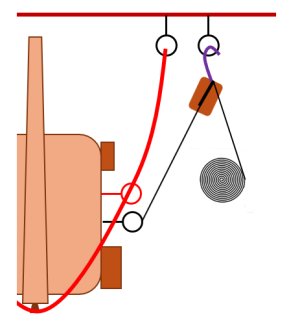
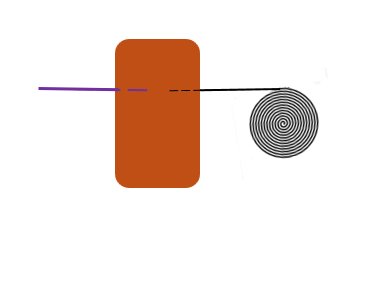
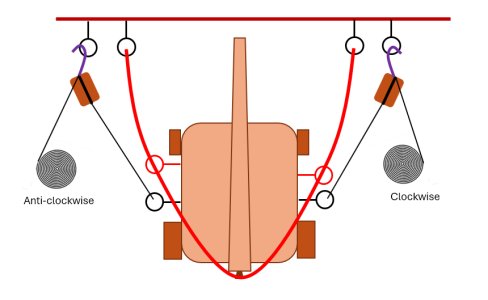
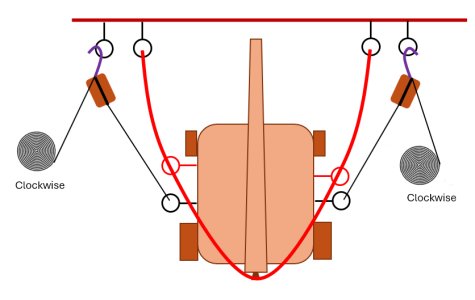
Here is my schematic of how the rigging should be done. (This is what I was going to do before reality raised its head.)
Pic-2171.jpg

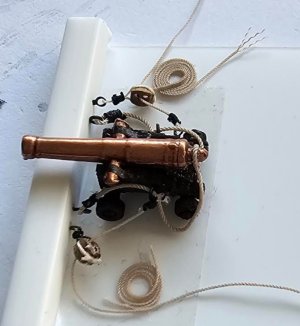
So now I am thinking that the two blocks are too complicated and not to scale. But if I want to keep the flavour or the tackle I can tie one end of the tackle line to the black hook, and that can go to a single block hooked into the ship. Then that rope goes to a coil on the deck...the coil is an essential detail that looks good :-) So my modified version looks like this:

Pic-2174.jpg

Thoughts or comments?
 
Another piece of advice please!

The eyebolts in the side of the ship require holes drilled into the hull, to hold them. The hull is very thin and I am not confident I can make such a shallow hole ... I expect I will go through the hull more than once.

Any hints on how to either avoid this or correct it?

How were eyebolts really attached? I was wondering if there was a metal plate on the outer side anyway, which I could add and would cover any hole I made!

Of course I can try to fill the tiny hole and pait over it...probably would work OK...
 
Why not place a knot in the ropes to simulate a block? At this scale, a knot with an added blob of glue to bulk it would 'look' as if it was a block. Especially if three lines go to it. And for the attachment to the hull - again, a blob of glue. How much stress will it need to take? better than punching a hole through.

J
 
Why not place a knot in the ropes to simulate a block? At this scale, a knot with an added blob of glue to bulk it would 'look' as if it was a block. Especially if three lines go to it. And for the attachment to the hull - again, a blob of glue. How much stress will it need to take? better than punching a hole through.

J
Good points... I might modify/simplify the hook...
 
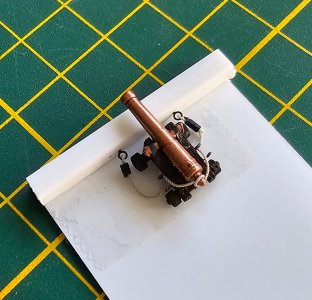
I did some more experiments today. I tried a zip seizing, as a new way of making seizings for the ropes. The breech rope is in place, the bolt it is attached to is about one millimeter long so I should be able to make a tiny hole in the hull without going through the side of the ship ... as Jim says, it doesn't have to take much stress so it doesn't have to hold a great deal of tension! . The seizing looks a little bit too large to me. Neat, but too large. I might try different technique tomorrow.

And I still need to experiment with my modified gun tackle. More tomorrow.
20260718_131530.jpg
 
Back
Top