
-

SUBSCRIBE TO SHIPS IN SCALE TODAY!
The beloved Ships in Scale Magazine is back and charting a new course for 2026!
Discover new skills, new techniques, and new inspirations in every issue.
NOTE THAT OUR NEXT ISSUE WILL BE July/August 2026 -

Win a Free Custom Engraved Brass Coin!!!
As a way to introduce our brass coins to the community, we will raffle off a free coin during the month of August. Follow link ABOVE for instructions for entering.


You are using an out of date browser. It may not display this or other websites correctly.
You should upgrade or use an alternative browser.
You should upgrade or use an alternative browser.
USS Constitution 1:70 Scratch
- Thread starter mtbediz1
- Start date
- Watchers 80
-
- Tags
- constitution


SHIPSHAPE! Excellent scale on the masting, spars, and rig; for me, the defining elegance of the real ship. The project is really coming along beautifully.

- Joined
- Jan 26, 2017
- Messages
- 1,379
- Points
- 493

Thank you!SHIPSHAPE! Excellent scale on the masting, spars, and rig; for me, the defining elegance of the real ship. The project is really coming along beautifully.

Hi Mustafa,
I hope you're enjoying your time away from the shipyard (and your laptop). When you do resurface, I'd like to ask you again about the blocks on the yards between the sling cleats. I remember asking you of this in the past and tried to find it at both sites. Perhaps I asked this of you at the other site, and your response was deleted along with your build log.
Anyway, as I began the process of finishing up as much as I can on the main yard while it is off the ship, I revisited the topic. Unfortunately, while at my shipyard, I couldn't find any of the details of the conversation. Worse, even though I KNOW that book with the diagram is in the shop, I could not find the page with the drawing. So, I came home to my base station and dug into my notes to confirm my recollection that you used double blocks between the cleats, as outlined by Bob Hunt in the Practicum, and as evidenced in XKen's build.
The reference you used to confirm a double block scenario. (why couldn't I find that in the book??? It was in my photo reference library at home though.)
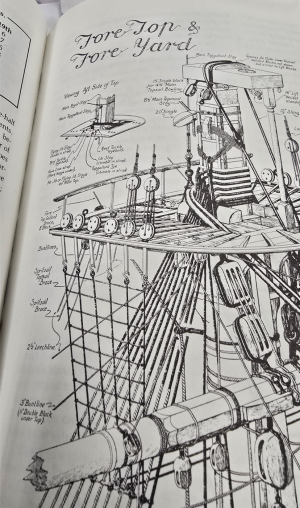
your deployment of a double block
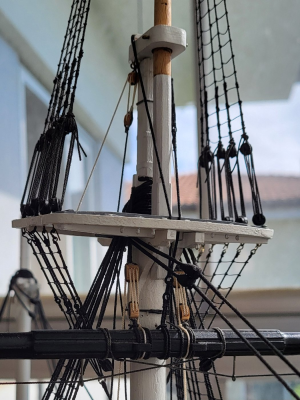
Here, another misstep in the Hunt practicum? (see page 4 of Rigging the Constitution, Chapter 4)
"Now we need to seize two triple blocks to the mast. These are also 3/16" blocks. They are seized with .021" tan rope around the mast as shown in photo P4.1.1-4. The figure eight method of seizing was used here."
And here's P4.1.1-4:
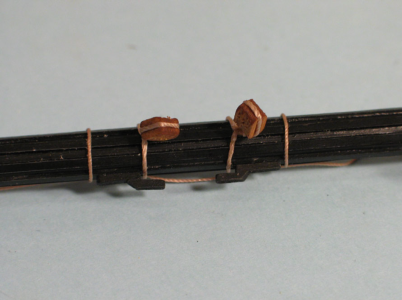
yet in Hunt's summary AFTER the above photo:
"Seize two 3/16" triple blocks using .021" tan rope to the center of the main yardarm inside the sling cleats."
From XKen's build log - triple blocks!
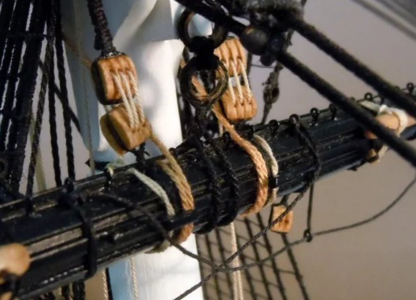
I am 90% certain that your implementation is the correct option. (Though now, I have to buy some 3/16" double blocks from Syren. I mostly have triple blocks in that size). What I am curious about is what Ken did here? Would you venture a guess? Where are those thicker tan lines going, since they don't seem to be rigged to the triple block? Is there an alternative rigging plan that I'm unaware of?
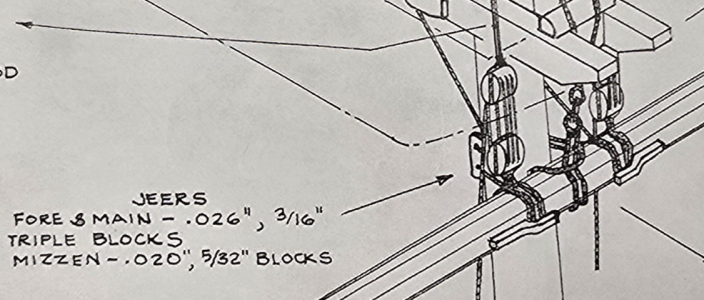
Here's the drawing from the MS kit plans that Ken must have been referencing. Confirming my suspicion that competing solutions do exist.
Again, I know we've discussed this in the past, and I apologize that I'm cluttering your build log by asking this again. But inquiring minds need to know..
Thanks again.
Peter
I hope you're enjoying your time away from the shipyard (and your laptop). When you do resurface, I'd like to ask you again about the blocks on the yards between the sling cleats. I remember asking you of this in the past and tried to find it at both sites. Perhaps I asked this of you at the other site, and your response was deleted along with your build log.
Anyway, as I began the process of finishing up as much as I can on the main yard while it is off the ship, I revisited the topic. Unfortunately, while at my shipyard, I couldn't find any of the details of the conversation. Worse, even though I KNOW that book with the diagram is in the shop, I could not find the page with the drawing.
So, I came home to my base station and dug into my notes to confirm my recollection that you used double blocks between the cleats, as outlined by Bob Hunt in the Practicum, and as evidenced in XKen's build.The reference you used to confirm a double block scenario. (why couldn't I find that in the book??? It was in my photo reference library at home though.)
your deployment of a double block
Here, another misstep in the Hunt practicum? (see page 4 of Rigging the Constitution, Chapter 4)
"Now we need to seize two triple blocks to the mast. These are also 3/16" blocks. They are seized with .021" tan rope around the mast as shown in photo P4.1.1-4. The figure eight method of seizing was used here."
And here's P4.1.1-4:
yet in Hunt's summary AFTER the above photo:
"Seize two 3/16" triple blocks using .021" tan rope to the center of the main yardarm inside the sling cleats."
From XKen's build log - triple blocks!
I am 90% certain that your implementation is the correct option. (Though now, I have to buy some 3/16" double blocks from Syren. I mostly have triple blocks in that size). What I am curious about is what Ken did here? Would you venture a guess? Where are those thicker tan lines going, since they don't seem to be rigged to the triple block? Is there an alternative rigging plan that I'm unaware of?
Here's the drawing from the MS kit plans that Ken must have been referencing. Confirming my suspicion that competing solutions do exist.
Again, I know we've discussed this in the past, and I apologize that I'm cluttering your build log by asking this again. But inquiring minds need to know..
Thanks again.
Peter


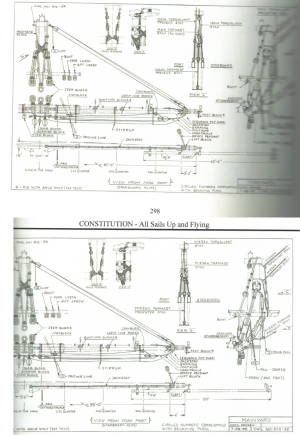
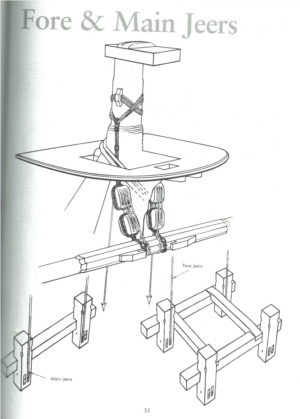
Peter, I am no where near this point in my build, but I got curious and checked my limited references. Rigging Period Ship Models by Lennarth Petersson pg 35 shows the jeers as a pair of triple blocks. The Constitution All Sails Up and Flying by Olof A. Eriksen pg 298 and 299 show a triple block and a double block lashed to the yard. Why one method over another, no clue.
Jon
Jon
I can't wait until my copy of all sails up and flying arrives, sadly that's still 3 weeks from now.
The sketches you supplied above confirm Mustafa's choice and the reference he sent me originally. But it doesn't explain the MS kit plans, and what Ken did. Absent any further information, I'm going with the two block solution. But I am curious..
Thanks Jon.
The sketches you supplied above confirm Mustafa's choice and the reference he sent me originally. But it doesn't explain the MS kit plans, and what Ken did. Absent any further information, I'm going with the two block solution. But I am curious..
Thanks Jon.


Perhaps the explanation for the differences is that the ASUAF rigging is how it was done (presumably) in 1812-1815 period, whereas the others are from other more recent periods? Now I guess it's just a matter of determining why the difference?
- Joined
- Jan 26, 2017
- Messages
- 1,379
- Points
- 493
Hi Peter. I remember this discussion. I'm actually the one who brought it up. This is another one of the mistakes in the MS plans. Since Mr. Hunt and Ken built their models by following the MS plans very closely, they ended up reproducing these errors as well.
When you look at the MS plans, can you actually see where the ends of the line running through the blocks are secured? I can't. It's also not clear where Ken attached the standing end of the line. As far as I can tell, this arrangement simply can't work.
The standing end of the line needs to be secured to the yard. If you use a pair of triple blocks, the running end will naturally finish at the lower block, which is attached to the yard. That makes this particular arrangement impossible to operate as shown.
My guess is that Ken simply secured the end of the line somewhere out of sight to reproduce the appearance shown in the plans.
So you should use double blocks between the cleats.
The truss pendant lead in the MS plans is also incorrect and cannot work in real life. You can find how I did it in the previous pages of this build log. (Post #975)
When you look at the MS plans, can you actually see where the ends of the line running through the blocks are secured? I can't. It's also not clear where Ken attached the standing end of the line. As far as I can tell, this arrangement simply can't work.
The standing end of the line needs to be secured to the yard. If you use a pair of triple blocks, the running end will naturally finish at the lower block, which is attached to the yard. That makes this particular arrangement impossible to operate as shown.
My guess is that Ken simply secured the end of the line somewhere out of sight to reproduce the appearance shown in the plans.
So you should use double blocks between the cleats.
The truss pendant lead in the MS plans is also incorrect and cannot work in real life. You can find how I did it in the previous pages of this build log. (Post #975)
Last edited:
- Joined
- Jan 26, 2017
- Messages
- 1,379
- Points
- 493
No Jon, if you look carefully, you'll see that in both drawings the blocks connected to the yard are double blocksPeter, I am no where near this point in my build, but I got curious and checked my limited references. Rigging Period Ship Models by Lennarth Petersson pg 35 shows the jeers as a pair of triple blocks. The Constitution All Sails Up and Flying by Olof A. Eriksen pg 298 and 299 show a triple block and a double block lashed to the yard. Why one method over another, no clue.
 Petersson used double blocks in the yard too.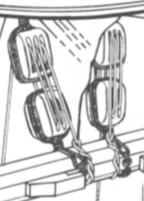
- Joined
- Jan 26, 2017
- Messages
- 1,379
- Points
- 493
Hi Peter, another solution for you; if you don't have double blocks, you can use triple blocks and you can leave one of the sheaves empty.am 90% certain that your implementation is the correct option. (Though now, I have to buy some 3/16" double blocks from Syren. I mostly have triple blocks in that size). What I am curious about is what Ken did here? Would you venture a guess? Where are those thicker tan lines going, since they don't seem to be rigged to the triple block? Is there an alternative rigging plan that I'm unaware of?
Last edited:
Mustafa, our apologies for disturbing you about this on your holiday! But, I replied to Peter privately with that same page 298 drawing reference from Olaf Eriksen's ASUAF book that Jon Gerson did above. And it pretty clearly shows that the top block of those jeer blocks is three sheaves. Is this not the same rigging that Peter was asking about? I'm just clueless as to where the line would fall to.No Jon, if you look carefully, you'll see that in both drawings the blocks connected to the yard are double blocks
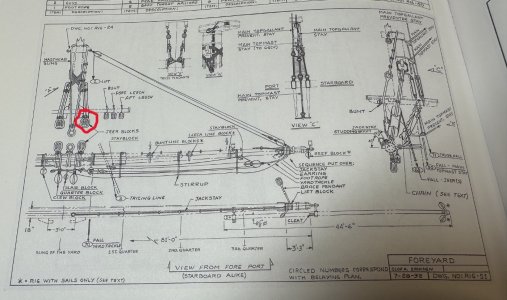
As I said to Peter, this rigging is all foreign to me right now, but Olof Eriksen's book has been an interesting read. Enjoy the remainder of your holiday, sir!
- Joined
- Jan 26, 2017
- Messages
- 1,379
- Points
- 493
Hi Greg, it's undisputed that the top blocks should be triple. Peter is just undecided about the bottom blocks connecting to the yard. They should be double blocks.Mustafa, our apologies for disturbing you about this on your holiday! But, I replied to Peter privately with that same page 298 drawing reference from Olaf Eriksen's ASUAF book that Jon Gerson did above. And it pretty clearly shows that the top block of those jeer blocks is three sheaves. Is this not the same rigging that Peter was asking about? I'm just clueless as to where the line would fall to.
View attachment 622904
As I said to Peter, this rigging is all foreign to me right now, but Olof Eriksen's book has been an interesting read. Enjoy the remainder of your holiday, sir!
Ahhh, my apologies! I read his concerns wrong then about which block he was questioning! I did find the discussion that Olof had in his ASUAF book regarding the details of that DWG-RIG-51 drawing with the references to the double block and triple block. I will send to Peter in a DM if he is interested so as not to continue to clutter your build log, Mustafa. Again, enjoy the remainder of your holiday time!Hi Greg, it's undisputed that the top blocks should be triple. Peter is just undecided about the bottom blocks connecting to the yard. They should be double blocks.
- Joined
- Jan 26, 2017
- Messages
- 1,379
- Points
- 493
Thank you so much Greg!Again, enjoy the remainder of your holiday time!
- Joined
- Jan 26, 2017
- Messages
- 1,379
- Points
- 493
Peter, the thicker tan lines are truss pendants.Where are those thicker tan lines going, since they don't seem to be rigged to the triple block? Is there an alternative rigging plan that I'm unaware of?
Last edited:
You are are right!! That's why I need 3 pairs of glasses: trifocal, computer, and reading glassesNo Jon, if you look carefully, you'll see that in both drawings the blocks connected to the yard are double blocks

Thank you Mustafa, Jon and Gregg for your help in this matter. Double blocks they will be.
And Mustafa, I agree with you that Ken must have hidden a standing end of that line somewhere. I do have a small supply of double blocks, but will order a replacement amount just to make sure I have enough to finish the model.
Before heading out to meet four other members of the Northern Illinois shipbuilders club for lunch today, I will swing by the shop and (attempt to) rig the two double blocks to the main yard. This may provide some show and tell material for the meeting.
Since the cleats are already glued to the yards, I don't think I can use Mustafa's technique here - elegant as that solution is. I may have to simply seize them to the yard.
Thanks again to all. And to Mustafa, enjoy the rest of your summer break.
And Mustafa, I agree with you that Ken must have hidden a standing end of that line somewhere. I do have a small supply of double blocks, but will order a replacement amount just to make sure I have enough to finish the model.
Before heading out to meet four other members of the Northern Illinois shipbuilders club for lunch today, I will swing by the shop and (attempt to) rig the two double blocks to the main yard. This may provide some show and tell material for the meeting.
Since the cleats are already glued to the yards, I don't think I can use Mustafa's technique here - elegant as that solution is. I may have to simply seize them to the yard.
Thanks again to all. And to Mustafa, enjoy the rest of your summer break.
- Joined
- Jan 26, 2017
- Messages
- 1,379
- Points
- 493
Hi Peter, while reading your post, I'm also watching the sunset over the Mediterranean and sipping my whiskey! Thanks for your kind wishes.Thanks again to all. And to Mustafa, enjoy the rest of your summer break.

Last edited:
Make mine a rye Manhattan.
Different scenery, but cheers!

Different scenery, but cheers!