
• Ships of Scale has incorportated an extra level of security when you log In. Please follow on-screen prompts to acknowledge that you are not a robot via a "Check Box" or a "Pictorial Check Box Puzzle". This is needed due to higher level of AI Activity Security.
  • SUBSCRIBE TO SHIPS IN SCALE TODAY!

    The beloved Ships in Scale Magazine is back and charting a new course for 2026!
    Discover new skills, new techniques, and new inspirations in every issue.

    NOTE THAT OUR NEXT ISSUE WILL BE July/August 2026
  • Win a Free Custom Engraved Brass Coin!!!
    As a way to introduce our brass coins to the community, we will raffle off a free coin during the month of August. Follow link ABOVE for instructions for entering.

Arnemuiden 1:50 A small Dutch Man-of-war

Joined
Dec 10, 2024
Messages
15
Points
78

Hello All!

After lurking for a considereable amount of time, I think its time to start my own build.

This build log follows my attempt to build a small Oorlogs jacht of the Admirality of Zeeland, as she might have looked around 1638. The main goal is to build a good-looking model while, at the same time, gaining more experience in building wooden ship models. In the longer term, I would like to use that experience to scratch build a ship using the historical construciton methods of the period.

For this build however I will be using a technique that is allready well known her on the forum, and which has been used to great effect by several other builders. I will be leaving out everything below the gundeck. This is partly to keep the project manageable, and also because my focus is on learning and imporving my building skills rather than reproducing every part of the ship.

The plans I'm using were drawn by Cor Emke and Ab Hoving and are included with the book "The Ships of Abel Tasman". Mr. Hoving mentions in the book that the plans for the ship heemskerk can also be used to represent other ships of a similar size. That is waht I intend to do here. I will use the plans as a starting point and modify them to represent a ship named "Arnemuiden". Planbashing, if you will.

There are no known pictures of the Arnemuiden, and barely any availeable information apart from armement, crew and aproximate capacity, so there is obviously a fair amount of interpretation involved. I will do my best to make the choices as historically plausible as possible, based on what we know about Dutch ships of this size and period. The result will therefore not be an exact reconstruction, but rather an attempt to show what the small man-of-war might have looked like around 1638.
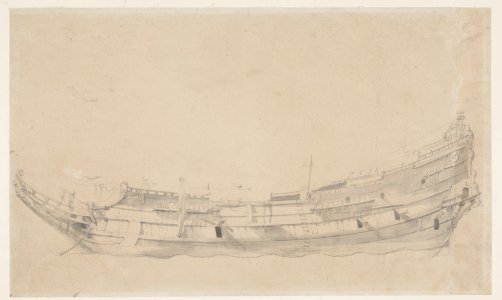

t2571_001.jpg
Van de Velde the elder, A small Dutch man-of-war, Courtesy of the Scheepvaartmuseum Amsterdam.
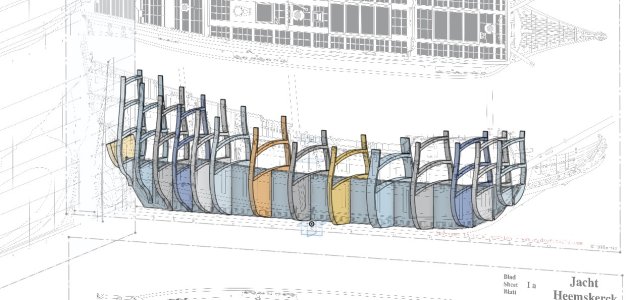
 
Now, one of the reasons I chose this planset is because it was availeable in a digital version thanks to the cd-rom included with the book, although I had to dust off an old laptop with diskdrive just to be able to read its contents, I can not remember the last time I used anything other than Webtransfer and USB's.
Even still, this planset being digital significantly curtailed the pre-production phase and effort I otherwise would have had to put into digitising a planset myself.

So I loaded it into Onshape and after a couple of nights of drawing and rechecking the deck levels against the sheerplan because some decklevels were off by too much to ignore. I Drew out the frames and backbone. Very lovely planset considering everything together. It has everything needed and is very detailed.

Screenshot 2026-08-18 221151.jpg

I then send it off to be lasercut, since this would save me a lot of time with manually sawing and correcting every part. Regreteably I forgot to check the material thickness and accidentally ordered the batch in 3mm mdf instead of the 6mm I had intended. So much for saving time I guess..
I decided to manually saw a new backbone out of 6mm with adjusted slots to allow the 3mm "frames" to be used so they should not be wasted. They are rather flimsy and feel like they should snap if I sneezed too loud, but since I'm filling the spaces in betweeen with solid wood It'll be fine for the time being.
20260612_204123.jpg

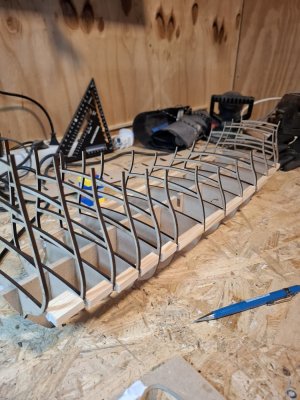
First off I'm bracking the frames/bulkheads at the broades points just below decklevel and make sure they are evenly spaced.

20260810_203441.jpg

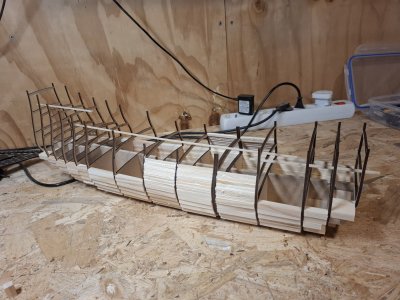
Then I filled in the rest of the space under deck level with thick pieces. Above decklevel, at the side of the gundeck I'm using wood which thickness is appropriate for the hull thickness at that point. This is to minimize the amount of sanding I'll have to do on the inside when I get to it. I also used a couple of balsa strips to support the frames in the center.

20260818_203757.jpg

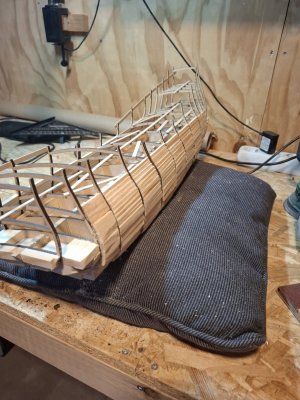
Even more support strips because it will have to stand a bit of manhandling during the sanding. This is about where I'm at right now. Making dust and my neighbours less happy with me.
 
Thanks for stopping by my log Doc! I'ts partly thanks to your very in depth vasa log that I got all the information and (perhaps misplaced)confidence to do this project ;). I've not build anything bigger than Billingboat's Hoogaars yacht so this is a dive into the deeper end.
In the mean time I'm also very much enjoying you current build.
 
I'm happy that my Vasa log encouraged you! That was my first ship model so there are plenty of things I would now do differently - but all-in-all I'm happy with the outcome. For the rigging I should be pretty close except I left off the backstays as Fred Hocker was uncertain about their placement at the time of my build.
 
Welcome Gentlemen, please make yourselves at home!

Allright, Now I've said that she will be called "Arnemuiden". But what does the name mean and what do we know about the historic vessel?

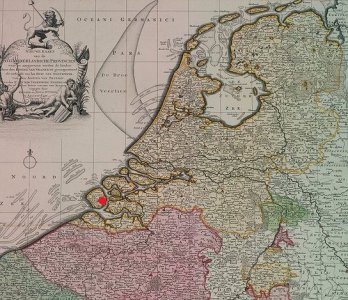
First off, the she is named after the town "Arnemuiden" in the Dutch province of zeeland. It is the town where I grew up and lived until I moved out. So I feel a strong bond with the Town and its story.

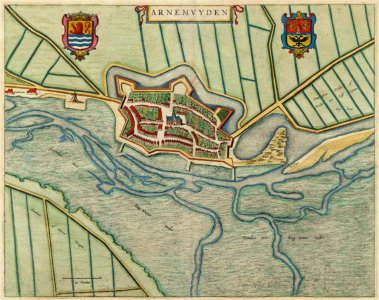
copy.JPGArnemuiden_1649_Blaeu.jpg

Situated on the island of Walcheren at the mouth of the River Arne, Arnemuiden grew from a small settlement into an important maritime trading centre during the late Middle Ages. By the fifteenth and sixteenth centuries, its roadstead had become an important transhipment point, serving not only Arnemuiden itself but also the larger trading centers of Middelburg and Antwerp.

MuseumArnemuiden-slider7.jpg
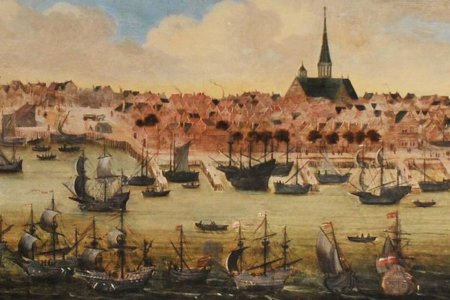
Arnemuiden around the 1580's.

At its height, Arnemuiden was a remarkably busy place. Merchant ships could anchor in several rows off the town, while goods were transferred between larger seagoing vessels and smaller craft.

The sea also played a less forgiving role in Arnemuiden's history. The original town was eventually lost to flooding and the sea, and the later town was repeatedly affected by the constant struggle between land, water and silt. The harbour and the River Arne gradually became shallower, and by the beginning of the seventeenth century the town's great days as a commercial port were already coming to an end.

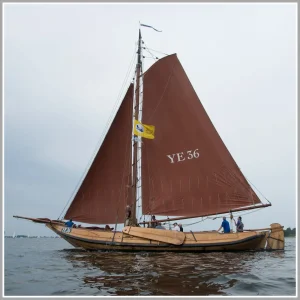
In the slightly younger by-gone days, the town and its people would mostly live off of the large fishing fleet tied to its, by that time, shallow and small port. Up till as late as the beginning of the 20th century the local shipyard had a steady stream of fishing vessels, specialised for the Scheldt Delta, running of the slips. These were known as Hoogaarzen. A fair number of them are still around, fitted out as yachts mostly but a couple have been preserved in the fishermen form that would have been familiar to many generations of "Arnemuidenaren".

YE36.jpg.webp
Fisherman's Hoogaars with the characteristic brown red sails, Courtesy of "Stichting Behoud Hoogaars"
 
What we know about the Arnemuiden.

There is unfortunately not much information available about the historical Arnemuiden. According to James Bender's "Dutch Warships in the age of Sail", she was commanded by Adriaen Janszoon Glooijende Oven, Carried 22 guns and had a crew of 80 men. And that is about where the solid information ends. I have done a preliminary look into the Archives but have not found anything usefull.
The 22 guns are interesting however. Compared to other vessels of the Zeeland Admirality, listed by Mr. Bender suggest that an armament of 22 guns for a ship of 108ft, which is the size I will be modelling, is quite plausible.

In the book "The ships of Abel Tasman, Mr. Hoving Calculates the possible armament of the ship Heemskerck while also leaving enough room for cargo. This makes sense as Heemskerck was a ship for the VOC, intended for both trade and protection, so she wouldnt want to spend all her displacement on guns.

Arnemuiden, on the other hand was used in a military role, Mr. Bender also tells us that she served in the blockading squardron off the coast of flanders, meant to keep the privateers in harbor and so to keep the dutch merchant shipping safe. Arnemuiden therefore would have had less reason to sacrifice guns for cargo space. Whether she was purpose-built or an upgunned merchantman, an extra pair of guns does not seem unreasonable to me.

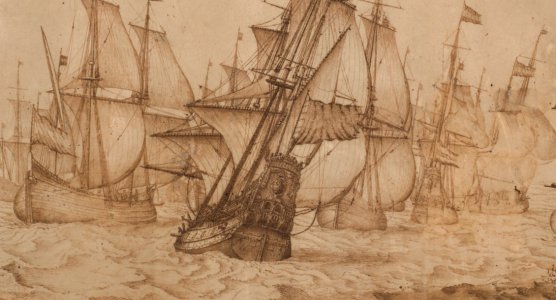
So this gives me the confidence that this size of ship is apporpriate, now for what she might look like I'm almost 100% guessing. But luckily there were some highly skilled Artist that put similar vessels in their works. One that I particularly like is this scene by Willem van de Velde the elder.

Screenshot 2026-08-21 220254.jpg
Small excerpt of a pendrawing by Willem van de Velde (I). " A small dutch escort ship, guarding merchantmen down english channel"
Courtesy of "Scheepvaart museum Amsterdam"


It shows a ship very much the size I'm looking for in the role of escorting merchantman.

Thats the info I'm working with. Thank you for checking in and Hopefully next time I have something ship shaped to show!
 
Hi Roger. Nice to see the start of your build-log and the build of the ‘Arnemuiden’. And it is a big advantage when you have a relation to the ship, its name or the related city. In this case the city where you grew up. Then you allow yourself to do a bit more, just like you did the extra work in that 3D environment. It is somewhat comparable to my Balder and Vlaardingen, where I grew up.
Hopefully there is some place for my chair besides Paul, Russ and Patrick? To follow your interesting approach for the hull.
Regards, Peter
 
Last edited:
In the longer term, I would like to use that experience to scratch build a ship using the historical construciton methods of the period.
This is not my area but I here are some thoughts to factor for your future direction:

Since your objective is to replicate an existing shape - I do not see that an exact reenactment of original methods as being a reliable way to get there. The original method included a significant design as you go component - let Nature win where it does not matter. I do not think that part will scale the same way as a board will bend at 1:1 scale.

I do not think that the physical reactions of wood to force and stress scales all that well.
As I understand it - the Low Country's method was shell first.
I do not see that a mimic of full size method at model scale as being a reliable way to replicate a design where the only known are length, breadth, depth, tunnage. For a model that is real from an historical aspect I see that your options are:
start with an authentic existing plan (not easy given that a fully expounded design on paper was not the method used) or morph an existing plan on paper to match what your target could be like.

I suggest doing a model using shell first, but form the shell over a mould that defines the shape. This mould should be more than:
midship, one forward shape, one aft shape, the stem, the sternpost. I think that wood at model scale is too perverse the behave the same as it would 50 times larger.
The replication method would be the same as is used to build a ship's boat.
I prefer a solid core, but a mold at every station - with a lot of stations is more the current practice.

After you have a shell, bending the internal support farming timbers would probably be the easy way. Next would be a sawn shape from a plan.
More difficult as I see it would be using a finger gauge to determine the internal shell shape and transferring it to a pattern.
I do not think that a fine enough and small enough commercial finger gauge exists. I think that you would need to design and build your own:
something like from #70 steel quilting pins - 50-100 or more - side by side - in a clamp that allows sliding up and down and then freezing.
In practice - I see it as like herding cats - including strong magnets may help.


Looking at post #2 - pix 2 -3 -4
Balsa can be nasty to work.
Do you have access to clear Pine? or Tulipwood? or even Linden?
Have you thought of going vertical instead or horizontal? Using the mold shapes as the pattern, almost all of the shaping can be done off the model. Each section can be slud in place between molds. Cardboard can be used to makeup for any shortfall.

Dean
 
You are all most welcome! I think there is enough space left. Otherwise we'll knock down a wall.
The coffee corner is selfservice Coffee.

This is not my area but I here are some thoughts to factor for your future direction:

Since your objective is to replicate an existing shape - I do not see that an exact reenactment of original methods as being a reliable way to get there. The original method included a significant design as you go component - let Nature win where it does not matter. I do not think that part will scale the same way as a board will bend at 1:1 scale.

I do not think that the physical reactions of wood to force and stress scales all that well.
As I understand it - the Low Country's method was shell first.
I do not see that a mimic of full size method at model scale as being a reliable way to replicate a design where the only known are length, breadth, depth, tunnage. For a model that is real from an historical aspect I see that your options are:
start with an authentic existing plan (not easy given that a fully expounded design on paper was not the method used) or morph an existing plan on paper to match what your target could be like.

I suggest doing a model using shell first, but form the shell over a mould that defines the shape. This mould should be more than:
midship, one forward shape, one aft shape, the stem, the sternpost. I think that wood at model scale is too perverse the behave the same as it would 50 times larger.
The replication method would be the same as is used to build a ship's boat.
I prefer a solid core, but a mold at every station - with a lot of stations is more the current practice.

After you have a shell, bending the internal support farming timbers would probably be the easy way. Next would be a sawn shape from a plan.
More difficult as I see it would be using a finger gauge to determine the internal shell shape and transferring it to a pattern.
I do not think that a fine enough and small enough commercial finger gauge exists. I think that you would need to design and build your own:
something like from #70 steel quilting pins - 50-100 or more - side by side - in a clamp that allows sliding up and down and then freezing.
In practice - I see it as like herding cats - including strong magnets may help.


Looking at post #2 - pix 2 -3 -4
Balsa can be nasty to work.
Do you have access to clear Pine? or Tulipwood? or even Linden?
Have you thought of going vertical instead or horizontal? Using the mold shapes as the pattern, almost all of the shaping can be done off the model. Each section can be slud in place between molds. Cardboard can be used to makeup for any shortfall.

Dean
You are right Dean, a lot of things will not work in scale as they do in 1:1 constructions. If and when the time comes I shall have to try and see what works and where (scale) corners have to be cut. However, as Maarten with his Shell first Fluyt and Mr. Hoving did with his ships as described in multiple of his books, the modeller can get very close. And let's not forget the Spanish Galleon build by Ramonolivenza. But I very much take your point and I shall have to a lot of research before I can start that build. As for the Balsa, its temporary bracing so my flimsy bulkheads dont snap during the sanding of the hull.

EDIT: Just to be clear, I didnt mean that list to be exhaustive. There are many many other skilled people on this here forum.
 
Last edited:
Back
Top