



• Ships of Scale has incorportated an extra level of security when you log In. Please follow on-screen prompts to acknowledge that you are not a robot via a "Check Box" or a "Pictorial Check Box Puzzle". This is needed due to higher level of AI Activity Security.
  • SUBSCRIBE TO SHIPS IN SCALE TODAY!

    The beloved Ships in Scale Magazine is back and charting a new course for 2026!
    Discover new skills, new techniques, and new inspirations in every issue.

    NOTE THAT OUR NEXT ISSUE WILL BE July/August 2026
  • Win a Free Custom Engraved Brass Coin!!!
    As a way to introduce our brass coins to the community, we will raffle off a free coin during the month of August. Follow link ABOVE for instructions for entering.

Jeer tackle ropes

Joined
Aug 26, 2020
Messages
576
Points
308

Location
UK Dorset
A common form or main or foreyard jeer seems to involve a pair of three hole blocks. If the tackle is used to raise the yard from deck level then the rope must be about 7x the height of the main top. What happens to it all after the yard is raised? On my current model (HMS Unicorn) I estimate that I should coil about 1.2 metres of rigging thread. For historical accuracy I should make a roughly 30 loop coil (of hand-made rope, of course!) to hang on each bitt. Has anybody done this?
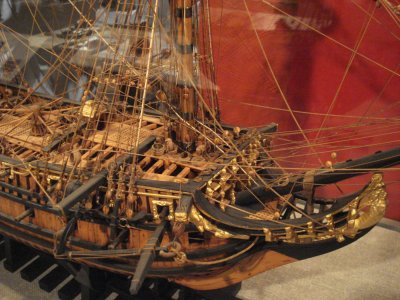
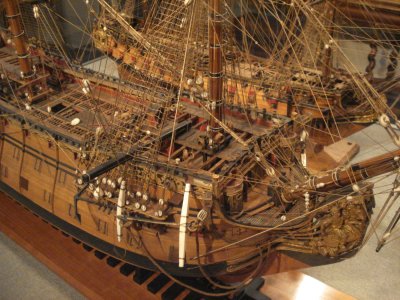
The token coils we often hang on belaying pins must often be rather inadequate for some of the running rigging functions on the higher masts.

 
A common form or main or foreyard jeer seems to involve a pair of three hole blocks.
What a great question. This got me interested so I did a little digging. On English ships of war Lees shows the use of triple blocks starting about 1830. Earlier ships used three singles, singles and doubles, a pair of single and double, and a pair of singles and a triple depending on the era. From 1670 to 1810 two pairs for each yard consisting of a single and a double block were used. I looked through The Elements and Practice of Rigging and Seamanship and there is a lot of detail, but no mention of the pile of rope. Using the ratios from Lees book and starting with a main mast diameter of 40 inches as an example for a first rate, the jeers for the lower yard on the main mast would be about 1.4 inch diameter. With a height of 100 feet above the deck and 700 feet of rope if after 1830, the loosely coiled rope would be about 3.3 feet in diameter and 1.6 feet high. It would be smaller when pairs of single and double blocks were used, but there would be two piles instead of one. Without looking further at deck layouts around the jeer bitts I have no idea if this is a big pile or not.

Again, you raised a great question. From what I could find, the jeers were not removed once the trusses or slings or parrels were secured so that pile of rope had to go somewhere.

Allan
 
Last edited:
For modeling purposes, I think the token coils are quite adequate.
Who are you answering to about an accurate length of model rope?

Do you see evidence that this was done on contemporary models?
 
That's 1 ! Are you sure the amount of rope is correct?

Still wondering who is going to notice if you only have 350 feet of model rope on the deck of your model ship when it should be 700 feet.
 
Still wondering who is going to notice if you only have 350 feet of model rope on the deck of your model ship when it should be 700 feet.
Probably no one :) :)
That's 1 ! Are you sure the amount of rope is correct?
Here's another one. As to the amount, it is far more than a few loops around the jeer pin but as to 350 feet or 700 feet, who knows??
1790122169627.jpeg
 
Back
Top