

- Joined
- May 3, 2026
- Messages
- 156
- Points
- 78

It will be interesting to see what kind of result you get.I am still playing mind games at this point.

 |
The beloved Ships in Scale Magazine is back and charting a new course for 2026! Discover new skills, new techniques, and new inspirations in every issue. NOTE THAT OUR NEXT ISSUE WILL BE July/August 2026 |
|
 |
As a way to introduce our brass coins to the community, we will raffle off a free coin during the month of August. Follow link ABOVE for instructions for entering. |
|
It will be interesting to see what kind of result you get.I am still playing mind games at this point.


That rope walk works the same way as a normal rope walk. That makes sense, because there’s only one way to make rope. People have been doing it this way for 2,000 years. The only difference is that the endless rope walk has a constant supply of yarn. The strands are twisted in one direction, and in principle, rope is formed automatically as the strands twist together. This happens naturally because the strands are twisted in the same direction. If that strand already consists of twisted rope and it turns out that the direction of your twist is opposite to that of the strand, then it will untwist the strand. It’s just simple math. The rope produced will not be stable because it lacks the natural tendency to form rope.i guess i am just wondering if the strands have to be unwrapped first or not. The head of my machine has a variable speed drive on it and I can also change it`s direction and I can also control the feedrate on the takeup spool, so I don`t see a scenario where what you said would happen, but hey. I haven`t tested it yet either. I am still playing mind games at this point.
Actually it doesn't.That rope walk works the same way as a normal rope walk.


Yes, it does. You just explained yourself that the machine winds the strands around about 10 times more than the rope. So it’s the same principle.Actually it doesn't.
a 'normal' rope walk twists the strands hundreds of times.
The planetary type machines twists the strands a few tens of times at most, making it difficult to get the tight lay a traditional machine provides.
In my mathematical evaluation the number of torsion/cm depends also on the original torsion of the strands and the final direction of torsion of the rope (rh) or of the cavble(lh). The E-Gutermann strand doesn't have any initial torsion at all, but all the other strands made by 2 or more single filaments have it, and it's usually rh. My ropewalk discerns the kind of starting treads and evaluates the amount of torsion needed: in some cases are not hundred, but thousands.Yes, it does. You just explained yourself that the machine winds the strands around about 10 times more than the rope. So it’s the same principle.
That’s actually somewhat limited by the gear ratio, though, because it would be better if there were two motors in the system. That way, you could adjust the number of windings more precisely. I once designed a system like that for someone who wanted to use industrial spools of yarn. I was able to power the spool motor using slip rings.
This made the machine much more versatile. Maybe this is something for @Lorenzo71 to design, because the machine requires many more settings than just the weight on a traditional machine.
I'm referring to the twisting of the strands by the whorls on a conventional machine. This is what builds the tension on the threads that causes them to form rope when allowed to twist together. The strands are trying to unwind, which causes them to twist together because they have no other place to go....which twist are you referring to? The one for each strand or the head rotation itself?
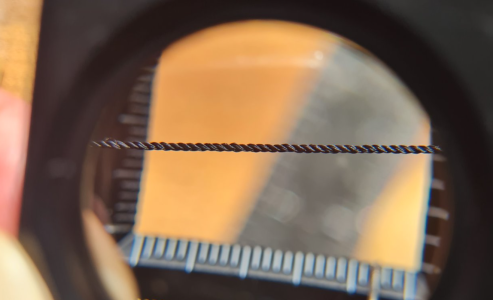
Well what about this one that I made this morning. I would love to get your opinion of it. the head is only at 30%
View attachment 638970
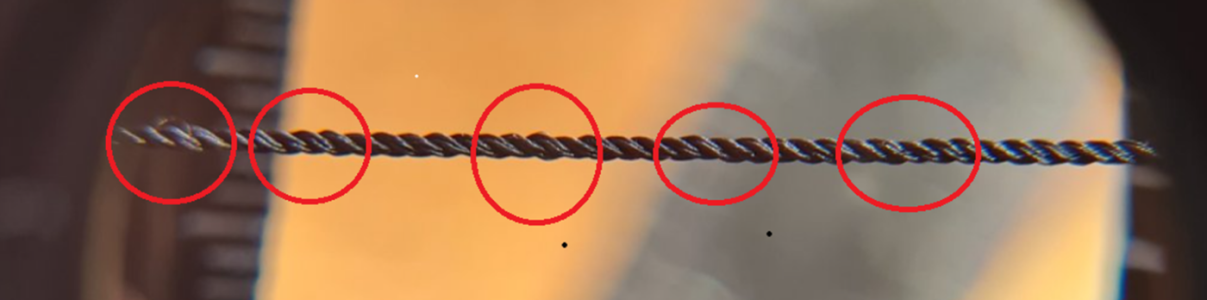
Ok, So what you are saying is that I should have gone to an s twist first because the strands are z twist?Here you can see the irregularities when you spin against the direction of the strands. You can see in the twists that they’re coming apart, creating thick and thin sections.
View attachment 638972
When I make rope on my rope walk, I do so over a 4-meter length. The strands then make a lot of turns. It rotates at 2,000 turns per minute, and the process takes 3 minutes. That’s 6,000 turns. The planetary rope walk makes rope over a 10-centimeter length, and in that case, it takes about 10 turns to make the first section of the rope. Over 4 meters, that’s 400 turns—not enough to achieve a good result. I can't show you no resultsI'm referring to the twisting of the strands by the whorls on a conventional machine. This is what builds the tension on the threads that causes them to form rope when allowed to twist together. The strands are trying to unwind, which causes them to twist together because they have no other place to go.
The orbital machines I have seen do not twist the strands very much compared to the conventional. This results in a relatively loose lay.
Do you have any examples of rope made with the orbital?
yesOk, So what you are saying is that I should have gone to an s twist first because the strands are z twist?
Sorry I don't mean to steal this topic.
thank you.