• Ships of Scale has incorportated an extra level of security when you log In. Please follow on-screen prompts to acknowledge that you are not a robot via a "Check Box" or a "Pictorial Check Box Puzzle". This is needed due to higher level of AI Activity Security.
  • SUBSCRIBE TO SHIPS IN SCALE TODAY!

    The beloved Ships in Scale Magazine is back and charting a new course for 2026!
    Discover new skills, new techniques, and new inspirations in every issue.

    NOTE THAT OUR NEXT ISSUE WILL BE July/August 2026
  • Win a Free Custom Engraved Brass Coin!!!
    As a way to introduce our brass coins to the community, we will raffle off a free coin during the month of August. Follow link ABOVE for instructions for entering.

Bulkheads

Joined
Jan 8, 2024
Messages
35
Points
58

I've built 26 models, and my current build is the Sakonnet Daysailer by Model Shipways, but my question applies to all plank on bulkhead models. When installing the bulkheads on the keel, how do you hold the bulkheads in place while the glue dries and confirm that the tops on the port and starboard bulkheads on the outboard side are aligned with each other? I use a small square to confirm that bulkheads are perpendicular to the keel, so that's not a problem. I've struggled with this on every model I've built.
 
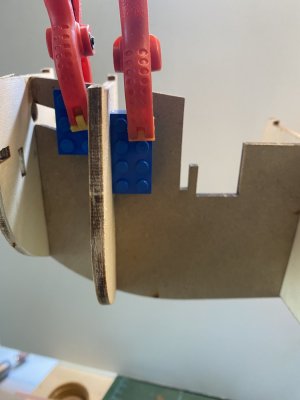
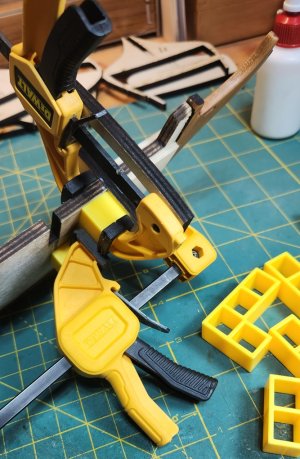
A lot of people (including myself) now use lego blocks clamped along both sides of the bulkheads when they are being glued to prevent them from shifting, You can also try using binder clamps.

Rob

IMG_2079.jpeg
 
That’s a problem with most kits, POB and Solid hull. When reproducing a complex shape like a boat or ship hull, to do precision work it’s necessary to have a rigid flat datum to measure to. The idea that you can assemble a precisely shaped hull by assembling bulkheads along a flexible spine aka False Keel is a myth. Even the famous Keel Clamps or expensive MDF Building Slips do not take the place of a rigid build board.

Solid hull kits suffer from the same problem. Trying to accurately fair a machine carved hull while accurately maintaining hull lines is difficult. If I were given a solid hull kit to build I would first bandsaw it down the middle and carve a pair of half models. I would then have access to a flat datum for aligning templates.

Roger
 
The original Italian kit developers called them bulkheads when they did their translation to English, and for steel vessels or sea going Chinese junks bulkhead is a part of the interior. Western wooden sailing vessels did not have bulkheads. That part of a POB model is actually a mold.

Here is a thought: the central spine at the place where are the molds - for most of the area has nothing going on. A perfectly square 1/4" x 1/4" strip of wood can be cut into short segments.
They can be PVA bonded at all four corners of every mold (where the legos are in post #2). They can be enforced by using Bamboo skewers as dowels. The slot for each mold is then a lot thicker - not much chance for any wagging. If another segment of the 1/4" stick is rotated 90 degrees it can fill the gap between the sticks of two sequential slots. If the fit is tight and it is glued to the central spine P&S - The spine will have a difficult time taking on a bend.
It is not the same as Roger's reference building board plane - but it is a ton more secure than current practice.
 
what about the "walls" that were taken down when going into action
I would not call temporary partitions "bulkheads".
It would make for an interesting exercise to operate guns on a deck that had solid waterproof walls at 10-20 foot intervals that formed chambers could only be entered by going up to the top deck.

My reading showed that a lot the the partitions were hinged at the top and were swung up to the underside of the deck beams - where there was room without blocking an access to above.
 
Well, as far as the name of the hull fabrication method - the damage has been done - for a long time.

I am not sure just how effective that sort of "bulkhead" is in protecting a ship with a hull breach from sinking. But why not let the definition of bulkhead be varied into uselessness?

They work the same as molds in upside down boat construction - except that they remain inside the hull.

The cringe part comes when they are called "frames". It is probably best left unexpressed what that indicates.
 
Good Morning,

Consider.

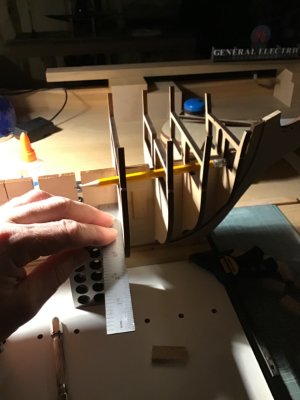
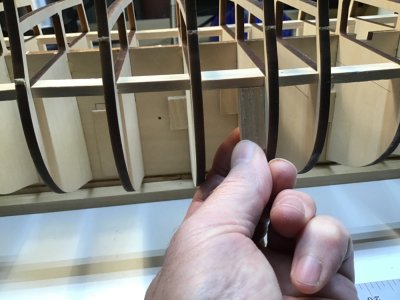
Blocks at the Keel/Bulkhead joint. Make sure keel and bulkheads are square. Tack with CA. Tack the blocks.

1791643748856.jpeg

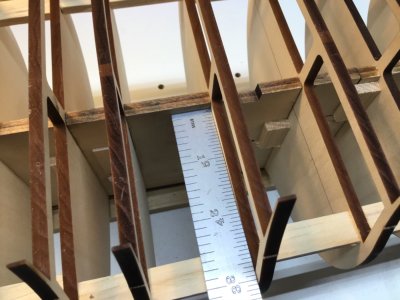
Then measure width between bulkheads at the keel and cut blocks that width for the outer ends of the bulkhead. Work from amidships alternating forward and aft. Dry fit or tack the blocks, in case of changes. Found these blocks straightened the keel, and would stay in from the force of the opposing block.

1791643133882.jpeg

Make sure outer blocks are perpendicular to the bulkhead. And check the plan for interference, a block in the way of something like a gunport.

1791644024206.jpeg

And everything is aligned.

1791644138522.jpeg

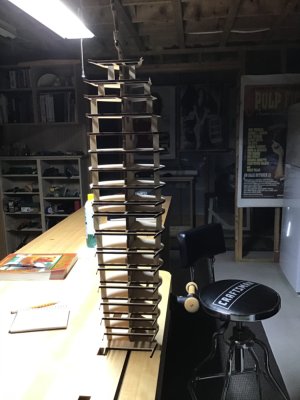
Stand the beast on end and eyeball it. It will look “right”.

1791644208191.jpeg

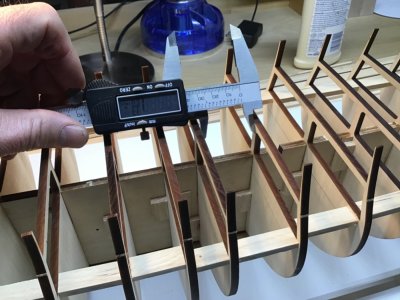
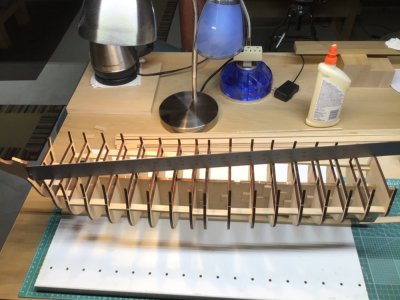
Lay a straight edge from bow to stern, measure the port and starboard sides. Ideally they should be the same. Expected a small difference but it did tie out.

1791643475335.jpeg

When all is well, filet the keel/bulkhead joints. Glue the outboard blocks.

Good luck,

-Rich
 
Bulkhead do not have to be permanent structures to be called bulkheads, neither to they have to be watertight. Bulkhead in double bottoms many contain lightening holes, which reduce weight while not significantly reducing their strength as supporting members in a hull. Temporary bulkheads on wooden warships serve to separate living spaces and are taken down quickly to open those spaces up to the rest of the gun deck as part of the operation "clear for action" prior to combat. The crew can quickly tear down and stow these bulkheads away, either slung to the overhead when they are hinged or taken below into the hold. The entire deck is transformed in minutes from living space to an artillery gun deck.
 
Last edited:
Ah, an eye for detail and text. I’m the chap who spots the errors on boxes of cereals.

Or the inconsistency in spacing of treenails or lengths of plank.

Jim
 
Back
Top