


• Ships of Scale has incorportated an extra level of security when you log In. Please follow on-screen prompts to acknowledge that you are not a robot via a "Check Box" or a "Pictorial Check Box Puzzle". This is needed due to higher level of AI Activity Security.
  • SUBSCRIBE TO SHIPS IN SCALE TODAY!

    The beloved Ships in Scale Magazine is back and charting a new course for 2026!
    Discover new skills, new techniques, and new inspirations in every issue.

    NOTE THAT OUR NEXT ISSUE WILL BE July/August 2026
  • Win a Free Custom Engraved Brass Coin!!!
    As a way to introduce our brass coins to the community, we will raffle off a free coin during the month of August. Follow link ABOVE for instructions for entering.

Bending

KRB

Joined
Jul 4, 2026
Messages
2
Points
3
Hello everyone

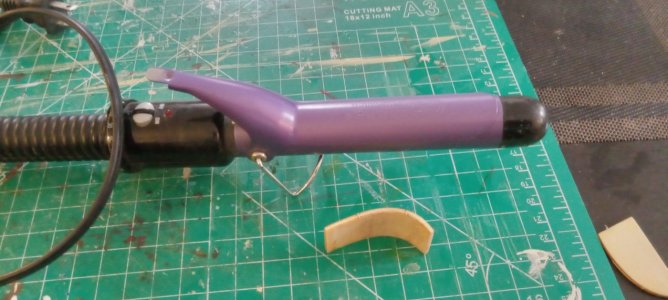
I thought I should share this with you. I needed to curve a small peice of wood for my model. Water alone wasn't working and I don't own a plank bender. The wife suggested I use her curling iron. Worked perfectly, you just have to be patient.f0a59394-9278-46aa-a532-8e62d39cab75.jpg
 
Yes, curling irons and electric hair dryers are often pressed into service to bend wood. Remember, it isn't the wet that makes the bend, but rather the heat. Heat is more easily transmitted through the wood when the wood is wet, but it really doesn't make all that much difference whether the wood is wet or not as long as the wood is heated "through and through." Successful bending requires heating through and through, though. Just getting the wood hot on the outside isn't going to work as well. You want the heat all the way through the wood.
 
now to just get a hot iron, or somesuch.

Try zapping the wooden piece to be bent in your kitchen microwave. It will probably take some practice to determine the amount of time required to heat it to the required temperature. One of the advantages of a microwave is that it will heat the wood evenly throughout, rather than just from the outside in. Wear gloves when handling so you don't burn your fingers.
 
There seem to be many ways to broad bend successfully. I wish someone would invent a practical adjustable tool for edge bending which is as critical and much more difficult to do. Spiling is the best way to go, but most kits only supply straight sticks so it is not so easy to taper in breadth then edge bend so they do not lift.
Allan
 
There seem to be many ways to broad bend successfully. I wish someone would invent a practical adjustable tool for edge bending which is as critical and much more difficult to do. Spiling is the best way to go, but most kits only supply straight sticks so it is not so easy to taper in breadth then edge bend so they do not lift.
Allan

The difficulty encountered with edge-bending that you've described is God's way of telling us that he never intended wood to be bent on edge.
 
when this subject comes up no one mentions the type of wood. Some woods are just stubborn and will split before they bend while others will bend easy like the sample below no heat, no water the wood bends naturally. This piece is .080 x .150 (2 x 4 mm)
You would think the thinner the wood the easier it is to bend but that is not always the case. The thinner the wood the weaker it becomes unless you have a very fine-grained wood. I realize if you are building from a kit, you have no choice in the wood the kit makers do not select wood with properties suited for the job they select wood they have available, cost less, and looks good.

SCN0442.jpg
 
he difficulty encountered with edge-bending that you've described is God's way of telling us that he never intended wood to be bent on edge.

You are of course correct, but with the vast majority of planking wood supplied being straight sticks instead of spiled planks something needs ot be done. Happily the method shown in the videos by Chuck Passaro works extremely well to get the proper shape and avoid lifting and gaps.
Allan
 
You are of course correct, but with the vast majority of planking wood supplied being straight sticks instead of spiled planks something needs to be done. Happily, the method shown in the videos by Chuck Passaro works extremely well to get the proper shape and avoid lifting and gaps.
Allan

A few more observations on the subject:

Spiled scale planks can easily be gotten out of wider flat stock. There's no need to use the unsuitable 1/4" wide stuff that the kit manufacturers provide in their kits. There is, of course, a bit of waste involved in cutting the curves instead of bending them, but if one planks "to scale," which is to say they use planks of the proper scale length, the amount of waste is greatly reduced, as is the required width of stock to accommodate the curve in any given length of plank. We often see modelers planking with narrow strip stock that is 12, 18, or even 24" long. Even a foot long planking strip on a 1:48 scale model is 48 scale feet long, at 1:96 scale, a foot long planking strip is 96 scale feet long, and so on. Due to the practical limitations of the available timber and handling convenience, even on the largest vessels, the maximum plank length in real life is about 24 feet. At the risk of being dismissed as a "rivet counter," all those clear-finished hulls with 150 or 200 scale foot planks hung with no regard to the proper planking lining or schedules and fastened with contrasting-colored treenails "to show the planking detail" are glaringly out of scale and incorrectly planked.

Passaro's edge bending method does adequately prevent the "buckling" that occurs when bending across the flat of a strip but note that in his demonstration videos he is bending Alaskan Yellow Cedar which is much more amenable to heat-bending than the low-quality "walnut," "mahogany," and other questionably identified exotic species frequently found in kit boxes. Much of the "kit wood" planking stock is so coarsely grained and figured that it's really unsuitable for any modeling purpose other than paint-stirring sticks! Buying better stock does occasion an additional expense, but in proportion to the overall cost of many kits and the time invested in building any ship model, using higher quality materials is a relatively small price to pay for a much better end result.

The far more efficient way to "get the proper shape and avoid lifting and gaps" is to exercise the required care in laying out the planking runs properly and spiling and cutting the planks to fit as they should. Edge-setting plank is an illusory solution that often causes more subsequent problems with plank seam gaps, clamping, and adhesive failures, than it solves in shaping the planks to fit properly before they are hung.

However, I do realize that there are many modelers who for whatever reason do not wish to invest the time and effort required to learn how to lay out planking runs and schedules and spile and fit planks, particularly if they intend to merely create a rough "strip planked" hull shape which will be puttied, sanded fair, and painted, and that for them none of these observations will be of much relevance at all.
 
Back
Top