• Ships of Scale has incorportated an extra level of security when you log In. Please follow on-screen prompts to acknowledge that you are not a robot via a "Check Box" or a "Pictorial Check Box Puzzle". This is needed due to higher level of AI Activity Security.
  • SUBSCRIBE TO SHIPS IN SCALE TODAY!

    The beloved Ships in Scale Magazine is back and charting a new course for 2026!
    Discover new skills, new techniques, and new inspirations in every issue.

    NOTE THAT OUR NEXT ISSUE WILL BE July/August 2026
  • Win a Free Custom Engraved Brass Coin!!!
    As a way to introduce our brass coins to the community, we will raffle off a free coin during the month of August. Follow link ABOVE for instructions for entering.

What Brands Make Higher End Limited Edition/"Museum Quality" Model Kits and How Different Are They from a Standard Kit?

Hi all,

New to the forum and ship modeling (but not woodworking and modeling more broadly).

I was wondering if anyone had any insights or experience with some of the higher end model kits, the difference in quality, and who makes them. Specifically, I am thinking of Occre's Limited Editions (Victory/Soleil Royal) and Agora (Constitution/Cutty Sark).

For those of you who have completed these models, is there a significant difference in quality and difficulty for these kits in the roughly $2,000 price point? Are there any other brands that offer these so-called "Museum Quality" model kits?

Thanks!
Sam
I was a member of "Ships Company" in Tulsa, Oklahoma. They were the oldest model ship builders club in the world at the time. There senior member actually built a model for the Smithsonian. It was not from a kit.
I learned a lot about building ship models in the 4 short years I was with them. I have built three very high quality Model Shipway kits. But I learned you have to "upgrade" your kit in order to make it worthy of putting in a museum.
My last kit was the Prince De'Neufchatel. I had a machine shop fabricate more accurate carronades, but later learned I could have purchased them much cheaper from a supplier in the UK. I spent over a year researching the proper rigging sizes and blocks for this vessel. I manufactured my own ropes to the right diameter. Most kits will only include a few thread sizes and they will be right hand wound. But standing rigging was always left hand, or cable laid. I purchased the proper size high quality blocks from Dry Dock Models and Parts in Canada. They have the highest quality blocks I could find.

To make a "museum quality" ship you will have to put more time into research than actually building the model. But it is worth it.

I hope to soon make the USS Constitution in 1:64 scale, even though no kit is available in that scale. So I have already purchased the Model Shipways 1:72 scale and will use it to go by. I recommend buying a kit even if you want to scratch build because it gives you a base to work from .
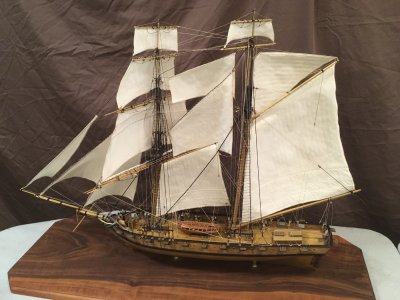
Prince 2.JPG
 
I think maybe it's more feasible to build a model based on a preliminary design, and iterate that, than it is to do the same with a real battleship. It's economics that dictate the decision, which is understandable. Kits could presumably be iterated after first release, based on feedback though. I know sometimes they are, but not as a rule. I think Watton iterates his kits and instructions with agility.

It's not a big deal as long as the kit is buildable with a reasonable amount of allowance for kit error by the builder. I know such things are considered "part of the hobby". But I'm probably not the only one curious why parts in kits that have been released for years are still substantially wrong. Recent example I've worked through is the beak on the lobster smack. This same issue is reported in build logs, so it's not just me. I didn't realize it was wrong until after painting.

Probably more than half of the "drawn to actual size" diagrams are not drawn to actual size.

An instructions errata insert seems easily feasible for established, well-reported kit errors.

All that said, I love Model Expo! The customer service is top notch, the products and prices are good, and the ads I get in email (every day) are actually usually pretty entertaining.
One issue I learned with the Model Shipways 3 boat intro series is that that the printed instructionsare not entirely to scale. They are about 2% smaller. If you print the instructions from their website they are to scale. Makes a difference with spars and the printed decoration on the side of the Smack bowsprit. You're right about the beak on the Smack. The one supplied with the kit is a sad and droopy thing. It's beyond me why they don't fix these obvious issues which multiple modelers have pointed out. I guess it all boils down to money and profits.
 
Thank you for all comments -and the compliments!
About the emails... I'm guilty as charged ;)
I am currently building your Harriet Lane kit. I am enjoying every minute of it, and learning a lot, despite what I call eruptions of Model Shipways-itis - things that don't match the instructions or pieces that don't exactly fit. I learned how to build wooden boat models from your Shipwright of Old series, and recommend them as often as I can. I owe my enjoyment of my new hobby to you. A question: your instruction manuals all seem to illustrate prototype kits. Do you ever have anyone build a production kit for the instructions? Your customer service is top notch in terms of replacing missing or damaged parts. Is there someone we could correspond with about issues with instructions (there are several in the Pram, Smack and Harriet Lane) or faulty laser cutting (I'm thinking about the cockpit seats in the Lobster Smack and bulkhead 3 in the Harriet Lane)?
 
but my parents had other ideas. Seems that I was destined to become one of the unfortunate souls that were sent off to military school while my parents moved from Massachusetts to Florida.
Sorry to stray off topic........
Norgale, If you substitute Pennsylvania for Massachusetts we could be related. Models and my entire collection of baseball cards from the fifties and early sixties were gone the first time I came back home several months after leaving for the academy. I could have bought a new car with the money the cards would have brought in
if I had been able to save them to sell in the 1980's.
 
Last edited:
A museum quality model is one that a museum is willing to put on display..

I have yet to identify a model in a museum that was made from a kit.

That doesn't mean there are none out there.
The Historic Dockyard in Portsmouth were going to display one of mine some years ago, it would have been a kit build back then. I sold it instead.
 
Hi all,

New to the forum and ship modeling (but not woodworking and modeling more broadly).

I was wondering if anyone had any insights or experience with some of the higher end model kits, the difference in quality, and who makes them. Specifically, I am thinking of Occre's Limited Editions (Victory/Soleil Royal) and Agora (Constitution/Cutty Sark).

For those of you who have completed these models, is there a significant difference in quality and difficulty for these kits in the roughly $2,000 price point? Are there any other brands that offer these so-called "Museum Quality" model kits?

Thanks!
Sam
OcCre's Victory, Artesania's answer with Surprise. Neither are accurate. Treat the words 'museum quality' with the disrespect they deserve! Kit manufacturers are essentially toy makers. Often very little research other than a scattering of famous exploits.
Any kit is bashable. It helps if the basics are accurate, by which I mean hull profile, decks, rigging, cabins are all easily adapted. (even on my screen I can see howling disasters!)
There are some pretty dire ship models in museums, even folk art. even souvenir shop low grade. It's meaningless.
If you aspire to your personal idea of that high quality research, , tools and your ability to use them, a set of plans, and the best timber you can source.
And...ignore anything OcCre might want to claim. They are somwhere on the lower sairs.
 
Sorry to stray off topic........
Norgale, If you substitute Pennsylvania for Massachusetts we could be related. Models and my entire collection of baseball cards from the fifties and early sixties were gone the first time I came back home several months after leaving for the academy. I could have bought a new car with the money the cards would have brought in
if I had been able to save them to sell in the 1980's.
Guess I'm not the only one who got left in the dust. My mother thought my dad told me where they were and he thought my mother told me. It didn't really matter as long as I got the ticket to fly home for holidays and my allowance every week. I was ok at the school as well as at home but that school had more rules and regulations than I had ever heard of before. I learned them fast too. The worst thing I lost was my American Flyer trains. My cousins got all that.
I was glad they still had my dog though. Losing her would have been grounds for instant divorce from the family I think.
 
I wonder. All I build are solid hull kits. Try Googling “
Pete Jacquith Newsboy: Built from MS solid hall kit. Would you call it ‘museum quality’? I might….

 
Pete Jacquith is a notable exception to the rule. He builds beautiful models, period. His Newsboy is a solid hull model and he knows how to accurately shape it. He also has a feel for the vessel’s hull lines. A solid hull shaped by a knowledgeable builder like Pete can result in a very accurate model.

Roger
 
What I am wondering is if there is any significant difference in terms of what you get for ships at this price point (which seems to be at minimum double or triple the cost of others).

My sense is that you might get better wood and perhaps an admiralty-style framing, but that these are otherwise solid models with good marketing behind them.

As for the question of why not scratch build, the only reason is a lack of familiarity with the subject matter, and kits have been fun so far.

I have read this thread to this point and it's full of useful information, so I'll just offer a few of my own observations that seem to me not to have been addressed, or at least given the emphasis I think they deserve.

Is there is any significant difference in terms of what you get for ships at this price point (which seems to be at minimum double or triple the cost of others)

There sure is, but there seems to be a lot less of a linear correlation between what you pay and what you get between one kit and another. You don't always get what you pay for. The more expensive kits are often larger, with more parts and ostensibly better-quality materials and instructions. But if we judge a kit based on quality of materials and instructions and how few problems will be encountered to build a good model from it, then, regardless of price, they're all over the map. Remember, knowledgeable estimates are than only one in ten ship model kits is ever completed! There's good reasons for that.

The ship model kit is what the marketing experts call an aspirational purchase. The average customer buys a ship model because they aspire to build one, at least for their own satisfaction, if not for the complements and status the customer hopes will be acquired by building it. The average buyer's decision to purchase a particular kit is usually based on their unsophisticated and thereby unqualified assessment of which kit produces the most impressive model given the buyer's budget and (usually wildly inaccurate) estimation of their abilities. This is why the kit manufacturers pick the model subjects they do: so often big eighteenth century ships of the line bristling with cannon and intricate rigging, far beyond the capabilities of the builder. What the kit marketers are primarily selling is not the kit, but rather the fantasy that if the customer buys the kit, they'll be able to call themselves a "ship modeler" and have the color glossy pictured finished model to display on their living room mantle or in their man cave. There is, however, "many a slip betwixt the cup and the lip!" (Remember, in forums such as this one, we see only those minority of kit purchases that progress beyond the kit buyer's closet shelf!)

My sense is that you might get better wood and perhaps an admiralty-style framing, but that these are otherwise solid models with good marketing behind them.

You betcha! You've got that right.

As for the question of why not scratch build, the only reason is a lack of familiarity with the subject matter, and kits have been fun so far.

This description hits the nail on the head. In my opinion, the most critical distinction between kit building ship models and scratch building ship models is the degree of knowledge required by each. This will probably get some people all defensive about which is better, but that will only be a projection of their own feelings of inferiority rather a valid assessment. It's entirely reasonable that some may for any number of reasons prefer to build kits and that realistically should have no bearing whatsoever upon the status of a modeler nor the quality of the models they build. That said, kits are designed to permit a builder to assemble a given ship model without having to do the in-depth historical research and acquire a command of the many required maritime trades in the context of the prototype's historical period. The real purpose of a kit, from the marketer's perspective, is to empower the buyer to believe they can get from wanting to build a ship model to actually doing it when they know they don't have the knowledge to know how to do it on their own. This is true whether the buyer is a complete beginner, or a highly experienced kit builder considering their next large, complex, kit build.

While perhaps the fault of our times, learning from books seems to be an option no longer favored by many. Time was, before the internet, if one wanted to know how to do something, we went to the library and read a book about it. Fortunately, for the moment, at least, there are still in print, or readily available on the secondhand market, many good books (and a few not so good, of course,) on ship modeling. Some of these are classics on the subject and have been around for some time (e.g., Anything by Charles Davis, Harold Underhill, Gerald Wingrove, Harold Hahn, Donald McNarry, Philip Reed, or Howard Chapelle, etc.) These books tell you how to build ship models. Simple as that. There are also many good "practicums" or "monographs," which are books that are highly detailed instructions on how to build a particular model (e.g., David Anscherl's books: https://www.bing.com/search?q=David...-36&sk=&cvid=D124389B35AA4321B82217D984D775A4)

All one has to do to become "familiar with the subject matter" is to read the darn books! (The measure of a serious scale ship modeler isn't how many models he's built, but how many books there are in his ship modeling reference library!) You can spend $2,000 on a ship model kit to (hopefully) build a model of a ship that's been modeled hundreds of times before, or you can spend even as much as a couple of hundred bucks to buy the most comprehensive and detailed practicum on a comparable ship of the line, buy the required milled scale stock, scale cordage, and other materials, and even a few store-bought fittings like blocks and cannon, and still probably have between $1,200 and $1,500 left over to spend on tools (you probably don't absolutely need, but are fun to have) and you're only going to have those tools to use for the rest of your days and with what you have learned from your reading, you will probably find yourself choosing for your next ship modeling subject a vessel of particular interest to you that maybe even has never been modeled before from original plans you found for free in a book or online or bought for relatively little from a museum.

Yes, this all does require one to learn how boats and ships were and are actually built, but that is always what "separates the men from the boys," isn't it? Those who are not academically inclined need not worry, though. As much as what one needs to know about the subject isn't rocket science. All one needs to learn is how to do the common thing uncommonly well.

There is no question that building a scale ship model kit can be very enjoyable and that alone is all the justification required for doing it. Whether one builds a model from a kit or not, as in all such things, the extent to which one wishes to challenge their "personal best" in the pursuit of perfection is a personal decision dependent upon the individual's personality. However, I do think it must be said that most kits, regardless of price, will be found inherently limited in what satisfaction they provide to those who reach a certain level of accomplishment in their modeling. Many modelers conclude after building a few kits that they could do a better job starting with plans and "making their own kit" as they go along, and for a whole lot less money.

As for kit prices and what you are getting for your money, the one thing that always amazes me is how some retail kit marketers are able to near-continuously hold sales discounting every kit they offer at "half-price." Think about it. What must the profit margin on a ship model kit be if they can sell them all the time at half-price? How much "bang for their buck" are those modelers who "can't pass up a bargain" and accumulate "stashes" of models that, given even the most generous estimates of their life expectancies, they will never build? The modeler who buys books from which he can build any modeling subject he wishes saves not only a lot of money spent on models he'll never get around to building, but also saves a lot of closet space! :D
 
You can spend $2,000 on a ship model kit to (hopefully) build a model of a ship that's been modeled hundreds of times before
I agree with you about the aspirational aspect of selling ship model kits (so true of most consumer advertising!). I, however, don't mind if a model has been made hundreds of times before. It's never been made by me, though (to misquote Sondheim), and that is what makes it unique, and enjoyable.
 
kits are designed to permit a builder to assemble a given ship model without having to do the in-depth historical research
One quick comment. This is strictly my opinion,........ It might be that the majority of kit makers assume the buyer is just wanting to have some fun and is not that interested in accuracy or is not familiar enough to know what is and what is not realistic. If doing research into accuracy by the buyer was a common part of choosing a kit manufacturer, most manufacturers would be out of business and our hobby would be in big trouble with a monopoly held by two or three manufacturers.
 
Back
Top