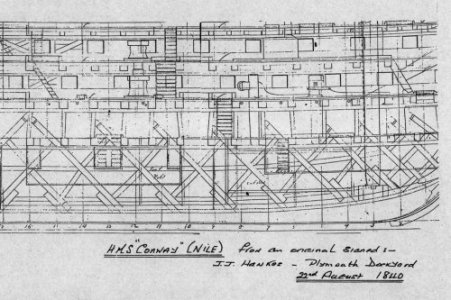
An interesting question. As the hulls of ships grew longer flexing in a seaway became a cause of hull failure for exactly the reason that Short John Bronze writes about. Lack of triangular structural members allowed adjacent strakes of planking to slide relative to each other causing the caulking to fail.
As Itar and Allan post, by the 1800’s efforts were made to add diagonal members. Perhaps the most well known example today is that of the very large American 44 gun frigates. When USS Constitution was repaired in the 1990’s there was evidence that she had originally been built with diagonal riders. The work done to allow her to sail included adding these back.
By the mid 1800’s high value American built ships; Clippers, and Warships, were being built with wrought iron diagonal strapping between the hull frames and planking, but the great 3-6 masted American Schooners built at the end of the century and into the 1900’s required periodic recaulking or abandonment once leakage from failed plank seams could not be controlled.
Rational structural analysis of ship hulls began with the work of British Civil Engineers notably Sir Isambard Kingdom Brunel. By treating the hull as a very large box girder it was realized that the primary structural member of the hull was the shell itself; planking or if an iron vessel plating. This analysis is still used today as the primary hull failure mode is considered to be hull fracture from longitudinal bending stresses.
Riveting of wrought iron plating and much later welding of steel plating has allowed building of very large ship hulls, and of course modern glues allow building of monocoque smaller craft but for large traditionally framed wooden hulls the problem still exists. Note the number of hogged replicas, old ships, and yachts still seen today.
Roger