Gute Frage, und überraschenderweise ist sie schwer zu beantworten.
Ich will das Thema etwas umgehen, indem ich Ihnen vorschlage, selbst etwas zu recherchieren.
Zunächst einmal: Welche Marken stehen Ihnen zur Verfügung? Nicht alle Sorten sind in allen Ländern erhältlich.
Schauen Sie sich dann die Webseiten der Hersteller an und lesen Sie deren Angaben und Empfehlungen zu verschiedenen Materialien und deren Schneideigenschaften. Sobald Sie wissen, was es gibt und wie die Materialien funktionieren, können Sie Testpackungen kaufen und selbst prüfen, ob sie den Erwartungen gerecht werden.
Was stearathaltige Schleifmittel betrifft, scheinen sie alle hellgrau zu sein (Mirka), während Norton Blue ein ausgezeichnetes und langlebiges Schleifmittel ist. Beachten Sie jedoch, dass auch das Trägermaterial entscheidend sein kann. Dasselbe Schleifmittel, beispielsweise Aluminiumoxid, kann auf Standard-Papierkaschierung, auf einer 15 Meter langen Rolle mit 10 cm breitem Papierkaschierung oder speziell für Maschinen wie Bandschleifer mit einer sehr robusten, biegsamen Trägerschicht erhältlich sein (was jedoch für unsere Zwecke oft zu unflexibel ist).
Aluminiumoxid stumpft schnell ab, ist aber scharf und wirksam, jedoch von kurzer Dauer (zumindest für mich).
Das ist ein umfangreiches Thema. Wir müssen mehr Daten und Erfahrungen zusammentragen.
Jim

-

Win a Free Custom Engraved Brass Coin!!!
As a way to introduce our brass coins to the community, we will raffle off a free coin during the month of August. Follow link ABOVE for instructions for entering.
You are using an out of date browser. It may not display this or other websites correctly.
You should upgrade or use an alternative browser.
You should upgrade or use an alternative browser.
Hallo!
1. Ich kaufe Schleifpapier bei einem Schleifmittelhändler. Dieser verkauft Schleifmittel für Gewerbe und Industrie. Das bedeutet, dass eine bestimmte Qualität gewährleistet ist.
Der Einsatz von Schleifmitteln ist zu erwarten. Meine Körnung beim Modellbau beginnt bei 80 und endet bei 240 oder 300.
2. Zum Schleifen des Rumpfes habe ich mir harten Schaumgummi gekauft und ihn zugeschnitten. Dadurch lassen sich die Rundungen leichter bearbeiten.
3. Zum Schleifen kleiner Teile verwende ich selbstgemachte Schleifpapierfeilen. Man nehme ein altes Lineal, bohre die Nieten aus und klebe die Teile mit doppelseitigem Klebeband und zugeschnittenem Schleifpapier oder Schmirgelleinen zusammen.
Übersetzt mit DeepL.com (kostenlose Version)
1. Ich kaufe Schleifpapier bei einem Schleifmittelhändler. Dieser verkauft Schleifmittel für Gewerbe und Industrie. Das bedeutet, dass eine bestimmte Qualität gewährleistet ist.
Der Einsatz von Schleifmitteln ist zu erwarten. Meine Körnung beim Modellbau beginnt bei 80 und endet bei 240 oder 300.
2. Zum Schleifen des Rumpfes habe ich mir harten Schaumgummi gekauft und ihn zugeschnitten. Dadurch lassen sich die Rundungen leichter bearbeiten.
3. Zum Schleifen kleiner Teile verwende ich selbstgemachte Schleifpapierfeilen. Man nehme ein altes Lineal, bohre die Nieten aus und klebe die Teile mit doppelseitigem Klebeband und zugeschnittenem Schleifpapier oder Schmirgelleinen zusammen.
Übersetzt mit DeepL.com (kostenlose Version)

This is all great information. So far I just sand using a variety of sandpaper grits and materials as a 'thing' to hold sandpapers from a plain wood blocks, dowels of different diameters as well as hard foam pads both homemade and commercial auto body versions. They all work. As to using a scraper - used them on wood working projects and repairing downhill ski bases but never on any models as I find that the depth and curve control is difficult FOR ME, others of course will differ. Those scrapers also need regular sharpening, for no better word or they just wont do the job - and that is a bit of an art to get the right edge. If I were to try these scrapers, it would be on something other then my many hundred hour (and dollar) wood ship but on wood that is similar in hardness to that ship and lots of practice.


No matter what or how you choose the sanding medium the one overall understanding is sanding can be very boring. Then the tendency is to find ways to hurry up the process which often does not help. So, be very patient…seriously…patience is the critical requirement for shaping.


Good advice. I found the same problem with my work and just decided to make whatever I needed. Sme worked great and some not at all but they all cost me nothing to make. Try inventing a shape that suits you and the work. Once you get the hang of it you'll wonder why you ever bought anything but the sand paper itself.LOL. The easy answer is just like clamps, you can never have enough shapes and types of sanding blocks nor enough sandpaper.I use everything from a large oscillating spindle sander all down to a 1/4" wide sanding stick and grits from 60 (for the really rough shaping) down to 320. I do have some really fine grit sandpaper (up to 10000) if I need to polish something like clear plastic.
Hello again, Jim, and thank you for the informative explanation about abrasives. It clears up a few questions I had regarding the different types of paper and their uses. Based on your advice and the suggestions from a few others in the thread, I have put together a small collection of the different types of abrasives that everyone has recommended. I am still trying to figure out the best sand block approach, as many people have given different advice on how to use abrasives and which blocks are most useful. Thanks again for the video, and keep the advice coming, it's very helpful.OK. Shooting Boards.
Sorry to have been a while in responding. Needed to delve a bit in the workshop to locate the shooting board I made up for a block plane to use on small parts (usually box interiors or bits of restorations)
i'm no videographer, so apologies for inflicting this on you, but it gives an indication of size and construction. Starting with a drawing, and on to my benchtop
View attachment 564932
and here's a link to(if it works) to one I use frequently, with a 60 ½ block plane that has been tuned up and is very sharp, sorry about the poor photography. If you make a block of timber with one face of abrasive, you can use it instead of a plane to do the very finest of trimming to small parts, with a bit of care over holding down and rotating a curved part with your left hand you can also handle convex curves, and end up with something that has crisp edges and corners, and is accurate.
Block plane board for square ends
and an improved design, albeit that this one is to produce an accurate 45 degree angle. It illustrates the use of a '2 rail' runway for the plane. If you are unsure of yourself, I recommend doing this for the 'standard' board. For larger work, I generally use a No 7 bench plane (a couple of feet in length) on a larger version. The added weight of the moving cast iron ensures no stopping as the blade cuts through end grain. You can also use the same arrangement for long grain of course, though that is usually accomplished on the bench top.
Block Plane shooting board for 45 degree joints
Whilst ferreting about finding the shooting boards I also came across some abrasives, so I made an attempt at documenting some of them. Garnet, Aluminium Oxide, Silicon carbide, different makers, different grades, and some I'd forgotten I had, including correspondence with Norton about their Zirconium material, with a couyplke of sample sheets (Good stuff by the way)
anyway, here's a few minutes of abrasive blather.
View attachment 564996


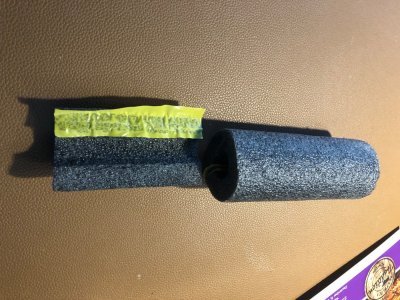
Great advice from all. As far as sanding I use a variety of sizes of cheap pipe foam insulation. Works for me.