
• SUBSCRIBE TO SHIPS IN SCALE TODAY!

    The beloved Ships in Scale Magazine is back and charting a new course for 2026!
    Discover new skills, new techniques, and new inspirations in every issue.

    NOTE THAT OUR NEXT ISSUE WILL BE MARCH/APRIL 2026
  • Win a Free Custom Engraved Brass Coin!!!
    As a way to introduce our brass coins to the community, we will raffle off a free coin during the month of August. Follow link ABOVE for instructions for entering.

Lowell Grand Banks Dory by JacquesCousteau, 1:24, Model Shipways

Joined
Nov 13, 2025
Messages
147
Points
113

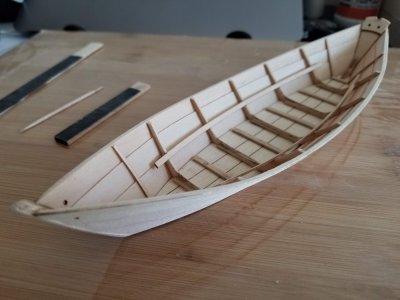
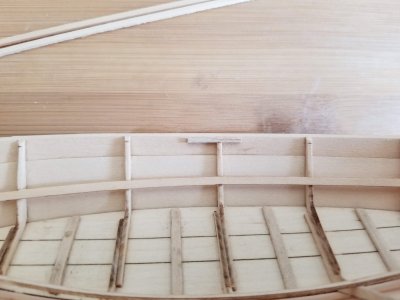
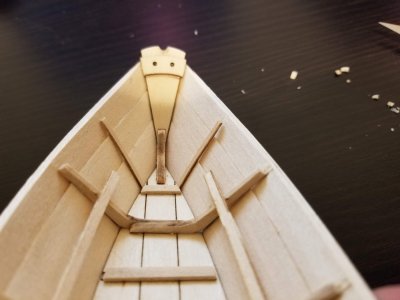
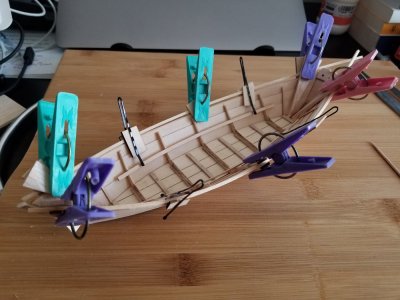
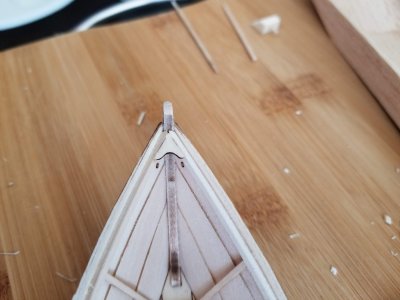
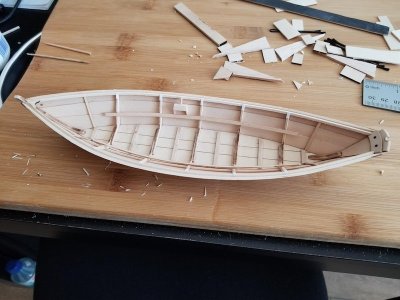
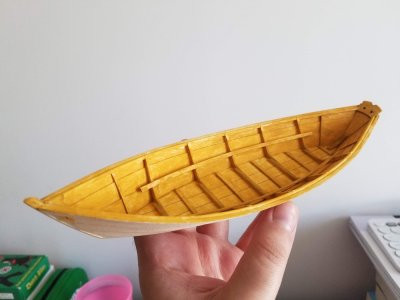
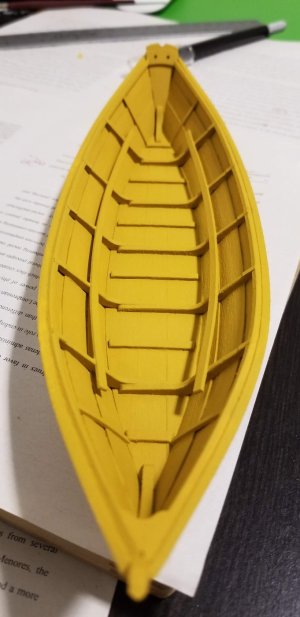
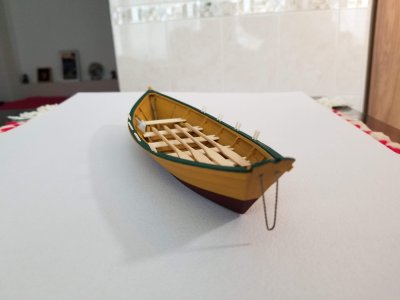
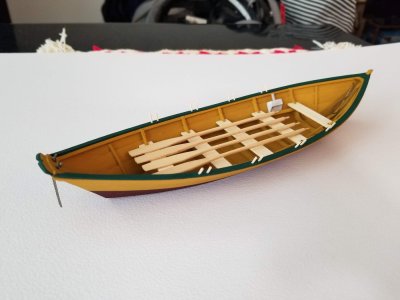
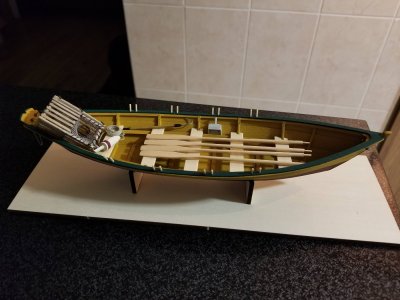
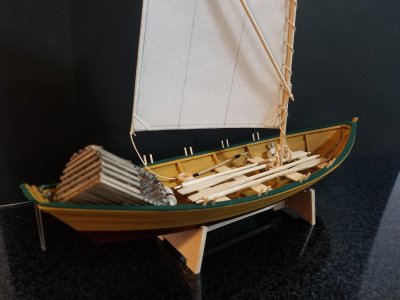
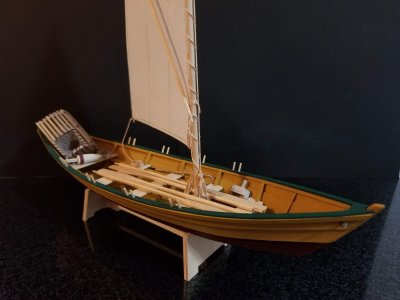
I've been meaning to repost my old build logs that were lost in the MSW crash, but haven't gotten around to adding many of them yet. This was my first build. The log may be shortened a bit compared to the original. As will be seen, I kitbashed this model a bit and had fun with the build. I found this to be an excellent introduction to wooden ship modeling, and highly recommend the kit to anyone interested.

_____________________________________________

Originally Posted 29 May 2023

Hi, this is my first post. I recently started on my first build, and thought I'd share my experience. Feedback and suggestions are welcome, I look forward to learning a lot here!

Although I whittled a few ship models when I was young, my building skills languished over the years. Recently, though, a drawing class made me remember how much I enjoy making things by hand. I was also inspired by a visit to the impressive collections of the Barcelona Maritime Museum, including the many traditional fishing vessels there. Hopefully I'll eventually be able to make a llaud like the ones I saw in Barcelona, but a smaller fishing boat sounded like a better first project. After coming across the forum and reading a lot of build guides, I decided the Lowell Grand Banks Dory from Model Shipways was an ideal starting point.

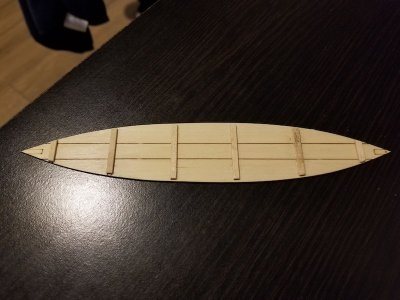
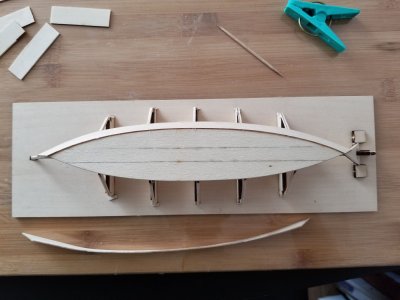
Once I scraped together some basic tools (which was trickier than I thought, most of the hardware stores near me only have tools for full-scale construction), I began by constructing the bottom. First I glued together the bottom planks, then cut the cleats to size and attached them. I had a bit of trouble with one, in particular, which came unstuck repeatedly after I tried to use a wet brush to remove excess glue (as suggested in the instructions). I eventually got it reattached, but was wary of using the brush again. As a result, there was a lot of residue left when it dried. I was able to scrape it off with my knife, but I realized that, for the future, it would be easier to remove excess glue before it dries. Maybe I just need to use less water or a smaller brush; for now, I've had some success with a toothpick.
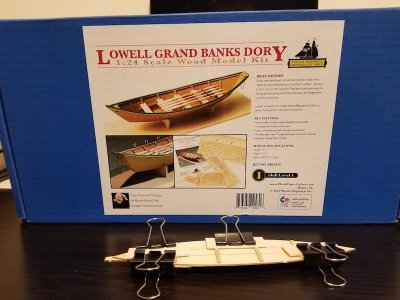
20230527_180528.jpg

20230527_182806.jpg

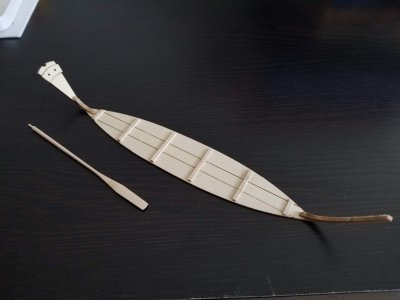
Next, the stem and transom assembly. Without a set square, I had a bit of a hard time making sure that they were at an exactly 90-degree angle where they connect to the bottom planks. But with a lot of trial and error, and being careful not to sand off too much at a time, I think they turned out all right. I also think the holes in the transom might be a little too small for the thread included in the kit (as at least one other build log mentioned). I may have to track down a tiny drill bit to widen them, or just find a thinner thread. In either case, I think that can wait a bit, and it's not a big problem.
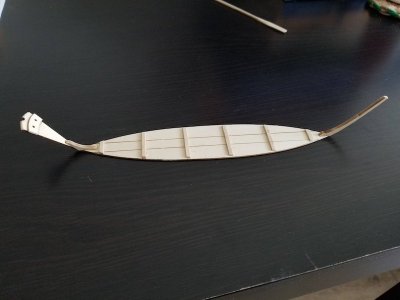
20230528_101713.jpg

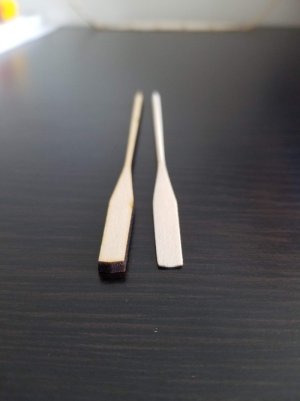
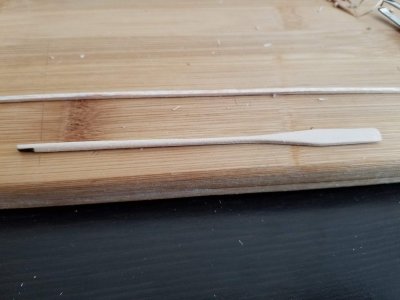
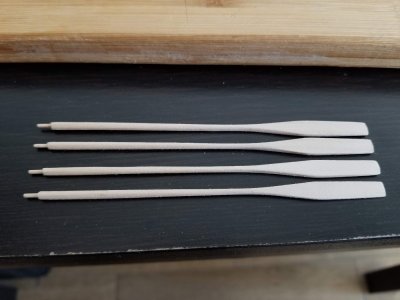
While waiting for glue to dry, I got started on shaping an oar. Originally I thought I would just sand the blade, but there's quite a bit to remove! (Photos include an unfinished oar for comparison). I whittled both sides down a bit, and finished with (still a lot of) sanding. I accidentally started cutting too deep on one side, but stopped the cut before it went too far, and was able to mostly smooth it with sanding. I think the imperfection will be covered by painting, and at worst, I can just glue the oar imperfection-side down at the very end and it won't be visible. Shaping the rest of the oar was a lot of fun. It's perhaps a little more oval than round in cross section, and if I really pay attention I can see that the blade doesn't taper exactly symmetrically, but I think it works for now. The kit comes with an extra oar, so maybe I'll do a better job on the next ones.
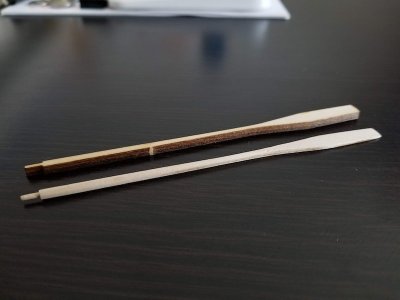
20230528_101601.jpg

20230528_101633.jpg

20230528_101832.jpg

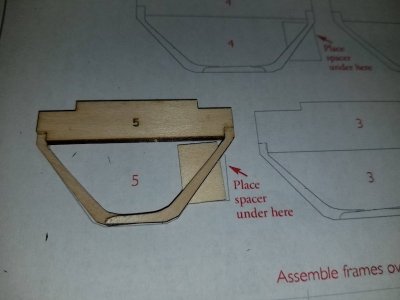
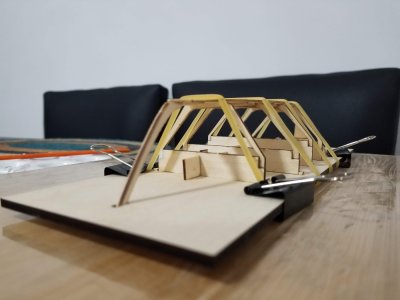
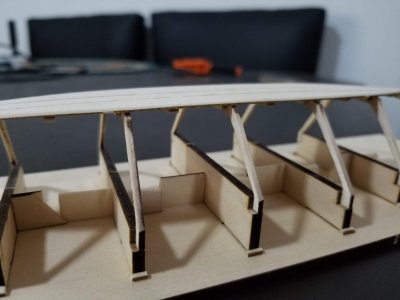
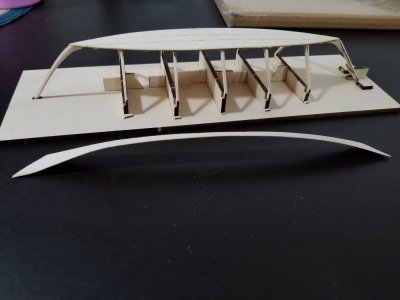
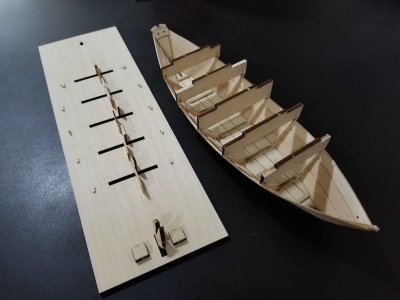
Next, I curved the bottom (which went ok, it didn't retain the curve as well as I thought, maybe because it was rainy and humid here) and started building the frames. They're coming together pretty well so far. I have noticed some very small discrepancies between the diagrams and how the parts fit together, but the difference is minimal. In any case, I'll be sanding the exterior edges later for planking, which should fix any issues.
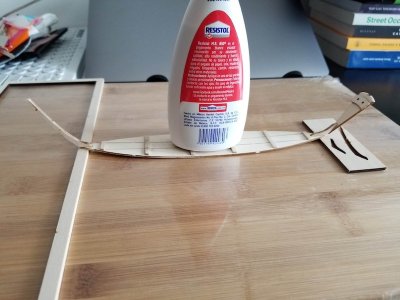
20230528_102407.jpg

20230528_191622.jpg

Overall, I'm having a great time with this. I'm impressed by the kit, which is very well-made, and the instructions are clear and helpful. Feel free to let me know if I'm making any terrible mistakes that will come back to bite me!

______________________________________________________________________

[Unfortunately, my method of saving my build logs by clicking "print-save to pdf" turned out to cut off some of the text, so there are parts where I'm unsure of what I actually said. I then posted about finishing making the frames and the sanding stick, following the instructions in the kit. I found that the moisture from gluing the latter together pushed the stick into a curve, which I tried to correct by weighting with a glue bottle.]
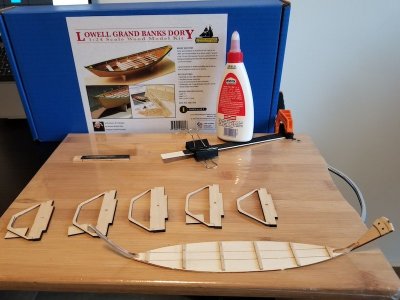
20230529_183126.jpg

While things were drying, I also made a second oar. This time I didn't cut too deep and I'm pleased with how it turned out, it looks pretty close to the first one.
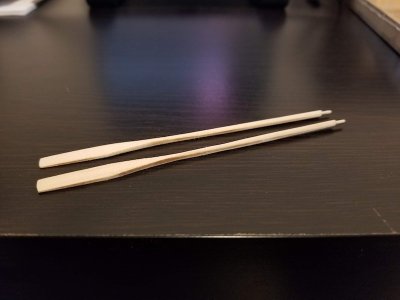
20230529_190928.jpg

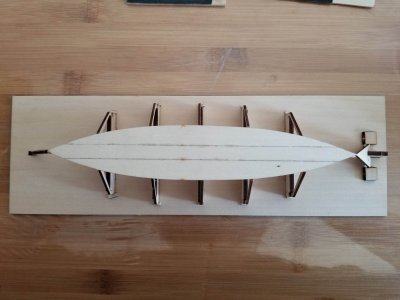
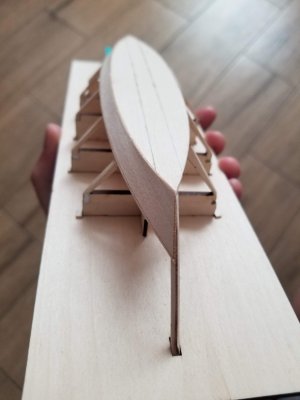
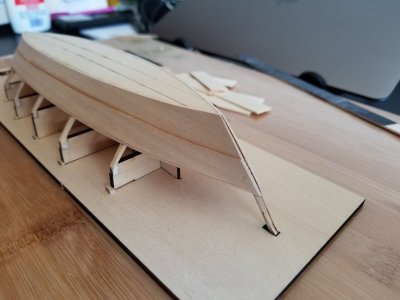
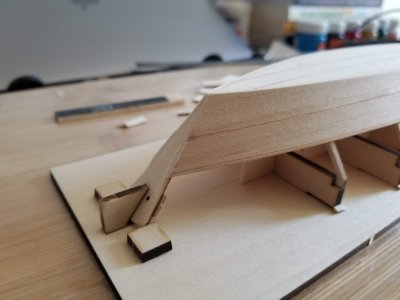
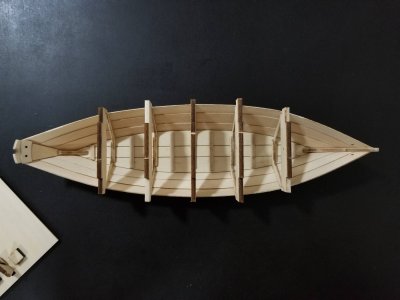
Once the frames dried, I put them on the building board. I couldn't resist taking a look at how it will be with the bottom attached (although of course I haven't glued anything yet). I like the way it's looking so far.
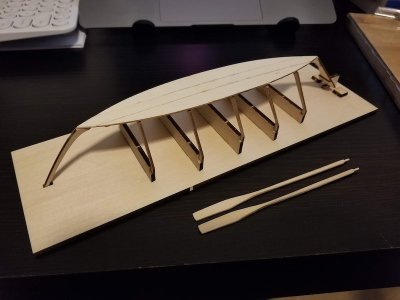
20230529_191420.jpg

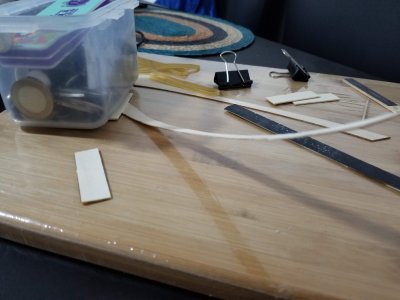
Finally, I noticed there was a bit of wiggle room to the sides of the frames on the building board, and they weren't necessarily standing perfectly upright. To get them as close to 90 degrees as possible, I used the square end of a metal ruler to hold each frame straight, then glued a squared-off bit of scrap to the board pressing the frame a little from the other side. Then I removed the ruler, let it dry, then glued another bit of scrap to the other side (see below). Using thin pieces of scrap wood made it easy to cut them, but probably less accurate than a thicker piece of wood. In any case, there's very little wiggle room now.

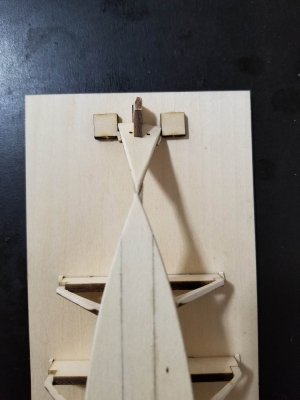
As for the side-to-side gap, first I measured and marked the midpoint on each frame. Then I started to measure to the midpoint of each frame slot, but I realized that the stem slot is slightly off-center on the board (just over 1/16th inch). So instead I marked a straight line from the middle of the stem slot to the middle of the transom holder slot, and used that to make sure the frames were centered. To prevent them from moving when I sand the bevel, I then glued a tiny bit of scrap wood to each side of the frame.
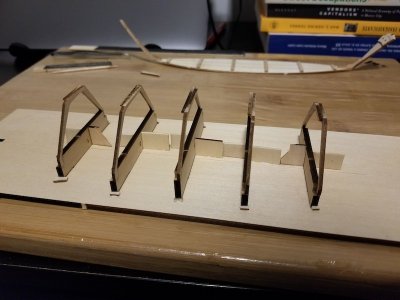
20230529_220036.jpg

With any luck, tomorrow I'll bevel the frames and attach the bottom.
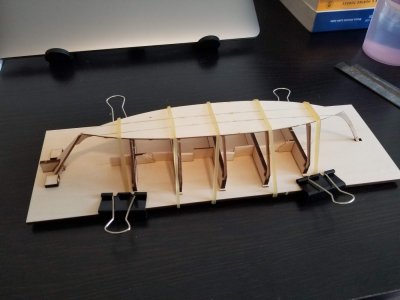
 
Originally posted 1 June 2023

I've been a bit busy with work lately, but I was able to bevel the frames with the sanding stick and attach the bottom. First, I realized that the number 4 frame was sticking up a bit higher than the rest--the 3 frame in the middle should be the highest. This is probably in part due to minor differences between how I glued the frames together. I was able to sand a little off the top of the frame spacer and make it sit at the right height, though.
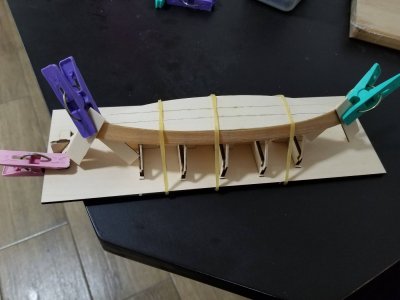
Beveling the frames was a little tricky. The instructions say to sand three at a time, but even with 220 grain sandpaper and a light touch, the frames kept popping out of the building board. I had an easier time sanding two at a time while lightly holding the frames in place with my fingers. It took a long time, but eventually the bevel looked good in test fittings.

After that, gluing on the bottom was a breeze. I used a number of rubber bands to hold it in place once I had it centered.
20230531_080155.jpg

Thanks to the advice earlier to use a damp instead of a sopping wet brush, I was able to clean off the excess glue pretty well.
20230531_080452.jpg

One slight issue: as noted above, I found that the stem slot on the building board is very slightly off-center by 1/16th of an inch. As a result, the frames are ever so slightly off from 90 degrees to the keel line (if it had a keel). I don't think it's much of an issue though, every wooden boat is unique anyways. (And it's not like I had the tools to make a new building board).
20230601_091022.jpg

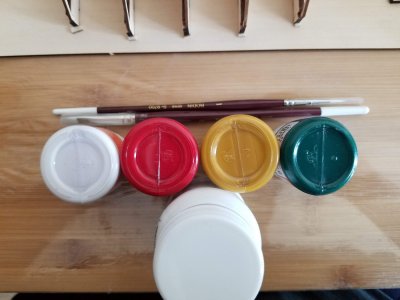
I was also able to stop by the craft store to pick up some better brushes, primer, and a few paints. While I like the classic look of ochre with green trim, I've seen a few dories with a red bottom which sounds like it might be a nice touch, and I think I want to paint the oars and thwarts a cream color (which I'll mix from the white and ochre).
20230601_090929.jpg

Next step: beveling the sides of the frames and preparing the garboards.

_____________________________________________________________

Original Post: 2 June 2023

Having never curved wood before, I was more concerned about the following steps than the rest of the build. Although there were some troubled waters to get through, things are still going well.

First, beveling the frames. This was pretty easy with the long, flexible sanding stick used earlier to bevel the frames for the bottom. The frames turned out pretty well, as far as I could tell.
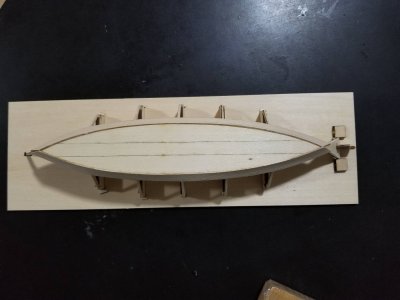
20230601_173044.jpg

20230601_173107.jpg

The stem was also pretty straightforward to bevel, and I made sure to follow the instructions and bevel until the char narrowed to a thin line.
20230601_173009.jpg

The transom was slightly trickier to bevel, and the transom holder got a little sanded as well, but it turned out pretty well.
20230601_173117.jpg

Next up, beveling the garboards. This part was a little confusing to me in the instructions, and a bit difficult to do in practice. It was hard to get the angle right. I've seen some other builds where people built a jig to keep the angle consistent, but I didn't have the tools for that. Only the bow and stern ends were supposed to be beveled to a complete 45-degree angle (for the rolling bevel, which I only understood once I saw other build logs). But given the thinness of the wood and my inexperience, I accidentally beveled the rest of it in nearly the same way. I was able to fix it a little by sanding down the edge very slightly, so it had a flat part and wasn't just pointy (except, again, at the ends with the rolling bevel), and fixing the bevel angle so it was closer to how it should be. Both garboards received the same treatment and turned out equal, at least, so the error shouldn't throw things off too badly.
20230601_191401.jpg

Then came the part I was really dreading: curving the garboards. I'd never curved wood before except for the bottom in an earlier step, which had worked well enough but wasn't all that curved. I was especially worried about cracking the wood from the pressure--would it hold?

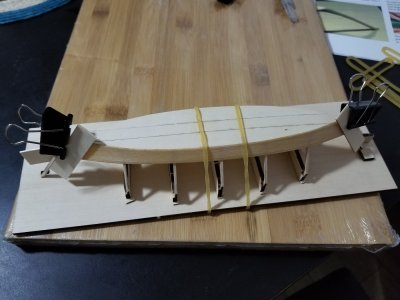
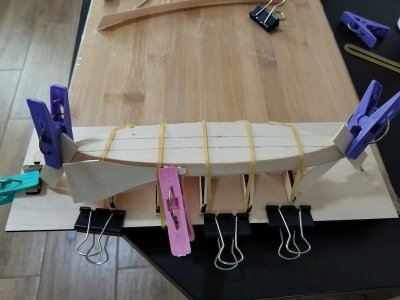
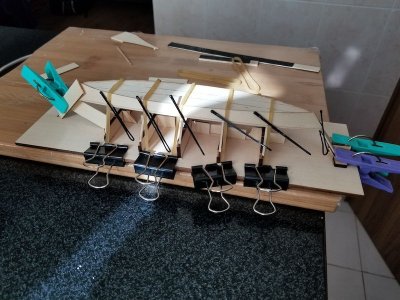
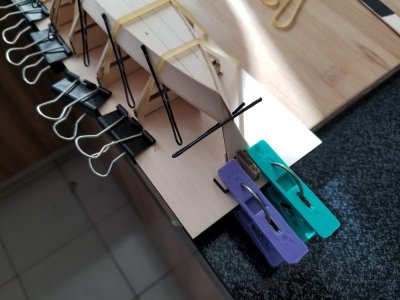
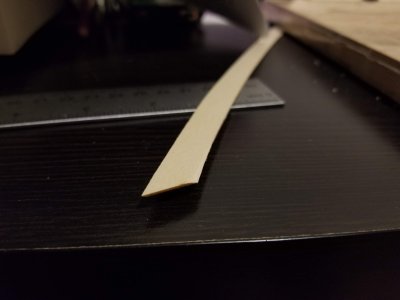
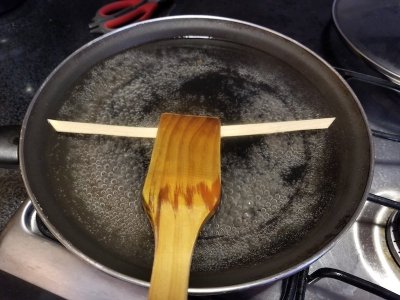
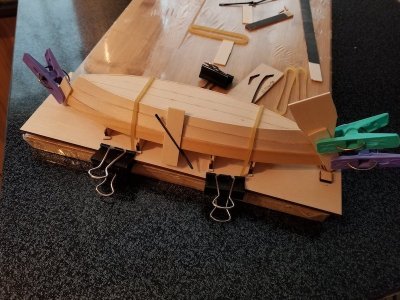
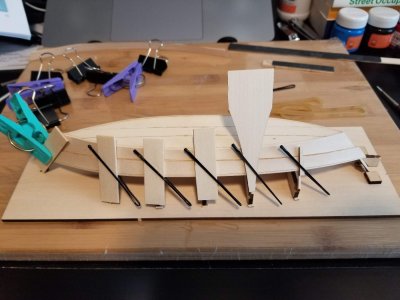
After a dry test fitting, in which I noticed that the wood wanted to bend out away from the middle frames, I soaked the first garboard in boiling water for 5 minutes. Then I patted it dry and put it in place with binder clips (making sure to use pieces of scrap wood to keep the clips from damaging the garboard itself) and some rubber bands. I was amazed at how flexible the wood was after being boiled.
20230601_205303.jpg

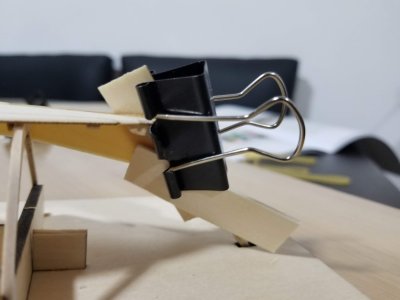
The stem was relatively easy to clip, as seen here.
20230601_205359.jpg

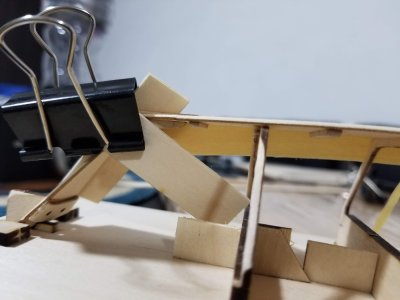
The transom was a bit harder to clip onto, and I had to be a bit creative to figure out the right angle.
20230601_205407.jpg

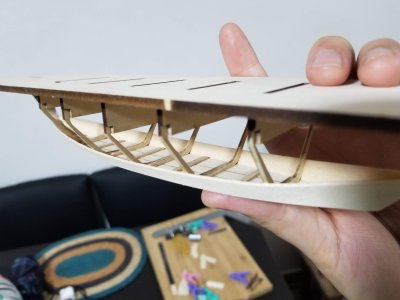
After letting it dry overnight, I took it out of the clamps to see how it was. At first, I was thrilled--there was no cracking and it retained the curve well.
20230602_085344.jpg

But then I noticed two issues. First, the stem had been clamped a little too far back, it seemed. So instead of a smooth single curve, the bow curved back out again (visible on the left in the photo).
20230602_085356.jpg

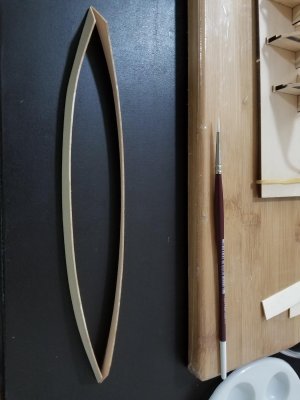
Thankfully, I knew from other build logs that this was a common issue, and I was able to fix it by wetting the outside of the wood and putting the bow end under a weight. At first the weight was a little too big and too far back, so it was flattening the board--not what I wanted after curving it overnight!-- but I was able to adjust. I also propped a toothpick under the garboard to help it retain the curve [after taking the photo below].
20230602_085631.jpg

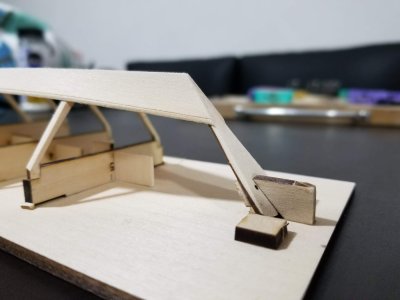
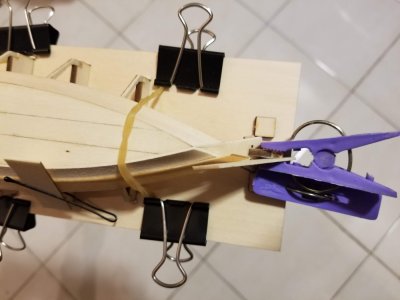
Then I noticed the second, more serious issue. My clamping on the transom had been enough pressure to warp it so it was now twisted at an angle. It also didn't want to stay in place between the blocks.
20230602_090034.jpg

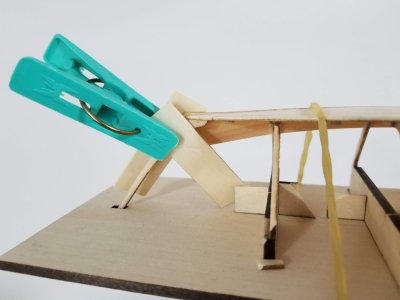
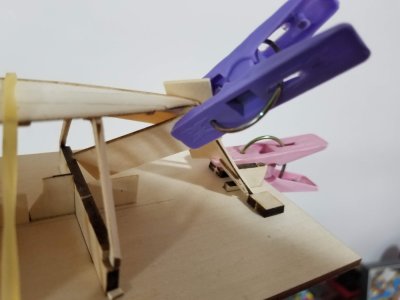
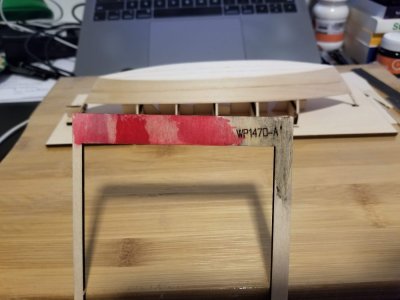
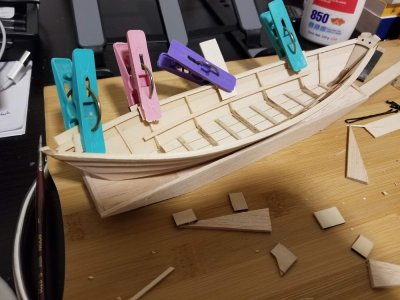
Checking the transom revealed that not all was lost, though. The joints were still solid, and the transom itself was still straight--whatever had twisted appeared to be in the stern knee. After some consideration, I decided to 1) switch to lighter clamps (plastic clothespins) that wouldn't exert so much pressure, and 2) lightly moisten the knee before clamping the other garboard in the same way in hopes that it would twist back the right way (using a clip on the building board to also pressure the transom back into place). Maybe a little risky, but if it worsened, I hadn't yet attached the garboards and I would still be able to make a new stern knee and reattach the transom.

Thankfully, the second garboard went much better.
20230602_091633.jpg

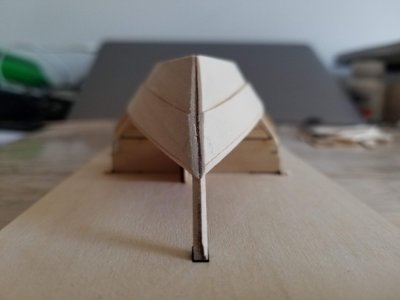
I was more careful at the stem and it didn't curve back the wrong way--a smooth curve the whole way.
20230602_093442.jpg

The transom--once again tricky to clamp--also ended up (almost) back where it should be (and, as will be seen, was completely corrected during the following step).
20230602_093359.jpg

This time I let it dry a bit over three hours instead of overnight, and I noticed that it retained its curve just about as well as the other garboard with its overnight drying. Good to know for the future!
20230602_131127.jpg

Next up, attaching the garboards.
 
Originally Posted 4 June 2023

Although I was nervous about attaching them, I'm very pleased with how the garboards turned out!

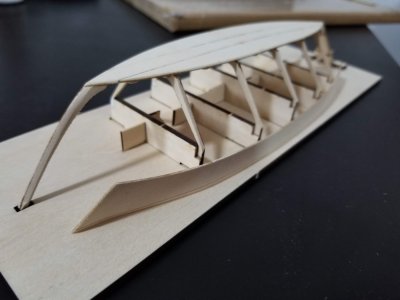
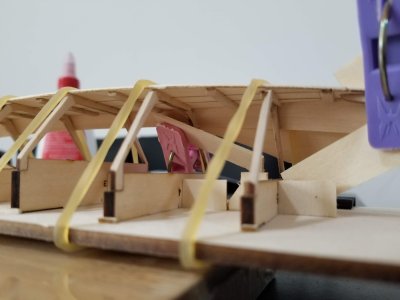
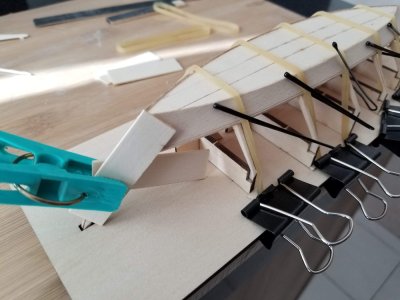
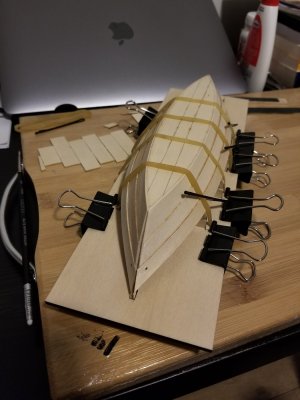
The instructions suggest attaching everything at once using a mix of glue and water, but I saw a lot of other build logs that said they needed undiluted glue to get things to stick. I started applying the glue at the bow, then realized that, at the slow speed I was applying it, the glue at the stem would be dry by the time I finished at the transom. So I attached and clamped it at the stem and then glued bit by bit, working my way aft. This worked ok, except that it was hard to get glue on the frames as there wasn't much of a gap. I placed rubber bands as I went to help hold everything in place. After gluing the garboard to the transom, I noticed that one of the frames wasn't making a very solid connection to the garboard. I quickly applied some glue via brush from the opposite side, then clamped the pieces together.
20230602_133925.jpg

As can be seen, I was unprepared for this, so the only scrap wood I had on hand was a bit unwieldy and didn't fit great, but it worked out in the end. Then, I ran some lightly diluted glue along the joints as the instructions suggest, following up with a damp brush to clean any excess.
20230602_133826.jpg

Once it had dried for a few hours, I removed the clamps and rubber bands.
20230602_161342.jpg

I was happy with how it turned out!
20230602_161728.jpg

Next, the other garboard. Once again, I glued bit by bit as I went, and followed the same process with running diluted glue along the joints afterward cleaning the excess. (This will probably be trickier to do on the interior once there is less space between the boards and the building board). This time I used bobby pins alongside the rubber bands to lightly hold the board to the frames.
20230602_165149.jpg

I did forget to do a test fit, though. While I already knew that the board itself was fine, I only realized after I had started gluing that I had no idea how I would clamp it now that the other garboard was in the way! But it didn't end up being a problem. After holding it with my hands for a few minutes, it was already set, or at least enough for me to improvise a way to clamp it at the bow (more as a precaution than anything). I ended up putting the clamp on the stem below the board, but using a piece of scrap wood so the pressure was transmitted up to the board itself.
20230602_165240.jpg

The stern joint also solidified with just a few minutes of finger pressure. I couldn't figure out how to clamp anything back there because of the angle, so I ended up just placing another bobby pin to make sure the tip didn't curl up from the moisture. (I also uses clamps on the building board while attaching both boards to fully correct the twisted transom I mentioned in the previous post).
20230602_165228.jpg

After everything dried, I checked how it looked.
20230602_192353.jpg

I was reasonably happy with the fit, but thought it looked a bit uneven at the transom. (Taking this photo made me realize that I had somehow lightly dented the transom, but I just put a bit of water on the spot and it corrected itself).
20230602_192526.jpg

Then I realized: I still had to sand it! Once sanded, everything looked better.
20230602_195919.jpg


I can live with the very slight unevenness at the bow (which is less noticeable to the eye than to the camera).
20230602_192609.jpg

And I think the transom came out well.
20230602_200312.jpg

I'm also pleased with how the frames are connecting to the boards on the inside.
20230602_200340.jpg

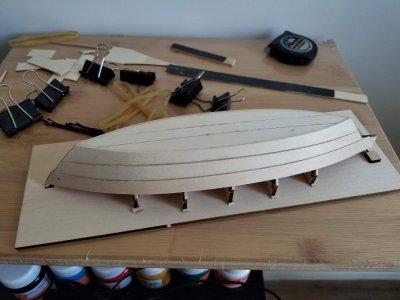
Overall, I'm happy with how it's turning out, and I'm glad that it looks more like a boat now that it has sides.
 
Originally Posted 5 June 2023

Broad planks have been attached with little incident, following a similar process to the garboards. Only a few things to note.
20230605_072930.jpg

First, I did a better job beveling the boards this time. The instructions' drawing of the inside rolling bevel isn't all that clear, but checking other build logs clarified things.
20230603_214253.jpg

(It's hard to get a good photo of the bevels, they're so small my phone can't focus well.)

Second, the planks have gotten longer and I now have trouble fitting them into the pan I was using for soaking. I had to bend the wood a bit and move it from side to side to make sure the ends got soaked. In the future, I think I'll just have to pour boiling water into a longer baking dish, although I worry about the temperature dropping too much without a burner.
20230604_091416.jpg

Third, when bending the plank, I had to get creative with clamping at the stern, as the transom really gets in the way. I ended up clamping scrap wood to the transom holder (which, per the instructions, isn't glued in) and running it up to pressure the plank against the transom, using another clamp on the building board to make sure it was tight. Not perfect--the pressure was highest at the edge of the plank--but enough for curving the plank.
20230603_223333.jpg

Fourth, it was a little tricky to get the plank to stick well to the frames this time, given that the plank is propped up a bit by its slight overlap with the garboard. I used bobby pins on every frame. The ends were set with finger pressure, and the clamp at the bow is more precaution than anything (as I didn't want it popping off while I worked my way aft).
20230604_165341.jpg

Finally, I'm happy with how it turned out overall. But one issue: it turns out that the laser cut lines marking the beveling weren't quite even, one marks a slightly larger space than the other, as can be seen by comparing them at the bow.
20230605_073018.jpg

My main concern is that this will throw off the sheer planks, so I'll have to keep this in mind when fitting them. I should have double-checked when I beveled the planks earlier. I might be able to lightly sand back the port bevel so it's more even with the starboard.

(Note: sanding the planks even ended up taking a bit more off the port plank as it was glued slightly further forward than the starboard one. The discrepancy will be covered by the false stem, though.)
20230605_072938.jpg

On to the sheer planks!

_____________________________________________

Originally Posted 7 June 2023

I've been busy and haven't done much lately, but the sheer planks are currently being molded into shape.
20230607_091300.jpg

Meanwhile, I did a bit of a test with paint and sealer/varnish (as the bottle I bought is labeled). After sealing a bit of scrap wood, I did a paint coat of varying consistencies over the sealed and unsealed part. (Left to right: unsealed with watery red coat, sealed with thick red coat, sealed with thin red coat, sealed with medium-consistency red coat). I noticed that the paint soaked quite a ways into the unsealed wood, so I'll definitely seal it before I paint. Then I tried experimenting with a light black wash (a technique I've never tried before) over some of the painted parts and some parts that were just sealed. At first the wash was much too dark (right side of the scrap piece) but I added more water and the lighter wash added a nice touch (between the red and the dark wash). I'm still not sure if I want to do the wash with the finished boat, but it's good to have the option. I'll just remember to keep it very light as I can always add another coat if necessary I also might just seal the thwarts and oars rather than paint them.
20230605_191404.jpg

__________________________________________________

Originally Posted 8 June 2023

I finished the sheer planks today!
20230608_001239.jpg
20230608_085220.jpg

After a bit of trimming, I released the frames from the building board.
20230608_094327.jpg

20230608_094347.jpg

The bow turned out pretty even. The port side is very slightly higher, but I think it can be easily dealt with by a little sanding, especially as the bottoms of the plank look pretty even. (And visual discrepancies on the stem will be covered by the false stem).
20230608_095015.jpg

The stern concerns me more. There was a bit of overhang that made it hard to properly judge height, and the starboard side ended up a good bit lower than the port. Sanding it even might not be the best option as the bottom of the plank is also uneven.
20230608_095037.jpg

So, I'm going to consider whether I should try to undo the starboard plank at the stern with alcohol to adjust.
 
Originally Posted 9 June 2023

After a lot of thought, I decided to re-do the upper strake at the transom and the aftmost frame. It took a lot of alcohol brushed om the joints, and a lot of patience, but eventually I was able to slide the knife in and release the plank from the transom. Then I moved forward bit by bit, applying alcohol to soften the glue (in the process accidentally spilling rubbing alcohol all over the workstation, although thankfully not the model).

20230608_195049.thumb.jpg.746b9517dc133f9febf63855eb661913.jpg


When it came time to re-attach it, I realized that there was a problem. While I hadn't sanded the plank fully flush with the transom before detaching it, I hadn't left as much room as I thought, and it didn't seem like it would be long enough on the bottom to fully reach the end of the transom.

20230608_200342.thumb.jpg.8fd99155bf5b6862f8dbfd0421cc3761.jpg


I gave it some thought--better to have a too-low plank, or an issue at the stern? I decided to fix the plank height at the cost of a bit of a divot where the stern plank meets the transom. After re-gluing it, I was able to sand the transom down a good bit to limit the problem. It won't be very noticeable, but is visible.

20230609_175307.thumb.jpg.5c56f35fe76fdf69836d686bca656ef0.jpg


After that, I popped the dory off the building board and went to work with a tiny saw blade attachment for the knife to saw off the frame assembly. It took a while, but it finally came off.

20230609_002151.thumb.jpg.88df7257911ec714375e4edaaed6929a.jpg


20230609_175243.thumb.jpg.109bc565a59e5c0857e6a3966fdf0fc6.jpg


Although the tops of the frames will be removed in a later step, they still need to be flush with the plank. Sanding them down was very slow, so I ended up carefully using the knife to whittle them down, which worked well. I also noted that I had been a bit messy with the glue way back when I attached the bottom. Good thing I'll be painting this!
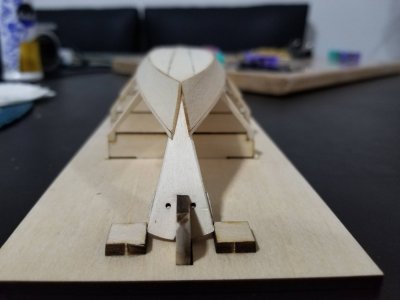
20230609_184411.jpg.2ea697a4ed19920c656136a1e16ee815.jpg


As other build logs have noted, the instructions are oddly vague about the false stem. I decided to use the leftover wood from the bottom cleats. I started trying to sand it into a triangular shape, but it was difficult, so I whittled it a bit before sanding.

20230609_184434.thumb.jpg.46af41e9f887619cbb48999a7f12daa7.jpg


Wetting the outside edge then attaching it was pretty easy (I just used finger pressure while the glue cured). I then cut off the excess, which I left on for ease of handling while shaping it, after it dried. (It still needs to be cut and sanded in this photo).

20230609_185133.thumb.jpg.c308c1d3b0bf3b4d0baac12fe29b1dfb.jpg


I also noticed that I had been a little overzealous in beveling the stem and there would be divots at the bottom of the joint just above the planks. Following a technique I've seen in other builds, I filled them with a bit of sawdust mixed with a tiny amount of glue, applied with a toothpick. Unfortunately, this turned a bit gummy when I sanded it--maybe it needed more time. (It still needs to be sanded in this photo).

20230609_203258.thumb.jpg.d13b67c9d0fdd85af41b2d1af4097aca.jpg


I forgot to take pictures of the next steps while under construction. The side cleats went in pretty easily. I lightly beveled the end that is propped at the cleat so it would have a more solid connection there. Cutting them to size after drying was straightforward. The risers were a little more difficult, but I got them lined up with the markings on the frame.

20230609_203233.jpg.c6a935069bc87def2931375bef3e773b.jpg


20230609_233157.thumb.jpg.dfb13bfdb8f2c6662ce784cf58d69aa9.jpg


20230609_233229.jpg.541ae354c5a41dea418e60acda41a2ed.jpg


Finally, I sanded the false stem to fully shape it. This was a little tricky, as the width varied across the bow and I didn't want to sand inti the overlapping planks at the stem. In hindsight, I may have sanded slightly more than I should have off the top, but I think I can live with it.

20230609_233140.thumb.jpg.a31fccbfc57e70ff98af233516839aad.jpg


Overall, I'm really happy with how this kit is coming together, and I'm learning a lot.

____________________________________________________________________

Originally Posted 10 June 2023

Attaching the bands took a lot of clamps, but was otherwise pretty straightforward. After rubbing some water on the outside edge to help them bend, I attached them at the bow first, held them in place with my fingers for a few minutes, then clamped and moved back, gluing and clamping as I went. I noticed that the instructions don't specify how the bands should look at the bow. I spent a few minutes googling and found that quite a few have the band starting at the back edge of the stem (or rather, the false stem), so that's what I went with.

20230610_143211(1).thumb.jpg.6c9f0b1cb1e52b14a7fbc4cbabb6fa7c.jpg


Next I have to sand the tops of the planks/bands level. I'm considering whether to first cut off the tops of the frames, which will have to be removed in the next step to fit the wales, as removing the top of the frames seems like it would make sanding the planks/bands level easier.

Also, I'm not sure if it's better to ask this question here or in one of the other threads, but here goes: As I get closer to the end of this kit, there are a few things I'm thinking about doing. First, as a lot of other build logs mention, the included rope (1.5mm diameter jewelry nylon) looks a bit too thick, so I'm looking to replace it. How do you find a line of the right thickness for the scale? Do you just eyeball it? In a craft shop, I saw this, which looked a bit thinner than what the kit comes with, but it's hard to tell if it's still too thick or not, especially as they don't bother to state the diameter. https:// www.hilosomega.com.mx/product-page/espiga-no-18

(Also, they only sell it in much larger quantities than I need--would something like this be useful for other models?). [NOTE: Although I ultimately made use of the threads I could find here for this build, for future builds I would use Ropes of Scale rope].

Relatedly, a lot of the other builds have included personalized touches, like the addition of bailers, buckets, nets, lobster traps, etc. I'd be interested in trying something like that, both to add a nice touch to the dory and to build experience with building very small accoutrements (which will be useful for a planned upcoming build, more on that to come...). Where do people find sizing information to make sure they're to scale? I would hate to put in a lot of work building something and then ruin it by sticking a very-out-of-scale bucket or something in it.

Thanks for the suggestions!
 
After attaching the bands, the next step was to bevel the tops of the planks. I was worried that the tops of the frames might catch on the sanding stick, and they were to be cut down anyway in a subsequent step to make way for the gunwales, so I carefully cut them down a little. Sanding was straightforward and I went until there was just the faintest char line left.
20230611_103632.jpg

Now it was time to cut down the frames, properly this time, to clear space for the gunwales. It was tricky to tell how far to cut them, so I used a 1/16 square balsa stringer I had lying around to mark it.
20230611_113952.jpg

The instructions recommend cutting the frames with a chisel blade. I just have an exacto blade, so I was forced to make do. A chisel would be easier though, and on a couple of cuts I sliced a little into the planking. Thankfully it will be covered by the gunwale and paint. Also, some of the frames and side cleats came loose at the top--given the angle of the planks caused by the strake overlaps, they were most strongly attached right where I was cutting. Gluing them down again added a bit of time.
20230611_220809.jpg

A number of other build logs mentioned the gunwales snapping while trying to fit them, so I soaked them in hot water and curved them before fitting them. Even with scrap wood in place, this dented the gunwales in a few places, but it was nothing a little bit of water couldn't fix.
20230612_080615.jpg

Trimming the ends was a bit tricky. I wish the instructions had shown a picture of what they were supposed to look like, or what they meant by adding an "undercut". I was able to shape them with patient trimming until they fit. Basically, they should lie flush with the stem and transom.
20230613_001422.jpg

At this point I also had to trim a couple frames down a little more so the gunwale took a nice smooth curve when in place. I started gluing it at the bow and worked my way aft, using clips as I went. (At this point, the hull of the trajinera--a simply-constructed but vibrantly-decorated barge-like vessel that I'm scratch-building--served as an effective stand. Build log to come, provided I don't make a mess of it in the next few steps, which is entirely possible).
20230613_003856.jpg

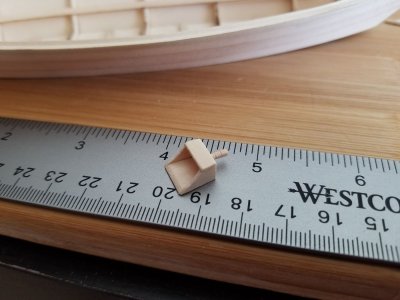
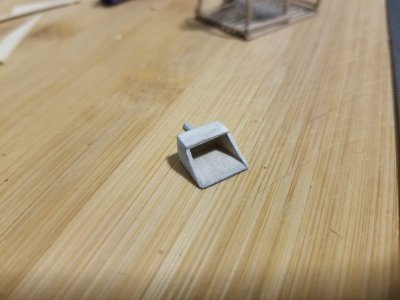
With the gunwale drying, I turned my attention to a small, scratch-built fitting: a bailer. I've seen similar ones in some other build logs, and wanted to give it a try, particularly as the trajinera will require building quite a few scale chairs and other fittings and I need the practice working with such small pieces. I based the bailer on a few I found online (here: https://www.worthpoint.com/worthopedia/antique-wooden-watermens-boat-bailer-old-paint, and ones built by The Dory Shop in Lunenburg, Nova Scotia) and by looking over other builds' versions.
20230613_083331.jpg

I'm pretty happy with how it turned out, but learned a few things that I'll definitely keep in mind. First, I made the rookie mistake of forgetting to take into account the thickness of the material (I used 1/32-inch basswood scrap, except the handle which is a toothpick). As a result, it ended up slightly larger than I planned. Thankfully, the bailer dimensions I had planned on were an inch or so smaller than some of the other bailers I saw, so it still works for the scale as a slightly larger but still normal-sized one, but it's a good reminder for me to make sure I'm considering the material when I scratch-build.

Second, I realized too late that gluing and painting something so small would have been easier if I had left a piece uncut until later, so as to have a handle. Come to think of it, the handle would have worked nicely for this.

Third, the handle would have been better attached if I had been able to fit it into a hole in the other pieces, making an actual joint instead of just sticking it on with a dab of glue. Unfortunately, this was done out of necessity as I don't have any sort of drill or drillbits.

In any case, next up were the (optional) frame head irons. As others have mentioned, the scale dimensions given in the instructions are much too large. I found that 1/16th by 3/16th of an inch (real, not scale, size) looked best. I had to sand down the number 2 frame a bit to get it even with the gunwale, but after that attaching the irons was simple.
20230613_095046.jpg

Finally, the breast hook. As can be seen, I had to shape this a good bit for the original piece to get it to fit--the little tab on the front was almost entirely removed.
20230613_100236.jpg

I'm happy with how it's going so far, and feel like I've really learned a lot. Looking forward to painting!
20230613_100527.jpg
___________________________________________________

Original Post 15 June 2023

Thank you all for your kind words of encouragement! Painting has been tricky, but I'm making progress.

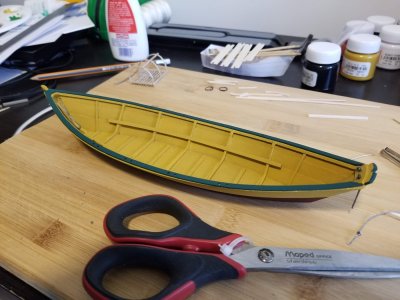
First I applied a clear coat of sealer/varnish, then started on painting. Following the instructions, I painted the interior first. This was actually a lot more frustrating than I expected--it really put the "pain" in "painting". There are so many tiny nooks and crannies that it was incredibly hard to paint. As late as the fourth coat, I was still finding bits I had missed! If I did this build again, I think I would paint the interior before I added the risers, as that would make it at least a little easier. I was also surprised that paint doesn't cover char marks and glue stains as well as I thought. They say the first coat should be patchy and semi-transparent, and by that measure, my first coat was a success!
20230614_075855.jpg

That said, I think I over-thinned the paint for my first few coats. This made it harder to keep from bubbling or from building up in the corners (of which there are many on the interior). It also meant that it still looked patchy after the third coat. Subsequently, I thinned it less. Despite the frustrations, I think the interior turned out pretty well.
20230614_213627.jpg

The exterior, in contrast, has been a million times easier to paint and I'm nearly finished.

Quick question: will scotch, masking, or blue painter's tape work for masking? There are a few details I'd like to add, but I'm worried that using the wrong tape will ruin things.
 
Originally Posted 16 June 2023

Painting the hull has been an adventure, but at least it's done now.

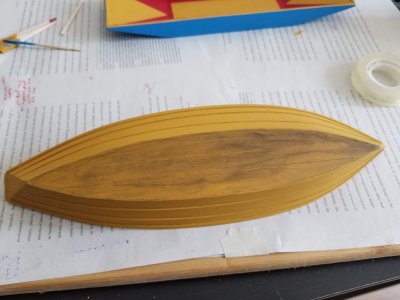
I was planning on painting the bottom red--I know it's not really traditional, but I thought it would add a nice touch. But before painting the bottom, first I wanted to use it to better test a light black wash for weathering (which I mentioned trying out on scrap in an earlier entry). I'm glad I tested it on an area that I would be covering first! It ended up simultaneously too dark and too watery and did not at all look how I wanted it.
20230616_124619.jpg

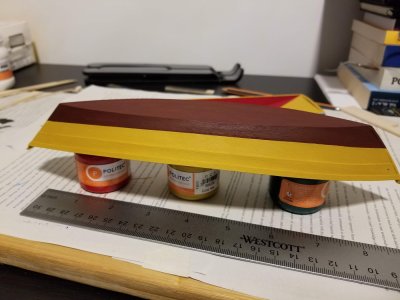
Painting the bottom was a bit trickier than planned, though. I should have followed the advice I got to get Tamiya modeling tape, but scotch tape had worked pretty well for the trajinera I'm building so I figured I would just use that to mark off 1/8 inch above the bottom. Big mistake! While the painted lines on the trajinera were all straight, painting the bottom evenly required a curve to match the rocker. Scotch tape does not curve well. Then I tried using a pencil to lightly draw a flat waterline, but that also didn't go very well--clearly I should have planned better.
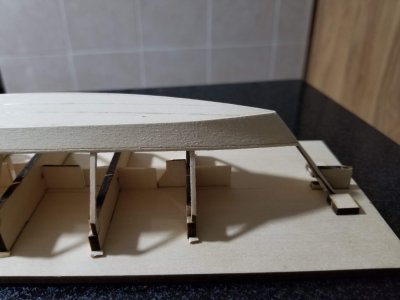
But I'm happy with how it turned out. I decided to just freehand it (except across the transom, I used tape for that) up to the top of the garboard. I thought my red paint was a little light, so I mixed a bit of black to get a sort of zinfandel color that I think worked out well.
20230616_211928.jpg

I can't say I'm really enjoying painting as much as the building, and it doesn't help that I can't really build anything while I'm painting because I don't want to get sawdust all over the drying paint. But I'm definitely learning a lot, especially from mistakes, and I'm looking forward to the last steps and figuring out what to build next.

___________________________________________________________________

Original Post 18 June 2023

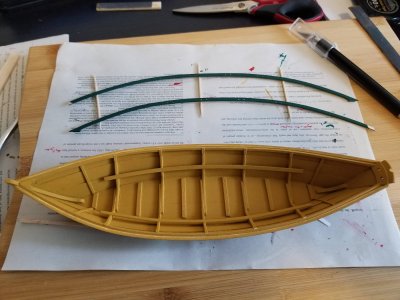
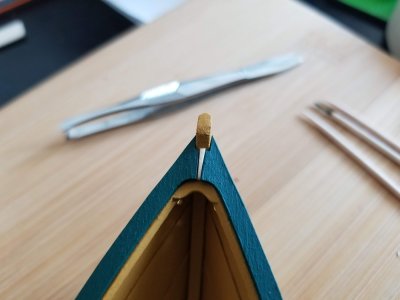
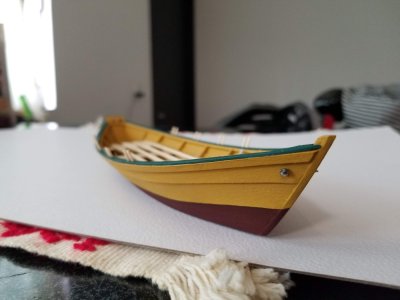
After painting the hull, I moved on to the cap rails, painting them a dark green. Here I should have double-checked the instructions before painting-- the tip on taping the rails down would have made painting a lot easier. Instead I left the very ends, which I knew would be trimmed, unpainted to have something to hold onto. I also scraped and sanded some of the paint off the top of the wales. As can be seen, I also slightly trimmed off the tops of some of the frame irons that I was worried might get in the way. I touched up the paint afterwards.
20230617_150353.jpg

Attaching the cap rails was a slow process of gluing from the bow back. This entailed at times leaving the rail floating a bit. Trimming the end took a few tries and a good bit of sanding, but I eventually got it to more or less fit.
20230618_134302.jpg

There was a small gap between the cap rails just aft of the stem. The instructions suggest using filler, but I don't have any. Instead, I cut a tiny sliver of scrap to size. After a couple tries, I had a good test fitting.... and then had a hard time getting it back out! I was eventually able to flip it up at the fore end with a toothpick and add some glue. Later, I sanded it smooth and painted.
20230618_150747.jpg

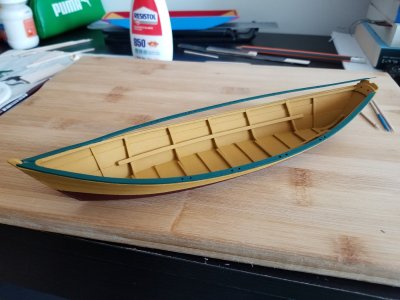
I ultimately wasn't able to fully get the cap rails to strictly follow the inside edge of the gunwale, as the curve they were cut to slightly differed from the shape my hull took, but I think it worked out well enough.
20230618_194459.jpg

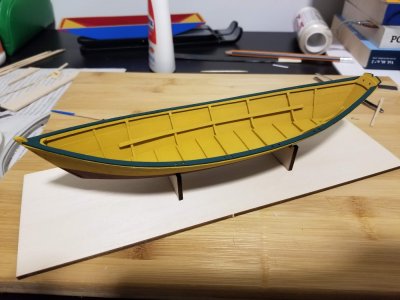
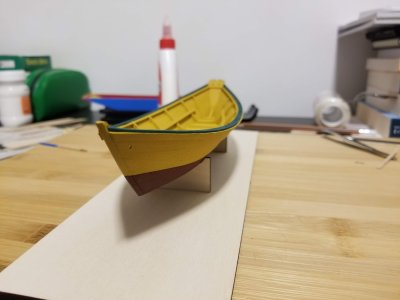
I'm happy with the color combination with the wine-red bottom, too.
20230618_194558.jpg

The end of the build is in sight! Next up, the beckets, which will require re-drilling the transom holes and touching up the paint. Then thwarts, thole pins, oars, and the base, and I'll be finished and on to the next model! After a great deal of thought, and considering my limited space and my wish to learn how to plank, I ultimately decided to go with the Model Shipways Muscongus Lobster Smack, which will undoubtedly be a huge step forward in complexity. [NOTE: The Lobster Smack kit never arrived, so, having learned my lesson about the difficulty of shipping to Mexico, I instead went with a scratch build. I did eventually get my hands on a Lobster Smack kit, which I am currently building.]

______________________________________________

Original Post 22 June 2023

Unfortunately, I haven't made as much progress on the dory as I would like--I was waiting for a pin vise so I could drill out the becket holes, and was busy with the trajinera build (I finally started the build log in the scratch-build section). I'll be traveling next week, so the dory won't be finished for a bit longer.

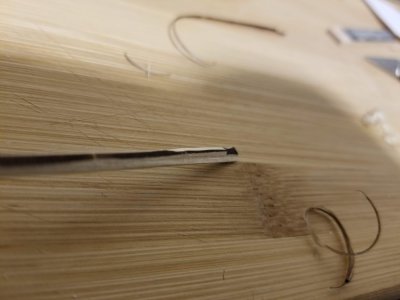
I did find the time to finish the oars, though. I just had one left to shape. Unfortunately my knife blade must be getting dull. While I was carving off an edge, it stopped cutting and started acting as a simple wedge, ripping off a substantial chunk of the oar, cutting far too deeply (as can be kinda seen below).
20230620_210929.jpg

I still had one extra oar, so I wasn't too worried, but as a test, I wanted to see if I could correct the error. I glued the strip back on and let it cure overnight. Then, I very carefully began shaping the oar. After a lot of sanding, I was happy with how it turned out. The split wasn't visible at all.
20230622_093304.jpg

Finally, I gave a final sanding to the other oars. I'll be coating them with a sealer/varnish but mostly leaving them natural, so I needed to get off all the remaining char. Overall I'm happy with how the oars turned out, and I learned A. not to carve with a dull knife, and B. that many errors are correctable with a bit of patience.
20230622_101053.jpg

____________________________________________________________________

Original Post 6 July 2023

Sorry for the long break between posts, I was traveling and finishing the trajinera. I've made good progress recently on the dory, though.

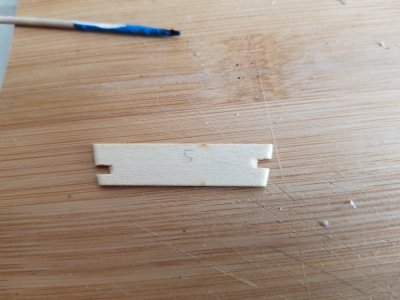
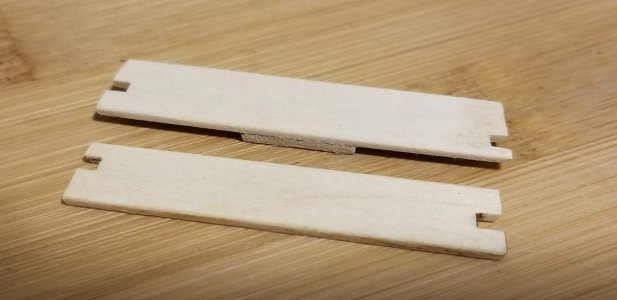
The thwarts required a good bit of shaping to fit, including beveling the side edges and part of the slot (which would have been easier to cut with a small chisel instead of the no. 11 exacto blade I used), as can be seen in the photo. (I numbered the thwarts on the bottom to keep track of them.)
20230706_090054.jpg

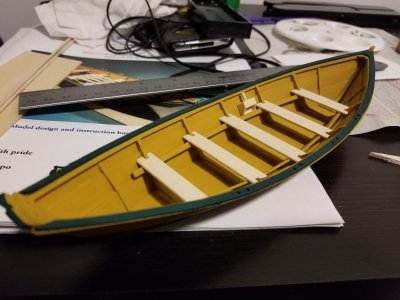
It took a little while and a lot of test fittings, but they came out even in the end. As will be seen in later photos, I then added a sealer-varnish, as I did with the oars, which ever-so-slightly darkened the thwarts.
20230703_220932.jpg

Experiments with using washes for weathering elsewhere proved encouraging, so I ended up applying a very thin black wash to the hull in order to lightly weather it. I didn't want a severe weathering, but just a little suggestion of a bit of grime, as might accumulate after a short voyage or two. My error with the previous attempt at a wash (discussed above) was using too big a brush, which slopped on a ton of wash at once. This time, I used my smallest brush and had a lot more success. It's hard to see in photos, but I do think it adds a bit of character. I also applied a wash to the bailer, but I didn't like the way it turned out--it was very patchy. I ended up later painting a thin white wash over it, and I think it came out looking appropriately aged--while the dory might be relatively freshly painted, perhaps the fisherman cut costs with a used bailer.
20230705_223347.jpg

Next, the beckets. As nearly every build log mentions, the included rope is much too thick. [NOTE: Actually, TrevorK had an interesting discussion on his build log at MSW, in which he noted that beckets actually did tend to be pretty thick, so the supplied rope would have worked out fine. I didn't know that at the time, though.] I didn't want to shell out for international shipping with purpose-made modeling rope, so I hunted around a bit in fabric shops. None of the threads I found actually stated the width, so I eyeballed it and ended up with something perhaps a bit too thin. But, it will be useful for other lines on the boat, so I don't think it's a terrible issue. Plus, the beckets are pretty simple, so it will be easy to replace with thicker thread if it really bothers me in the future. The thread I got was white, so I dyed it a bit in the leftover black wash, which turned out ok. Following the kit instructions to attach the beckets worked perfectly, except that I used full-strength rather than watered-down glue, following suggestions in other build logs. I also tried a real stopper knot on the ends, but it was a little small, so I added a simple knot to make sure it wouldn't slip through. The knots were glued, too. Overall I'm happy with how the beckets turned out.
20230705_181242.jpg

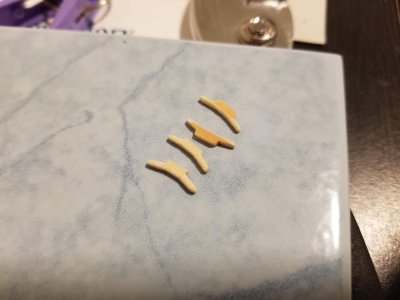
Next, the thole pins. The squared-off wooden piece you cut them from is very thin and I found it hard to sand it fully round. Instead, I took off the edges a bit--necessary for it to effectively roll for the cutting method--and then only rounded a bit at a time, just enough for one or two thole pins, then cutting them and sanding the next bit. This worked well, and the cutting method given in the instructions worked perfectly.

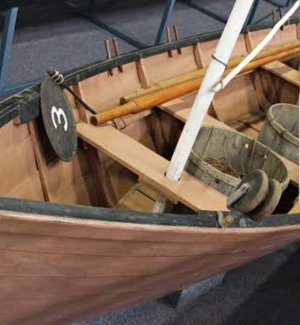
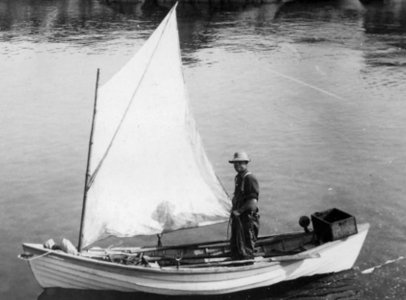
The instructions say that the thole pins are to be vertical. This doesn't follow any of the photos I've seen of actual dories, which have thole pins that follow the flare of the hull and which actually pass entirely through the cap rail and gunwales, as in this image from the International Small Craft Center:
20230706_182700.jpg
Source: https://iscc.marinersmuseum.org/watercraft/grand-banks-dory/

Accurately modeling this would require drilling through the gunwales at the correct angle and making longer thole pins. The drilling seems like something that could very easily go wrong, and I'm not sure if there's enough material for longer thole pins, so I decided to just angle the pins out as they would look on a real dory. I think the "vertical" should be taken to mean that the thole pins are vertical when viewed from the side, not completely vertical from all angles.
20230706_101828.jpg

20230706_101655.jpg

At this point, the dory is complete by the instructions, except for making the stand. That said, I'm not marking this build log as "finished" yet, as there are a couple extra furnishings I'm working on that I'll be continuing to post about. Overall, though, I want to say that this has been a fantastic kit that I've really enjoyed. The pieces are well-cut, the instructions are very clear, and the kit has clearly been designed and made with care. I highly recommend it to anyone interested in starting up ship modeling (or anyone with experience who wants a simple, fun build). Anything I do to mess it up in the future stems from going off-kit to do my own additions.
20230706_101709.jpg
 
Originally Posted 8 July 2023

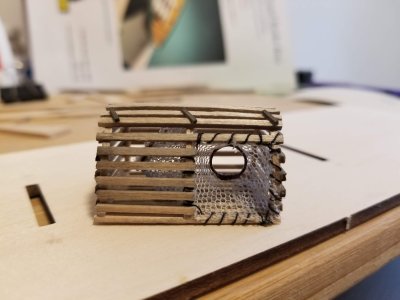
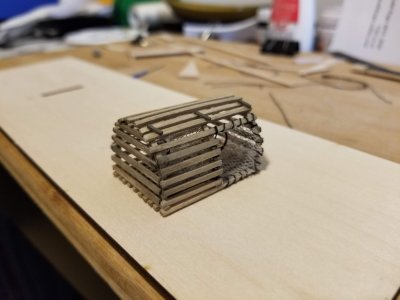
The trajinera, with all its chairs, table, and decorations, really built my confidence with scratch-building, and I wanted to apply that to the dory. So, I made a lobster trap.
20230708_170135.jpg

This does entail a choice to build this less as a dory used on the grand banks, where they were mostly targeting fish, but rather a dory used for inshore fishing.

I based the design on photos from a number of other builds (shout-out to posts by users Keithbrad80, ThirdCoast, John Ruy, and Mr. Bluejacket), as well as on images and descriptions at these sites: https://www.fao.org/3/x2590e/x2590e07.htm https://scarboroughhistoricalsociety.org/2016/11/lobster-traps/

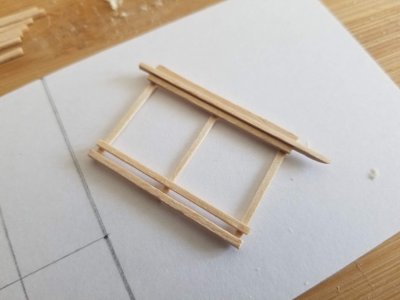
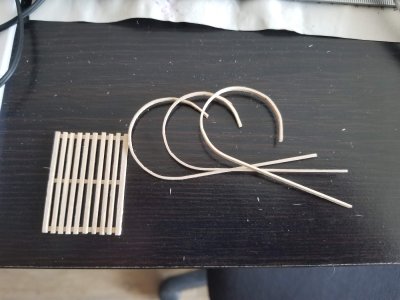
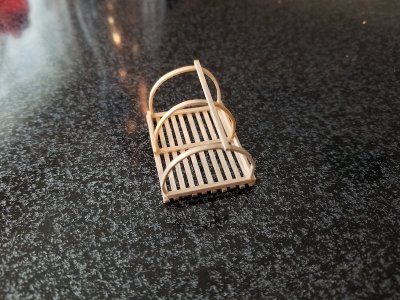
The trap is mostly constructed of slats of basswood, 1mm thick (more or less) that I stripped from a 1/16th inch thick board (so, they're 1/16th of an inch wide). I would have made them thinner, 1/32 inch, but I had a hard time stripping the wood very precisely with just my exacto knife and a straightedge. I consoled myself with the knowledge that lobster traps were often built by hand by fishermen, and usually looked a bit rough, and pressed on. I drew a template to follow for the outer pieces, and then added the slats across the bottom, using a piece of scrap wood as a spacer.
20230703_111316.jpg

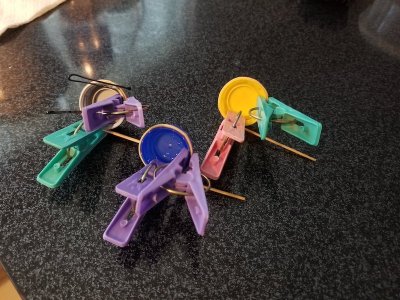
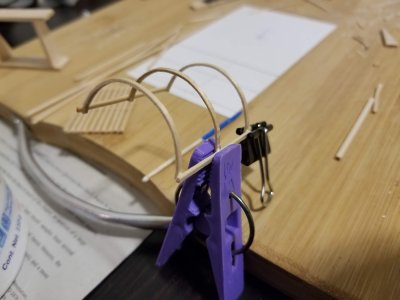
For the curved frames, I soaked three slats in hot water and bent them around plastic bottle caps that were the correct size. I had some minor issues with the slats kinking rather than following smooth curve--perhaps the wood was a little thick for such a tight curve--but I was able to use hairpins to clamp those parts down into more of a curve.
20230703_105021.jpg

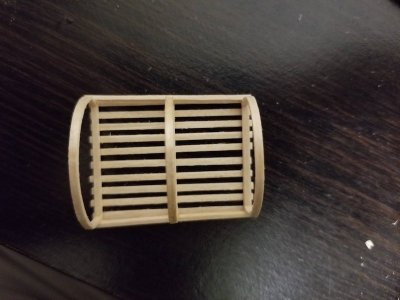
I was happy with how the curved frames and base turned out.
20230703_130641.jpg

Attaching the frames was tricky, as there was very little surface area to attach them and they had opened up slightly after taking them from the mold. First I tried to use super glue to add a bottom piece--essentially making a "D" shape with the frames--but this did not work at all. The glue ran everywhere, and the frame stuck only to my fingers! After peeling it off and scrubbing my hands for far too long, I decided on a different approach.

I added a slat running across both ends of the frames. Once that assembly dried, I then was able to attach all three frames at once to the base.
20230703_200845.jpg

After attaching them, I noticed that the angle was a bit off. The top left part (in the photo below) didn't worry me as I was going to cut that part of the slat off anyway to make the entrance, but the bottom left and center frames were cut off and reglued, which resolved the problem.
20230703_221659.jpg

One of the frames at this point developed a slight kink again. I tried to pin it down a little by attaching a support slat and clamping, which helped a bit but not fully. Later, with the trap mostly complete, I simply sanded a bit off the slats at that point, which brought them into a smooth curve with the rest of the trap.
20230704_102338.jpg

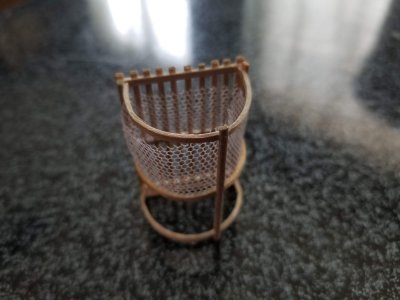
Before attaching the funnels, I gave the whole assembly a light black wash to add some character. I wanted to do this now so that the trap interior wouldn't be unpainted.

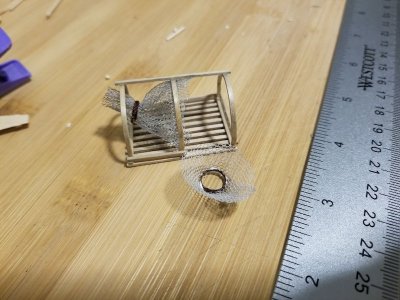
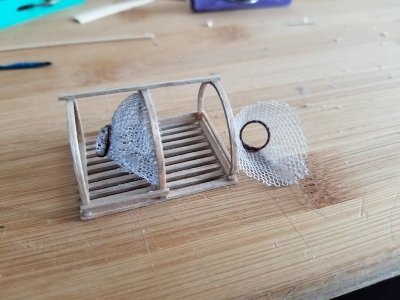
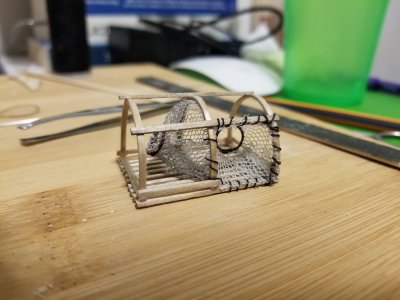
Making the funnels was very difficult! I used a thin tulle for the netting, dying it in the black wash so it was less white. Interestingly the surface tension is enough that the tulle just sits on top of the water until you really force it in. I decided to do the interior funnel first, as it would be less visible if I messed up. My first plan to make the funnel was to attach straight strips of tulle inside the frame, which I would slit and glue into more of a conical shape. This did not work at all. Tulle is very hard to glue, for the simple reason that it's more holes than solid. When glued to itself, it prefers to stick to anything but itself, especially whatever is used (fingers, tweezers, etc) to push the tulle pieces together. With the first funnel a disaster, I cut it out and went back to the drawing board.
20230705_104823.jpg

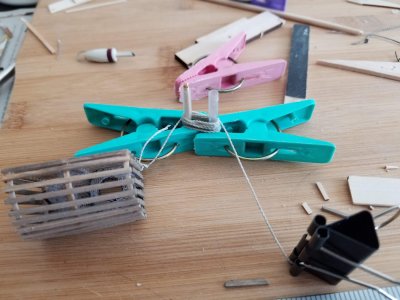
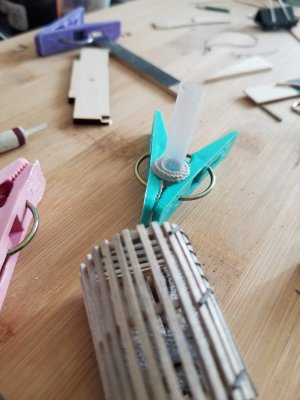
In the meantime, I made the funnel entrance rings. I soaked sone brown thread in the black wash to make it darker, then wrapped it around a cylindrical plastic brush cover and soaked it in glue, trimming the edges once it dried.
20230705_094912.jpg

I decided the funnels themselves would have to be made as funnels before being attached to the frames, so I cut larger strips of tulle, rolled them into funnels, and glued. This was still extremely difficult, given the above-mentioned problem of gluing tule, but making it a single area to be glued instead of multiple was somewhat manageable (although this still left some of the "net" clogged with glue--at least it dried clear, and I picked out some with a needle). That said, the interior funnel was still much too wide. I decided to try two different methods of making the funnels. For the interior funnel, I figured the ring would be most visible on its exterior, so I placed the ring over the edge and slid it down to hold it into a better shape. I then glued the funnel to the frame, as seen. For the exterior funnel, which ended up much closer to the correct size, I figured the ring would be most visible looking in from the trap entrance, so I glued the ring to the funnel interior, as seen. I waited to attach the exterior funnel until later.
20230705_222855.jpg

Once the glue dried, I moved the interior funnel ring into the correct position and glued it, then cut off the excess tulle once it dried. As the funnel was too big, it looked very messy, but 1) it was still a net funnel! and 2) it was going to be mostly boxed in anyway.
20230706_085732.jpg

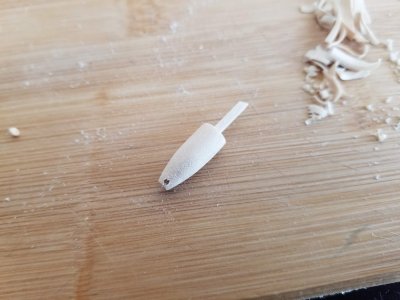
At this point, I also started making a buoy. I laminated two pieces of scrap 1/8th inch basswood and whittled and sanded for the body, and used my pin vice to make a joint to better attach the stick part (I have no clue what the correct terminology is). Growing up, my family had an old buoy as decoration, so I based my design on that one. Hence why the stick part (I'm sure there's a better word but this post is already long and I am tired) is cut off at an angle--the tip had broken off around a knot on our buoy. I also drilled out a hole for the rope, which almost split the tip.
20230707_093907.jpg

Then to the exterior funnel. I added a pre-painted slat at the correct height to make the entrance. I decided that gluing tulle was too much of a pain, so instead I wanted to sew it in place. Surely, I thought, this would be easier?

I was mostly wrong. Sewing the tulle was a real pain in the neck. It had a real tendency to simply follow along with the thread instead of staying in place. After multiple failed tries, I ultimately had to glue down the four corners. This helped, but it was still difficult and every non-glued part pulled moved a lot, at least until it was halfway sewn on to the trap. The tulle moved so much that it partially ripped off from the ring, which had to be re- glued. The thread also had a tendency to stick to itself. Finally, though, I finished and tied it off. It was sloppy, but at least it worked.
20230707_203726.jpg

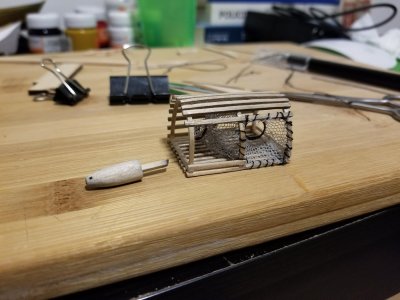
I noticed my spacing was a bit off on the left side, so I filled in the gap by tying a bit of string there. This helped a lot with reducing the irregularity, and isn't very noticeable. I also started attaching the pre-painted slats.
20230707_214611.jpg

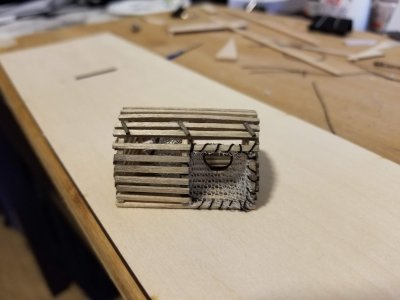
After finishing off the slats--some of which had to be carefully placed between the loops of the line holding in the netting--I finally added three small "buttons" used to close off the trap lid on top. With that, the trap was finished!
20230708_165947.jpg

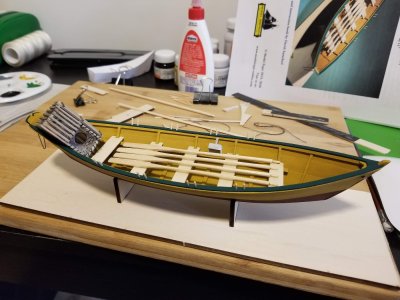
Overall, I'm happy with how it turned out, and I think it looks good in the dory, although I still need to finish the buoy and line. Would a lobster trap's line be more likely to be coiled in a line tub/bucket, or just left more loosely coiled on the thwart?
20230708_165955.jpg

20230708_165835.jpg

A few thoughts on what I've learned:

On pre-painting the slats with a black wash: after initially painting each slat separately after they were cut to size, a slow process, for the side slats I simply painted the entire strip before cutting to size, later adding a bit of wash at the ends. This ended up making the ends a bit too dark as the pigment in the wash was concentrated there, and I think it would look more consistent to paint the whole slat after cutting to size.

I probably should have used a thread the same color as the tulle, but I don't think the black looks horribly put of place.

In hindsight, I think it would have worked better to make the funnels mostly by sewing the tulle into shape, given how difficult it was to use the glue. The rings also probably should have been sewn instead of glued on. That said, tiny pieces of tulle are tricky enough to sew that this would still be frustrating.

I wish I had gotten the frames more square to the base, but I think it looks good enough for something that a fisherman would have made himself. Next up: possibly a few more fishing tools, plus something else a bit larger.
 
Thanks, @DocTom ! It was a very fun build, and a great first model to start with. There are a lot of things I would do differently now if I were to make this model again, but I learned a lot from this build.
____________________________________________

Originally Posted 11 July 2023

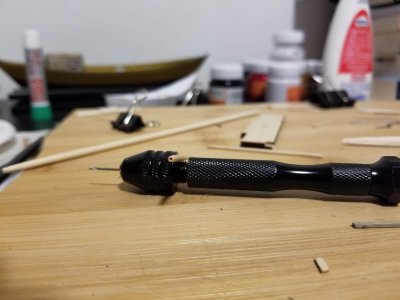
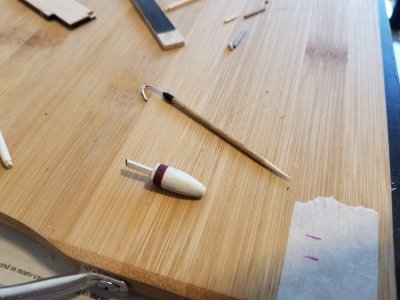
The University of Maine's Lobster Institute lists a gaff hook among the tools used in lobstering, especially for hooking the line connected to the buoy. Sounds good to me! I decided to make the shaft out of a toothpick, and the hook from a paperclip. I started by cutting off the tip of the toothpick and using the pin vise to drill a hole, about 1/8th to 1/4th of an inch deep, to secure the paperclip hook. I've found that, given the limited pressure you can exert on a pin vise, it's best to start with a small pilot hole and work your way up. Despite the small diameter of the hole I drilled, I still needed to use three drill bits to cut it! (This might in part be because I bought a very cheap pin vise and many drill bits are not very sharp at the tip, although for all I know that's normal for tiny drill bits). The photo below shows the toothpick, end-on, propped up by the pin vise.
20230710_212624.jpg

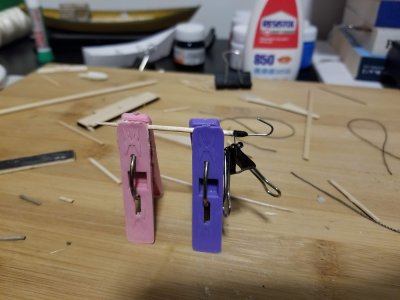
I don't have a wire cutter, so I used some pliers to twist the paperclip back and forth at a certain point until it broke, making the hook. I rubbed the broken end on some sandpaper in hopes that that would wear down any jagged bits. Then I was able to fit the hook into the shaft. Thinking back to when I used to tie fishing flies, I used black thread as a serving on a makeshift jig. The serving was a bit messy but it worked.
20230710_224825.jpg

I realized then that I should have painted the shaft before serving. Thankfully, I was able to carefully paint it without painting the serving. I didn't want it to be the same color as the trap, so I gave it a few coats of a thin ochre wash, followed by a light black wash to bring out the texture of the wood.

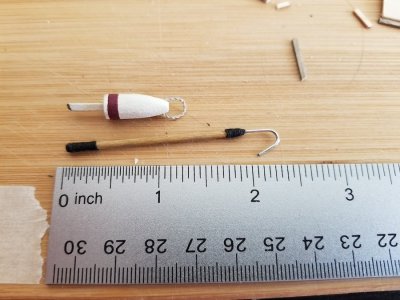
I also painted the buoy. I thought a thin white coat over a black wash would look good, but it ended up a little stark and grey. I mixed a tiny bit of ochre into the white to make more of a cream color, which I used to paint the buoy. I added a dark red stripe, then a very light black wash for texture. The photo below shows how the buoy and gaff hook turned out after painting--note that I left the end of the hook unpainted, as it will be cut off. Also note that, after finding in a test that the paint doesn't adhere very well to the paperclip, I decided to leave the hook as natural metal. Maybe in the future I'll experiment with aging effects on metal, but for now I can live with the hook being a bit shiny.
20230711_081604.jpg

I finished the gaff hook by cutting off the end, painting the cut end black, and adding serving again as a sort of handle. I also glued in a loop of string to the end of the buoy to finish that part, as well.
20230711_093035.jpg

About the rope/string: I wasn't crazy about how the beckets had turned out, so after some experimentation I found that the string looks better and more consistent if it's first lightly soaked in the cream-colored wash, then, after that dries, quickly dipped in a black wash. It's a subtle difference, but it takes some of the sheen off the string. The effect with the black wash can be seen above with the buoy, or later. I think adding the black wash makes sense for lines that would spend a lot of time in the water, like the lobster trap line, but I like the cleaner look of the cream wash for something like rigging. Hmmmm, shame there's no rigging on this dory... more about that later.

Finally, I wanted to make a rope loop for the line connecting the lobster trap to the buoy. I decided against a line bucket for now, but thought a rough loop (instead of a tight coil) sitting on the thwart wouldn't look bad. I made a jig using plastic brush protectprs and used watered-down glue to make the loop. My first attempt, pictured below, tried to make it look like the line had been simply looped around someone's arm from elbow to hand. But, it not only didn't turn out looking right--it was too tall--but also the glue was too watery, failing to hold its shape.
20230711_105858.jpg

Thankfully, the watery glue also meant the line could still be shaped. I simplified the jig to make more of a circular loop and gave that a try.
20230711_152627.jpg

Ultimately, I'm reasonably happy with how it turned out, although I think it could be shaped to better fit, and hang more naturally, at the stern thwart. The line is by now soaked in enough glue that it's hard to shape it more. The gaff hook looks decent in the dory as well, albeit a little shiny, and I'm not totally sure where they would put it. All fittings are currently not glued in place, so if you want to suggest a more accurate way to place things, I'm all ears!
20230711_175612.jpg
______________________________________________________

Originally Posted 12 July 2023

At this point, I think I'm done with the furnishings. But, I've been working on a larger addition to the build: a mast and sail. I was especially inspired by the many fantastic build logs of the Bluejacket dory kit, which does include a sail. Although this dory won't have a rudder (or a centerboard) and isn't a dedicated sailer, simple spritsails were nonetheless common on dories, designed to be easily unshipped and used only if the wind was favorable. I plan to make mine so it can also be unshipped, which is not only an interesting possibility for displaying the model but also will make transporting it much easier.

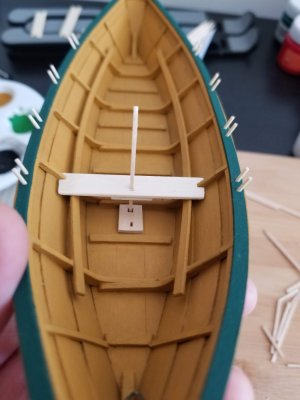
The first step was preparing the mast step assembly. I noticed that the Bluejacket kit looks to be framed following the Shelburne dory style, with each frame made of three pieces held together with metal braces at the joints, while this kit, representing a Lowell dory, uses frames build of two pieces of wood. This means that each frame is rather thicker across the bottom than on the Bluejacket dory, which is relevant for the mast as the mast needs to be stepped through the number two thwart and down to a mast step on the bottom. The thwart in the kit sits centered on the frame, making it impossible to fit a mast as the frame is right under it. So, the first step for me was to make a new thwart from scrap wood, with the frame slots further back so that the thwart sits further forward. I also added a piece across the center on the bottom to reinforce the area where the mast step will be drilled, as I saw this on a photo of a dory in a museum (below). The mast step hole will have to be cut toward the front of the thwart to fit around the frame, but it will work. The photo below compares the kit's thwart (below) with my scratch-built one (above), prior to drilling the mast step hole.
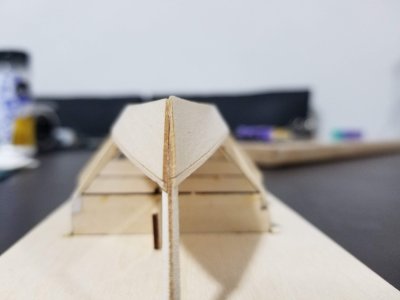
Screenshot_20230710-103320_Gallery.jpg

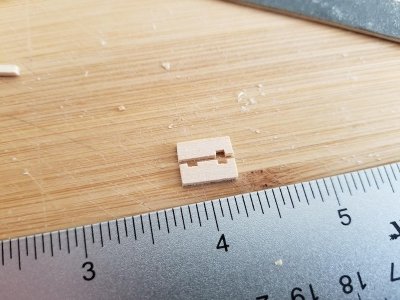
Next, the mast step itself, which I made of scrap wood. Lacking any files, I decided the best way to make a square hole (measured for a 1/16th inch square piece) would be to cut the step in half, cut out half the step, then glue it back together. As can be seen, I first accidentally cut the wrong side, but I decided against replacing the part. Instead, I filled it in with scrap wood and sawdust with glue. After sanding and painting, the mistake was invisible, as seen later.
20230707_101833.jpg

After the glue was dry on the step, but before gluing anything to the dory, I drilled a pilot hole in the thwart and did a test fitting with the leftover 3/64th-inch thole pin material, just to check that nothing was horribly out of alignment.
20230707_104629.jpg

It still wasn't time to attach the step, though--first I wanted to make the mast itself, so I could make sure to fit the mast step properly. I made the mast out of the scrap wood from around the display board. Following the suggestions given in the Model Shipways Norwegian Pram instructions (which are available for download on the model shipways site) I cut the 1/8th-square piece into an octagonal cross-section, making sure to always cut with the grain, and then carefully sanded it circular and tapered a bit at the ends by running it through a sheet of sandpaper that I held curved in my palm. I could do a better job getting it perfect in the future, but for a first attempt I'm happy with it. I also noticed that the basswood seems a little soft for making masts, and had to fill a divot that somehow got sanded into it with a mix of glue and sawdust, which seemed to work. I then drilled a hole at the top for the rigging and added a bit of 1/16th-square wood at the bottom to slot into the mast step (I used the pin vise to drill a hole in the bottom to better hold the piece).
20230711_110030.jpg
20230707_194901.jpg

Finally, I drilled out the hole in the thwart for the mast. I did a test fitting, marked the location for the mast step, then glued it to the bottom after scraping a bit the paint that was where it would be. Then I painted the step.
20230707_212942.jpg

I'm happy with how the mast fits!
20230707_213013.jpg

As for the sail, I had no luck finding a really thin cotton fabric despite visiting multiple shops, but in one shop's scrap pile I did find a large number of pieces that are a good size for the sail (and extra in case I mess up). They're slightly thicker than I would like, but for now it will work, especially considering they were about 50 cents. I haven't started making the sail yet, but will be drawing on the Norwegian Pram instructions as well as the "Scale Sails For Your Model" pdf.

At this point, while I still haven't made the sprit or sail, there's something I'd like to ask for help to clarify. The Bluejacket kit depicts a spritsail rigged with a snotter and with lines tied off at cleats. This seems like the classic way to rig a spritsail. But, a different method seems to be used in the examples I've found online. The dory at the Mariner's Museum, seen below, seems to have the sprit basically just tied to the mast (which might technically be a snotter, just an extremely short one). The sprit-rigged lobstering peapod below also seems (it's a bit blurry) to be similar. No cleats in sight.
20230706_182700(1).jpg
Source: https://iscc.marinersmuseum.org/watercraft/grand-banks-dory/

20230711_132037.jpg
Source: https://maineboats.com/online/boat-features/evolution-maine-lobsterboat

So, how should I go about rigging this? Part of me wants to just base it on the Bluejacket model and include cleats etc, which would look nice and be good for building experience. But part of me thinks I should follow the photos and go for accuracy. If I do the latter, though, there are two things I'm unsure of. 1) How does the loop of the snotter that goes around the mast stay in position and not slide around, especially given the taper of the mast? (I mean, I could glue it, but that seems like cheating). Reading online about spritsails on smsll boats, it seems like a sliding snotter could be used to adjust the sail, but that still doesn't tell me anything about how it would stay in position when you didn't want it to slide. 2) No hoist--I think that's the term for the line used to haul up the sail, but I might be wrong, different articles seemed to use different terms with one calling it a halyard--is visible. Where would it be tied off without a visible cleat?

If you have any suggestions, please let me know, I'd really appreciate any help. I've tried looking in David Steel's 1794 book "The Elements and Practice of Rigging and Seamanship," but while it's useful on the sails themselves it's not very clear on the questions I have.

In any case, I'm learning a lot from this build, and really enjoying it!

[MSW Member Robert952 very helpfully shared information from Howard I. Chapelle's American Small Sailing Craft with me about dory rigging options. I ultimately decided not to include a jib, as the dory I was modeling was conceived less as a dedicated sailing vessel than as something that would use the sail as an auxiliary.]

______________________________________________________

Originally Posted 16 July 2023

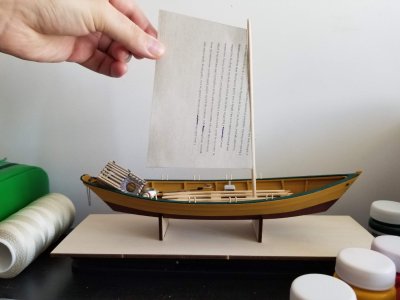
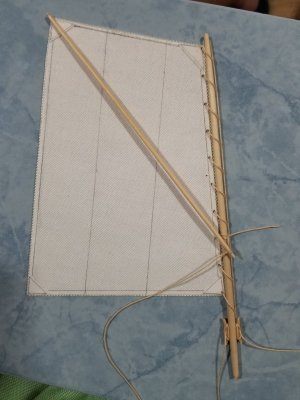
I ended up modifying the Chapelle sail plan substantially, although the mast and spar dimensions are similar (slightly shorter as it's a smaller vessel, though) and I'll be following that example for rigging the snotter. I'm modeling a slightly shorter vessel than in the Chapelle plans, and one that isn't a dedicated sailer--the sheet is just held by hand instead of run through a block at the stern. So I shortened the foot to make a more manageable sail. I also raised the tack and foot a bit higher so the sail wouldn't interfere with any fishing equipment in the boat (althoughto be honest the sail on the peapod I showed earlier looks pretty low). Finally, I lengthened the head a bit so that, with the other modifications, it wouldn't be too small of a sail. I tried a few templates cut from scrap paper, eventually finding one I liked.
20230712_092233.jpg

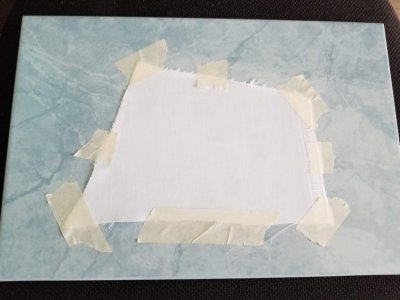
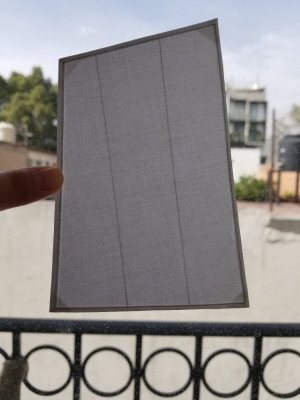
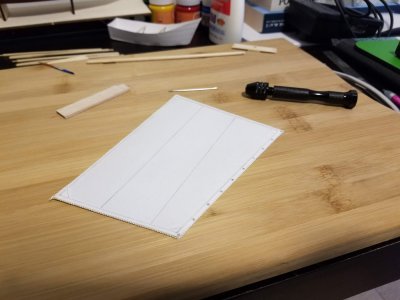
I followed the Norwegian Pram instructions to make the sail. I made a few mistakes with my first attempt. First, I should have waited to draw the sail template onto the fabric until after I added the watered-down glue, as I read in build logs that the pencil lines become impossible to erase after gluing. Second, my sail material was a bit larger than the non-stick flat backing I had (a spare flooring tile), so I ended up doing a poor job taping it. It seemed fine at first, but after leaving it to dry I found that the material had bubbled. The material was still useful for cutting reinforcing strips and corners, but I thought it wouldn't work for the sail. For my second attempt, I cut a smaller piece of the material so it could be better taped down. It turned out much better, although it still had some very slight bubbling later (after I added another coat of glue with the reinforcement strips).
20230713_095338.jpg

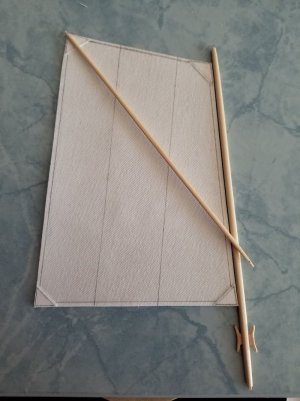
I added reinforcing strips around the edges. I also decided to draw on the seams and stitches with a pencil, especially because the fabric is a bit too thick and the reinforcements don't show through the other side very well unless it's held up to light. I was pretty happy with how the sail looked.
20230714_094648.jpg

Meanwhile, I had been working on figuring out the rigging. Some articles online about sprit rigs suggested that you could just tie things down around the thwart, but that a cleat was easier to handle and better organized. Tying off around the thwart sounded like something that would make unshipping the mast harder--after all, I'm trying to model something that would be taken down and set up quickly when the opportunity arose--and also like something that would look messy. Ultimately, I decided to go with two cleats, on the fore and aft sides of the mast. This would keep things orderly and allow the mast to be easily unshipped, as a unit, or for the sail to be let down if desired. I made the cleats from scrap basswood at first, although I decided it was a bit too weak and made new ones from a coffee stir stick.
20230716_200138.jpg

I then made the spar from some scrap basswood. As with the mast, I found it a little hard to smoothly sand it round, and there were a few minor gouges during sanding. Ideally I think I would like to use a harder wood for masts and spars. I drilled a hole for the snotter and carefully trimmed the end for where the bolt rope loops around the sprit at the peak.

Next, the bolt rope. I wasn't fully happy with how my rope dyeing was turning out, so I decided to leave it as-is. In any case, I'm not planning on weathering the sail, so I don't want it to look out of place. I read a post, I think by ccoyle, somewhere on the forum saying that, if you're careful, you can attach the bolt rope right on the edge of the fabric. I actually had an extremely easy time doing so, which is a clear sign that my sail cloth is much too thick--the bolt rope is actually a bit thinner than the sail at the corners where there are multiple layers of reinforcements. In my defense, I couldn't find anything more suitable despite going to three fabric stores. Seemingly everything available is polyester.

The bolt rope, and sail more generally, turned out well, but I'm considering whether I should try a few more fabric stores to see if I can find thin cotton fabric. On one hand, it would be more accurate. On the other hand, it would be more work, both finding the fabric and making a whole new sail from it. In any case, I feel like I've learned a lot about sail making from this.
20230715_083743.jpg
 
Originally Posted 17 July 2023

The dory is nearly done!

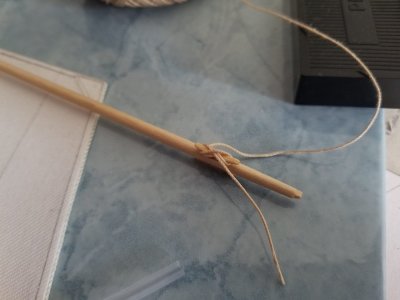
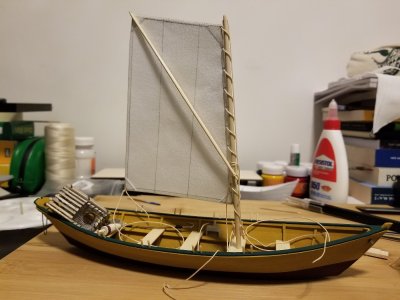
Given my difficulties with finding good sail material, I decided that I can live with the too-thick sail for now, and it wouldn't be all that difficult to change it out if I want to in the future. I got some new thread that's closer in color to manila rope. As practice, I tried a cleat hitch from memory (as can be seen, I messed up). In any case, I think this thread will work better for the running rigging.
20230717_094436.jpg

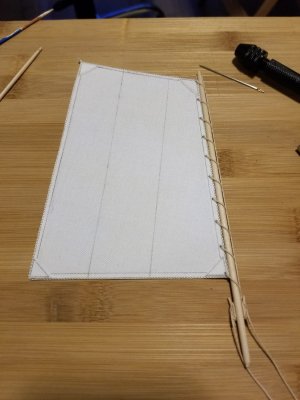
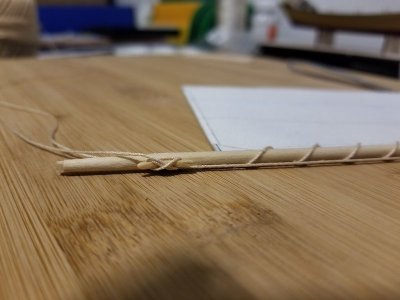
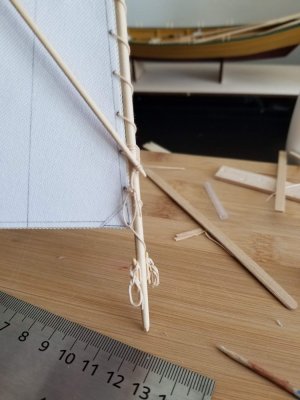
Next I marked where the sail will be lashed to the mast with pencil. Punching the holes in the thick, heavily glued sail material was difficult. I ended up putting a needle in my pin vise and using it as a punch with scrap balsa beneath, which worked.
20230717_190059.jpg

Even still, it was hard getting the needle and thread through the sail to lash it to the mast. But it was doable.
20230717_192339.jpg

This time the cleat hitches were done correctly!
20230717_191553.jpg

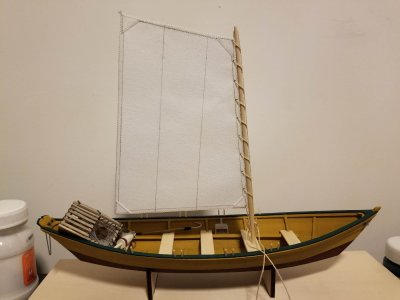
The fact that the sail is thick enough to stand perfectly upright without the sprit definitely shows that it's too thick... oh well, I'll learn for the future.
20230717_191713.jpg

The sprit was a little tricky to tie off. I used a rolling hitch on the mast, which turned out ok. There was very little space to tie off the line around the sprit, though, that I just did a simple knot.
20230717_212139.jpg

Finally I tied the sheet at the clew. A few drops of glue rubbed into the line, and at the bolt rope loop around the end of the sprit, served to make sure everything would stay together.

The boat is nearly done now, I just have to figure out what to do with the dangling rope ends and rearrange the fishing gear into a configuration that makes more sense with the sail. Some of the excess rope, like around the snotter, can simply be trimmed a bit close to the knot. Any suggestions for what to do with the excess below the cleats, or for the sheet? It seems like a few too many lines for each to be a neat rope coil.
20230717_214155.jpg

____________________________________________

Originally Posted 21 July 2023

Things have been busy, so I worked slowly this week, but the build is finished!

MSW member Mark.bukovich's Chesapeake Flattie build had some great directions for making nice rope loops that hang off a cleat, so I followed his example. Mine ended up being a bit clunky, but they work, and in any case this isn't a naval vessel I'm modeling. I'm just glad the rope is up off the thwart. I used a bit of glue to help shape the line. Also, I clearly need to get some locking tweezers or hemostats for rigging, as it was very tricky to hold the bights with normal tweezers while looping the rope.
20230718_110222.jpg

Also, as seen above, I did something a little unusual with the line hanging off the snotter. The simplest thing to do would be to just trim it nearly to the knot, but I figured you might want to have a bit of extra length in the line in case you needed to retie it on the fly or something. I also didn't want to just have a lot of line dangling. So, I tied a bowline with the excess, high up enough that it shouldn't snag anything.

I tried some different arrangements with the fishing equipment. Here, for instance, a thwart is removed and the lobster trap is in the middle.
20230720_001226.jpg

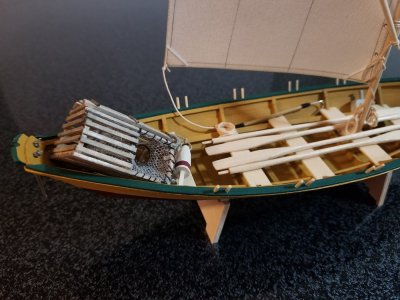
Ultimately, I think the lobster trap looks best in the stern, especially because I want the funnel facing starboard so it's visible (and, with the rope and buoy, it's hard to fit it that way at the bow), but it might get in the way of sailing and steering there. I decided to leave it that way for now, but nothing in the boat is glued down so I can move things around if I change my mind.

I also added a loop in the sheet following the same method as for the lobster trap line. With that, the rigging was complete.

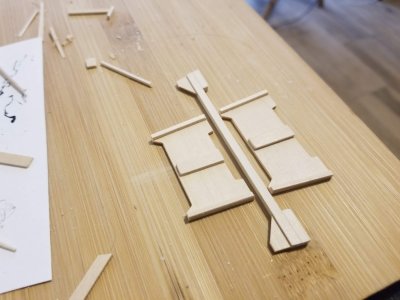
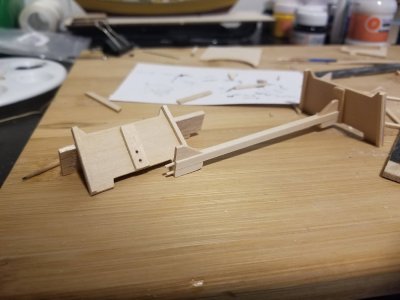
I've also been working on a scratchbuilt stand, as I would like to save all the thick basswood that I can (it's not readily available here, as far as I can tell). I'll have to pack things up for moving, so to reduce the risk of breakage I want something that can be disassembled. I also wanted something that looks nice with angled upright pieces. I probably way over-engineered this, but it's fun.
20230721_175623.jpg
20230721_182102.jpg

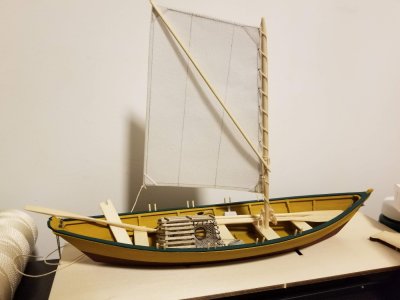
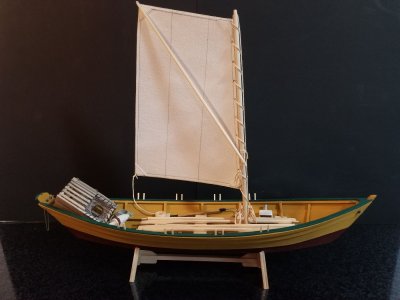
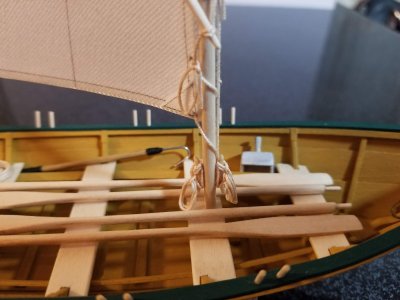
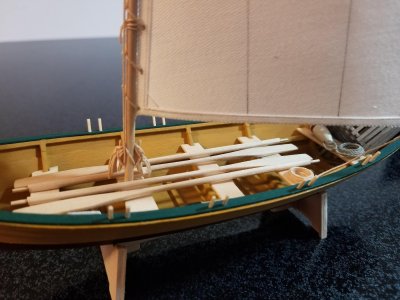
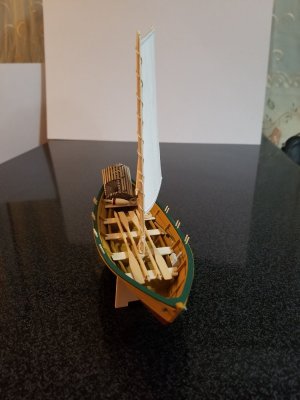
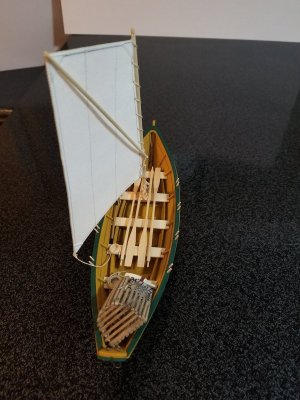
With the sheet looped and the new stand built, the dory was finished! I don't think it turned out half bad.
 
And with that, on 21 July 2023, a bit under two months after starting, I finished the first model ship I started (although it was actually the second I completed--I built the Trajinera while building the dory).

Some photos:

20230721_192543.jpg

20230721_192033.jpg

20230721_192042.jpg

20230721_192400.jpg

20230721_192143.jpg

20230721_192257.jpg

20230721_192632.jpg

20230721_192649.jpg

Reposting this build log has been an experience--it's been interesting to revisit my thought processes and see how this model came together. I stand by my original assessment that this is an excellent kit for a beginner (although I note with some dismay that the price has gone up a fair bit). The kit and its detailed instructions taught me a lot about the basics of modeling, which has served me well in subsequent builds. I had a lot of fun kitbashing it, as well, in order to personalize it, and I think the basic kit design, not to mention the wide range of uses for dories, really lends itself to making a lot of changes. The lobster trap and sail were fun additions and I really learned a lot by adding them. There are some things I would do differently if I redid this model today. I would probably do a lot more research (John Gardner's The Dory Book would be a must-read) and follow a plan for the sail design. I would also by now use paper for the sail, as that fabric was really quite absurdly thick, and better rope, although at the time I certainly didn't have access to high-quality premade rope. Today I would perhaps build it as a Grand Banks fishing boat, equipped for cod fishing, but that's really because by now I've made quite a few lobster traps (besides this one, also for the Midwest Peapod and a Christmas ornament as a gift).

Thanks also to all those who offered help and support in the original build! I couldn't really include their comments in this repost, but their assistance was greatly appreciated and very helpful.
 
And with that, on 21 July 2023, a bit under two months after starting, I finished the first model ship I started (although it was actually the second I completed--I built the Trajinera while building the dory).

Some photos:

View attachment 608743

View attachment 608738

View attachment 608739

View attachment 608742

View attachment 608740

View attachment 608741

View attachment 608744

View attachment 608745

Reposting this build log has been an experience--it's been interesting to revisit my thought processes and see how this model came together. I stand by my original assessment that this is an excellent kit for a beginner (although I note with some dismay that the price has gone up a fair bit). The kit and its detailed instructions taught me a lot about the basics of modeling, which has served me well in subsequent builds. I had a lot of fun kitbashing it, as well, in order to personalize it, and I think the basic kit design, not to mention the wide range of uses for dories, really lends itself to making a lot of changes. The lobster trap and sail were fun additions and I really learned a lot by adding them. There are some things I would do differently if I redid this model today. I would probably do a lot more research (John Gardner's The Dory Book would be a must-read) and follow a plan for the sail design. I would also by now use paper for the sail, as that fabric was really quite absurdly thick, and better rope, although at the time I certainly didn't have access to high-quality premade rope. Today I would perhaps build it as a Grand Banks fishing boat, equipped for cod fishing, but that's really because by now I've made quite a few lobster traps (besides this one, also for the Midwest Peapod and a Christmas ornament as a gift).

Thanks also to all those who offered help and support in the original build! I couldn't really include their comments in this repost, but their assistance was greatly appreciated and very helpful.
A truly wonderful job! You really personalized your build. As for the sails I have seen others very successfully use paper. I was in Europe and noted some of the tissue paper they use there is substantially more rugged than what is used in the USA. It may provide a better option if you want to go there. You might also consider the use of silkspan which I believe is a special paper product. It is often used by RC airplane modelers. Tom Luria has a you tube video on how to use it for replicating sails.


Rob
 
A truly wonderful job! You really personalized your build. As for the sails I have seen others very successfully use paper. I was in Europe and noted some of the tissue paper they use there is substantially more rugged than what is used in the USA. It may provide a better option if you want to go there. You might also consider the use of silkspan which I believe is a special paper product. It is often used by RC airplane modelers. Tom Luria has a you tube video on how to use it for replicating sails.


Rob
Thanks! It was quite a fun build, kitbashing it really gave me the confidence to quickly do scratch-builds as well. Since this early model, I did switch to using paper for the sails. I wasn't able to find silkspan here in Mexico City, but for my next builds I used coffee filters. I'm planning on experimenting with some different types of paper for my current builds.
 
Back
Top