
• SUBSCRIBE TO SHIPS IN SCALE TODAY!

    The beloved Ships in Scale Magazine is back and charting a new course for 2026!
    Discover new skills, new techniques, and new inspirations in every issue.

    NOTE THAT OUR NEXT ISSUE WILL BE July/August 2026
  • Win a Free Custom Engraved Brass Coin!!!
    As a way to introduce our brass coins to the community, we will raffle off a free coin during the month of August. Follow link ABOVE for instructions for entering.

SHARPIE

Dave Stevens (Lumberyard)

Vendor
Vendor
Sponsor
Joined
Dec 1, 2016
Messages
6,734
Points
728

A NEW PROJECT! this class will be headed by Roger

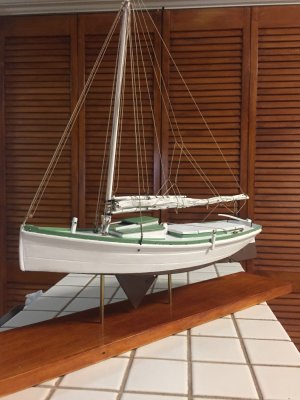
As everyone must know by now, Americans celebrate the 250th anniversary of of the Declaration of Independence this July 4th. So why not celebrate by building a model of the All American Boat. No, I’m not talking about an aluminum Lund fishing boat with its outboard motor or, Ugh, a pontoon boat. According to the late Dean of American Maritime Historians, Howard I. Chapelle it’s the SHARPIE.

In a Smithsonian Institution paper (The Migrations of an American Boat Type) he writes:
“For a commercial boat to gain wide popularity and use, it must be suited to a variety of weather and water conditions and must have some very marked economic advantages over any other boats that might be used in the same occupation.”

He then goes on to explain “that of the 200 boat types employed in American fisheries during the last 60 years of the Nineteenth Century,” the Sharpie was unique in that its use spread down the East Coast to Florida, to the Midwest along the South Shore of Lake Erie, and to areas of the West Coast. Today Sharpies are built and sailed by home builders. They are truly All American boats.

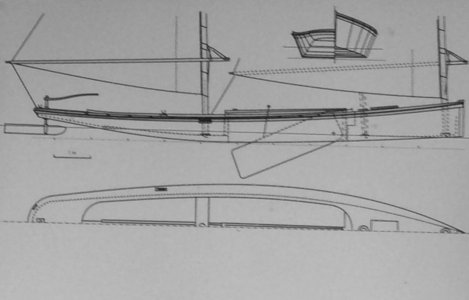
One, would, therefore, think that someone would offer a kit that captures the graceful lines of this remarkable craft. A drawing of a New Haven Sharpie is included below. Such is not the case. There is a Midwest kit of a Sharpie schooner, and the Nautical Research Guild offers plans and instructions for a Generic East Coast Sharpie on their website. Sharpie schooners are not nearly as attractive as the original New Haven built craft and the nicest thing that I can say about the NRG’s craft is that “they certainly succeeded in making it generic!”

Instead, we’ll build this one from scratch. We’ll begin with offsets of an actual boat measured in the late 1920’s by Howard Chapelle, prepare a lines drawing, make molds from the lines drawing and use the molds to build one of three models
1. A beginner version.
2. A more advanced version
3. A lean mean racing machine (about more later)
All three are built to the same set of lines. Differences are in the details. I’m building choice #3 but as we move along I’ll include shortcuts for building#1. #2 lacks the yacht like finish of #3.

Acknowledgments to:
Dave Stevens for establishing the School
Greg Davis for his Gold Metal Gundalow model that reminded me of the possibilities for building models of these Nineteenth American working craft.

My intention is to move at a pace that will allow me to post weekly. Stay Tuned.

Roger

IMG_3123.jpeg
 
Last edited:
The History of the Sharpie

Scholars of maritime history love to trace the genealogy of different types of watercraft, Sharpies included. I won’t bore every one with the various theories. The short answer is that nobody really knows how and if the sharpie evolved from any other boat type.

One theory: oysters were originally harvested by tonging. Tongs that looked like a pair of garden rakes with long handles were used to pull up oysters from the bottom of shallow waters. The men doing the tonging used canoes carved from large white pine logs. The canoes had flat bottoms. Towards the middle of the Nineteenth Century the large white pines suitable for building these canoes and growing near the shore were gone so the oyster men began looking for a cheap boat that could be sailed yet could carry a heavy load. The sharpie was the result.


The sides of a sharpie are what is known as a developable surface. The entire side lies in a single plane. The sides were put together and bent about a single mold erected midships. The bottom was cross planked and the stem did not require a rabbit.

The leg of mutton rig with a sprit was found to be very powerful, and could be easily adjusted to flatten the sail as required while requiring little rigging. The resulting boats were very fast

Unfortunately, as the City of New Haven grew, so did pollution of nearby waters, killing the oysters so oyster harvesting moved into offshore. Oysters were then harvested by dredging requiring a larger, more powerful boat. So, during the early Twentieth century use of the sharpie in waters near New Haven declined. Howard Chapelle visited the area in the late 1920’s to measure some boats and was able to do so but the sharpie boat type was no longer active.

Meanwhile, sharpies were being used for fisheries in the North Carolina sounds and for the pound net fisheries on Lake Erie as well as on Chesapeake Bay.

Roger
 
My mistake: these were referred to as Flatties, not Sharpies. Not sure what the differences might have been.
 
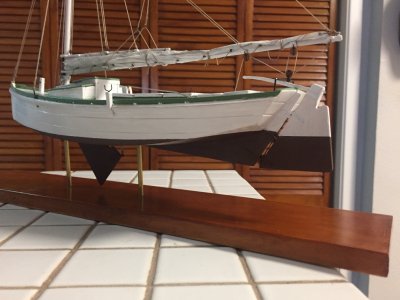
Regardless of what you call it’s a nice model.

The original classic sharpie is the developed in New Haven for oyster tonging. They were half decked open boats with no skeg in the stern and they had a balanced rudder. For comparison see the drawing in my post #1 above.

The design was so successful that it has been adapted and modified ever since. It should come as no surprise that the use of plywood as a marine construction has resulted in the sharpie design being a favorite for home builders resulting in my opinion in some very ugly boats.

According to Chapelle, the Sharpie may or may not have influenced building flat bottom and later Vee bottom boats on Chesapeake Bay. Another scholar argues not very convincingly that the reseeding of depleted oyster beds with oysters from Chesapeake Bay brought flat bottomed boat construction north to New Haven.
 
THE MODEL

My intention is to build a model of New Haven Sharpie of 1900.

The Scale will be 1:32 or as I prefer to think of it, 3/8”=1ft-0”. Why that scale? Scale is always a compromise between the model being large enough for the details that you wish to show, and small enough to comfortably display. For small craft 1:32 is a good compromise. The model will be slightly longer than 13in. It is also convenient. For those of us that model using what used to be known as the English System of dimensions, 1 inch is represented by 1/32”.

Of the several books about or that include information about Sharpies, the essential one is Chapelle’s American Small Sailing Craft.

Other references:

The Migration of an American Boat Type, by Howard Chapelle
Largely duplicates information in American Small Sailing Craft. Does include larger versions of key drawings from the book.

Boatbuilding by Howard Chapelle. 80-90 year old boat building technology. Some information applicable to Sharpies.

The Classic Boat, Time Life Boats. Includes a drawing of a Sharpie being built upside down on Molds

Small Yachts by C.P. Kunhardt. WoodenBoat Edition. Includes a section on Sharpies

The Sharpie Book by Ruele Parker. Mostly about designs for modern day home built boats.

The hull for the model that I am building is shown in Figure 41 of Chapelle’s Small Craft book. The drawing is highly detailed and represents the final evolution of the New Haven Sharpie in the year 1900. A larger version of this drawing is reproduced in the Migration of an American Boat Type Paper. This is a boat that Chapelle had access to and measured in the 1920’s.

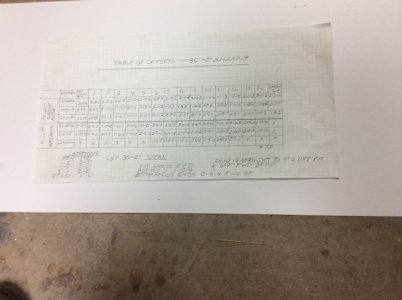
Chapelle’s small craft book includes an Appendix that includes tables of offsets for selected boats in the book. We are fortunate that this includes the Sharpie that will be modeled. In my next post I’ll explain the Table of Offsets and explain how it is used to create a lines drawing.

Roger
 
Well, I’m moving along with the build. I’m making molds so the choice of designs is fixed.

On the other hand, it would be interesting to see what HAMMS has to offer.

Thanks,
Roger
 
Hi Roger,
I would be interested in the process you are following to make the molds too.
For Prints I have the ASSC listing from Smithsonian 2022 edition (Prices might have gone up)
ASSC-41 New Haven Sharpie c.1900 Lines, inboard profile construction details scale 3/4" $10
ASSC-41A Offsets $10
Guy
 
There are two Sharpies in HAMMS, one is unnamed survey 2-145 and the other is Pompano survey 8-45. Pictures to follow.
 
Lofting, Part 1

Naval Architects, agree that a good model must accurately represent the hull shape of the real vessel being modeled. L. Francis Herreshoff said that one that doesn’t “is an evil thing.” While “evil” is certainly a strong word, a nicely finished model with a misshapen hull is of little or no value. The key to accurate hull construction is Lofting. Lofting is the process where design information is used to make full sized patterns for elements of the hull’s structure that define its shape.

Lofting the hull of our sharpie will require:

A Table of Offsets.

Use of the Table of offsets to draw a lines drawing

Transferring body plan sections to a scrive board

Building molds (patterns) for each body plan section on te scrive board.

This lesson deals with the Table of Offsets. In his excellent book, American Small Sailing Craft, Howard Chapelle includes drawings for half a dozen or so Sharpies. One in particular Figure 41 caught my attention it has the lean hull lines and circular stern that I wanted to represent in my model. While I could order this drawing from the Smithsonian, I chose to make my own and Chapelle provides the means to do so.

His book includes an appendix with tables of offsets for selected vessels in his book including the Figure 41 sharpie. A Table of Offsets is a digital description of the vessel’s hull form.

IMG_3183.jpeg]

IMG_3183.jpeg
 
Lofting, Part 1

Naval Architects, agree that a good model must accurately represent the hull shape of the real vessel being modeled. L. Francis Herreshoff said that one that doesn’t “is an evil thing.” While “evil” is certainly a strong word, a nicely finished model with a misshapen hull is of little or no value. The key to accurate hull construction is Lofting. Lofting is the process where design information is used to make full sized patterns for elements of the hull’s structure that define its shape.

Lofting the hull of our sharpie will require:

A Table of Offsets.

Use of the Table of offsets to draw a lines drawing

Transferring body plan sections to a scrive board

Building molds (patterns) for each body plan section on te scrive board.

This lesson deals with the Table of Offsets. In his excellent book, American Small Sailing Craft, Howard Chapelle includes drawings for half a dozen or so Sharpies. One inparticular Figure 41 caught my attention it has the lean hull lines and circular stern that I wanted to represent in my model. While I could order this drawing from the Smithsonian, I chose to make my own and Chapelle provides the means to do so.

His book includes an appendix with tables of offsets for
selected vessels in his book including the Figure 41 sharpie. A Table of Offsets is a digital description of the vessel’s hull.

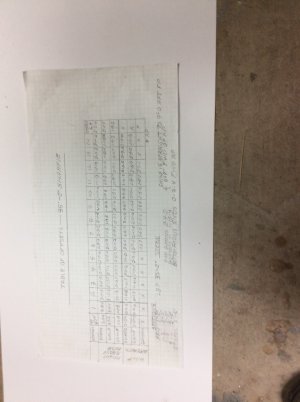
Across the top of the page are numbers 1-14 representing stations on the lines drawing and we will make a mod fr each station. Down the side, are two major categories: Height Above Base Line and Half Breadths. These are further divided:

Height above base line: Sheer, Wale , and Chine (we will ignore wale for the time being)

Half breadrh: Sheer, Chine and foaming

A box occurs at the intersection of each horizontal and vertical column. Numbers given in feet, inches and eights represent the distance from centerline or baseline at t applicable lines drawing station.

Example: station 6
Sheer
Box 3-2-5
The sheer line is 3ft, 2-5/8” from the vesse’s centerline @ station 6.

IMG_3183.jpeg
 
Back
Top