

- Joined
- Dec 1, 2016
- Messages
- 6,729
- Points
- 728

A NEW PROJECT! this class will be headed by Roger
As everyone must know by now, Americans celebrate the 250th anniversary of of the Declaration of Independence this July 4th. So why not celebrate by building a model of the All American Boat. No, I’m not talking about an aluminum Lund fishing boat with its outboard motor or, Ugh, a pontoon boat. According to the late Dean of American Maritime Historians, Howard I. Chapelle it’s the SHARPIE.
In a Smithsonian Institution paper (The Migrations of an American Boat Type) he writes:
“For a commercial boat to gain wide popularity and use, it must be suited to a variety of weather and water conditions and must have some very marked economic advantages over any other boats that might be used in the same occupation.”
He then goes on to explain “that of the 200 boat types employed in American fisheries during the last 60 years of the Nineteenth Century,” the Sharpie was unique in that its use spread down the East Coast to Florida, to the Midwest along the South Shore of Lake Erie, and to areas of the West Coast. Today Sharpies are built and sailed by home builders. They are truly All American boats.
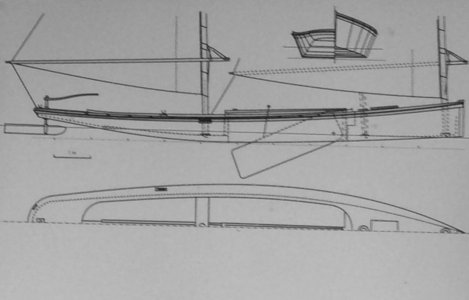
One, would, therefore, think that someone would offer a kit that captures the graceful lines of this remarkable craft. A drawing of a New Haven Sharpie is included below. Such is not the case. There is a Midwest kit of a Sharpie schooner, and the Nautical Research Guild offers plans and instructions for a Generic East Coast Sharpie on their website. Sharpie schooners are not nearly as attractive as the original New Haven built craft and the nicest thing that I can say about the NRG’s craft is that “they certainly succeeded in making it generic!”
Instead, we’ll build this one from scratch. We’ll begin with offsets of an actual boat measured in the late 1920’s by Howard Chapelle, prepare a lines drawing, make molds from the lines drawing and use the molds to build one of three models
1. A beginner version.
2. A more advanced version
3. A lean mean racing machine (about more later)
All three are built to the same set of lines. Differences are in the details. I’m building choice #3 but as we move along I’ll include shortcuts for building#1. #2 lacks the yacht like finish of #3.
Acknowledgments to:
Dave Stevens for establishing the School
Greg Davis for his Gold Metal Gundalow model that reminded me of the possibilities for building models of these Nineteenth American working craft.
My intention is to move at a pace that will allow me to post weekly. Stay Tuned.
Roger
As everyone must know by now, Americans celebrate the 250th anniversary of of the Declaration of Independence this July 4th. So why not celebrate by building a model of the All American Boat. No, I’m not talking about an aluminum Lund fishing boat with its outboard motor or, Ugh, a pontoon boat. According to the late Dean of American Maritime Historians, Howard I. Chapelle it’s the SHARPIE.
In a Smithsonian Institution paper (The Migrations of an American Boat Type) he writes:
“For a commercial boat to gain wide popularity and use, it must be suited to a variety of weather and water conditions and must have some very marked economic advantages over any other boats that might be used in the same occupation.”
He then goes on to explain “that of the 200 boat types employed in American fisheries during the last 60 years of the Nineteenth Century,” the Sharpie was unique in that its use spread down the East Coast to Florida, to the Midwest along the South Shore of Lake Erie, and to areas of the West Coast. Today Sharpies are built and sailed by home builders. They are truly All American boats.
One, would, therefore, think that someone would offer a kit that captures the graceful lines of this remarkable craft. A drawing of a New Haven Sharpie is included below. Such is not the case. There is a Midwest kit of a Sharpie schooner, and the Nautical Research Guild offers plans and instructions for a Generic East Coast Sharpie on their website. Sharpie schooners are not nearly as attractive as the original New Haven built craft and the nicest thing that I can say about the NRG’s craft is that “they certainly succeeded in making it generic!”
Instead, we’ll build this one from scratch. We’ll begin with offsets of an actual boat measured in the late 1920’s by Howard Chapelle, prepare a lines drawing, make molds from the lines drawing and use the molds to build one of three models
1. A beginner version.
2. A more advanced version
3. A lean mean racing machine (about more later)
All three are built to the same set of lines. Differences are in the details. I’m building choice #3 but as we move along I’ll include shortcuts for building#1. #2 lacks the yacht like finish of #3.
Acknowledgments to:
Dave Stevens for establishing the School
Greg Davis for his Gold Metal Gundalow model that reminded me of the possibilities for building models of these Nineteenth American working craft.
My intention is to move at a pace that will allow me to post weekly. Stay Tuned.
Roger
Last edited: