
• Win a Free Custom Engraved Brass Coin!!!
    As a way to introduce our brass coins to the community, we will raffle off a free coin during the month of August. Follow link ABOVE for instructions for entering.
  • SUBSCRIBE TO SHIPS IN SCALE TODAY!

    The beloved Ships in Scale Magazine is back and charting a new course for 2026!
    Discover new skills, new techniques, and new inspirations in every issue.

    NOTE THAT OUR NEXT ISSUE WILL BE MARCH/APRIL 2026

18th Century British Gun Ports

Joined
Nov 14, 2023
Messages
6
Points
1

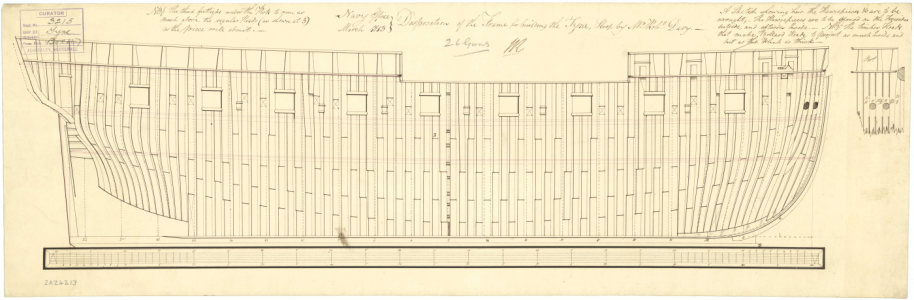
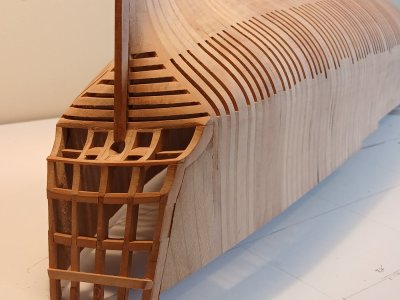
My current project is a POF Dockyard Model of the Dolphin built to the modified 1719 20's Establishment Keel was laid down in January 1730 and launched in January 1732, she was converted to a fireship in 1755 and renamed the Firebrand, she was again converted back a sixth rate in 1757 and renamed Penguin she was taken by two French frigates off Oporto Bar on the 28th March 1760. There is a very fine contemporary model of her in the Greenwich Maritime Museum, I have a copy of her Draughts and was very lucky to obtain numerus photographs, I had also visited Kew many times to study and copy many of her pages of logs. The Model Cat#1731-2 was made by John Hancock a shipwright at Deptford.
I've laid the keel, constructed the 84 frames including cants assembled the hull and am now at the stage of transferring the gun port tracing to the broadside. All other two models one completed and another at the planking stage are both smaller ships, the finished model is the Fly class sloop the Ranger 8 x 3 + 10 swivels launched October 1752 and ongoing is the Swan class sloop the Nymph 14 x 6 + 14 swivels, both of these ships had open gun ports with no Lids so the gun port opening was as per the drawings. So my question is the gun port size? my blueprint of the Dolphin draught shows 2' 3" fore and aft the photo's show 2' 3" fore and aft, Page 106 of the "ship Repository 1788" which is the only reference I have for gun ports states Ship of 20 guns: fore & aft 2' 3" the ports with gun lids have a cil about 2" +- deep which would make the lidded ports outer layer of planking 4" wider than the other unlidded ports so are the lidded ports gun openings actually narrower?

 
The Treatise on Ship-Building Mungo Murray 1765

Gunports - English 1750
Spaced: center to center 25X dia. of shot
Length fore & aft 6.5X dia. of shot
Height 6X dia. of shot
Sill height 3.5X dia. of shot above deck
 
The Treatise on Ship-Building Mungo Murray 1765

Gunports - English 1750
Spaced: center to center 25X dia. of shot
Length fore & aft 6.5X dia. of shot
Height 6X dia. of shot
Sill height 3.5X dia. of shot above deck
Thanks, will have to get a fascimile copy, the above fits my naval draughts. However if you view contemporary models the unlidded and lidded ports all seem the same fore & aft width?
 
I would want micrometer measured data before I accepted that.
The designers started with the size and number of guns and developed a ship design to be an artillery platform for that size.
All things being based on proportions the width should appear to be the same if photos enlarged the hull profile all to the same width.
 
Ship of 20 guns: fore & aft 2' 3" the ports with gun lids have a cil about 2" +- deep which would make the lidded ports outer layer of planking 4" wider than the other unlidded ports so are the lidded ports gun openings actually narrower?

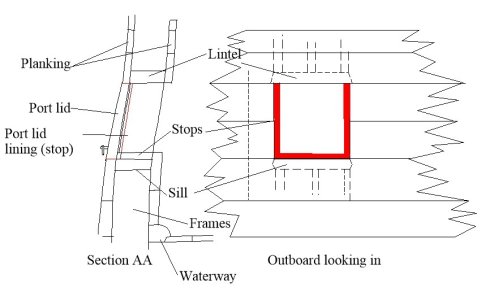
I am probably misunderstanding your question. Why would a lid with a port have a different dimension than one without a lid? Ports with or without lids have sills/cils/lintels and the hull planking covers them. The lids sit inside the opening so to be flush with the hull planking. The stops keep them from swing in too far. Sorry if I am not understanding your question and this response makes no sense :)
Allan

1775089763390.jpeg
 
I am probably misunderstanding your question. Why would a lid with a port have a different dimension than one without a lid? Ports with or without lids have sills/cils/lintels and the hull planking covers them. The lids sit inside the opening so to be flush with the hull planking. The stops keep them from swing in too far. Sorry if I am not understanding your question and this response makes no sense :)
Allan

View attachment 588977
Thanks for the drawing Allan, I think will help me explain my question better. First is the fact that there are establishment dimensions for gun ports of the different calibre cannons, these figures are important in locating the cannon, height from deck, centre to centre, height and the fore & aft dimension. If you look at your drawing of the side view and relate it to a 20 gun sloop the port opening is 2’ 3” which is the establishment measurement, however add the cills and you reduce the establishment fore & aft and height measurements. The amidships gun deck ports had no lids so no cills so 2’ 3” fore & aft, however the bow port and the three aft ports have lids so cills are added so I presume the gun ports fore & aft dimensions are increased so as to accommodate the cills and have the same fore & aft width.
 
a 20 gun sloop the port opening is 2’ 3” which is the establishment measurement, however add the cills and you reduce the establishment fore & aft and height measurements. The amidships gun deck ports had no lids so no cills so 2’ 3” fore & aft,

You may be right, but I am pretty sure all gun ports had cills, even if there were no port lids. Which Establishment are you using? The 1719 has the opening as 24" up and down which is between the cills, it does not include the cills or lintels or stops. The 1741, 1745, and 1750 Establishment had no changes from what I can see. The first drawing below is a 20 gun and shows the cills and lintels on all ports even though there were no lids midships.

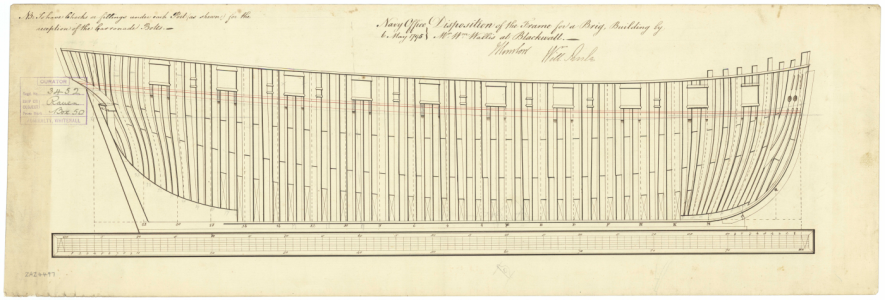
These drawings are later, but you can see what I am getting at with the dimensions of the openings being the same for every port.


1775128049378.png

18 gun
1775128525917.png


From a contract for a 20 gun - I realize no two ships were exactly the same, but this may shed some light :)
Portsills The upper deck portsills to be 6 in deep, put in with a bill as is done in the King’s Yards, and in each of the lower sills to have 2 small bolts of ⅝ in diameter drove from without, & clenched on the spirketting. Spirketting To have 2 strakes of spirketting on each side of 3 ½ in thick at the lower edge and 3 in at the upper edge, & to shut in from the spirketting to the string between the ports with 2 in Prussian deal, except the two foremost rooms, which is to be of oak plank the ends turned off with a quarter round, as also the upper & lower edges of the string and spirketting. Transom To have a transom cross the stern at the height of the ports 4 ½ in deep, scored &bolted to the stern timbers, & kneed at each end, with one iron knee, which is to cast down under the gallery door, and be continued long enough to receive 2 bolts afore it, The athwartship arm to be 3 ft 6 in and bolted with 7 saucer headed bolts of 1 in diameter well clenched without side. Upper Deck Ports To have 11 upper deck ports on each side, fore & aft 2 ft 4 in and in depth 2 ft 2 ½ in 2 ports in the stern and to make & hang all such port lids as shall be required, and fit then with proper shackles for hauling them up & bearing them in, and also to make such half ports with slit deal or sheathing board as usual, & shall be demanded on the upper deck.

Keep in mind this does not include the linings which were about 1"-1.5" thick. There were three for each port, one rested on the top of the lower cill and there was one on each side.

This discussion is very interesting, thanks for bringing it up!

Allan
 
however add the cills and you reduce the establishment fore & aft and height measurements. The amidships gun deck ports had no lids so no cills so 2’ 3” fore & aft, however the bow port and the three aft ports have lids so cills are added so I presume the gun ports fore & aft dimensions are increased so as to accommodate the cills and have the same fore & aft width
It appears to me that there is a confusion between port sills and port lid stops.
All ports has sills - a structural component. The stops for the lid that were used to keep water out. In an open waist there are too many ways for water to get in. Lids were pointless. No lids, no stops. The stops would slightly reduce the degree of depression and require more brute force for a full traverse. The stops were superficial and not a structural component.
If a model is on display with closed lids, adding the stops would be unnecessary.
 
It appears to me that there is a confusion between port sills and port lid stops.
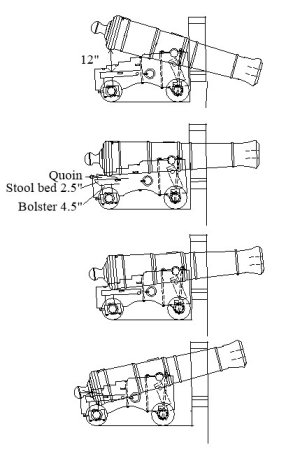
Totally agree Dean. The drawing in post #5 shows the difference between the two but maybe was not noticed. I started searching for more dimensional information on the carriages and I cannot find any information on the maximum thickness of a quoin for a given caliber and era. It does not really matter as the maximum depression may be difficult with a quoin. Maximum depression is limited by the stool and bolster. From a practicable standpoint, the thickness of the stop/lining on the top of the bottom sill/cill will not amount much of a problem, if any. The below sketch is to scale for a 6 pounder 6 feet long which I believe would be about right for a 20 gun vessel in the RN in the mid 18th century.
Allan

1775156625119.jpeg
 
Thanks Allan, Jaager has hit the nail on the head I've been calling the stops cills. No lids No stops, therefore the gun port dimensions on the Dolphin draught are as per the establishment dimensions add lids then you need to add stops so the gun port size will be reduced. I presume that the gun port dimensions where established for each gun calibre so there was sufficient room to arc and sweep the barrel therefore to maintain establishment dimensions the structural gun ports would need to be increased in size. As I said earlier I have a very good photo of the Dolphin model that shows the aft lidded ports a larger size? there is very little distortion to the photo as the lens was parallel to the models hull with three unlidded ports and three lidded ports I had a print blown up to an aproximate1/64 scale and am sure I'm correct? As I said earlier I have completed the framing as per the Greenwich model and do not want to start hacking away the gun ports if they are not correct.
 
the gun port size will be reduced.
The opening into the hull is the same for all the ports. it will not be reduced. Unlike the sills which are flush with the framing inboard and outboard, the stops are recessed into the port on the outboard side the thickness of the planking, so the full openings of the ports are all the same. I believe the planking and thus the recess would be 3". The clearance is reduced slightly by the bottom stop. There are no stops on top of the opening which would be the underside of the upper sill/cill so it has no effect on affecting the elevation possible. My apologies for not being more clear earlier. I thought the drawing which shows both stops/linings, and sills would have been better than me trying to explain with words. :( Picture and a 1000 and all that :) Note that the inboard edge of the three stops extends to the edge of the frames so the planking will lie flat against and cover them, unlike the visible recess outboard.

Which Establishment are you using?

Thanks

Allan

View attachment 589139
 
Let me state one thing which seems to have been missed in the discussions above: gunports did NOT have separate linings fitted around them. The stops were formed by leaving the planking short around the outside of the gunports, leaving part of the framing timbers visible to form a stop.

To fit separate linings around the holes within the timbers is a great deal of wood and work, and is totally un-necessary when the same result is achieved merely by stopping the planks before they reach the edge of the ports. It would also, unless the holes in the frames are sized differently, lead to ports with a lid being a different size to those without a lid, for the same calibre of guns; as discussed above.

As far as I am aware this confusion has arisen because contracts for ships stipulate, when talking about the port lids, that the lining shall be 1 1/2" (or 2", can't remember exactly) This is, however, not referring to any lining of the ports' edges, but to the inner layer of planking of the gunport lid; which was made up of an outer layer of horizontal planking matching the outer planking of the hull, and an inner layer of vertical planking holding it all together. This inner layer is the 'lining'.

Ratty
 
gunports did NOT have separate linings fitted around them. The stops were formed by leaving the planking short around the outside of the gunports, leaving part of the framing timbers visible to form a stop.
Bummer! It is so much easier to get a flat smooth surface at the sides of a port if it is done as a loose piece of wood - instead of doing it in situ on the hull. At least if the mortise for the ends of the sill and lintel are made first the gap saves working in a corner.
 
Back
Top